The AI Agency Red Flags List: 9 Signs You Are About to Waste $10,000
Most AI agency pilots fail because buyers miss simple warning signs before they sign. If I were spending $10,000 on an AI pilot today, I’d look for nine things first: clear ROI, proof of work, proper discovery, use-case-first planning, clean ownership terms, business reporting, flexible pricing, a named delivery team, and post-launch support.
Here’s the short version:
- No KPI = no way to judge success
- No live proof = more risk
- No discovery = bad scoping
- Tool-first pitch = weak fit
- Weak ownership terms = lock-in
- Vanity metrics = weak reporting
- Long retainer with no exit = buyer risk
- Hidden team = staffing risk
- No support plan = trouble after launch
The article’s core point is simple: with 88% of AI pilots not reaching production and 95% of generative AI pilots showing no measured return, I should treat a small AI engagement like a strict buying process, not a test run. I want a working prototype in about 3 to 6 weeks, tied to numbers like SQLs, CAC, MRR, pipeline speed, or support resolution time.
Quick Comparison
| What I want to see | Bad sign | Good sign |
|---|---|---|
| Success target | Vague promises | Named KPI with baseline |
| Proof | PDF case study | Live system or sandbox |
| Scoping | Full quote on day one | Discovery before build price |
| Delivery approach | Tool pitch first | Business problem first |
| Ownership | Agency keeps control | I own code, prompts, keys, and data |
| Reporting | Clicks and “AI activity” | SQLs, CAC, pipeline, revenue |
| Pricing | 6–12 month lock-in | Exit clause and milestone checks |
| Team | Unknown builders | Named people in contract |
| Support | Stops at launch | Monitoring, fixes, and review plan |
If an agency fails 3 or more of those checks, I’d move on.
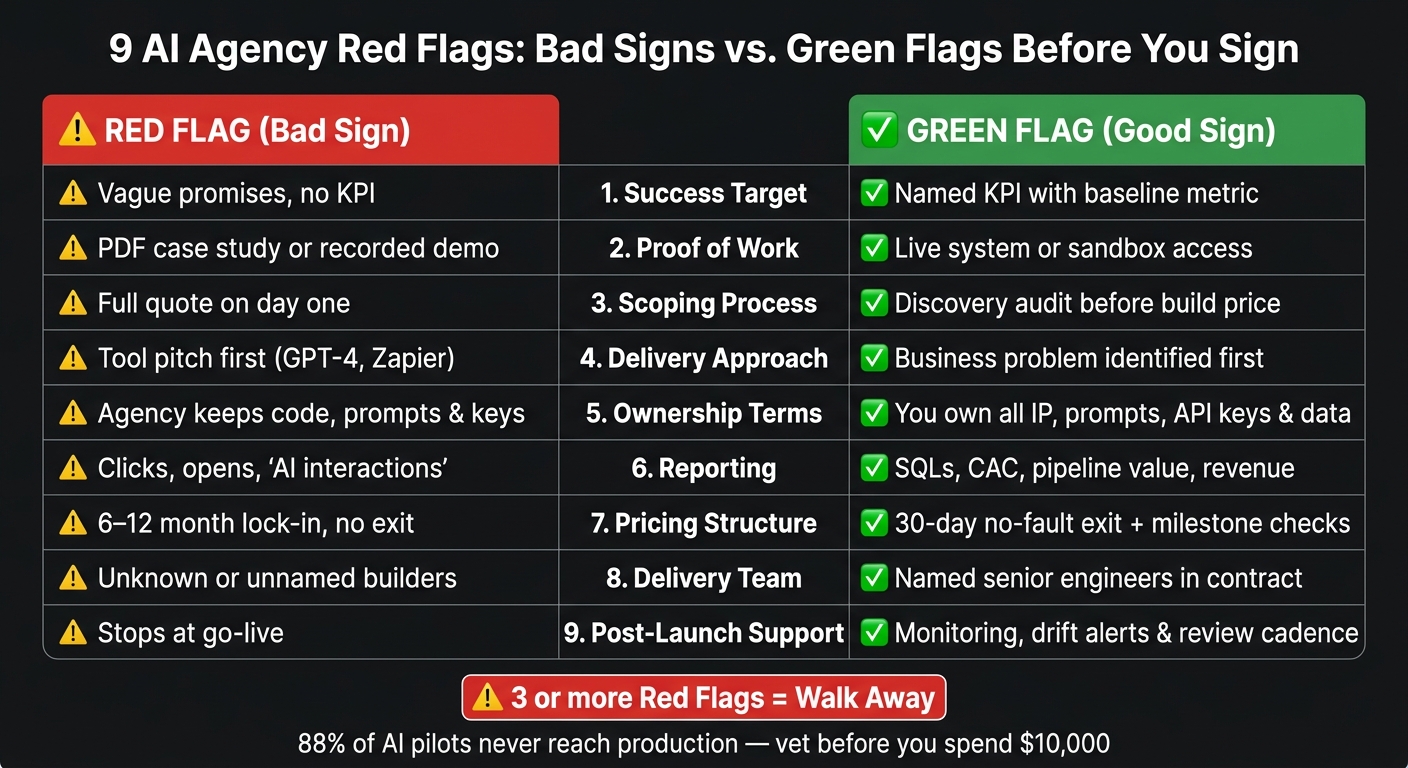
9 AI Agency Red Flags: Bad Signs vs. Green Flags Before You Sign
9 Red Flags That Signal a Wasted $10,000
Red Flags 1–3: No Clear ROI, No Proof, No Discovery
The first thing to pay attention to on a sales call is how the agency talks about results. If the proposal skips a clear KPI - like cost per lead, SQL volume, or pipeline velocity - then there’s no real target for success.
The second red flag is a lack of proof. Ask to see a live system, not a PDF case study or a recorded demo. If an agency can’t show active work, you may be paying for something it hasn’t shown it can deliver.
The third red flag is a full-build quote before any discovery work. A good agency won’t price the job until it has reviewed your CRM, data quality, and workflow. That audit should happen first. After discovery, the scope of the build, ownership, and reporting should be just as clear. For those looking for a proven framework, we use a specific AI lead-gen playbook to ensure these milestones are met.
Red Flags 4–6: Tool-First Delivery, Weak Ownership Terms, Vanity Reporting
A tool-first agency starts with what it builds - “we use GPT-4” or “we automate with Zapier” - before it understands your funnel, your ideal customer profile, or how your sales team qualifies leads. That’s backwards. It’s selling tools before it understands how your team works.
Ownership terms are where many buyers get burned without noticing it at first. If the agency keeps rights to the build or the platform, then you don’t own what it made for you. Before you sign, get it in writing that you own all prompts, automations, source code, API keys, and exported data.
Reporting is the third trap in this group. Agencies that send weekly updates about clicks, open rates, or “AI interactions” are often avoiding the numbers that matter. A good partner reports SQL quality, pipeline value, CAC, and closed-won revenue, with raw data access and CRM integration. That’s the fastest way to tell whether the agency reports business results or vanity metrics.
| Reporting Area | Red Flag | Green Flag |
|---|---|---|
| Lead Quality | Email open rates, clicks | SQL volume, SQL quality |
| Pipeline | "AI engagement" activity | Pipeline value added, deal velocity |
| Cost Efficiency | Messages sent | CAC before vs. after |
| Revenue | "AI interactions" | Revenue tied to AI workflows |
| Data Access | Proprietary dashboard only | Raw data export + CRM integration |
If reporting looks weak, the contract and team setup often look weak too.
Red Flags 7–9: Lock-In Pricing, Unclear Delivery Team, No Post-Launch Plan
A 6- to 12-month retainer with no performance benchmarks is built to protect the agency, not the buyer. Ask for a 30-day no-fault exit clause and a stop-loss clause tied to month-two milestones. If the agency pushes back, that usually means it isn’t confident in what it can deliver.
The eighth red flag is simple: who is actually doing the work? Ask for the names, roles, and backgrounds of the people building the system. If the agency can’t tell you before you sign, stop there.
The ninth red flag is no plan for what happens after launch. A working AI system needs monitoring for model drift, incident handling, and regular tuning. If the proposal stops at go-live, you’re buying a one-time build with no support window, no iteration cadence, and no performance review schedule. A good agency includes monitoring, incident handling, and retraining after launch. [9][8]
sbb-itb-9cd970b
What a Reliable AI Agency Should Show You
Use this checklist to look for the opposite of the nine red flags above.
The Baseline for Strategy, Delivery, and Measurement
A reliable agency should start the first meeting with your business goal, not a pitch for some shiny tool. Before it writes a proposal, it should audit your stack and workflows and point to the exact bottleneck it plans to fix.
It should also show you a live client system, not just a slide deck. And it needs to be clear about the tools it uses and how those tools connect to your CRM, billing system, or sales workflow [5][7]. A working prototype should be live within 3 to 6 weeks. As Dan Pollack of AgencyReview put it:
"If your AI agency hasn't delivered a working prototype within 6 weeks, something is wrong. Full stop." [1]
Tool choice should follow strategy, not lead it. That means setting baseline metrics, holding weekly check-ins, running monthly outcome reviews, and having a post-launch plan for drift monitoring, incident handling, and alerts when workflows break [5][8]. It should also be obvious where human review happens in any customer-facing step.
Contract Terms to Confirm Before You Sign
If the strategy and prototype look good, check the contract before you pay.
| Contract Term | Minimum Standard |
|---|---|
| Ownership and Control | You own all prompts, source code, workflows, and configurations; you hold all API keys, admin logins, and export rights at all times [4][5][7][10] |
| Deliverables by Phase | Each phase has named outputs and a clear roadmap, not vague milestones [5] |
| Exit Clause | 30-day no-fault termination with full credential handover [5][11] |
| Success Criteria | Named metrics tied to dates, such as an 80% call-completion rate by week 8 [5] |
| Data Privacy | Written Data Processing Addendum (DPA) compliant with CCPA and HIPAA if applicable [5][10] |
If the contract says the agency keeps rights to the platform or workflow logic, Kadin Nestler of Ascero AI put it plainly:
"If the agency insists on owning your workflows, the deal makes leaving expensive. Walk." [5]
Also confirm excluded work and change-order rules in writing before you approve the budget.
A One-Page AI Agency Vetting Scorecard
How to Score Agencies Before Approving Budget
After you screen for the nine red flags and the contract terms, use this scorecard to rank your finalists based on proof, not presentation skills. That shifts the red-flag checklist from a loose warning system into a practical decision tool that helps protect leads, pipeline, CAC, and revenue.
This review should include four people acting as a budget-protection team: the founder for strategic fit, the revenue leader for ROI and pipeline impact, ops for workflow fit, and a technical owner for stack visibility and data security [5][12]. Each person spots a different kind of risk. And the same team should be involved from design through build and deployment.
The cutoff is simple: three or more Fails = Fail [3][7].
Before approving any budget, run every shortlisted agency through the table below.
Use Pass, Medium Risk, or Fail for each row, and score based ONLY on proof you can check yourself.
| Red Flag | Risk Level | What to Ask For | Follow-Up Question |
|---|---|---|---|
| 1. Vague ROI claims | High | Named metrics tied to a baseline (for example, "7.75 hours recovered/week") [3] | "What happens to our contract if we don't hit that number?" |
| 2. No proof of work | High | Named testimonials and a live client deployment or live sandbox - not a PDF or recorded demo [7][5] | "Can I speak with a current and a former client in my industry?" |
| 3. No real discovery | Medium | A discovery agenda showing the agency spent most of the call on your bottlenecks, workflow, and metrics. | "What do you need to know about our funnel economics before you forecast?" |
| 4. Tool-first delivery | High | Named models and orchestration tools matched to the use case [7][5] | "What specific AI models do you use for reasoning vs. speed, and why?" |
| 5. Weak ownership terms | Critical | Written proof that you own the IP, workflows, and credentials [5][4] | "If we end this tomorrow, do we keep the source code and the 'AI brain' docs?" |
| 6. Vanity reporting | Medium | Live CRM-connected dashboard [11] | "Where does pipeline revenue appear, and whose system feeds it?" |
| 7. Lock-in pricing | High | 30-day no-fault exit clause; flat retainer or outcome-based pricing models [5][11] | "What's the fastest way out if this isn't working after 90 days?" |
| 8. Unclear delivery team | High | Named senior engineers in the contract - the same people on the sales call [5] | "Who from this conversation will actually be building our system?" |
| 9. No post-launch plan | High | Defined support cadence and alerting for broken workflows [5] | "What does your weekly support cadence look like after launch?" |
A simple rule here saves a lot of pain later: score only live logins. Recorded demos fail. If an agency racks up three or more Fails, move on. No exceptions. Bad builds cost a lot to repair.
Conclusion: Only Spend $10,000 Where Results Can Be Verified
Use the checklist and scorecard together. A $10,000 AI agency engagement is a purchase, not a trial. All nine red flags point to the same problem: once the money is gone, you may have no clear way to check whether the work did anything useful.
That matters because this kind of budget should buy verified movement in leads, conversions, or revenue - not vague AI momentum.
The bigger danger is partner choice. 60% of AI projects fail because the wrong partner was chosen, not because the technology failed [1][6].
"A delivered system has a measurable outcome. Ask three things: what did you deliver, what was the metric before, and what was the metric after." - Imraan, Founder, twohundred.ai [2]
That quote sets the bar for this checklist. The safest $10,000 you can spend is tied to a named metric with a verified baseline - qualified leads generated, conversion rate lift, hours recovered per week, or revenue recovered from leakage.
If an agency can't name the current cost of a process, any savings claim is fiction [2].
And if a finalist still seems like a good fit, cut risk before you commit to a full build. Pay for a 2-week technical spike first - $5,000–$15,000 - and test the idea on your data [1]. Then use the scorecard to rank agencies by proof, not pitch.
The firms worth hiring will be clear about process, metrics, ownership, and exit terms.
FAQs
How do I verify an AI agency’s ROI claims?
Skip vague promises. Ask for a clear measurement plan from day one.
Confirm the baseline metrics they’ll track, such as cycle time, conversion rate, or cost per lead, and ask exactly how they’ll measure results.
You should also ask for case studies that show:
- the starting point
- the attribution method
- the timeframe
Make sure you own your data and analytics accounts. If an agency dodges clear attribution or can’t point to measurable benchmarks, that’s a red flag - and often a good reason to walk away.
What should I own after an AI pilot ends?
After an AI pilot ends, you should own everything built for your business.
That includes source code, data, automations, account access, and documentation like runbooks, model settings, and technical workflows.
An agency can keep its own frameworks or templates. That part is fair. But anything set up for your stack or your data, like custom configurations, integrations, or tuned prompts, should be handed over to you.
If they push back on that, treat it as a red flag.
Should I pay for discovery before a full build?
Yes. A paid discovery phase before a full build is a smart way to separate agencies that can do the work from agencies that are mostly putting on a show.
It should lead to clear, documented deliverables, such as a system review, risk assessment, opportunity map, and a first-build recommendation. That gives you a practical way to judge the agency’s technical skill, communication style, and how well they handle ambiguity - without putting your full $10,000 budget on the line.