77% of Small Businesses Use AI. Fewer Than 5% Have Someone Running It.

Most small businesses don't have an AI tool problem. They have an ownership problem.
I see the same pattern again and again: teams use AI for lead generation and follow-up, CRM updates, outreach, and content, but no one is clearly in charge. That leads to mixed output, weak tracking, extra cleanup, and money spent without clear results.
Here’s the short version:
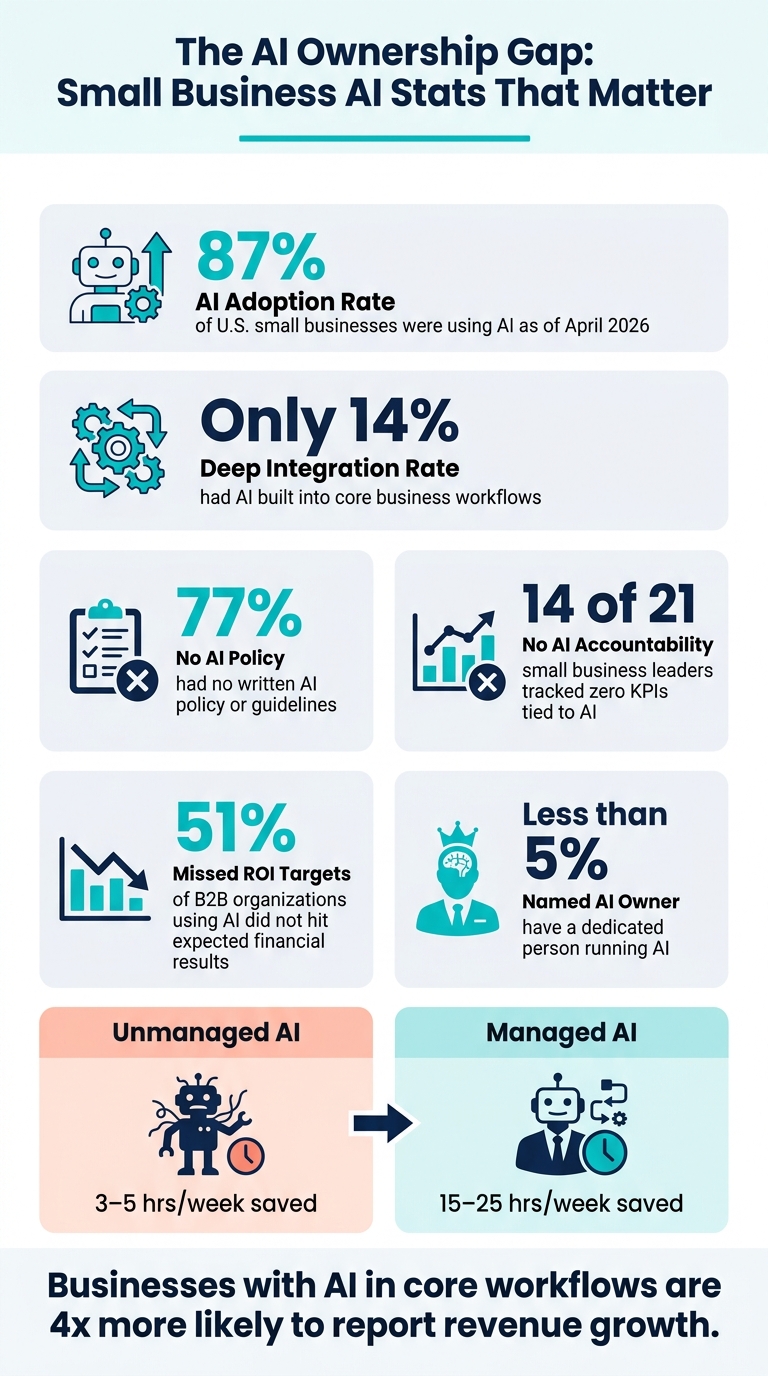
- AI use is high: as of April 2026, 87% of U.S. small businesses were using AI.
- Deep use is low: only 14% had built AI into core business work.
- Rules are missing: 77% had no written AI policy or guidelines.
- Tracking is weak: 14 of 21 small business leaders said they had zero KPIs tied to AI.
- Results often miss the mark: 51% of B2B groups using AI did not hit expected financial results.
What this means for you is simple: if no one owns AI, it turns into random tool use instead of a repeatable system.
The fix is not more software. The fix is to put one person in charge of prompts, workflows, reviews, approvals, and results. On a small team, that may be the founder or ops lead. If no one has time, a fractional outside partner may cost less than a full-time hire, with in-house AI roles around $120,000 per year and fractional help starting near $3,500 per month.
Here’s where the lack of ownership usually shows up first:
- Lead generation: follow-up rules drift and handoffs get messy
- CRM data: duplicate records, bad enrichment, and manual cleanup pile up
- Sales outreach: emails sound flat, off-tone, or under-personalized
- Content: prompts vary by person, so brand voice starts to slip
I’d keep the response simple and measurable. One owner should review AI work each week, set approval rules, and track a short scorecard built around:
- Lead response time
- Lead-to-opportunity conversion rate
- Correction rate
| Area | When Nobody Owns AI | When One Person Owns It |
|---|---|---|
| Lead handling | Inconsistent follow-up | Same process each time |
| CRM | Data errors and cleanup | Clear rules and review |
| Outreach | Mixed tone and weak replies | Reviewed drafts before send |
| Content | Brand drift | Shared prompts and edit checks |
| ROI | Hard to prove | Tracked against baseline numbers |
My takeaway is simple: stop counting how many AI tools your team uses. Start asking who owns the work, what gets reviewed, and which numbers prove it’s paying off.
That’s the core idea behind the article: AI helps small businesses only when one person turns scattered use into a controlled workflow.
AI Adoption vs. AI Ownership Gap in Small Businesses (2026)
Where AI breaks down without a named owner
Lead generation and marketing automation
AI lead scoring and follow-up start to slip when nobody owns the prompts, rules, and integrations. One person writes prompts one way, someone else does it another way, and soon the same task gets different outputs depending on who touched it. Then the handoff between marketing and sales gets messy, and the workflow changes from week to week instead of running the same way each time [2].
The same ownership gap shows up in CRM and outreach.
CRM enrichment and sales outreach
CRM data falls apart fast when AI is writing to it without oversight. If AI doesn't sync cleanly with the CRM, teams end up doing manual cleanup anyway. That wipes out the time savings the workflow was supposed to create [4][8]. And when nobody is checking outputs against facts and brand standards, small errors stack up in the background until they become a bigger mess [2][4].
AI-written outreach runs into the same issue, often requiring specialized outreach tools to maintain quality. Without a steady review step, teams send messages that feel generic, slightly off in tone, or thin on the kind of personalization that gets a prospect to reply. When outreach is treated like random one-off prompt use instead of a managed workflow, results bounce around.
The same lack of control affects client-facing content.
Content production and brand control
Client-facing content carries the company voice. When teams don't use shared prompts and a review step, tone, structure, and specificity start to drift. That's the pattern known as prompt drift [2]. In some cases, unmanaged AI can invent details or make promises the business can't fulfill [9][5].
That is why the fix starts with a named owner.
sbb-itb-9cd970b
AI on Main Street: How U.S. Small Business Owners Use AI - and What It Means for Content Marketing
How to assign AI ownership in a small business
The fix is simple: put one person in charge. That person is accountable for how AI works across the business, not just who gets to use the tools. They become the control point for prompts, workflows, and approvals.
Pick one owner, not shared responsibility
Shared ownership may sound fair, but in practice it often leads to mixed standards and messy execution. One person needs to make the calls on AI strategy, standards, and results.
On very small teams, that person is often the founder or the ops lead. On larger teams, it usually makes more sense to give the role to an experienced operator who has enough authority to change workflows. That last part matters most. You need someone who can change how work gets done, not just someone who knows how to use AI tools.
Define what the owner actually manages
This owner should manage prompt standards, data rules, workflow design, weekly reviews, and sign-off thresholds. Why does that matter? Because those are the pressure points where things tend to go wrong: broken follow-up, bad CRM data, and off-brand content.
A 30-minute weekly review is usually enough to catch mistakes early and adjust one rule or threshold before those mistakes spread.
At minimum, the owner should control five areas:
| Responsibility Area | What the Owner Actually Does |
|---|---|
| Tool Management & Governance | Evaluate tools, manage subscriptions, set access rules, update the AI policy quarterly, keep an error log |
| Quality Control | Maintain prompt libraries, enforce brand voice standards, run weekly audits |
| Operations | Map workflows in Zapier or Make, document SOPs, track ROI |
| Sign-off Thresholds | Define what AI can do without human review versus what requires approval before it goes out |
The owner also sets the line between what AI can handle on its own and what needs a human sign-off before it goes out, whether that’s a client email, a CRM update, or a sales message [11].
When an external partner makes sense
An external partner can make sense when no one on the team has the bandwidth, process discipline, or technical depth to run AI in a consistent way [1][2]. Hiring a full-time in-house AI engineer costs about $120,000 per year, while a fractional operator usually starts at around $3,500 per month [1].
Internal or external, the role needs to control workflow rules, review cadence, and sign-off.
Turn scattered AI use into managed workflows
Once one person owns AI, the next move is to turn that work into workflows that run the same way each time. That’s where results start to show up: repeatable steps, clear handoffs, and a human approval step before anything reaches a customer. It’s the difference between random tool use and managed operations.
Build lead follow-up and CRM workflows with checkpoints
When systems are connected cleanly, AI can take care of transcription, triage, and drafting the first response. The owner sets the checkpoint: a human reviews lead categorization before any reply is sent or any appointment is booked. That review step helps keep bad data out of the CRM.
Review sales outreach before it goes out
AI can draft personalized email sequences in seconds using enriched CRM data. But the prompt isn’t the main thing here. Oversight is. The workflow that tends to work looks like this: AI drafts the sequence, a human approves or tweaks the personalization, and the rep sends it after review. That same review rule should cover every customer-facing message.
Use AI for content with human review
A content workflow usually works best when a human sets the brief and keywords, AI creates the draft, and a human handles the brand review and final edit before it goes live. One AI-assisted content workflow cut first-draft time from 45 minutes to 5 minutes while still keeping human review on every piece. The owner keeps one shared prompt library so each draft starts from the same standard.
Managed workflows make AI measurable, repeatable, and safe to scale.
Measure outcomes and hold AI accountable
Managed AI matters only if it improves revenue, speed, or quality. Once your AI workflows are live, review them every month.
Track the metrics that show real business impact
You don't need to track everything. Stick to three numbers that connect straight to business results: lead response times, lead-to-opportunity conversion rate, and correction rate. If you want extra workflow-level tracking, use content output and hours saved per task as secondary measures.
Before anything else, write down your current baselines - response times, close rates, and labor hours. Without that starting point, you can't show ROI.
This scorecard should be reviewed by the named owner, not the whole team.
Unmanaged AI vs. managed AI workflows: a comparison
| Area | Unmanaged AI Use | Managed AI Workflows |
|---|---|---|
| Consistency | Prompt drift; inconsistent tone and structure [2] | Standardized prompt libraries and brand-fit checklists [2][6] |
| Speed | Scattered savings (3–5 hrs/week) [7] | Systematic efficiency (15–25 hrs/week) [7] |
| Tool Spend | Overlapping subscriptions; tool overlap [2] | Audited tool stack tied to specific bottlenecks [12] |
| Lead Handling | Manual copy-pasting; response times measured in hours [7][13] | Managed routing, reviewed handoffs, and automated enrichment [3][13] |
| Pipeline Impact | Fragmented activity; ROI is hard to prove [5] | Predictable pipeline support; measurable close rate increases [13] |
That’s the gap this section addresses.
Conclusion: one owner turns AI use into revenue support
The core issue is simple: adoption without ownership creates noise, not results. Unmanaged AI brings real commercial risk - mixed customer communication, wasted tool spend, and leads slipping through the cracks.
Businesses with AI built into core workflows are 4x more likely to report revenue growth compared to those still in the pilot phase. [10]
One owner, a clear set of workflows, and a short monthly scorecard can turn scattered AI activity into something you can measure. For founders and operators, the takeaway is simple: stop counting tools, start counting outcomes. Assign one person to own AI, give them a scorecard, and hold the work to the same standard you'd apply to any other part of the business.
FAQs
Who should own AI on a small team?
AI ownership on a small team should usually sit with someone who’s already on the team, not a new hire. In very small businesses, that often means the founder. As the company grows, that role can move to an operations manager, a department head, or a trusted senior staff member.
That person should handle tool evaluation, keep prompt libraries organized, manage risk, review outputs, and track results. The main point is clear ownership - instead of treating AI like everyone’s job.
When should we hire outside AI help?
Hire outside AI help when the six hours a week you spend setting up, testing, and managing workflows is worth less than the client work or planning work you could be doing instead.
If your business brings in more than $500,000 in revenue, outside support often makes sense when your team doesn’t have the time to stay on top of AI and you need results that are consistent, secure, and reliable.
How do we measure AI ROI?
Measure AI ROI by tying it to a clear business result, not just activity.
Before you roll anything out, pick one metric that matters. That could be faster lead response times, higher revenue per employee, or hours saved each week. A single target keeps the team focused and makes the impact easier to spot.
From there, track results on a weekly or monthly basis. Don’t wait until the end of the quarter and hope the numbers tell the story.
When choosing where to use AI first, start with repetitive workflows. Look at:
- How often the task happens
- How much time it takes
- How often mistakes show up
And make sure someone owns the process. If no one is responsible for reviewing the metrics and checking accuracy, the numbers can drift fast.