Why We Turned Down 3 Clients Last Quarter

We said no to three deals because each one would have cost more to deliver than it was worth.
If a client misses on fit, ROI, data, compliance, or ownership, I pass. That protects margin, team time, and delivery quality.
Here’s the short version:
- Client 1: Wrong company size, custom legacy work, and no internal owner
- Client 2: 6-week timeline, no clear success metric, and weak ROI
- Client 3: Siloed data, weak governance, and compliance gaps
A few numbers shaped those calls:
- We look for CLV:CAC above 3:1
- We want CAC payback under 12 months
- We want gross margin above 70%
- A bad firmographic fit can catch 61.1% of disqualified deals early
- In one dataset, company size mismatch drove 54.3% of rejected accounts
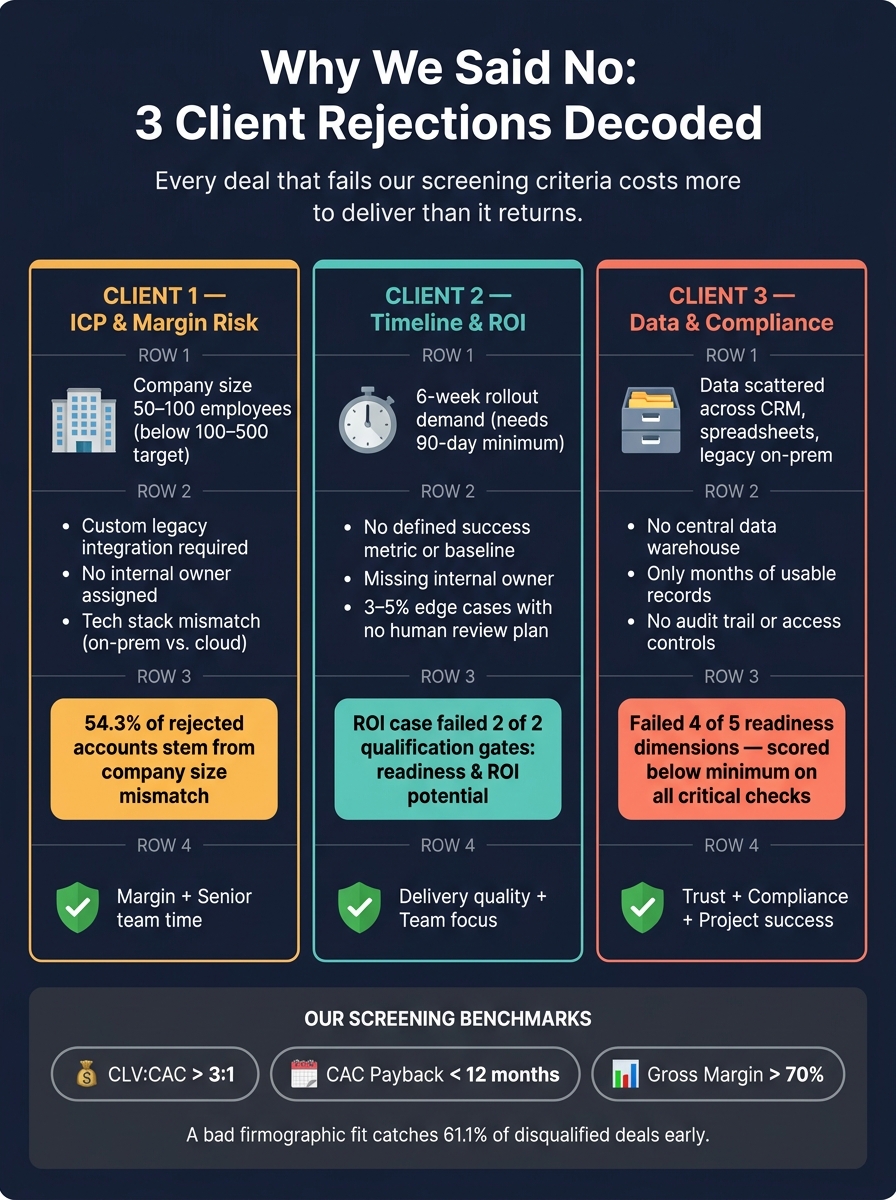
Why We Said No: 3 Client Rejections Decoded
How to Define Your Ideal Client Profile (ICP) for B2B SaaS Growth
sbb-itb-9cd970b
Quick Comparison
| Client | Main issue | What I protected by saying no |
|---|---|---|
| Client 1 | selling to the wrong buyer and custom legacy scope | Margin and senior team time |
| Client 2 | Rushed rollout and weak ROI case | Delivery quality and team focus |
| Client 3 | Bad data setup and governance risk | Trust, compliance, and project success |
The main point is simple: if a deal needs too much custom work, lacks a clear owner, or has no clean path to ROI, it is not growth. It is extra work with less return.
Client 1: Poor ICP Fit and Margin Bleed Risk
This prospect looked close on paper, but it didn't pass our fit or economics check.
Where the Prospect Fell Outside Our ICP
The company had 50–100 employees, which put it below our 100–500 employee target band. Its use case also didn't line up with a standard, repeatable workflow tied to a measurable baseline metric. On top of that, the requested integration called for custom work on a legacy on-prem system, which sits outside our normal delivery model.
There was another red flag: the CEO was the only champion, and no internal owner was assigned.
Why the Economics Did Not Work
Even if you put the fit issues to the side, the numbers still didn't make sense. The custom work would have stretched the timeline and pulled engineering time away from core product work. And the legacy stack would likely have added more support work after launch.
| Prospect Attributes | Our ICP Benchmark | Variance | Impact on Margins |
|---|---|---|---|
| 50–100 employee company | 100–500 employees | Below target size band | More support per dollar |
| Custom integration required | Standardized, API-first use case | High customization required | Engineering time not billable |
| No dedicated internal owner | Named internal owner | Missing champion | Adoption drag and higher churn risk |
| Legacy on-prem stack | Modern cloud or SaaS stack | Tech stack mismatch | Slower onboarding; late-risk |
In one study of over 3,400 disqualifications, exceeding the company size ceiling accounted for 54.3% of all rejected accounts [3]. Size misalignment isn't just a firmographic detail. It hits cost, support load, and margin.
The next prospect fell apart for a different reason: the timeline and ROI case didn't hold up.
Client 2: Unrealistic Timeline and a Weak ROI Case
This prospect fit our ICP. But the 6-week rollout and the vague ROI story made it a no.
Unlike Client 1, this wasn’t a fit issue. It was a timing and ROI issue. It failed two gates in our qualification screen: implementation readiness and ROI potential.
The Timeline and Scope Demands That Broke the Deal
The prospect wanted a board-imposed 6-week rollout. For a similar AI or GTM project, a realistic delivery window usually needs a 90-day runway for implementation and initial optimization [5][4][7].
That gap matters.
A timeline built for a board slide, instead of actual execution, tends to point to a project driven by optics rather than outcomes. And in this case, the risk got worse because the client still hadn’t defined what success would look like.
Why We Could Not Justify the Client's ROI Model
When we asked for a 90-day success metric, baseline, first workflow, and internal owner, none of it was in place. Without those inputs, the ROI case didn’t hold up.
The bigger issue? The real project wasn’t the AI build. It was data consolidation.
We also had to factor in the operational drag the prospect hadn’t planned for: onboarding, stakeholder resets, and the 3–5% of edge cases that still need human review [6][1]. That may sound small on paper, but those edge cases have a way of eating time. Without a dedicated owner, that review load turns into another hidden cost.
| Scenario If We Accept | Scenario If We Decline | |
|---|---|---|
| Capacity | The team absorbs firefighting and revision churn. | Capacity stays open for deep work and active optimization on current accounts. |
| Implementation Quality | Pressure pushes the work toward optics-first AI instead of useful automation. | The team can stay focused on systems that produce measurable results. |
| ROI | Weak, because the success metric is vague and internal ownership is missing. | Protected, because the project never starts without a real business case. |
| Delivery Risk | Higher across the board as rushed timelines and missing ownership compound each other. | Lower, because selectivity keeps delivery standards intact for existing clients. |
That brought us to the third prospect, where data readiness and compliance risk became the deciding factors.
Client 3: Data Readiness and Compliance Risk Too Low for AI Deployment
This prospect had budget, executive buy-in, and a real problem to solve. On paper, it looked like a strong fit. But once we got into discovery, the data setup just wasn’t ready to support the AI they wanted.
This case cleared the budget and executive-support checks, but it failed on readiness.
What the Data Readiness Review Found
Their data was scattered across a CRM, spreadsheets, and a legacy on-prem accounting system, with no central warehouse. On top of that, records used different formats across systems. That would have made any AI output shaky from day one and pushed the project into cleanup mode before any business value could happen.
Predictive models need long, steady histories. This prospect had only a few months of usable records. We ran a light validation pass with Great Expectations and dbt tests to confirm what discovery had already surfaced: missing fields, overlapping categories, and no single source of truth [8][9].
In plain terms, this was a data consolidation problem, not an AI deployment.
The Minimum Compliance and Governance Standard We Require
Even if the data had been usable, governance gaps still would’ve stopped the deployment. There was no clear internal data owner, access controls were informal, and the prospect didn’t meet our minimum audit-trail and privacy standard. For any AI deployment, those aren’t side issues. They’re table stakes.
We scored the prospect against our readiness checklist across five dimensions before making a commitment. This client failed four of the five.
| Readiness Dimension | Client Score | Required Minimum | Decision |
|---|---|---|---|
| Data Centralization | 1.5 / 5 | 4.0 / 5 | No-Go |
| Format Consistency | 2.0 / 5 | 3.5 / 5 | No-Go |
| API Accessibility | 1.0 / 5 | 4.0 / 5 | No-Go |
| Historical Baseline | 2.5 / 5 | 3.0 / 5 | Warning |
| Documentation & Governance | 1.8 / 5 | 3.5 / 5 | No-Go |
Prospects with AI readiness scores above 70% are 3x more likely to successfully implement AI within 12 months [8]. This prospect wasn’t close. Taking the engagement would have meant starting with cleanup, not value creation. We declined and pointed them toward a 3–6 month data consolidation effort as the step that needed to happen before any AI engagement could begin [1][9].
Conclusion: A Repeatable Client-Screening Process That Improves Growth Quality
In all three cases, the breakdown looked different. But the price was the same.
Each prospect failed for its own reason, yet the pattern was clear: bad-fit deals eat away at margin, team capacity, and focus.
The damage usually doesn't show up in the contract value. It shows up later - in blocked onboarding capacity, tired team members, and churn around the 90-day mark. Saying no to these three prospects protected onboarding room for clients who were ready, kept senior time focused on current accounts, and strengthened a market reputation for having standards.
Key Takeaways Leaders Can Apply This Quarter
This process is simple enough to use again and again.
- Set hard ICP boundaries, including a size ceiling. If a prospect's operating model doesn't fit your delivery motion, extra revenue isn't a good enough reason to make an exception.
- Calculate the full cost, not just the contract value. Back out opportunity cost, probability-weighted retention risk, and brand drift before you say yes to any large deal.
- Require a real ROI case. If a prospect can't explain a measurable baseline and a believable path to lift, the engagement has no clear success metric.
- Test data readiness before any AI commitment. A named internal data owner, centralized records, and a governance baseline are table stakes - not a nice extra.
- Decline early when a prospect fails two or more non-negotiables. Don't wait for discovery to confirm what the first call already told you.
"The best pipeline is clean, not large." - Noah Marks, GTM Council [2]
Treat client screening like an operating discipline, not just a sales filter. That's how you build a right-fit pipeline. Growth quality comes from being selective, not from saying yes to everything.
FAQs
What counts as a bad-fit client?
A bad-fit client is a prospect whose needs, decision-making style, or goals don’t line up with how you do your best work. They may look great on paper. But if the fit is off, the fallout can hit your margins, wear down your team, and slow growth over time.
Common red flags include poor operational readiness, messy or unclear decision-making, weak alignment on process or success metrics, and a mismatch between their needs and your positioning.
How do you measure ROI before saying yes?
We measure ROI before we accept a client, using a structured scoring model with a hard qualification gate, not gut instinct.
Each lead gets a 0–100 score based on five factors:
- Ideal customer fit: 30%
- Intent and behavior: 25%
- Timeline: 20%
- Budget authority: 15%
- Engagement recency: 10%
But a high score by itself doesn’t seal the deal.
If a prospect doesn’t have budget authority or doesn’t have a near-term timeline of 30–90 days, they stay in nurture status no matter how high their score is.
What should a company fix before starting an AI project?
Before starting an AI project, a company needs to lock down a few basics. Skip this step, and things can go sideways fast.
- Define a specific, measurable problem that AI is supposed to solve.
- Assign a clear internal owner who will lead the process and push adoption.
- Make sure data is clean, consolidated, and easy to access.
- Secure leadership commitment to changing workflows.
AI won't fix messy processes or missing data. It works best when the process is already defined and working. Think of it like adding a turbocharger to a car: if the engine is broken, more power won't help.