Cloudflare's CEO Says AI Agents Threaten Small Business. Here Is the Part He Got Right.
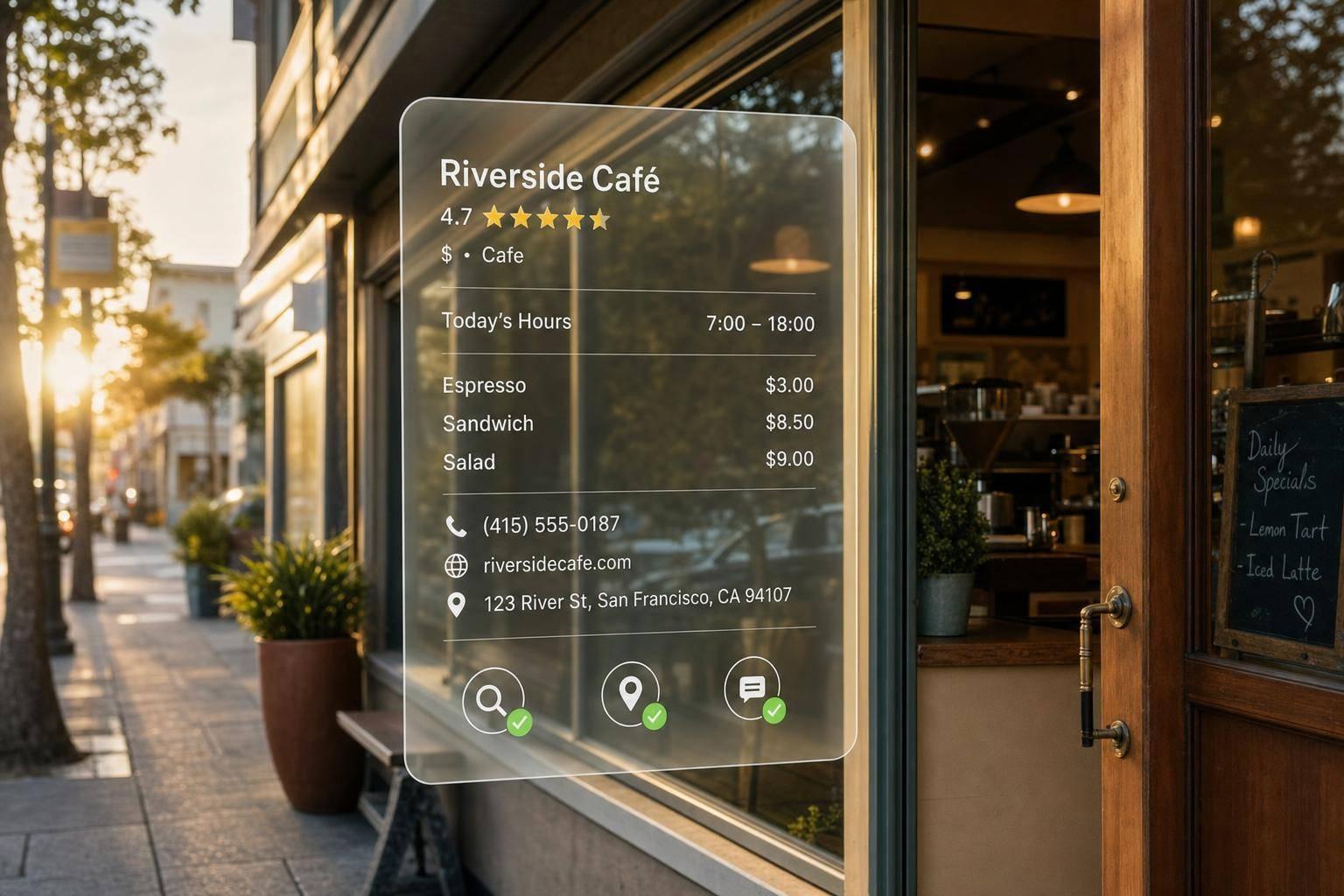
Yes - I think Matthew Prince is right on the main point: AI agents can cut small businesses out of demand before a buyer ever visits their site. If an agent does the search, comparison, and buying, then your website, brand pitch, and sales funnel matter less.
Here’s the short version:
- AI agents are becoming gatekeepers between customers and businesses
- Search traffic can drop even when rankings stay the same
- SaaS, e-commerce, and local businesses face the most risk
- Machines pick from shortlists, not from the full market
- Price, reviews, availability, and structured data matter more than design or brand voice
- Bad AI summaries can cost money, leads, and trust
- The fix is plain: make your site easy for machines to read
A few numbers stand out:
- 57.5% of page requests came from bots and agents as of June 2026
- Only 12% of URLs cited by AI tools match Google’s top 10 results
- 58% of consumers have used AI tools for local business suggestions
- Some B2B sites still hide pricing in ways agents can’t read
I’d sum it up like this: the problem is not AI itself. The problem is that AI agents now sit between you and the customer. And if they can’t read your pricing, policies, services, or reputation, they may skip you.
What I’d watch first:
- falling organic click-through rate
- more traffic from
chatgpt.comorperplexity.ai - wrong AI summaries about your business
- bot activity going up while leads go down
What I’d fix first:
- add Schema.org / JSON-LD
- make pricing and policies public and easy to parse
- keep your business info the same across all listings
- clean up reviews, FAQs, and product or service data
- use directories and listings that help AI systems confirm what you do
This article gets one part very right: small businesses are not just fighting for rankings anymore. They’re fighting to be included in the machine’s shortlist.
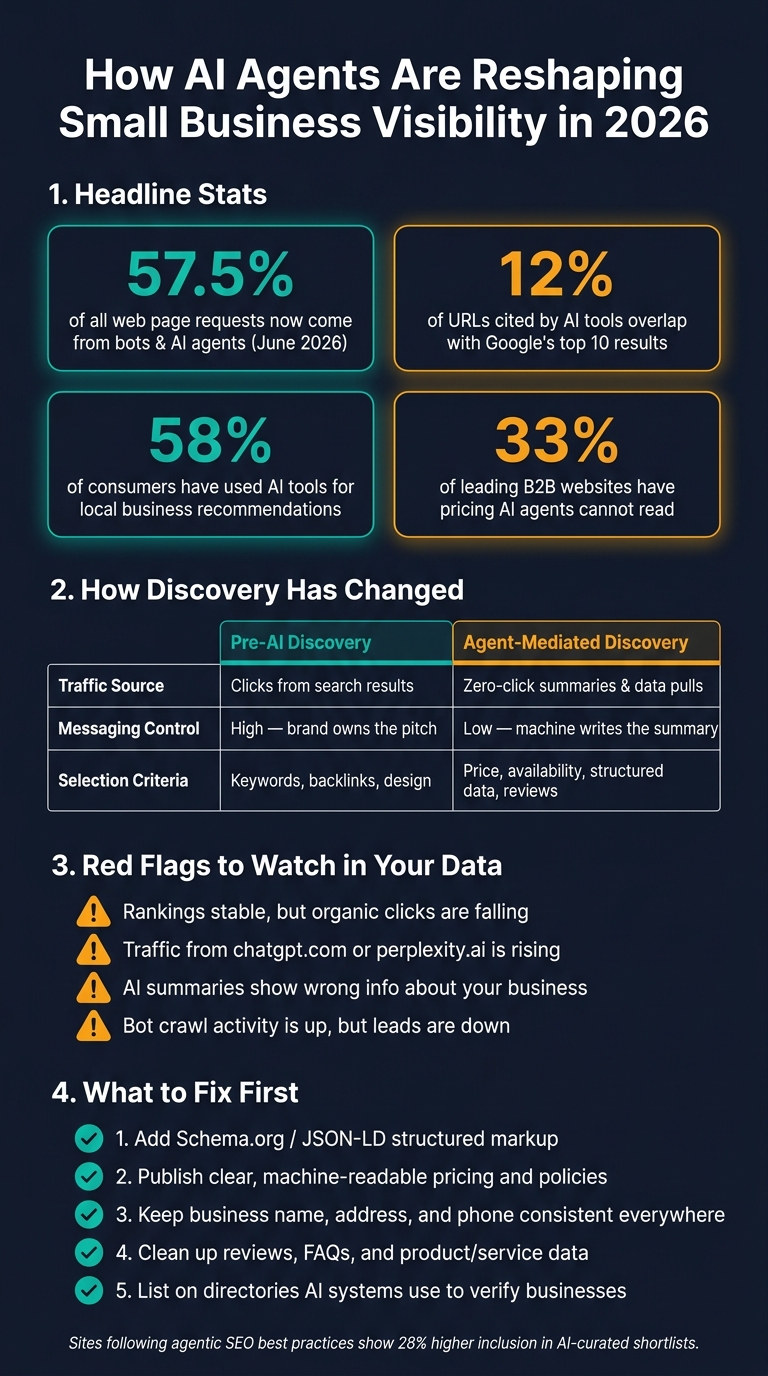
AI Agents vs. Small Business: Key Stats & Risk Signals in 2026
How AI agents reduce visibility and direct customer access
This shift in distribution isn't theoretical anymore. As of June 2026, automated requests from bots and agents made up 57.5% of all page requests, beating human traffic for the first time.[6]
For small businesses, that changes the game fast.
| Pre-AI Discovery | Agent-Mediated Discovery | |
|---|---|---|
| Traffic source | Clicks from search results pages | Zero-click summaries or machine-readable data pulls |
| Control of messaging | High - brand-owned site, copy, and design | Low - machine-synthesized summaries only |
| Selection criteria | Keywords, backlinks, visual appeal | Price, availability, structured data, reviews |
AI summaries and answer engines cut clicks before a visit happens
The first hit shows up in search and answer tools. When someone types a question into Google or ChatGPT now, they often get the answer right there on the page. No visit. No click. No chance to make your case in your own words.
That matters because only 12% of URLs cited by AI tools overlap with Google's top 10 search results.[7] So even if you rank well on Google, that doesn't mean you'll appear in the places where agents pull answers.
"These aren't search engines anymore, they're answer engines. The economics and rules are very different. Search engines were the engine that drove revenue on the web. If there's no traffic, then the existing ecosystem... falls apart." - Matthew Prince, CEO, Cloudflare [4]
Shopping and procurement agents choose from shortlists, not open markets
When an agent handles a purchase, it doesn't browse the way a person does. It pulls structured data like price, availability, and return policy, then builds a shortlist on its own.
That sounds simple, but many sites still aren't readable in the right way. Roughly 33% of leading B2B websites have pricing that AI agents simply cannot read because of technical barriers like server-side rendering.[6] If an agent can't read your price, it skips you. That's the blunt reality.
Big companies are already moving on this. In March 2026, Target said ChatGPT referral traffic was growing 40% month over month after it added agent-friendly APIs and schema.[7] For a small business, matching that kind of spend and technical work is a tall order.
Why small businesses lose leverage when the website is no longer the main sales surface
A website used to be the place where a business could shape the pitch, control the look and feel, and guide the sale. Now it's often just a data source - and only if the data is clean enough for machines to read.
That comes with risk. In August 2026, Google's AI overview wrongly described The Plastics Shed as having "overwhelmingly negative" feedback, mixing in irrelevant reviews. The mistake cost the owner £700 per month in wasted ad spend and took weeks of manual corrections to fix.[2]
Once agents take over discovery, the next battle is simple: getting onto their shortlist.
sbb-itb-9cd970b
Where Prince is right for SaaS, B2B, and e-commerce operators
Prince's warning lands hardest on a few business models. SaaS vendors, e-commerce sellers, and local service providers each get hit in a different way. But the root issue is the same: these businesses were built for human buyers, not AI agents.
SaaS tools can become invisible if agents cannot evaluate or activate them easily
For SaaS vendors, the main risk is simple: if a machine can't read it, it may as well not exist. If pricing, docs, or signup flows aren't machine-readable, the product might never make the list.
An agent comparing software options won't fill out a demo request form. It won't pause on a "contact us for pricing" page and try to figure things out. It just skips that option and keeps going.
E-commerce brands face margin pressure when agents optimize for price and fulfillment
In e-commerce, the pattern stays the same, but the pain shows up differently. When an agent manages the purchase, much of the brand story gets stripped away. What remains? Price, shipping speed, and return policy.
That puts sellers in a tight spot. If they win on brand, taste, or curation, that edge can disappear when the buyer is software instead of a person.
"A brand purchased without being deliberately chosen by a human may have surrendered its pricing power." - Ana Mourão, Martech Professional [8]
There's another catch. If your return policy isn't available in a structured, machine-readable format, an agent may not be able to verify it at all. And if it can't verify it, your site may get dropped from consideration.
Local and niche providers are at risk when agents suppress the long tail
Local and niche businesses often face the toughest version of this problem. Many have patchy listings, thin review profiles, or missing structured data. That can knock them out before a human ever sees their name.
"The shortcuts of trust that small business had in the past... are going to be much more difficult." - Matthew Prince, CEO, Cloudflare [1]
As of 2026, 58% of consumers have used AI tools for local business recommendations. [5] But these agents tend to favor providers with consistent data across platforms and verified policies. They don't care much about proximity, word-of-mouth, or neighborhood reputation if those signals aren't easy to confirm in a machine-friendly way.
What to monitor now and how to reduce the risk
Warning signs in your traffic, leads, and conversion data
If agents control the shortlist, you need to spot the moment they start leaving you out. One of the clearest signs is this: your rankings stay steady, but clicks drop. That usually means AI agents are stepping in before people ever reach your site.
Another signal shows up in where new visitors come from. If traffic from chatgpt.com or perplexity.ai goes up while direct and organic traffic go down, buyers are starting their journey inside AI assistants instead of search.
Here’s a simple way to track the main risk factors and what they look like in your data:
| Risk Factor | Observable Metric | Warning Sign |
|---|---|---|
| Lost shortlist presence | AI shortlist mentions | Brand absent from top 3 results for category prompts in ChatGPT or Gemini |
| CTR erosion | Organic CTR | CTR drops >50% despite stable rankings |
| AI referral shift | AI referrer traffic vs. direct/organic | chatgpt.com or perplexity.ai referrals grow while direct and organic traffic falls |
| Wrong brand summaries | AI Overview accuracy | AI summaries show incorrect reviews, locations, or competitor data for your brand |
| Bot reads, no leads | Bot crawl activity vs. leads or sales | High bot crawl activity with no corresponding lead or sale movement |
| Lost sales | Agent-mediated lead or sale volume | Leads drop without a clear change in ad spend or rankings |
When these numbers move, the issue usually isn’t demand. It’s machine readability.
The fixes that improve machine readability
Once you see that pattern, the next step is pretty straightforward: clean up your data and make your machine-readable signals clearer.
Most small business websites were built for people first. That makes sense. But AI agents need something else. They need clean, structured facts they can pull, check, and compare without guessing.
Start with structured data. Adding JSON-LD with Schema.org markup helps agents parse your core business details, especially fields like hasMerchantReturnPolicy for e-commerce. Sites that follow agentic SEO best practices show a 28% higher inclusion rate in AI-curated shortlists [3].
Past that, consistency matters a lot. Your business name, address, and phone number should match across every platform. AI models cross-check sources to resolve entities, and even small mismatches can lead AI Overviews to mix your business up with a competitor or show the wrong reviews and locations [2][9].
Pricing and service details matter too. If an agent can’t tell what you sell or what it costs, it’ll just move on. Publish clear pricing pages. Write FAQs that answer plain-language questions. And if you sell products or take bookings, build or connect an API that agents can query directly.
It also helps to watch how your business appears across the third-party sources AI systems already use to confirm facts. That includes review platforms and community sites, not just your own site. The more steady those signals are, the easier it is for AI models to identify your business correctly and include it in a shortlist [9][2].
Why curated SaaS and AI directories matter more in an agent-driven market
This is where structured listings start to matter more. They give agents a faster way to confirm your category, pricing, and proof.
AI assistants verify entities, not pages. So a clear category page, steady product data, and supporting third-party references help build the kind of machine-readable signal agents can trust [9][7].
"The next decade of commerce won't be won by the brands with the best websites or the highest Google rankings. It will be won by the brands that machines understand, trust, and recommend." - Aviv Shamny, CEO, Limy [7]
For SaaS and AI products, the practical goal is simple: make your category, use case, and proof points easy for an assistant to verify. Agents trust businesses they can confirm fast and across structured sources, and structured listings make that process easier [9][7][2].
Conclusion: AI agents will not kill every small business, but they can quietly cut many out of demand
The practical takeaway is pretty simple: Matthew Prince's warning hits hardest on one point - AI agents are turning into gatekeepers. They sort options by price, quality, and speed, not brand loyalty. That gives an edge to businesses with clean data and clear signals, while pushing aside those that don't have them.
This shift isn't theoretical. It's already showing up in the data, and adoption is still climbing fast.
For small businesses, the main issue isn't whether agents matter. It's whether your systems are readable by them. The businesses most at risk are still set up for human browsing, not machine evaluation. That can be fixed, but only if you treat agent-readiness like an infrastructure issue and move before your visibility starts to slip.
Key points to take away
The priority isn't more traffic. It's better machine visibility. That means putting machine-readable data first: structured markup, consistent pricing and policy details across channels, and regular audits of how AI systems read your site. That's what protects demand, visibility, and long-term enterprise value - not more content or higher rankings.
FAQs
How do AI agents decide which businesses to recommend?
AI agents recommend businesses based on credibility, machine-readable data, and how closely a business matches the user’s query.
In plain English: they lean toward businesses that make key details easy to find and easy to parse.
That usually means clear, structured information such as:
- accurate pricing
- current stock status
- return policies in machine-readable formats
They also look at signals from outside your site, like Google Business Profiles, recent reviews, and mentions in trusted directories.
If a business has data that’s inconsistent or tough for machines to read, it may get filtered out entirely.
Which small businesses are most at risk from AI agents?
Small businesses face the most risk when they lean on brand loyalty, foot traffic, or broad online visibility. That’s because AI agents don’t care much about brand identity. They tend to rank options based on price, quality, and efficiency.
That shift puts local businesses such as plumbers, dentists, and independent retailers in a tough spot. If they don’t have machine-readable structured data, accurate product feeds, or support for direct machine-to-machine transactions, agents may skip over them entirely. In plain English: they can become invisible to these systems or get stuck at the last step, unable to complete the sale.
How can I make my site easier for AI agents to read?
Put structured, machine-readable data ahead of visual polish. AI agents look for clear facts they can act on, not things like hero images or carousels.
Use JSON-LD with Schema.org Product markup to spell out prices, stock levels, dimensions, and return policies. Then back that up with plain answers to real customer questions. Your business details should also stay the same across your site, Google Business Profile, and third-party platforms.