You're Invisible to AI. Here's the Data That Proves It.

Most businesses are invisible to AI, and it's costing them. AI tools like ChatGPT, Claude, and Gemini now influence how customers discover vendors, but 71% of websites are never cited by AI systems, and only 0.12% are AI-ready. If your business isn’t showing up in AI-generated answers, you’re missing out on high-converting traffic and sales opportunities.
Key Findings:
- 95.7% of B2B companies only appear in AI responses when the buyer already knows their name.
- AI-referred visitors convert at 15.9%, compared to just 1.76% for Google organic traffic.
- Businesses invisible to AI lose out on $18M in potential revenue over three years.
Why This Happens:
- AI relies on structured data, third-party mentions, and consistent business descriptions.
- 44% of brands ranking in Google’s top 10 are invisible to ChatGPT for the same keywords.
- Inconsistent metadata and outdated information lead to exclusion.
What You Can Do:
- Run an AI visibility audit: Test how often your business appears in AI-generated answers.
- Fix your data: Ensure consistent metadata, schema markup, and verified profiles like Wikidata.
- Leverage third-party platforms: Build authority on directories, Reddit, and review sites.
- Update content regularly: AI favors detailed, recent, and well-structured content.
The takeaway: AI is reshaping how customers find businesses. Showing up in AI answers is no longer optional - it’s essential for staying competitive.
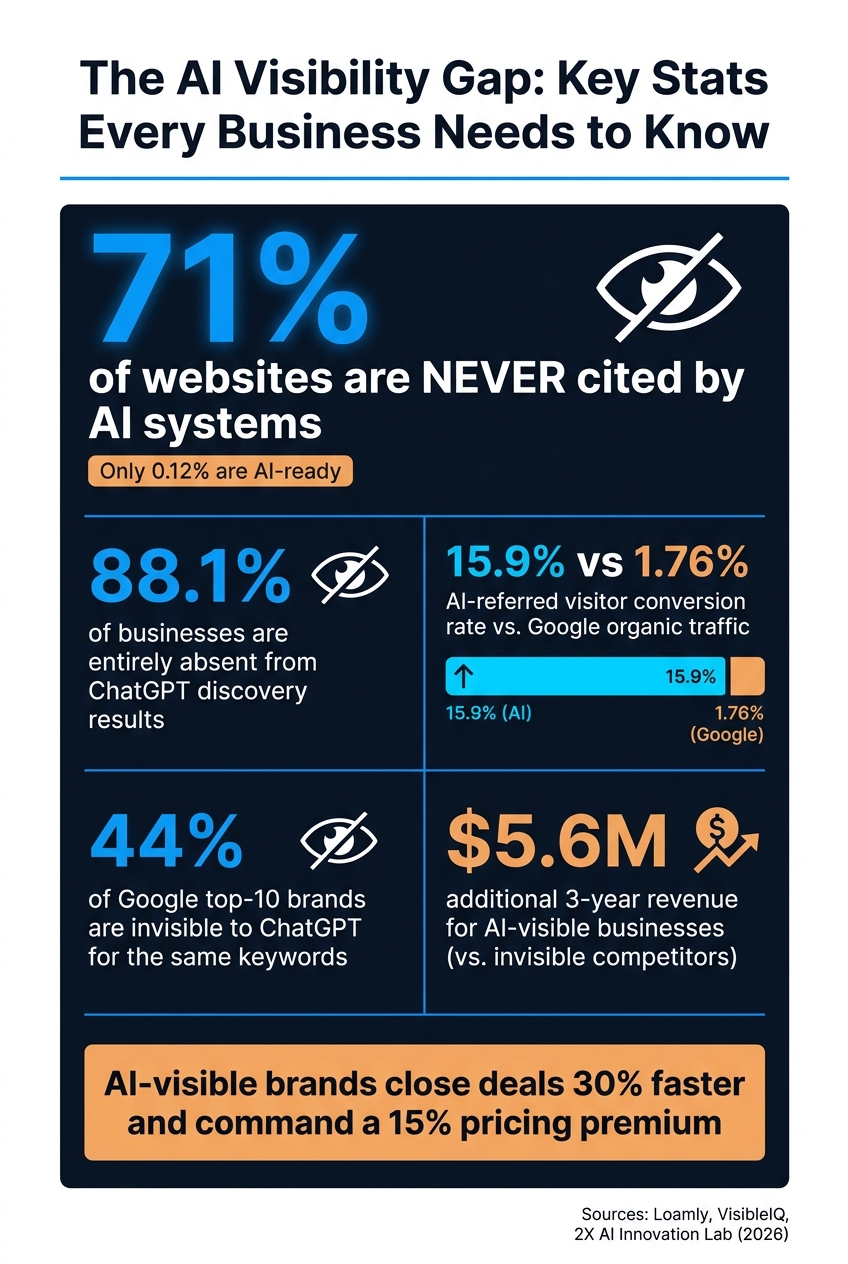
The AI Visibility Gap: Key Stats Every Business Needs to Know
The Ultimate Guide to AI Visibility: How Service Businesses Get Recommended by ChatGPT
sbb-itb-9cd970b
How Big Is the AI Visibility Gap?
The numbers paint a clear picture: the AI visibility gap is massive. A striking 88.1% of businesses are entirely absent from ChatGPT’s discovery results [2], and 85.7% of companies score between 0 and 20 on AI visibility scales [6]. This creates a sharp divide - businesses are either highly visible or completely ignored. Only 4.3% of companies manage to score above 80 [6], dominating the majority of AI-driven attention. To put this into perspective, the Gini coefficient for AI visibility is 0.87, which is as unequal as global wealth distribution [6].
Data That Shows Where AI Falls Short
This gap doesn’t affect all industries equally. For example, local service businesses average just 31 out of 100 on AI visibility, while hospitality and travel companies fare slightly better at 48 [7]. A study conducted in March 2026 examined 1,700 businesses and found that Asana led the project management category with 92% AI visibility, while Basecamp - a well-known name in the space - scored only 25%. Even more telling, 17 other tools in the same category had zero visibility [2][3].
The disparity between traditional search engines and AI systems is also striking. Research shows that 44% of brands ranking in Google’s top 10 are invisible to ChatGPT for the same keywords [5]. On the flip side, 81% of brands mentioned by ChatGPT don’t show up in Google’s top 10 [5]. Essentially, these are two separate ecosystems, and excelling in one doesn’t guarantee success in the other. This disconnect underscores the challenges businesses face in navigating AI-driven visibility.
How Bad Data Creates Misrepresentation
Visibility isn’t the only issue - AI systems often misrepresent businesses due to outdated or inaccurate data. Relying on old articles, obsolete reviews, and incorrect information can lead to significant errors. For instance, AI might surface outdated pricing, reference features that no longer exist, or confuse one company with a competitor. According to research by Loamly, every single paid AI audit they conducted uncovered factual inaccuracies in how AI described the audited companies [6].
"AI models don't care about org charts or market caps. They respond to clarity, consistency, and corroboration across the open web." - Will Waugh, Executive Director, 2X AI Innovation Lab [1]
These inaccuracies can do more than just leave your business out of the conversation - they can actively misinform potential buyers. This misinformation can hurt your reputation, confuse your audience, and ultimately increase the financial impact of being invisible to AI.
The Business Cost of Being Invisible to AI
The financial consequences of poor AI visibility are staggering. AI-referred visitors convert at 15.9%, compared to just 1.76% for Google organic traffic [4]. Signups from AI referrals occur at rates 11 times higher [6]. When your business is invisible to AI, you’re not just losing traffic - you’re losing the most valuable, high-converting traffic available.
| Metric | Invisible to AI | Visible to AI | Impact |
|---|---|---|---|
| 3-Year Total Revenue ($7.5M base) | $19.0M | $24.6M | +$5.6M [4] |
| Conversion Rate vs. Google Organic | 1.76% | 15.9% | ~9x Higher [4] |
| Sales Close Velocity | Baseline | 30% Faster | −30% Cycle Time [4] |
| Annual Traffic/Revenue Growth | −28.1% | +2.5% | 30.6% Delta [4] |
On top of this, AI-visible brands enjoy a 30% faster sales cycle and can command a 15% pricing premium [4]. The numbers make it clear: being invisible to AI doesn’t just cost you visibility - it directly impacts your bottom line, and the financial toll adds up quickly.
Why AI Systems Miss Your Business
Understanding why your business is invisible to AI systems is crucial to addressing the issue. While we've already discussed the financial consequences of being overlooked, it's time to dive into the root causes.
The Problem with AI Training Data
AI models don't operate like traditional search engines. For a significant portion of queries - ranging from 24% to 78% - these systems generate responses directly from their static training data instead of performing live searches on the web [8]. If your business wasn't well-represented when the training data was compiled, even the best SEO efforts won't make you more visible.
But it's not just about being included in the training data; it's about presenting a clear and consistent identity. AI systems rely on entity resolution, which means they aggregate signals to form a unified profile of your business. If your website describes your company as "Data Solutions", but your LinkedIn profile says "Compliance Consulting", the AI might not connect the dots. This lack of a cohesive identity could result in your business being excluded from the AI's retrieval pool [11].
Inconsistent terminology can also create problems. Referring to your product as a "platform" on one site, a "tool" on another, and a "suite" elsewhere makes it harder for AI to categorize your offerings accurately. As Maria Dykstra, an AI Visibility Architect, explains:
"The system isn't critiquing your company - it simply lacks sufficient clean signals to include you." [11]
AI models also rely on corroboration from independent sources like industry publications, Reddit discussions, or Wikipedia entries. If your business is only mentioned on your own website, the AI may treat your claims as unverified and favor businesses with broader, third-party validation [10][11].
This highlights the importance of maintaining clear, consistent metadata.
Why Metadata and Machine Readability Matter
Even if your content is excellent, it won't matter if the AI can't identify your business as a distinct entity. AI systems don't just pull text - they match businesses to their internal knowledge graphs. Without structured data, your business may be treated as an unverified fragment of text rather than a recognized entity [12].
To avoid this, ensure your business has:
- A verified Wikidata entry
- Consistent Name/Address/Phone (NAP) details across platforms
- Schema markup that uses the
sameAsproperty to link your website to profiles like LinkedIn and Crunchbase
Brands with verified Wikidata entries are 3.2 times more likely to appear in AI-generated citations [12]. On the flip side, inconsistencies - like conflicting founding dates on different platforms - can confuse the AI, leading to disambiguation errors or complete omission [12].
Content depth is another factor. AI systems tend to favor content with substance. The average length of AI-cited content is around 2,900 words, while most B2B blog posts are only 300–500 words long [11]. Thin content doesn't provide enough depth for the AI to confidently assess your authority.
How Feedback Loops Keep You Hidden
When inconsistent metadata and signals persist, feedback loops can further marginalize your business. Once a company secures a spot in AI recommendations, it gains more citations and corroboration, strengthening its position over time. This creates a snowball effect, making it increasingly challenging for new or smaller businesses to break through. Between December 2025 and February 2026, the market concentration index for AI citations surged by 293% [13].
Smaller businesses often fall into what's known as the "alternative trap." AI systems classify them as secondary options compared to market leaders, and this labeling reinforces their lower priority. To avoid this, it's important to steer clear of language that positions your business as merely an alternative to established players [11].
Interestingly, size and revenue don't guarantee AI authority. In a 2026 study, Teladoc Health, with $2.5 billion in revenue, outperformed UnitedHealth Group, which had $400 billion in revenue. Why? Teladoc's cleaner and more consistent structural positioning as a category leader gave it the edge [11]. As Maria Dykstra puts it:
"Market leadership did not predict AI authority. Revenue did not predict it. Headcount did not predict it. What predicted it: structural legibility." [11]
How to Make Your Business Visible to AI
If AI is overlooking your business, it's time to address the issue. Fixing these visibility gaps requires a different approach than traditional SEO.
Run an AI Visibility Audit
Start by evaluating how visible your business is to AI. Instead of searching for your brand name, create 20–30 buyer-intent prompts like "best compliance software for mid-size healthcare companies." Run each prompt 3–5 times across AI platforms like ChatGPT, Claude, Perplexity, and Gemini to account for variability in responses.
Use a five-tier scoring system created by Zilwaris in 2026 [17]:
| Tier | Label | What It Means |
|---|---|---|
| 0 | Invisible | Not mentioned at all |
| 1 | Source-only | URL appears in sources but not answers |
| 2 | Passing mention | Named in a list, not recommended |
| 3 | Recommended | Suggested with specific reasoning |
| 4 | Top recommendation | The primary or only answer given |
Focus on "answer gaps" - situations where competitors are mentioned, but your brand is missing. These gaps should be your priority. Also, double-check that your robots.txt file allows AI crawlers like GPTBot and ClaudeBot to access your site.
"Your Google rankings don't tell you if AI recommends you. Only 12% of AI citations match the top 10." - Rafael De Jesus, Founder, VisibleIQ [14]
Once you've identified gaps, adjust your data structure to improve how AI systems interpret your content.
Structure Your Data for AI Systems
To make your business more accessible to AI, focus on two key areas: establishing a clear entity identity and optimizing your content so it is easy for AI to process.
For entity identity, claim and verify your Wikidata entry. Then, ensure your business details - name, founding date, and category - are consistent across platforms like LinkedIn, Crunchbase, and your website. Use JSON-LD schema markup with the sameAs property to link your domain to these profiles. Verified Wikidata entries make businesses 2.7x more likely to appear in AI Overview citations [12].
For content formatting, lead each major section with a concise, 40–80 word summary. Since 44.2% of all LLM citations come from the first 30% of a webpage [15][16], structure your pages with clear H2 and H3 headings to create logical sections. Also, ensure your site uses server-side rendering, as many AI crawlers, like GPTBot, can't process JavaScript-rendered content.
Use AI-Native Marketplaces to Get Found
Optimizing your website is just part of the equation. 85% of AI brand mentions come from third-party sources like Reddit, G2, and industry publications [14][15][16]. Building authority on these platforms is essential.
Getting listed and reviewed on AI-friendly directories is one of the most effective ways to boost your visibility. Platforms like Top SaaS & AI Tools Directory are structured to be easily parsed by AI, giving your business a stronger, more credible presence. Reddit alone accounts for 40% of AI citation share for SaaS-related queries [16], highlighting the importance of community-validated sources over self-published claims.
Track Results and Keep Improving
AI visibility requires ongoing effort. Content updated in the last six months is cited 71% more often than older material [18], so keeping your content fresh is critical. Re-run your prompt audit monthly, monitor competitors' mentions, and update your content when new gaps emerge.
Tools like Loamly can help identify "dark AI" traffic - high-converting visits from AI platforms often mislabeled as direct traffic in GA4 [9]. This matters because AI-referred traffic converts at 4.15x the rate of regular organic traffic [9]. Without proper tracking, you could miss out on one of your most effective channels.
"The brands that establish AI visibility in 2026 will own their categories in AI-mediated discovery for the next three years." - Yatin Malik, Founder of TopSlot [19]
Conclusion: Competing in an AI-Driven World
The analysis of the AI visibility gap makes one thing clear: thriving in an AI-driven world requires swift and deliberate action. The numbers speak volumes. Recent data reveals that 96% of B2B companies remain invisible during the earliest stages of AI-driven buyer discovery [1]. On top of that, 77% of businesses ranking on Page 1 of Google fail to appear in ChatGPT recommendations [2]. Relying solely on traditional search rankings no longer guarantees visibility to buyers. This shift demands a new approach - quickly.
The opportunity to act won’t last forever. Early adopters who establish strong citation and entity authority gain an edge that compounds over time.
"The competitive window for early-mover advantage in B2B SaaS AI visibility is measured in months, not years." - Searchless Journal [20]
The steps to adapt are clear. Focus on making your website AI-accessible, standardize your entity identity, and create content that AI tools can easily interpret. Build a presence on reliable platforms like Reddit, review sites, and industry directories. And don’t stop there - track your progress monthly and refine your strategy as needed.
"Wait and see is the worst possible strategy. Each month you remain AI-invisible, your competitors accumulate more corroboration, more citations, and more entity confidence." - Metricus [13]
AI levels the playing field. It doesn’t favor the biggest ad budgets or the most recognizable brands - it rewards businesses that prioritize clarity, consistency, and corroboration. The question is: are you ready to act?
FAQs
How can I tell if AI tools recommend my business?
Want to know if AI tools are pointing customers to your business? Try simulating customer searches. Use platforms like ChatGPT or Perplexity and type in queries like:
- "Best [your trade] in [your city]"
- "Who offers [your service] near [your location]?"
Check the results to see if your business gets mentioned. Pay attention to competitors too - this can help you understand how you're stacking up.
Next, take it a step further by asking about your business by name. For example, type in "[Your business name]" and see what kind of information the AI provides. This will give you insight into how AI tools are presenting your brand to potential customers.
What data fixes make AI trust and cite my brand?
To earn trust in AI and ensure your brand gets proper recognition, shift your focus from traditional keyword-based SEO to entity-based optimization. This approach emphasizes defining your brand as a verified entity, which helps search engines and AI systems understand and trust your content.
Here’s how to get started:
- Use schema markup: Implement structured data types like Organization, Product, and FAQ to clearly define your brand and its offerings.
- Maintain consistent data: Ensure your business information is accurate and uniform across all platforms, directories, and listings on the web.
- Build off-site authority: Get your brand mentioned on reputable websites and platforms to reinforce credibility.
Additionally, structure your content thoughtfully. Use clear headers, FAQs, and tables to make your information easy to navigate. Regular updates are also key - keeping your content fresh helps maintain its relevance and authority.
How do I stop AI from showing wrong info about my company?
To minimize the chances of AI showing inaccurate details about your business, it's crucial to keep your information consistent across all online platforms. Start by auditing third-party profiles like Google Business and LinkedIn to ensure your name, address, and other key details align perfectly.
On your website, use structured data like schema markup to make your information machine-readable and precise. Additionally, focus on creating a clear, entity-driven website that highlights your business identity. Over time, strengthen your credibility by ensuring consistent mentions and references on trusted, authoritative sources.