The Agentic CDP Explained in 4 Lines (and When You Are Too Small for One)

Here’s the short answer: an agentic CDP is a customer data platform that doesn’t just store customer data - it uses AI agents to decide what to do next and send the next action on its own. If your team still works fine with hourly or daily updates, a leaner setup is often the better call.
I’d sum up the article like this:
- A standard CDP puts first-party customer data in one place.
- A composable CDP runs from your warehouse and gives data teams more control.
- An agentic CDP adds AI agents that read live signals, choose the next step, and act across sales and marketing.
- You are too small for one if your signal volume, channel mix, team setup, and budget are still low.
The main buying rule is simple: if humans can still handle the workflows with basic tools, don’t add an agentic layer yet. But if you have high event volume, many systems, and repeated actions that need to happen in near real time, the math starts to change.
A few points stand out:
- AI-led personalization leaders can drive 40% more revenue from those efforts than average companies.
- Agentic CDPs work best when they can react in seconds, not hours.
- They depend on clean identity resolution. If your web, CRM, and product data don’t match up, the agent will make bad calls from bad inputs.
- For many early SaaS teams, a mix of CRM automation, product analytics alerts, event tracking, and BI is enough.
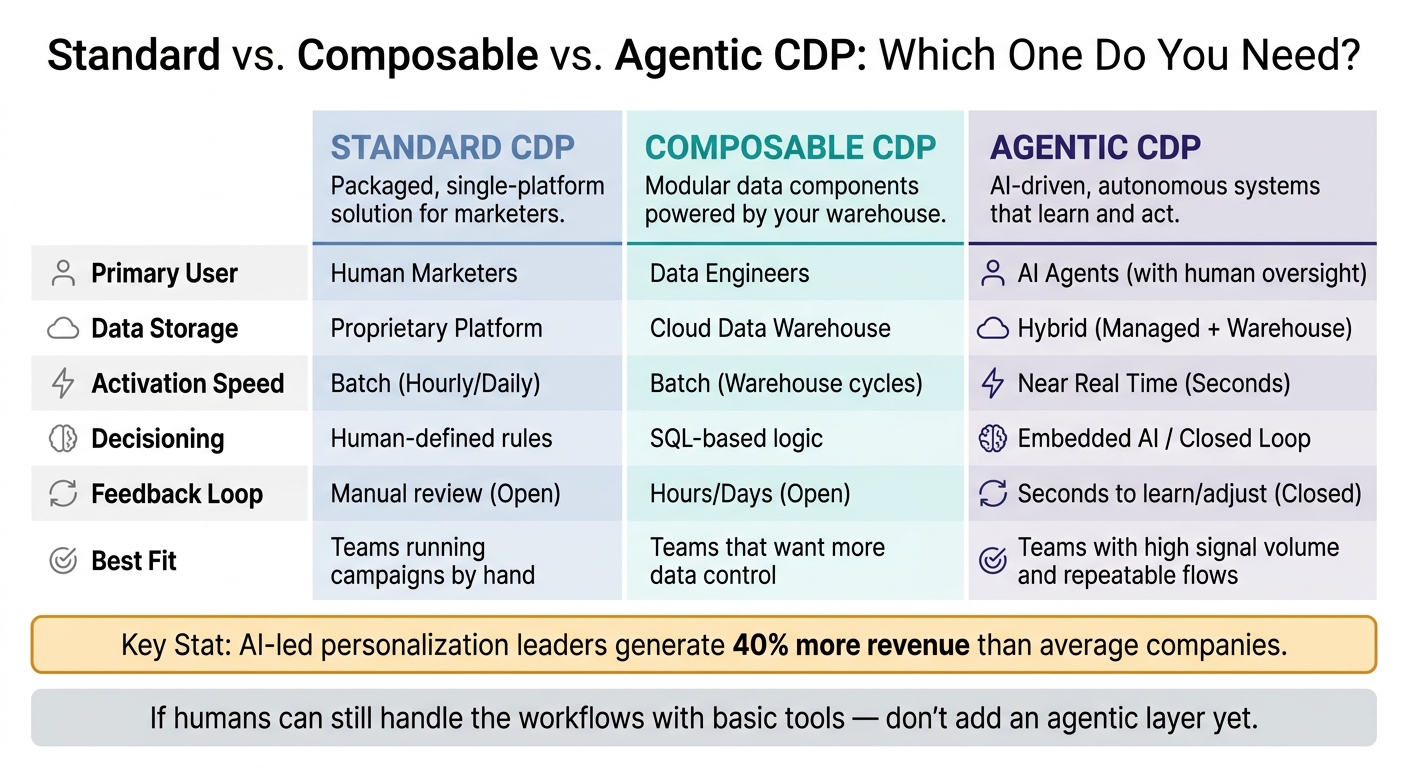
Standard vs. Composable vs. Agentic CDP: Which One Do You Need?
Introducing CustomerLake – the agentic CDP built in Databricks
sbb-itb-9cd970b
Quick Comparison
| Type | Main user | Data setup | How actions happen | Best fit |
|---|---|---|---|---|
| Standard CDP | Marketers | Vendor platform | Human rules and batch sends | Teams running campaigns by hand |
| Composable CDP | Data teams | Cloud warehouse | SQL logic and warehouse syncs | Teams that want more data control |
| Agentic CDP | AI agents with human review | Managed layer + warehouse | Live decisioning and closed-loop actions | Teams with high signal volume and repeatable flows |
So if I were making the call, I’d use this test: Do I need AI agents to read live customer signals and act right away, or can my team still do the job with cheaper tools and slower updates? That question gets you most of the way there.
What an Agentic CDP Is and How It Differs from a Standard CDP
A standard CDP brings customer data into one place. An agentic CDP takes that shared profile and uses it to make decisions and trigger actions on its own, within guardrails set by people.
The day-to-day difference comes down to speed. Standard CDPs often refresh on an hourly or daily schedule. Agentic CDPs work in near real time and learn from results in seconds. [1][2][4]
Standard CDP vs. Composable CDP vs. Agentic CDP
These three CDP models serve different teams and solve different jobs. Here’s where they split:
| Capability | Standard CDP | Composable CDP | Agentic CDP |
|---|---|---|---|
| Primary User | Human Marketers | Data Engineers | AI Agents (with human oversight) |
| Data Storage | Proprietary Platform | Cloud Data Warehouse | Hybrid (Managed + Warehouse) |
| How Decisions Are Made | Human-defined rules | SQL-based logic | Embedded AI / Closed Loop |
| Activation Speed | Batch (Hourly/Daily) | Batch (Warehouse cycles) | Near Real Time |
| Operating Effort | Manual marketing automation work | Engineering-heavy maintenance | Low manual / High strategic oversight |
| Feedback Loop | Open (Manual review) | Open (Hours/Days) | Closed (Seconds to learn/adjust) |
A composable CDP sits in the middle. It lets data engineers activate data straight from a cloud warehouse like Snowflake, which gives teams more control over the data layer. But it still doesn’t have native AI decisioning or real-time feedback loops. So yes, you get more flexibility. You don’t get autonomous action.
An agentic CDP is API-first infrastructure that agents can call directly. It exposes data through APIs, which lets agents read signals and trigger actions without someone clicking through dashboards. [1]
That change matters most when signals from product, CRM, and the website need to lead to action right away.
Why This Matters More for SaaS and AI Growth Teams
In SaaS, timing is everything. The win comes when live signals turn into action before the moment passes.
A B2B SaaS company throws off signals all day long: product usage, CRM updates, and website intent data. When those signals live in separate systems, growth teams miss the best moment to step in.
Take onboarding. If a user gets stuck at 2:00 p.m. on a Tuesday, they’re probably not waiting around until Wednesday morning for a marketer to refresh a segment. That window is measured in minutes, not days. Joe Stanhope, VP and Principal Analyst at Forrester, puts it this way:
"Agentic AI offers the pathway to not only implement new capabilities that extend the CDP's remit but also develop a new paradigm for generating insights, targeting audiences, decisioning, and orchestrating customer journeys." [5]
An agentic CDP closes that gap by turning signals into action right away. That might mean a churn-risk alert, an expansion offer triggered by a spike in usage, or a personalized onboarding nudge sent in the middle of a session. Companies doing well with AI-driven personalization already generate 40% more revenue from those activities than average players. [1]
What an Agentic CDP Can Actually Do
An agentic CDP turns signals into decisions. It treats signals as triggers, not just logs sitting in a dashboard. In day-to-day growth work, that changes a lot.
Lead Scoring and Revenue Qualification from Live Customer Signals
An agentic CDP uses AI-powered lead scoring to evaluate prospects continuously. It pulls in live product signals, billing context, support status, and CRM data at once. So if a trial user visits your pricing page and starts using key product features, you don't wait for tomorrow's batch sync to spot it. The score updates in real time, and the system can route the lead, trigger the prompt, or start the sequence on its own. Many organizations have seen significant results by moving away from manual methods, as seen in these AI lead scoring case studies.
| Feature | Basic Marketing Automation | Standard CDP Scoring | Agentic CDP Scoring |
|---|---|---|---|
| Primary Inputs | Email opens, form fills | Unified web, CRM, and offline data | Live product signals, billing, and support context |
| Speed | Batch / Rule-based | Batch / Warehouse syncs | Real-time / Streaming |
| Decisioning | Static point values | Predictive propensity models | Autonomous "Next Best Action" agents |
| Action Triggered | Static email sequence | Audience sync to ad platforms | Multi-channel action and CRM update |
The same idea also runs lifecycle campaigns, not just qualification.
Outbound Personalization and Lifecycle Campaigns Without Manual Audience Work
The big win here is automatic audience creation and upkeep. Instead of a marketer writing SQL or dragging filters around to define "users likely to upgrade", an agentic CDP lets agents find that group on their own based on a goal, then keeps the audience current as behavior changes. [2]
That shifts how lifecycle campaigns work in practice. A churn-risk campaign doesn't depend on someone noticing that logins dropped and then pulling a list by hand. The system can spot lower feature adoption or a jump in support tickets, choose the right recovery offer, and send it through the best-performing channel without manual work.
This shows up across the whole lifecycle. Trial onboarding nudges fire when a user gets stuck on a certain step. Expansion prompts kick in when usage crosses a threshold. Email, SMS, in-app, and push all work from the same shared profile, so a support agent fixing a billing issue and a marketing agent pushing an upsell don't end up working at cross-purposes. [8]
How the CDP Connects to the Rest of the Stack
An agentic CDP doesn't replace your CRM, analytics tools, or outreach platform. It ties their data together and pushes actions back into them. The flow goes both ways: the CDP sends propensity scores and next-best-action recommendations into Salesforce or HubSpot, while sales activity, pipeline changes, and meeting outcomes flow back in to retrain the model. [6]
The real question isn't whether these tools should connect. It's whether your volume is high enough to justify adding an agentic layer.
When You Are Too Small for an Agentic CDP
The decision is pretty simple at its core: are your live signals frequent enough to make automation worth paying for?
An agentic CDP starts to make sense only when your team has enough data, enough channels, and enough repeatable workflows to automate. If those pieces aren't there yet, you're paying for a layer your business may not be ready to use.
Readiness Signals: Data Volume, Complexity, and Repeatable Use Cases
Readiness comes down to one thing: are those signals common enough to trigger the same actions again and again?
A good rule of thumb is this: if the conditions below are missing, the agentic layer is too early. That also includes day-to-day discipline. If your team doesn't yet have repeatable go-to-market workflows or clear success metrics, handing decisions to autonomous agents will lead to uneven results. [3][6]
Identity resolution is another hard requirement. If your stack can't reliably connect a web session to a CRM contact, an AI agent will act on broken or conflicting data. In most cases, fixing that first - before adding an agentic layer - is the smarter move. [1][6]
| Dimension | Not Ready - Use a Simpler Setup | Ready for an Agentic CDP |
|---|---|---|
| Customer Volume | Low traffic / low signal volume | Millions of profiles with high-frequency interactions |
| Data Sources | 1–3 sources (e.g., web, CRM, email) | 10+ sources including web, app, support, ERP, etc. |
| Channel Complexity | Single-channel, like email only | Omni-channel: SMS, push, web, in-app, ads |
| Team Capacity | Marketing manager owns data; no data pipelines | Dedicated data engineers and ML ops |
| Governance Needs | Basic GDPR/CCPA compliance | Complex consent, regional rules, and AI auditability |
| Budget | Limited MarTech spend | Meaningful data-infra budget |
Simpler, Lower-Cost Setups That Solve the Problem Earlier
If the answer is no, keep your stack lighter and handle the same jobs with simpler tools.
For many early-stage SaaS teams, the same work - lead scoring, behavioral alerts, lifecycle messaging, and reporting - is better handled inside tools you may already have. A CRM with native automation, a product analytics tool with automated alerts, light event tracking with basic identity resolution, and a BI tool on top of your warehouse can cover the most common use cases without the engineering load of an agentic system. [7][6]
And here's the plain-English version: if hourly or daily refreshes already match your campaign timing, you don't need sub-second streaming.
That leaves one final question: buy now, or later?
Conclusion: A Simple Rule for Deciding Now vs. Later
After the readiness checklist, the choice gets pretty simple: use a standard or composable CDP when people are still building segments and journeys by hand. Use an agentic CDP when AI agents need to make decisions and take action in real time. [1][3]
The line is usually easy to spot. If signals come in often, workflows repeat, and teams still pass work manually from one step to the next, automation starts to make a lot of sense. But if your decision loop still moves on an hourly, daily, or weekly schedule, you can usually hold off. [1][2]
That leads to a straightforward buying rule: invest now when real-time decisioning is needed. Wait when data volume is low, the stack is small, or your use cases still work fine on batch timing.
FAQs
How does an agentic CDP actually make decisions?
An agentic CDP works like an autonomous decision layer inside a closed-loop, real-time system. Instead of depending on hand-built rules, it uses built-in machine learning models - such as propensity scoring and next-best-action logic - to assess customer signals like clicks or product usage.
It keeps reading from a unified profile, picks the best action based on business goals and guardrails, carries it out, and then learns from the result so it can make better decisions next time.
What breaks if identity resolution is weak?
Weak identity resolution leaves agents with a broken picture of the customer. When that happens, they can read behavior the wrong way and act on bad assumptions. For example, an active buyer might get flagged as churned if their in-store activity isn’t tied to their email engagement.
It also makes coordination messier. Different agents can end up sending mixed messages because they’re working from different slices of the same customer record. The result is less precise automation and messaging that feels irrelevant, repetitive, or out of step with what the customer is trying to do.
When should a small SaaS team upgrade to an agentic CDP?
Small SaaS teams should hold off until they’ve moved past batch-based workflows and have enough operational discipline to make the spend worth it.
As of 2026, this category is still a bit too early for most early-stage companies. If your marketing still runs on batch processes like weekly churn models or monthly audience refreshes, simpler and lower-cost tools are usually a better fit than a full agentic platform.