Adobe, HubSpot, and Databricks All Shipped Agentic Marketing Tools This Month. You Need Exactly 1 of Them.

You do not need all three. You need the one that fixes your biggest bottleneck first.
If I cut this down to one line, it’s this:
- Pick Adobe if your problem is complex campaign control across many channels
- Pick HubSpot if your problem is slow lead follow-up and messy handoffs
- Pick Databricks if your problem is scattered customer data and you have engineers to build on it
This month’s launches matter because each tool aims at a different gap:
- Adobe focuses on buying-group assembly, journey orchestration, and brand rules
- HubSpot focuses on CRM-based automation for marketing, sales, and service
- Databricks focuses on customer data activation inside the data layer itself
A few numbers make the tradeoff clear:
- HubSpot says one team cut cost per lead by 26%
- Lead response time in that case dropped from 2–4 hours to 15 minutes
- Adobe is often a 6–12 month rollout
- HubSpot can be live in 1 day to 2 weeks
- HubSpot pricing starts at $890/month
- Adobe deals often land in the six- to seven-figure range
- B2B buying decisions now involve about 13 people
My take: if you are a lean or mid-sized team, start with HubSpot. If you run a large enterprise with strict brand and workflow rules, start with Adobe. If your main issue is data spread across many systems and you already have a data team, start with Databricks.
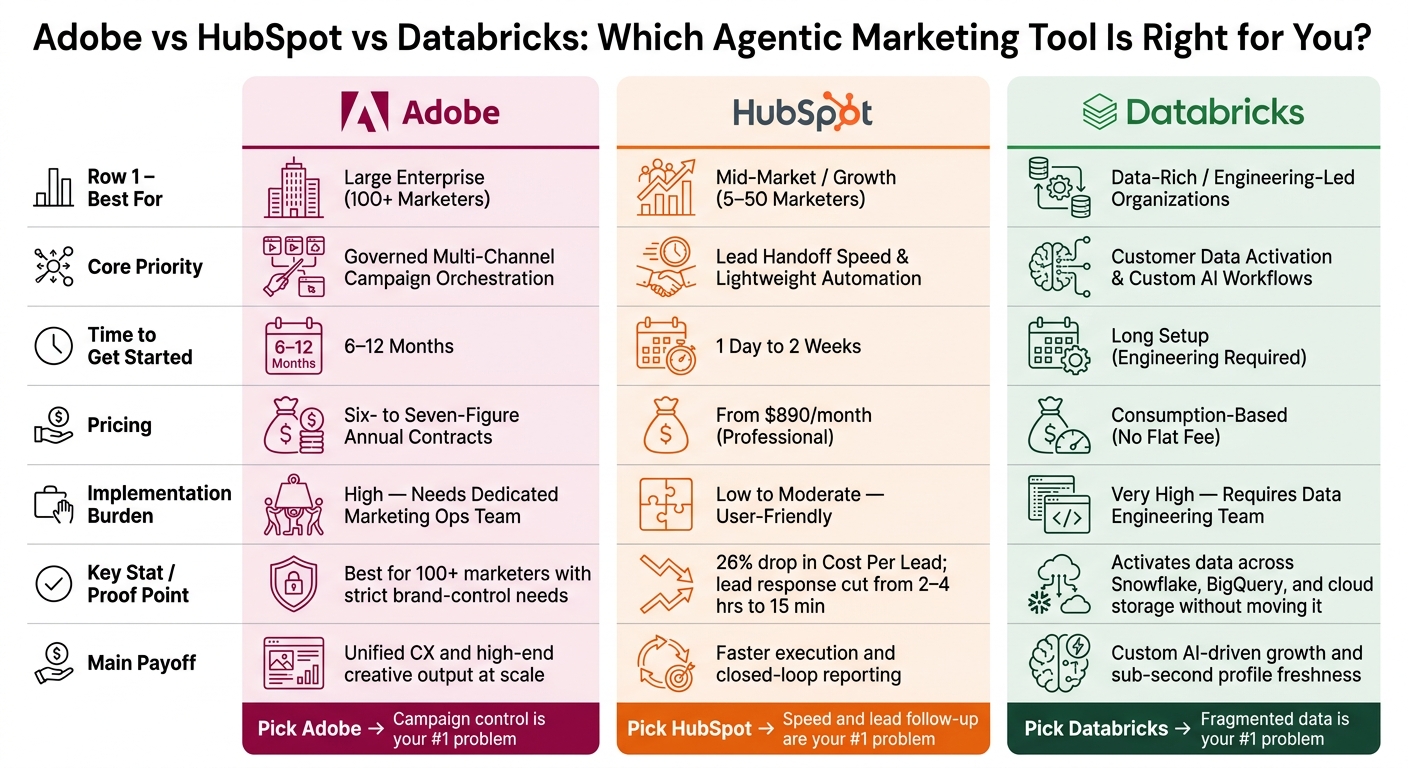
Adobe vs HubSpot vs Databricks: Agentic Marketing Tools Compared
Quick Comparison
| Platform | Best for | Main need before setup | Time to get started | Best company type |
|---|---|---|---|---|
| Adobe | Multi-channel campaign control | Adobe stack, clean CRM data, marketing ops team | 6–12 months | Large enterprise |
| HubSpot | CRM-based automation and lead follow-up | Clean records, lifecycle stages, UTM rules | 1 day to 2 weeks | Growth-stage and mid-market |
| Databricks | Data activation and custom AI workflows | Lakehouse setup, governance rules, engineering team | Long setup | Data-heavy enterprise |
The short version: I would not stack these tools on day one. I would fix the costliest problem first, get one system working, and only then decide if I need anything else.
sbb-itb-9cd970b
Adobe: The right pick for enterprise campaign management and controlled optimization
Where Adobe performs best
Adobe's CX Enterprise brings together Brand Intelligence, Engagement Intelligence, and Agent Orchestrator to manage governed marketing workflows.[1] Adobe stands out when control matters just as much as automation.
Its main edge is goal-based, multi-channel journey orchestration. Instead of relying on fixed send schedules, agents watch real-time buyer behavior and move contacts to the next stage on their own.[2] That means small adjustments can happen automatically, while bigger actions still go through human approval.[3]
What you need in place before Adobe pays off
Adobe is an enterprise system, not a plug-and-play tool.[5] ROI tends to be highest for teams already using Adobe Experience Cloud, especially Journey Optimizer, Real-Time CDP, and Experience Manager.[1][3] Setup often takes 6 to 12 months, annual contracts often land in the six- to seven-figure range, and you'll need a dedicated Marketing Ops team.[6]
Clean data isn't optional here. Adobe's agents can magnify data problems much faster than any manual process, so UTM governance and CRM lifecycle mapping need to be cleaned up before deployment, not after.
Best fit: enterprise teams managing customer experience across large audiences
Adobe makes the most sense when your biggest problem is governed campaign management at scale, not speed and not raw data infrastructure flexibility. It's a strong match for global enterprises with 100+ marketers and strict brand-control needs.[1]
If your team is already deep in the Adobe ecosystem and the main bottleneck is managing complex, multi-channel journeys without losing brand control, Adobe's agentic tools fit well. For smaller teams, or teams that care most about speed, the setup cost is often too high for what you get. If you need faster automation with less operational overhead, move to the next option.
HubSpot: The right pick for faster automation across marketing, sales, and service
Where HubSpot performs best
HubSpot’s edge is pretty simple: its agents work inside the same place your data already lives. With Breeze and Agent Hub, marketing, sales, and service agents use the same CRM context, including deal history, contact timelines, call transcripts, and buying signals, without manual field mapping.[4]
That built-in connection helps teams move faster. Lead response gets faster. Handoffs get smoother. Pipeline movement gets less stuck. The Prospecting Agent researches accounts, drafts personalized outreach, and recommends send timing based on real-time CRM activity.[2] The Customer Agent handles Tier 1 support and works across the buyer journey.[2]
The results can be hard to ignore. In one 2026 example, Wizehire rolled out HubSpot’s agentic lead handling and funnel optimization. The outcome: a 26% drop in Cost Per Lead, and lead response times went from 2–4 hours down to 15 minutes.[2]
Behavior-based triggers are another big reason HubSpot works well for lean teams. Triggered emails can hit 45% to 65% open rates, compared with about 25% for broadcast emails.[2] For a small team juggling several sequences at once, that gap matters. It’s why HubSpot makes the most sense when speed and lead response matter more than deep custom setup.
What you need in place before HubSpot works well
Agent Hub and Agent Builder are available on Professional and Enterprise plans, starting at $890/month for Professional and $3,600/month for Enterprise.[7]
Before you roll it out, get the basics in order:
- Standardize UTMs
- Define lifecycle stages
- Dedupe CRM records[2]
If lifecycle stages are fuzzy or your records are full of duplicates, the agents will just scale that mess faster than a human team would.[2]
The good news? You don’t need a data engineer or a full marketing ops team to get started. If you’re a solo marketer with clean, organized CRM data, you can have a working agentic workflow live in a single afternoon.[7]
Best fit: growth-stage and mid-market teams that need speed and simplicity
HubSpot is the right move when your main bottleneck is execution speed. It fits lean teams of 1–30 marketers that need to launch personalized sequences fast, tighten handoffs between marketing and sales, and skip a long rollout.
Setup can take anywhere from one day to two weeks.[7] If your team already uses HubSpot’s Smart CRM as its system of record, the agentic layer plugs in with minimal lift. If your main problem is custom data activation, Databricks is the stronger fit.
Databricks: The right pick for customer data activation and custom AI-driven growth
Where Databricks performs best
Databricks solves a different kind of problem. Instead of pulling customer data into another marketing system, it activates that data where it already lives: inside the lakehouse. Profile Agents pull fragmented records together into golden profiles, and Campaign Agents use that context to suggest next-best actions and run always-on campaigns. [8]
That matters because the lakehouse can work with structured and unstructured data in the same place. So teams can analyze support logs, internal docs, and profile tables without stitching them across separate systems first. [3][9] And with Lakehouse Federation, they can query data from Snowflake, Google BigQuery, or cloud object storage without moving it first. [8][9]
Governance is another big reason teams pick Databricks. Every agent decision follows the permissions and audit trails already set in Unity Catalog. In Adobe and HubSpot, governance stays inside the marketing product. In Databricks, it extends across the full data platform. [9]
That’s a strong setup. But it also comes with more build work, which is where the tradeoff starts.
What you need in place before Databricks creates value
The same flexibility that makes Databricks powerful also makes it heavier to put in place. It’s a build platform, not a self-serve tool for marketers. The main users are data engineers and data scientists, not growth teams looking for a point-and-click workspace. Before Databricks starts paying off, you need mature lakehouse operations, versioned identity rules, clear governance policies, and a team that can set up and maintain those guardrails. [3][10]
Its pricing is consumption-based. You pay for the compute used to build profiles or resolve identities, and there’s no flat platform fee. [8][9] That can work well at large scale, but costs rise with usage, so early scoping matters a lot.
HP shows what this can look like in practice. In June 2026, HP became a design partner for Databricks CustomerLake to move past fragmented data and build customer intelligence on the same trusted data foundation already used by finance and operations. [8]
"Databricks CustomerLake brings that vision to life, enabling HP to build customer intelligence, personalization, and activation on the data foundation we already trust, rather than creating another place where data must be copied, reconciled, and secured." - Kumar Ram, Global Head of Marketing Technology and AI Enablement, HP [8]
Best fit: data-rich organizations building their own growth systems
Databricks makes the most sense when your main bottleneck is data activation at scale. If customer data is scattered across systems, identity resolution is locked inside a black-box CDP, or your marketing team can’t work from the same customer view your data team relies on, Databricks is likely the better fit. [10][11]
It’s a strong choice for organizations that want long-term control over customer intelligence and growth operations, and that have the engineering team to build that system instead of buying a packaged one.
At this point, the decision comes down to a simple question: is your biggest constraint campaign control, execution speed, or data activation?
Which one should you choose? A direct recommendation by company type
Pick Adobe, HubSpot, or Databricks based on your biggest bottleneck
Pick the tool that removes your biggest bottleneck. The simplest way to make the call is to look at the problem that's costing you the most revenue and choose the platform built to fix it.
Pick Adobe if your main bottleneck is governed, multi-channel campaign orchestration at enterprise scale.
Pick HubSpot if your bottleneck is faster lead handoff and lightweight automation.
Pick Databricks if your customer data is fragmented and you need engineers to turn it into custom AI-driven workflows.
Here’s the fast-scan version.
Final comparison summary
| Platform | Best Fit | Core Priority | Implementation Burden | Main Payoff |
|---|---|---|---|---|
| Adobe | Large Enterprise (100+ Marketers) | Governed Campaign Orchestration | High - needs specialists | Unified CX and high-end creative output at scale |
| HubSpot | Mid-market / Growth (5–50 Marketers) | Lead Handoff and Execution Speed | Low to moderate - user-friendly | Faster execution and closed-loop reporting |
| Databricks | Data-rich / Engineering-led | Customer Data Activation | Very high - requires data engineering | Custom AI-driven growth and sub-second profile freshness |
Choose the platform that fixes the bottleneck costing you the most growth.
FAQs
How do I identify my biggest marketing bottleneck?
Start by mapping where your data lives now and where it needs to go to support your goals. Keep your focus tight. In most cases, unifying just two or three key data sources can make the biggest difference in your marketing.
Next, look for the friction that keeps showing up. Pay attention to the data question your team escalates most often, along with manual campaign work like batch exports or handoffs. Those pain points usually point straight to your biggest bottleneck.
What should I clean up before turning on agentic workflows?
Before you turn on agentic workflows, get your data house in order. Agents need clean, unified, up-to-date data to act well. If the inputs are fragmented or stale, the outputs will be too.
Focus on a few non-negotiables: sub-second profile freshness, governed and reversible write-back, and strong data hygiene. That means standardized UTM governance, mapped CRM lifecycle events, aligned attribution logic, a single source of truth for reporting, and audit trails for agent decisions.
When should I start with one platform and add another later?
Start with one platform when you first need a solid data base or core guardrails like lifecycle management and compliance. Pick the platform that matches where your team is right now, then pilot a narrow, high-frequency use case that can show clear ROI within weeks.
Bring in a second platform later, once your data governance is strong enough to support autonomous action without creating silos or fragmented signals.