31. You Don't Have a Marketing Problem. You Have a Data Ownership Problem.

When your marketing campaigns fail, the issue often isn’t the strategy - it’s your data. Most businesses don’t own their marketing data; they rely on third-party tools that control how data is stored, accessed, and used. This creates problems like vendor lock-in, compliance risks, and incomplete insights. Without true data ownership, you can’t fully control or trust your analytics, attribution, or decision-making.
Here’s what you need to know:
- Data ownership vs. access: Viewing data in a dashboard doesn’t mean you own it. Ownership means you control where it’s stored, how it’s used, and can move it freely.
- Risks of poor ownership: Vendor shutdowns, lost historical data, and unreliable insights are common when you don’t own your data.
- Signs of a problem: Fragmented systems, reliance on vendor dashboards, and inconsistent tracking are red flags.
- Solution: Build a first-party data strategy. Audit your data, assign clear responsibilities, and choose tools that let you fully control your data.
Without data ownership, your marketing is built on a shaky foundation. Start by mapping where your data lives and ensuring you have full control over it. The future of your campaigns depends on it.
What is first party data collection and why is it important?
What Data Ownership Actually Means for Marketing
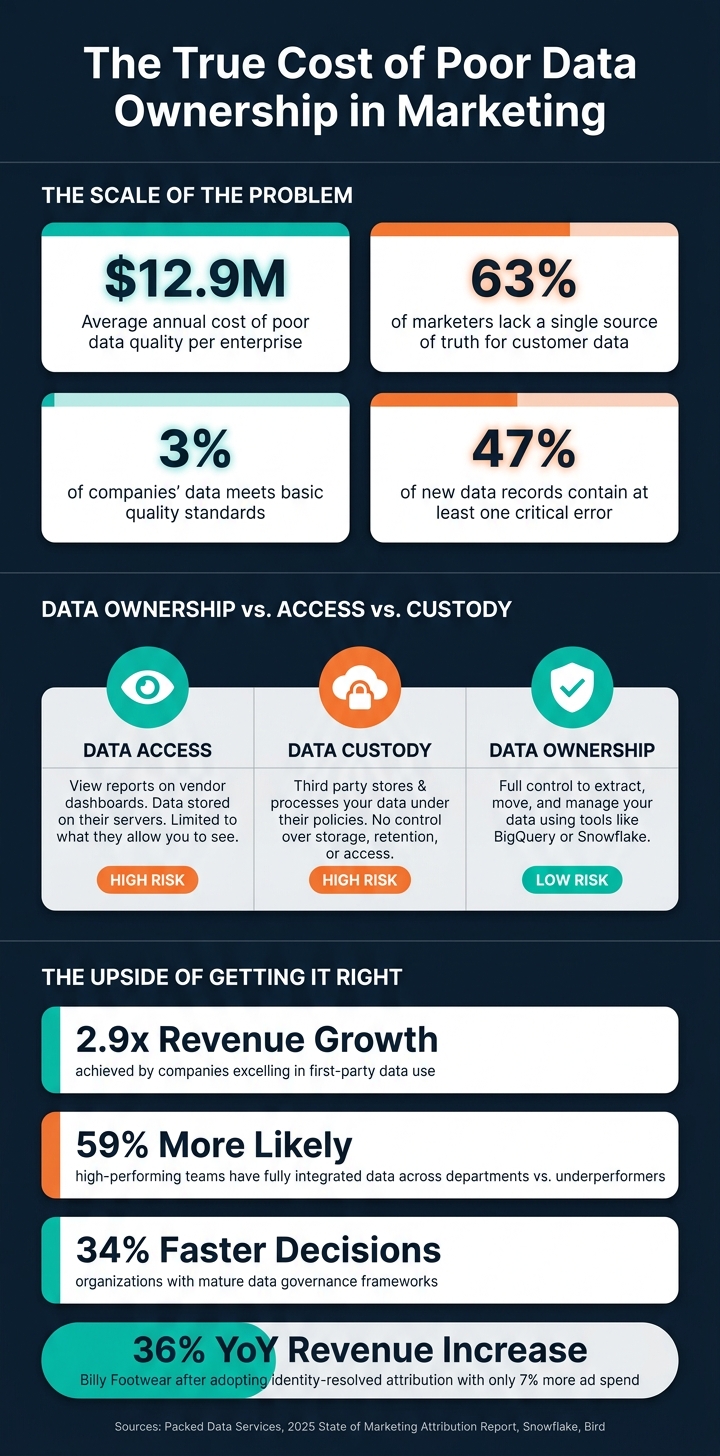
The True Cost of Poor Data Ownership in Marketing
Building on the earlier discussion about managing data, it's important to understand that just being able to see your data doesn’t mean you have control over it. Many marketers assume that visibility equals ownership, but this misconception can end up costing businesses far more than they realize.
Data Access vs. Data Custody vs. Data Ownership
These three terms might sound similar, but they represent very different levels of control over your data.
- Data access: This means you can log into a platform, view reports, and interact with dashboards. However, the data itself is stored on the vendor’s servers, and you’re limited to what they allow you to see.
"When you rely on third-party tools, you're essentially renting insight. The data might live on someone else's servers, and you access it via their interfaces." - Onur Alp Soner, CEO, Countly [9]
- Data custody: In this case, a third party - like Google or Meta - stores and processes your data under their own policies. You don’t control where the data is stored, how long it’s kept, or who else might have access to it.
- Data ownership: This gives you full control over your data. You can extract it, move it, and manage it however you want, often using tools like BigQuery or Snowflake [1][9].
These distinctions are critical. When you only have access, you’re tied to the vendor’s rules. But with ownership, you have the freedom to manage, transform, and analyze your data independently.
"Data ownership accountability is frequently mistaken for data access. Data access does not necessarily imply data ownership." - Packed Data Services [3]
Grasping these differences is essential, especially as your data spreads across various platforms and tools.
Where Your Marketing Data Actually Lives
Your marketing data often exists across multiple platforms, each using its own format and definitions [2]. For instance:
- Your CRM might store contact records and lead data.
- Ad platforms manage campaign performance data.
- Email tools track engagement metrics like opens and clicks.
- Analytics platforms capture user behavior on your website.
Even if you can export a CSV file, that doesn’t mean you truly own the data. Many tools let you download basic information, like contact lists, but restrict access to deeper insights - such as engagement history or behavioral sequences - that offer a complete picture of how customers interact with your brand.
What You Risk When You Don't Own Your Data
Not owning your data can lead to serious consequences. Poor data quality alone costs businesses an average of $12.9 million annually [3]. Without ownership, you face risks like:
- Vendor lock-in: You become dependent on a single provider, limiting flexibility.
- Regulatory issues: You may struggle to meet compliance requirements if you don’t control where and how your data is stored.
- Unreliable insights: Without full access, your analytics and attribution models might be incomplete or inaccurate. To fix these gaps, you can implement a proven AI lead-gen playbook to regain control over your outreach and data scoring.
In short, a lack of data ownership can hurt your business financially and strategically, leaving your marketing efforts vulnerable to errors and inefficiencies.
31 Signs You Have a Data Ownership Problem
Most businesses don’t realize they have a data ownership problem until something goes wrong - like a vendor changing terms, a report that doesn’t add up, or a contact list disappearing. But the warning signs are usually there long before a crisis hits. These signs highlight the gap between merely accessing data and actually owning it, exposing risks that can undermine your marketing efforts.
No Single Source of Truth for Customer Data
A staggering 63% of marketers report lacking a single source of truth for their customer data [10]. Instead, they rely on conflicting records spread across tools like CRMs, email platforms, ad systems, and analytics software. Each of these tools often uses different naming conventions and definitions, creating a fragmented view of customer information. Bird puts it bluntly:
"You don't have data silos. You have data fragments scattered across multiple systems with no authoritative source, no consistent identifiers, and no reliable way to know which version is correct." [5]
This fragmentation leads to major issues, like retargeting customers who’ve already made a purchase, sending duplicate messages, or misidentifying top leads. Without strong data quality measures in place, duplicate records can make up 10% to 30% of your database [3]. And when there’s no unified data source, you’re often forced to rely on vendor dashboards.
You Rely Entirely on Vendor Dashboards for Decisions
If your marketing decisions are based solely on reports from platforms like Google Ads, Meta, or your email system, you’re not seeing the whole picture. Research shows that 96% of marketers say their data doesn’t flow between tools, and 83% admit they need engineering support to access it [10]. Vendor dashboards are designed to highlight their own strengths, not to provide a clear, cross-channel view of performance. Jim Warner, Field CTO of Advertising & Marketing at Snowflake, explains:
"You can't tell where you're going unless you know where you are. For example, how much are you spending? Where are you spending your budget. Putting everything into a common language so that you can compare apples to apples." [1]
When you depend on vendor dashboards, you’re not just at risk of misinterpreting performance metrics - you’re also exposing deeper problems around data custody and ownership. This dependency often comes to light during issues like historical data retention.
Your Historical Data Is Locked in Third-Party Tools
The transition from Universal Analytics to GA4 was a perfect example of what happens when historical data is locked in a vendor’s system. Businesses that didn’t export their data lost years of benchmarks overnight. Any third-party tool can change its data retention policies, deprecate APIs, or shut down, leaving you without access to critical information. If your campaign performance, audience segments, or conversion history live exclusively on someone else’s platform, you don’t own your data - you’re just borrowing it.
Your Tracking and Attribution Are Inconsistent
Nearly half - 47% - of newly created data records contain at least one critical error [8]. Attribution models built on fragmented and inaccurate data lose their reliability. For instance, a team at A Cloud Guru struggled with misleading performance data until they centralized their Google Analytics and ad platform data in a Snowflake data warehouse. This move allowed them to create custom attribution models they controlled entirely [1].
Vendor Shutdown Risks Wiping Your Data
What happens if a vendor shuts down, raises prices dramatically, or gets acquired? Data stored in their system could disappear or become inaccessible. As House of MarTech puts it:
"If your customer intelligence lives inside someone else's platform, you do not have a strategy - you have a subscription." [7]
This isn’t a hypothetical risk. Agencies sometimes keep client data in master accounts, giving businesses view-only access. When the relationship ends, historical records often can’t be migrated [4][6]. To avoid this, use internal emails for tool setup and carefully review contracts to ensure you retain control over your data.
How to Build a First-Party Data Ownership Strategy
Creating a solid first-party data strategy is essential for addressing fragmented insights and achieving marketing success. This requires a structured approach that ties your data initiatives to measurable business outcomes, establishes accountability, and ensures you have the right tools to manage your data effectively.
Connect Your Data Ownership Goals to Business Outcomes
Start by clearly defining your business goals and identifying the specific data needed to achieve your marketing and revenue objectives. For B2B companies, this often involves resolving data at the account level, while for B2C businesses, the focus is typically on individuals or households. Establish a unified customer record from the outset to avoid duplication, where the same customer might appear multiple times across your CRM, BenchmarkONE, and ad systems.
Once you’ve outlined what a clean customer record should look like, conduct a thorough audit of all your data touchpoints - such as your website, ActiveCampaign, billing systems, and customer support tools. This will help you pinpoint gaps in data collection and control [12][14]. Companies that excel in leveraging first-party data often experience up to 2.9x revenue growth and 1.5x cost savings [13]. With your business outcomes clearly mapped, assign responsibilities to maintain data accuracy and integrity.
Set Up Governance and Assign Data Responsibilities
After defining your goals, the next step is to formalize roles for managing your data. Governance involves setting clear rules and assigning responsibilities to ensure consistency and accountability. Without this structure, you risk issues like inconsistent naming, tracking errors, and mismatched reports.
Here are the three key roles to establish [20–22]:
- Data Owner: A senior leader, such as a VP of Marketing, who oversees data quality and ensures alignment with strategic goals.
- Data Steward: A hands-on professional, like a Marketing Operations Manager, who sets standards, resolves data quality issues, and acts as the go-to expert.
- Data Custodian: A technical team member, such as an IT specialist or Data Engineer, responsible for managing infrastructure, security, and backups.
To streamline implementation, use a 90-day plan: spend the first month auditing your data, the second month assigning stewards and implementing quality checks, and the third month launching a monitoring dashboard [15]. Organizations with mature governance frameworks often make decisions 34% faster and encounter 28% fewer compliance issues [15].
Pick Tools That Give You Control Over Your Data
When choosing software tools, ask critical questions like: Can you fully export your data? Is API access available? What happens if you decide to cancel the service? Selecting tools that align with your need for data control and portability ensures you retain ownership as your marketing tech stack evolves.
By May 2026, 19 US states will enforce comprehensive privacy laws [11], making features like data portability and consent management non-negotiable. Look for platforms with consent built into their architecture from the start, rather than as an afterthought [14]. Additionally, prioritize server-side tracking, as browser-based methods are increasingly blocked by Safari, Firefox, and iOS privacy updates [12][14].
To simplify the process, refer to directories like the Top SaaS & AI Tools Directory, which can help you find tools tailored for lead generation, CRM, and marketing automation without the need for exhaustive evaluations. Before finalizing any contract, carefully review the terms to ensure your business retains ownership of the data you generate or provide [7].
Tools and Frameworks to Take Back Control of Your Data
Taking control of your data starts with understanding its current state, choosing the right tools, and consistently monitoring performance. These steps are essential for aligning your marketing strategy with measurable business goals.
How to Measure Your Data Ownership Maturity
Before solving a data issue, you need to gauge how severe it is. The Marketing Stack Complexity Index (MSCI) is a 50-point diagnostic tool that evaluates your setup across five key dimensions: Tool Overlap, Integration Debt, Data Silos, Ownership Gaps, and Workflow Friction [16]. Each dimension is scored from 0 to 10, and a total score above 26 suggests your system may cost more to maintain than it delivers in value [16].
Additionally, assess where your organization stands on a four-stage data maturity scale [17]:
- Fragmented: Systems lack shared identifiers, and every report requires manual effort.
- Standardized: Naming conventions and data pipelines are consistent.
- Governed: Data is cataloged, with clear business definitions and assigned owners.
- AI-Ready: Reliable, low-latency data actively supports models and real-time decisions.
Most marketing teams find themselves between the Fragmented and Standardized stages. The objective isn’t to leap straight to AI-Ready but to progress one step at a time, ensuring accountability at every stage. This evaluation lays the foundation for selecting tools that enhance data control.
Using the Top SaaS & AI Tools Directory to Find the Right Tools
The next step is identifying tools that support your data ownership goals. The Top SaaS & AI Tools Directory is a resource that helps you filter tools for CRM, analytics, marketing automation, and lead generation - areas where data control plays a major role.
When evaluating tools, prioritize those offering:
- CNAME-based tracking
- Server-side activation via APIs
- Full data export in standard formats
These features can help you avoid being locked into proprietary systems. Traditional marketing stacks often lose 20% to 40% of data due to browser and ad blocker restrictions on third-party tracking [19]. Server-side setups can mitigate this loss by ensuring data collection operates from your own subdomain.
"If your customer intelligence lives inside someone else's platform, you do not have a strategy - you have a subscription." - House of MarTech [7]
The directory also highlights tools with native integrations, reducing your reliance on fragile custom scripts or third-party connectors. This minimizes potential points of failure where data might be lost or distorted.
Metrics to Track Whether Your Data Ownership Strategy Is Working
Once you’ve implemented the right tools, monitor your progress using these key metrics:
| Metric | Target | Metric Description |
|---|---|---|
| Data Quality Score | >95% | Percentage of records that pass validation checks [15] |
| Time-to-Insight | <2 days | Time from data event to actionable analysis [15] |
| Compliance Audit Pass Rate | 100% | Adherence to GDPR, CCPA, and state privacy laws [15] |
| Data Access Request Fulfillment | <5 days | Response time for data queries [15] |
| MSCI Score | <10 | Health of your marketing stack (lower is better) [16] |
| Identity Resolution Rate | High | Percentage of records matched to a persistent customer ID [17] |
Two metrics stand out. Time-to-Insight directly impacts how quickly your team can act on data. Organizations with strong governance frameworks make decisions 34% faster than those without [15]. Meanwhile, your MSCI Score acts as a real-time indicator of stack health. Reassessing it quarterly helps catch emerging complexities before they escalate.
High-growth organizations often automate data validation, with 78% doing so before data even enters their CRM [18]. This proactive approach ensures issues are caught early, saving time and resources down the line.
Conclusion: Better Data Ownership Leads to Better Marketing
Most marketing issues aren't actually about marketing - they're about data. When attribution falls apart, campaigns miss their mark, and teams end up wasting hours reconciling reports, the root cause is often a lack of proper data ownership. This highlights the importance of reclaiming and using first-party data to drive smarter, more effective marketing strategies.
The numbers tell the story. Poor data quality costs large enterprises an average of $12.9 million annually [8], and only 3% of companies' data meets basic quality standards [8]. On the flip side, high-performing marketing teams are 59% more likely to have fully integrated data across departments compared to their underperforming counterparts [2]. The difference between these groups isn’t about talent or budget - it’s about having the right data infrastructure.
"When attribution breaks down, it's never the model. It's always the foundation." - 2025 State of Marketing Attribution Report [2]
This insight offers a clear path forward. You don’t need to tackle everything at once. Start by conducting an honest audit of your customer data - where it lives, how accessible it is, and whether you can act on it independently. Assign a single person to oversee your commercial data model, avoiding the inefficiency of a committee. From there, build step by step. For example, Billy Footwear took this approach by adopting identity-resolved attribution with LayerFive. The result? A 36% revenue increase year-over-year with only a 7% boost in ad spend [2]. They succeeded simply by pinpointing which channels were driving actual conversions.
While platform reach is temporary, your first-party data grows in value with every customer interaction. Companies that prioritize data ownership as a business goal - not just an IT task - are the ones that make faster decisions, run leaner campaigns, and create marketing systems that remain resilient no matter how vendor policies evolve.
A single audit and clear ownership structure can completely reshape your marketing results. Take the first step today: map out where your data resides, identify who controls it, and evaluate what you’d lose if a vendor disappeared tomorrow. The future of your marketing depends on it.
FAQs
How do I know if I actually own my marketing data?
To truly own your marketing data, you need complete control over how it's accessed, stored, and managed - without being overly dependent on third-party platforms or agencies. A few signs of ownership include having a centralized system like a data warehouse, ensuring that your tools integrate smoothly, and maintaining direct access to your analytics accounts. On the flip side, if your data is fragmented, access is limited, or you're reliant on external parties, it’s a clear indication that you don’t fully control it.
What should I export first so I don’t lose historical marketing data?
To keep your historical marketing insights intact, start by exporting your customer data. Gather your first-party data - like contact information, purchase history, and engagement records - and store it in a centralized system. This approach helps you stay in control of your data, reduces reliance on third-party platforms, and protects you from issues like vendor lock-in or unexpected platform changes. By doing this, you’ll ensure your marketing efforts remain accurate and consistent.
What’s the fastest way to start a first-party data strategy without a big rebuild?
The fastest way to kick off a first-party data strategy without making sweeping changes is by leveraging the tools and platforms you already use. Start by collecting data from your existing customer touchpoints - like your website, email marketing efforts, and CRM systems - while making sure you're following consent management guidelines.
To make this data actionable, bring together sources such as website analytics and customer service logs into one centralized system. This approach allows you to streamline and make better use of your data with minimal interruptions to your current operations.