Enterprise AI Marketing vs. SMB AI Marketing: The 3 Rules That Flip

If you market to SMBs and enterprises the same way, you will waste time and budget. I’d sum it up like this: SMB AI marketing is about fast launch, self-serve conversion, and low-cost tools. Enterprise AI marketing is about approval, buying-group coverage, and connected systems.
Here’s the short version:
- SMB sales cycles are often 1 to 30 days, while enterprise sales cycles can run 6 to 18 months.
- SMB deals may involve 1 to 4 people. Enterprise deals often need 6 to 14 stakeholders.
- SMB teams can get live in days or weeks with tools that cost about $250 to $600/month.
- Enterprise teams may need 3 to 9 months before launch, with software spend from $100,000 to $1,000,000+ per year.
- SMB success is tied to metrics like trial-to-paid and CAC payback.
- Enterprise success is tied to pipeline quality, account engagement, and win rate.
So the three rules that flip are simple:
-
Speed vs. control
SMBs can ship fast and clean it up later. Enterprises need legal, IT, access controls, and audit history before they scale. -
One buyer vs. buying group
SMB funnels need fast sign-up and activation. Enterprise funnels need messaging for multiple people across the same account. -
Light tools vs. connected stacks
SMBs do well with lean tools and simple automations. Enterprises need CRM, intent, and data systems working together.
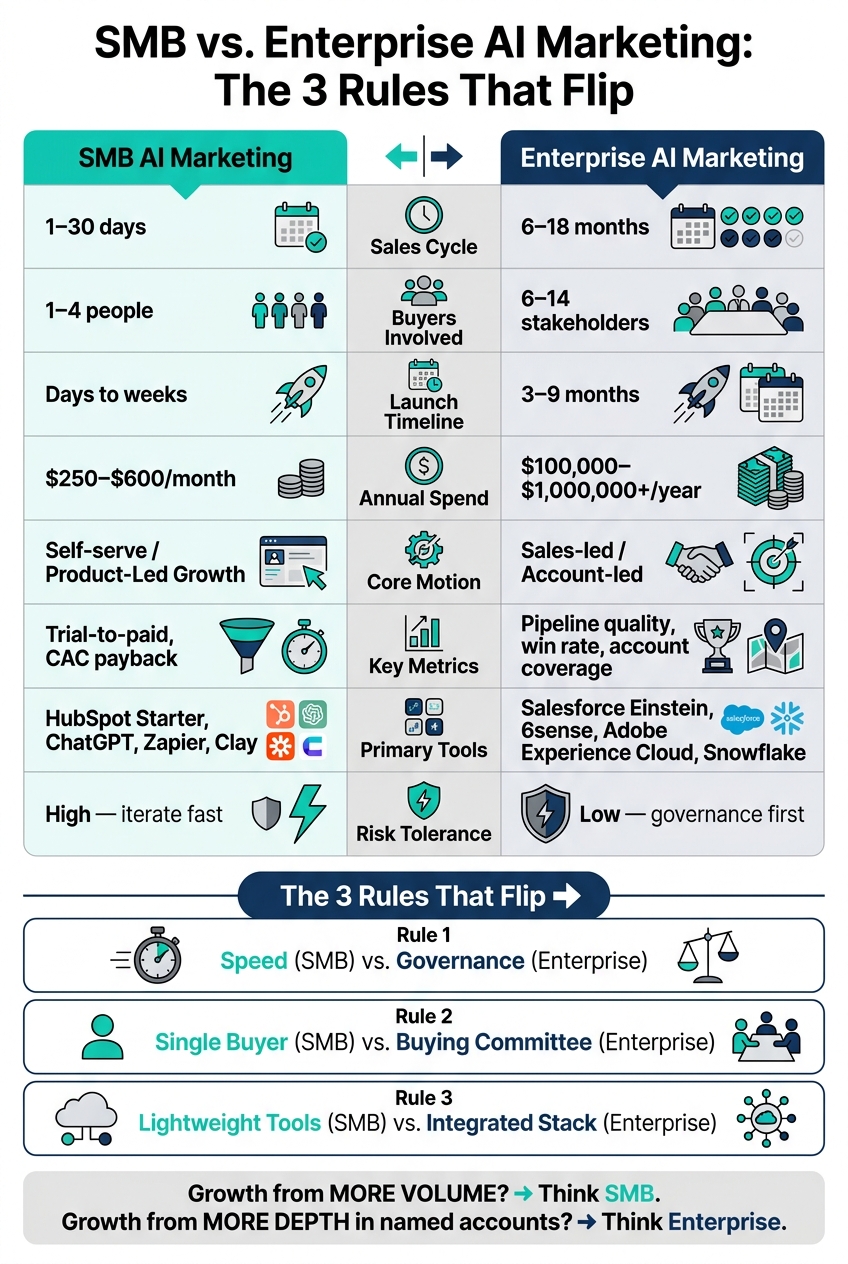
SMB vs. Enterprise AI Marketing: Key Differences at a Glance
Should you skip the SMB and go straight to the enterprise? 💸💸💸
Quick Comparison
| Criteria | SMB AI Marketing | Enterprise AI Marketing |
|---|---|---|
| Sales cycle | 1–30 days | 6–18 months |
| Buyers | 1–4 | 6–14 |
| Main goal | Fast conversion | Account progression |
| Main motion | Self-serve / PLG | Sales-led / account-led |
| Tool setup | Lean, modular | Connected, deep setup |
| Launch timeline | Days to weeks | 3–9 months or more |
| Spend | $250–$600/month | $100,000–$1,000,000+/year |
| Main metrics | Trial-to-paid, CAC payback | Pipeline, win rate, account coverage |
I’d use this as the gut check: if growth comes from more volume, think SMB. If growth comes from more depth inside named accounts, think enterprise.
That’s the whole point of the article: same AI category, but the rules flip once deal size, risk, and buying motion change.
Rule 1: Speed Wins in SMBs; Governance Wins in Enterprises
In SMBs, speed usually wins. In enterprises, governance wins. That one change shapes how AI affects lead generation, conversion, and the sales handoff across the funnel.
Here’s where that shows up in day-to-day work:
| Dimension | SMB AI Marketing | Enterprise AI Marketing |
|---|---|---|
| Approval Path | Owner or founder decides in 24–72 hours | Legal, IT, Finance, and RevOps must all sign off |
| Compliance Gate | Minimal - launch fast, refine quickly | SOC 2, GDPR, ISO, SSO, role-based access, audit trails |
| Deployment Owner | One generalist or part-time staff member | Engineering-led, with custom APIs and hybrid-cloud controls |
| Risk Tolerance | High - iterate in production | Low - auditability and compliance first |
| Core Tools | ChatGPT, HubSpot AI (Starter), Zapier | Salesforce Einstein, 6sense, Adobe Experience Cloud |
SMB Playbook: Launch Fast, Test Often, Accept Some Mess
For SMBs, the big edge is simple: fast approval.
A 14-person e-commerce brand rolled out a single AI agent to manage support tickets and abandoned-cart follow-ups. One part-time staff member ran it. Within two weeks, first-response time dropped from 9 hours to under 20 minutes. That improved lead follow-up without adding headcount and lifted trial-to-paid conversion by shrinking the gap between interest and activation. [5]
That’s the appeal of the SMB setup. A ChatGPT workflow tied into Zapier or Make and connected to HubSpot AI (Starter) can draft outbound personalization sequences, generate follow-up prompts after demos, and improve lead response rates within weeks, not quarters. In most cases, a modular stack like that costs about $250 to $600 per month. [2][10]
It’s not always neat. But for a small team, “good and live” often beats “perfect and delayed.”
That speed edge starts to fade when buying turns into a committee process, which is why Rule 2 matters.
Enterprise Playbook: Get Legal, IT, and RevOps Aligned Before You Scale
Enterprise teams can’t afford a messy rollout.
Once AI touches customer data or feeds a sales workflow, Legal, IT, and RevOps usually need to review it first. That slows things down. Enterprise rollouts often take 3 to 9 months before they’re ready to scale, and Fortune 1000 deals can stretch to 18 months. [1][2]
There’s a reason for that. Enterprises need SSO, SOC 2 certification, role-based access controls, and audit trails. AI can multiply output, but it can also multiply bad data, weak process, and simple mistakes. Fast.
That’s why platforms like Salesforce Einstein and 6sense fit this kind of setup. They’re built for stricter controls, but they also come with enterprise-level pricing. Annual contracts often start around $50,000 to $100,000+ and can climb well past $500,000 for full deployments. On top of that, implementation costs often add another 30% to 50%. [2][10]
If the setup is done well, the upside is cleaner attribution, lower operational risk, and a more dependable sales handoff. Skip governance, and the mess doesn’t disappear - it just shows up later as risk and rework.
Once governance is set, the next question is whether the AI can persuade one buyer or an entire committee.
Rule 2: Self-Serve Conversion Works for SMBs; Buying Committee Orchestration Works for Enterprises
Once governance is in place, the next divide is conversion. In SMB, you're often selling to one person. In enterprise, you're working through a group. That's the second flip: SMBs need a single buyer to act, while enterprises need account-wide coverage.
In SMB marketing, the usual target is one founder or department head, often making the purchase with a credit card. In enterprise marketing, the job is very different. You're trying to get 6 to 14 people - legal, IT, finance, procurement, and an executive sponsor - lined up around one decision [4]. The tools, metrics, and AI workflows that help one motion often fall apart in the other.
Use an enterprise motion on SMB deals, and you slow everything down. Use an SMB motion on enterprise deals, and you end up with leads that procurement never touches.
| Dimension | SMB AI Marketing | Enterprise AI Marketing |
|---|---|---|
| Core Model | Self-serve / Product-Led Growth | Account-led / Sales-led |
| Decision makers | 1–4 (founder or department head) [4] | 6–14 (IT, Legal, Finance, C-suite) [4] |
| Decision motion | Single buyer, credit card purchase | Committee consensus, procurement process |
| AI Workflows | Automated nurture, self-serve chat, in-product prompts | Intent detection, account research, signal-to-sales routing |
| Core Metrics | Trial-to-paid rate, CAC payback, activation rate | Buying committee coverage, pipeline velocity, win rate |
| Primary Tools | HubSpot AI (Starter), ChatGPT, Zapier | 6sense, Salesforce Einstein, HubSpot Enterprise |
SMB Funnel Design: One Buyer, Clear Offer, Fast Activation
The SMB funnel is a speed game. You want one decision-maker to go from landing page to activation in under five minutes [4].
That usually means one-click SSO sign-ups, short ChatGPT-assisted email sequences - often four touches over eight days [11] - and in-product upgrade prompts based on usage milestones instead of long email nurtures. The signal that matters here isn't the MQL. It's the Product-Qualified Lead (PQL): the point where a user hits a usage level that suggests they're likely to pay. HubSpot AI (Starter) fits this kind of light, modular setup well.
The target numbers for this motion are clear: 8–15% trial-to-paid conversion for freemium, and 20–35% for time-limited trials [4]. Push SMB prospects into enterprise-style discovery calls, and conversion can fall by up to 40% [9].
That pace disappears the minute more people enter the deal.
Enterprise Funnel Design: Multi-Thread Messaging Across the Account
Enterprise conversion starts with account coverage, not form fills. The key question isn't, "Did someone fill out a form?" It's, "How many people inside this account are engaged?"
Enterprise deals with 3 or more engaged threads close at 2.5x the rate of single-threaded deals [4]. That's why tools like 6sense matter in this motion. They surface intent signals at the account level, which helps your team spot when a target company is researching your category before anyone fills out a form. Salesforce Einstein adds predictive lead scoring and deep CRM integration [2].
The AI SDR workflow changes too. Instead of a short, high-volume sequence, enterprise outreach runs longer - up to 14 touches over 60 days [11] - with role-specific messaging for each stakeholder. A CFO needs an ROI model. A CIO wants security documentation. An end-user needs a usability walkthrough. Send one generic message to all of them, and the deal can stall fast.
"The defining characteristic of enterprise buying is one thing: risk mitigation through process." - Kris Carter, Founder, Segment8 [9]
The practical move is to equip an internal champion early with ROI calculators, business-case templates, and security docs [8][9]. That's what helps move a $100,000+ deal through a committee [4], not a clever subject line.
Rule 3: Lightweight Tools Fit SMBs; Integrated AI Stacks Fit Enterprises
If Rule 2 focused on who buys, Rule 3 focuses on what your stack can actually handle. Tools tend to follow the way a company runs: SMBs buy for speed, while enterprises buy for control. And that choice shapes a lot more than software spend. It affects how fast leads get routed, how accounts get ranked, and how cleanly sales teams can move.
SMB Stack: Simple Tools That Reach Value Fast
For SMBs, the target is time-to-value in days, not months. That’s why a practical SMB stack usually stays pretty lean.
A common setup looks like this:
- HubSpot Starter or Pro as the CRM base
- ChatGPT or Claude for content drafts and email copy
- Zapier or Make to connect repeat workflows
- Clay or Instantly for outbound prospecting
That full setup usually lands between $250 and $600 per month [10].
Why do simpler tools win here? Because most SMB teams just don’t have the technical bandwidth to babysit heavy integrations. If the stack gets too complicated, the team ends up spending time fixing workflows instead of building pipeline. In plain English: too much tooling becomes a drag on growth [7].
Enterprise Stack: Connected Platforms That Support Scale and Control
Enterprise teams are dealing with a very different setup. When you're working across 200 to 2,000 target accounts and trying to coordinate outreach across 6 to 14 stakeholders per deal [4][6], disconnected tools stop being a small annoyance and start becoming a real problem.
Blind spots show up fast. One tool has account intent. Another has CRM activity. A third tracks campaign data. If those systems don’t talk to each other, teams miss signals, route leads late, and lose context. It’s not surprising that 76% of enterprises report negative outcomes from siloed AI tools [10].
That’s where a connected stack starts to make sense. A common enterprise setup uses Salesforce or Adobe as the core platform, 6sense or Demandbase for intent data and account ranking, and Snowflake or Databricks for data infrastructure.
There’s also a timing lesson here. Startups that jump into enterprise platforms too early often burn money on software they can’t fully use yet. In many cases, they waste 60% to 80% of their license value on features that sit idle [2].
| Dimension | SMB AI Stack | Enterprise AI Stack |
|---|---|---|
| Primary Tools | HubSpot Starter/Pro, ChatGPT, Zapier, Clay, Instantly | Salesforce Einstein, 6sense, Adobe Experience Cloud, Snowflake |
| Implementation | Days to weeks; self-serve | 4–12 weeks; hands-on |
| AI Use Case | Content generation, lead triage, automated outreach | Predictive scoring case studies, account prioritization, stakeholder mapping |
| Integration Depth | Pre-built connectors; lightweight "glue" | Custom APIs; deep native integrations |
| Governance | Basic SaaS security (GDPR/CCPA) | SSO, RBAC, SOC 2, HIPAA compliance |
| Typical U.S. Spend | $250–$600/month [10] | $100,000–$1,000,000+/year [10] |
A good rule of thumb: move toward an integrated stack when your team is spending more than 20% of its time maintaining manual integrations, or when your contact database grows past 250,000 to 500,000 records [2]. Below that point, a modular stack usually does the job better.
How to Match AI Marketing Strategy and Tooling to Company Size
These three rules come down to one simple buying test: volume for SMBs, account depth for enterprises.
Here’s the quick gut check. If doubling your budget would buy you more reach, you’re in SMB mode. If that same budget would help you cover named accounts more deeply, you’re in enterprise mode. That one answer should shape the tools you buy, the workflows you build, and the metrics you watch.
If You Sell to SMBs: Buy Speed, Simplicity, and Fast Payback
If you sell to SMBs, buy for speed, not complexity. SMB marketing is an efficiency game. Every tool, workflow, and campaign should pass one test: does it lower CAC or speed up time-to-revenue? Aim for a CAC payback window of 3 to 9 months [4]. If something doesn’t help that number, cut it.
Your messaging should stay short and useful. Think how-to guides, comparison pages, and plain feature benefits. This isn’t the place for long, layered messaging. People want to know what the product does, why it helps, and how fast they can get started.
Activation matters just as much. Remove friction wherever you can. Extra form fields, avoidable sales gates, and clunky steps chip away at conversion. In many cases, each unnecessary hurdle reduces conversion by 10–20% [4].
For measurement, stay focused on the numbers that show direct buying motion:
- Trial-to-paid
- Cost-per-lead
- CAC payback
Don’t center your reporting on pipeline value here.
If You Sell to Enterprises: Buy Control, Integration, and Account Coverage
If you sell to enterprises, buy for coverage, control, and integration. Enterprise marketing is an account-precision game. It’s about reaching and moving a named account list, not casting a broad net across an ICP [3].
That changes how you judge AI investments. Look at pipeline quality, deal progression, and win rate instead of MQL volume. If a team is still grading success by lead count rather than account-level engagement, that’s one of the clearest signs the investment doesn’t fit the motion [4].
Coverage inside the account matters a lot. When 3+ engaged stakeholders are involved, win rates go up. Enterprise deals with that level of account coverage close at 2.5x the rate of single-threaded deals [4]. So your workflows can’t just support one contact. They need to help your team build momentum across multiple people in the buying group.
Before you buy anything, check the basics:
- SSO
- SOC 2
- Admin controls
- SLAs
Miss those, and enterprise deals often stall in procurement [8].
If you sell to both SMBs and enterprises, split the motion. Enterprise should own ABM, field, and partnerships. SMB should own SEO, paid search, and lifecycle [3]. One team trying to run both, with one shared metric set, usually ends up breaking both motions.
FAQs
How do I know whether my AI marketing motion should be SMB or enterprise?
Match your motion to the buying process.
You’re enterprise when you go after a named account list of 50 to 500 companies, need buy-in from a committee of 6 to 10+ people, and work through a sales cycle that can run 6 to 18 months. On top of that, you usually have to clear procurement, security review, ROI checks, and integration needs.
You’re SMB when buyers can make a call in days or weeks, pricing and contracts are published or low-touch, onboarding takes minutes to days, and success is tracked with metrics like CPL, cost per trial, and trial-to-paid conversion.
If you’re not sure which camp you’re in, that’s often a sign you need separate motions.
When should a company upgrade from a lean AI stack to an integrated one?
Upgrade when you need unified data signals across platforms to make sharper decisions. A custom data setup starts to matter when your target account list grows past 500 and your average contract value is over $50,000.
It also makes sense once enterprise requirements show up: SSO, SOC 2, admin controls, and API access. A lean SMB stack usually isn't built for multi-stakeholder buying or the kind of procurement process that comes with enterprise deals.
Can one team market to both SMBs and enterprises effectively?
Yes, but only if each segment has its own execution setup.
If you run enterprise and SMB with the same process, team structure, and tools, things start to break. The reason is pretty simple: enterprise buyers move through deep, long sales cycles with multiple stakeholders, while SMB buyers usually want a high-volume, low-friction, self-serve path.
A shared strategic layer can still make sense. You can align on the big picture, core messaging, and overall direction.
But day-to-day execution should stay separate, including:
- channel mix
- team structure
- success metrics
Once you’re past the early startup stage, dedicated teams are usually the better fit.