White Label vs In-House Delivery: Which Scales Better With AI?

I would choose white-label AI delivery for added capacity without new hires, in-house AI delivery for close control, and hybrid delivery when both matter. For agencies with 15+ clients, I would test the choice on approved work per employee and total delivery cost, not the number of drafts AI makes.
AI is not the bottleneck. Missing client context is. When briefs leave gaps, your team spends the saved time on questions, checks, and fixes.
At Agile Growth Labs (AGL), we use Portable Delivery Intelligence to keep client briefs, QA notes, and approval records with the work across handoffs. Our target is 18 to 25 accounts per account manager, compared with a cap of 4 to 8. That is a target, not a promised result.
Quick Comparison
| What I would compare | White-label | In-house AI-assisted | Hybrid |
|---|---|---|---|
| Added capacity | Partner capacity | Staff time or new hires | Internal team plus outside help |
| Client context | Needs a complete brief | Stays close to the team | Shared for scoped tasks |
| Control | Agency checks partner work | Agency runs production and review | Agency keeps final approval |
| Full cost | Vendor fees plus internal review | Payroll, tools, training, and review | Both, plus handoff time |
| Main risk | Handoffs and rework | Staff and review limits | Gaps between teams |
<u>I would test 1 service before expanding.</u> Keep scope and review rules the same. Count briefing, production, wait time, revisions, and approval against your margin goal.
Next step: Run the free calculator.
White-Label vs In-House AI Delivery: Key Trade-Offs
White-label AI delivery adds outside production capacity, while in-house AI delivery keeps work close to your team but adds fixed costs and staff demands. Compare the same deliverable, revision limit, and turnaround window, then check which model handles client context, review, and rework at a lower total cost.
Faster drafts do not always mean more approved work. Context is the bottleneck when someone still has to explain the client, check the work, and send it back for changes.
| Factor | White-label AI delivery | In-house AI delivery |
|---|---|---|
| Cost structure | Provider fee plus internal QA and coordination | Payroll, benefits, training, management, software, and idle time |
| Capacity speed | Use the provider’s current capacity, subject to onboarding and availability | Use spare staff time or hire and train |
| Voice control | Voice guides and editing help limit rework | Direct access to client context can speed up revisions |
| Coordination load | Staff manage outside handoffs, leaving less time for other accounts | Team leads assign and review work, limiting their account load |
| Continuity risk | Vendor disruption can delay approvals and cut margins | Work can depend on a few employees, putting approved output at risk |
These are common patterns, not promises. An established internal team may add capacity faster than a provider that needs a long onboarding period.
Compare approved work through the same review capacity, not draft volume alone. Neither model removes the need to pass along client context.
White-Label Delivery: Added Capacity With External Handoffs
White-label delivery means an outside provider does the work under your agency’s brand, while your agency owns client approval. The provider executes. Your team still owns the client relationship and final sign-off.
Onboarding needs client context, access setup, and clear standards for what counts as done. Without those inputs, handoffs and rework can use up the capacity you meant to add.[3][7]
Set the revision limit and turnaround terms before work starts. The trade-off is less direct control over output, QA, and timing.
In-House AI Delivery: Direct Control With Fixed Costs
In-house AI delivery means your employees use AI tools to produce client work. They can draw on what they already know about the client, which can speed up revisions.
But review time and fixed labor costs still limit how much work the team can carry. Count training, management, idle time, and the client knowledge lost when staff leave.[3][4][5][7]
Require complete intake fields, process training, and human review of facts, claims, and positioning. Name the person who approves work for release. AI access does not create a process.[1][5][8]
sbb-itb-9cd970b
What Limits Scale: Context, Coordination, and Approval
Context, handoffs, and approvals limit scale when account managers must repeat briefs or chase feedback. Track time to approval, not draft time, because faster AI drafts do not mean more approved work per employee when the saved time goes into fixes and review.[5][6]
Track Handoffs and Internal Work
For each deliverable, log who owns it, each handoff, work time, wait time, revision rounds, and why work came back. Sort fixes into 3 groups: missing context, production errors, and new client requests.[5][6]
Compare each model using the same deliverable, approval owner, and revision limit. This makes the source of delays easier to see. Track brief quality, review load, wait time, and rework against delivery costs, including staff and overhead, to see the effect on margin.[5][6]
| Stage | White-label delivery | In-house AI-assisted | Hybrid | Human oversight required |
|---|---|---|---|---|
| Briefing | Required brief fields record client context.[5] | Internal team uses the stored context. | Agency keeps strategy in-house and shares only the context needed for production.[3] | Check that the brief is complete before work starts.[5] |
| Production | Partner does repeat work. | Operator drafts with AI. | Partner handles repeat production work. | Check work against agreed standards to catch errors early.[6] |
| Review | Agency senior reviews partner work. | Internal specialist reviews work. | Internal QA reviews partner work. | Track time spent on operator, specialist, and client-facing checks.[6][3] |
| Approval | Agency owns final release.[6] | Internal team owns release.[1] | Agency keeps release control and records proof of approval.[1] | - |
| Revisions | Feedback goes through the account manager. | Feedback goes through the internal team. | Feedback goes through the account manager. | Check revisions before release to stop repeat errors.[6] |
These checks show where work stalls and which context needs to travel with it.
Where Portable Delivery Intelligence Fits
Agile Growth Labs (AGL) uses Portable Delivery Intelligence to keep briefs, QA notes, and proof of approval usable across handoffs in internal or hybrid delivery. This cuts context loss, rework, and the need to explain the same account again.[3][1][2]
Keep strategy and client ownership inside the agency. Share only the context needed for production. Keep human checks for facts, positioning, regulated claims, and separation between client workspaces.[3][1][2]
Compare Capacity and Margin on the Same Work
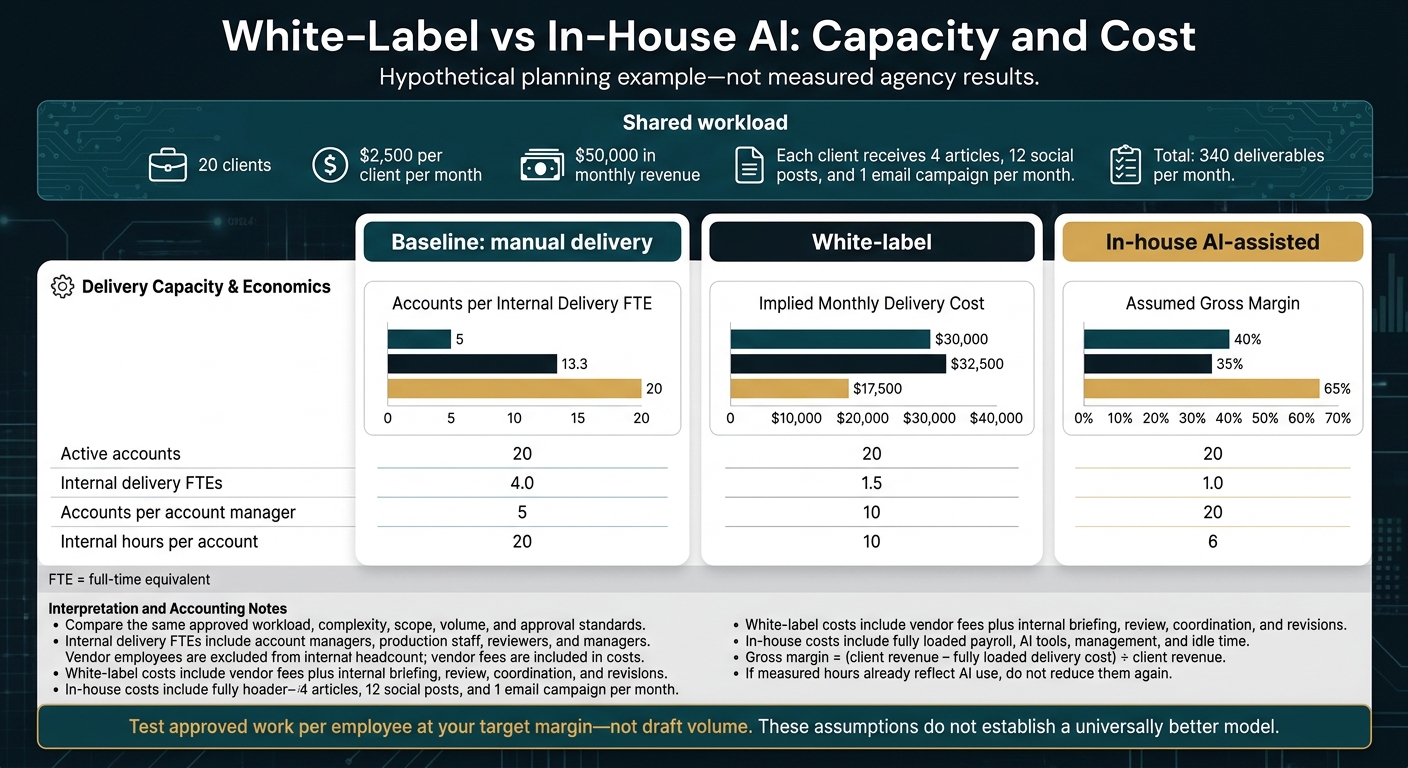
White-Label vs In-House AI: Capacity and Cost
Compare capacity and margin using the same approved workload, with complexity, scope, volume, and approval standards held constant. Count all internal delivery time, not just production, so a model looks better only when it supports more approved work at the same margin.
Include account managers, production staff, reviewers, and managers in total internal delivery full-time equivalents (FTEs). Count vendor fees as costs, but leave vendor employees out of internal headcount.
Example: Outsourced Content vs an In-House AI Team
Hypothetical planning example - not measured agency results: An agency serves 20 clients at $2,500 per month each: $50,000 in monthly revenue. Each client receives 4 articles, 12 social posts, and 1 email campaign, totaling 340 deliverables per month.
Report accounts per account manager and accounts per internal delivery FTE separately. Review and coordination affect margin, even when production takes less time.
Monthly metric Baseline: manual delivery White-label In-house AI-assisted Active accounts 20 20 20 Internal delivery FTEs 4.0 1.5 1.0 Accounts per account manager 5 10 20 Accounts per internal delivery FTE 5 13.3 20 Internal hours per account 20 10 6 Assumed gross margin 40% 35% 65% Implied monthly delivery cost $30,000 $32,500 $17,500
These are planning assumptions, not measured results. For white-label work, add vendor fees to internal briefing, review, coordination, and revision costs.
For in-house work, include fully loaded payroll, AI content creation tools, management, and idle time. Then check whether AI adds capacity or just moves work from production to review.
Calculate Capacity Without Counting AI Gains Twice
Lost context can turn saved production time into rework. Count the full workload once, including the time spent passing client details between people and tools.
Calculate accounts per delivery employee as:
Available monthly delivery hours ÷ measured monthly internal hours per account
Include production, coordination, review, and rework in those hours. Calculate account manager capacity separately, using account manager hours alone.
If measured hours already reflect AI use, do not cut them again. If you start with pre-AI estimates, reduce production hours only once. Then add the oversight work that remains. Less production time does not mean reviewers can approve more work.
Gross margin = (client revenue − fully loaded delivery cost) ÷ client revenue. Delivery cost includes vendor fees, internal labor, tools, and rework [1].
Track active accounts, on-time approvals, revision hours, coordination hours, approval time, missed deadlines, escalations, and quality.
Choose a Model and Test Its Capacity
Choose white-label, in-house AI-assisted, or hybrid delivery by service, then test whether it produces more approved work per employee at your target margin. The model alone does not set capacity: the test is whether each person or partner has the client context needed to deliver work that passes review.
Match Delivery to Demand and Client Context
Choose by service, not agency-wide. Use the capacity and margin numbers from the previous section to pick which model to test first. Then test it on 1 deliverable.
| Decision factor | White-label | In-house AI-assisted | Hybrid |
|---|---|---|---|
| Demand stability | Variable or occasional work | Steady volume that supports payroll | Recurring work plus peaks |
| Urgency | Adds capacity once partner readiness is checked | Existing team has room; new hires need ramp time | Outside overflow supports internal delivery |
| Specialist needs | Occasional skills outside your core services | Skills central to your services | Outside specialists support an internal lead |
| Client context needed | Work can follow a complete brief | Work needs deep client knowledge | Strategy and final approval stay internal; clearly scoped production goes outside |
| Unit cost at current volume | Vendor fee plus oversight fits target margin | Revenue covers payroll, tools, and review | Combined cost stays below either model alone |
| Available oversight | Team can brief, manage, and review partners | Team can manage production and QA | Named internal lead coordinates both |
Outsource clearly scoped production or overflow, not accountability. If nobody can review the work, neither AI nor a partner closes the capacity gap. More output is not the same as more approved work.
Pilot 1 Service Across Several Accounts
Test 1 service across similar accounts before you expand. Measure approved work per employee at your target margin, not just how much work gets made.
Set acceptance rules, exclusions, and agency pass/fail thresholds before the test starts. Track accounts and approved deliverables per internal employee, cost per approved deliverable, revision rate, approval time, gross margin, and utilization.
Agile Growth Labs (AGL) uses Portable Delivery Intelligence to keep client context attached to delivery work. Keep intake fields, QA notes, and approval records with that work so the next person does not have to piece them together.
Use 1 internal approval step before anything goes to the client.
Conclusion: Choose Approved Work at Your Target Margin
Choose white-label for flexible capacity, in-house for client knowledge and direct control, or hybrid for both. Expand only when the pilot shows more approved work per employee at your target margin, with approval control intact.
FAQs
When does in-house AI delivery become cheaper than white-label?
In-house AI delivery costs less when steady, high-volume work keeps your team and systems busy, with strong quality checks and no added strain on senior staff. White-labeling carries less risk when demand shifts, work calls for special skills, or you need to start fast without hiring.
The choice turns on steady demand, not just AI costs. An in-house team needs enough work to cover staff and system costs. White-labeling avoids that fixed cost when demand is less certain.
Portable Delivery Intelligence is a system that gives teams shared client context and repeatable delivery steps. Agile Growth Labs (AGL) uses it to standardize in-house work and move routine tasks to systems, so the same team can serve more accounts without relying on outside vendors.
How can we share client context without exposing sensitive data?
Keep client knowledge in systems you control, not just with staff or outside vendors. Portable Delivery Intelligence puts each client’s strategy, rules, priorities, and approvals in 1 place your team and AI tools can read.
Sensitive data stays under your control, and context stays tied to the work. New hires and white-label partners can use that context without repeated briefings or access to unsecured outside systems.
How long should we pilot a delivery model before scaling?
Test the delivery model for at least 1 quarter. Start with 1 high-volume, low-risk service line, not your whole client roster. Run a full production cycle and track actual task time. Tasks often take longer than planned.
Before you scale, put a written scorecard in place and check that the test workspace works as intended. Confirm that the model keeps quality steady without depending on 1 person no one else can replace.