The Agency Operating Layer: Templates + AI + Human Approvals

The Agency Operating Layer: Templates + AI + Human Approvals
Most agencies do not hit a people limit first. They hit a process limit first.
I see the fix as simple: put client work on 1 system with templates, AI drafts, and human sign-off. That is how AGL uses Tango to run many marketing departments with a small team. The rule stays the same: humans decide, machines repeat, nothing ships without approval.
Here’s the lesson in plain terms:
- Templates set the starting point
- AI handles repeat work in the middle
- People make the final call
- 1 approval map keeps quality tight
The payoff shows up fast. One agency cut work from 22 hours to 9 hours per client per month and made room for 4 new clients without hiring. Another cut onboarding from 3 weeks to 1 day. Teams using codified process saw 20% to 35% lower margin variance. AI-aided delivery can lift cycle time and output per FTE by 30% to 80% in 90 days.
If I run marketing for many clients, I do not need more random tools. I need 1 way of working that my team can follow every time.
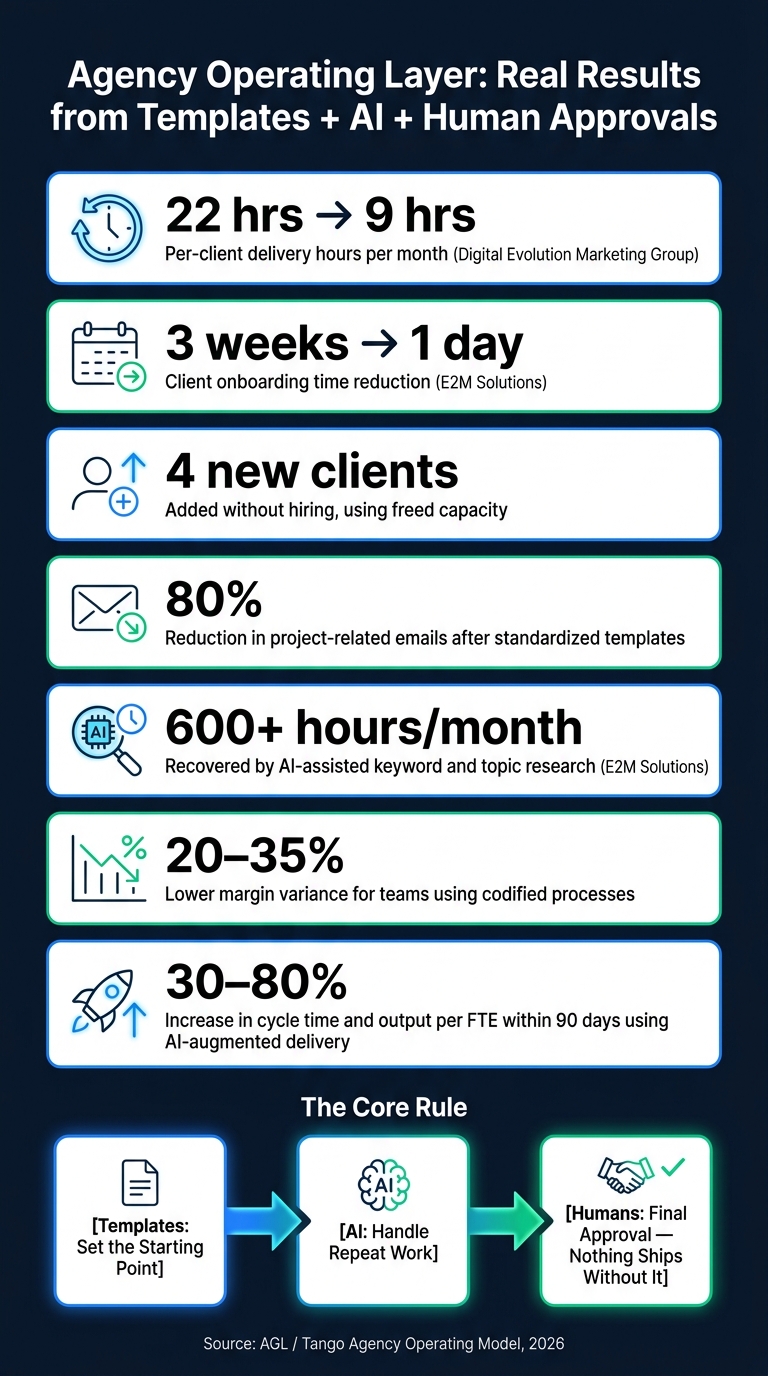
Agency Operating Layer: Key Stats & Performance Gains
The Core Building Blocks: SOPs, Templates, and Checklists
Most agencies do not slow down because the team lacks skill. They slow down because the work moves in a different way every time.
That is why the base layer is documentation. SOPs, templates, and checklists show the team how work moves from start to finish. In Tango, these docs shape what the machine drafts and what humans approve. Humans decide. Machines repeat. Nothing ships without approval.
Client Onboarding SOPs and Access Checklists
A reusable onboarding checklist takes the guesswork out of the first client window. It covers contracts, account access, workspace setup, and stakeholder roles in one place. It runs the same way every time.
That gives your team 1 source of truth for access, roles, and approvals. No digging through old emails. No loose notes. No handoff mess.
In 2026, E2M Solutions cut their project onboarding timeline from 3 weeks to 1 day by replacing email back-and-forth with a self-serve onboarding link and a standardized template library, removing roughly 80% of project-related emails from the process. [1]
The onboarding SOP also creates a shared client reference file. It stores brand voice, audience, offer details, and rejected directions. [2] That file acts like team memory. If an account manager changes, the account does not reset.
Once onboarding runs on rails, recurring delivery can run on the same logic.
Content Briefs, Campaign Frameworks, and Recurring Delivery Templates
The same rule applies to production. A content brief sets goals, audience, offer, channel rules, and brand guardrails before writing starts. That is the frame AI needs to draft without forcing the team to redo strategy in review.
Standardized briefs usually save 60 to 90 minutes per brief and cut context drift, which happens when writers or AI work without a clear frame. [2]
Campaign frameworks and recurring delivery templates do the same job at a bigger level. They define the shape of the deliverable, so your team is not rebuilding the setup each time. That is a big part of how AGL runs many marketing departments with a small team using Tango.
Strong briefs turn strategy into work that can move.
QA Checklists and Approval Criteria by Work Type
The QA checklist defines what done means. It checks assets, copy, tracking links, naming rules, and brand standards against a fixed set of checks. Without that, review turns into opinion. Then everything slows down.
One simple model is the 3-Gate Protocol: a Brand Voice Gate, a Claim Gate, and an Offer Gate. [2] Each gate gives the reviewer a clear task.
- Brand Voice Gate: Does this match approved samples?
- Claim Gate: Are all numbers and stats verified?
- Offer Gate: Is the pricing and CTA correct?
This is how Tango keeps output moving without letting quality slip. The machine can draft. The human still makes the call.
| Asset Type | Speed Gain | Error Reduction | Flexibility | Key Handoff Checkpoint |
|---|---|---|---|---|
| Onboarding Checklist | High | High | Low | Client reference file sign-off |
| Content Brief Template | Medium | Medium | High | Strategist approval of AI-drafted brief |
| QA Checklist | Low | Very High | Medium | 3-Gate Protocol |
That review gate is the point of control. It is also the part that helps agencies deliver more, keep quality tight, and support higher retainers without adding an AI stack to babysit.
sbb-itb-9cd970b
Where AI Fits Inside the Operating Layer
Here’s the shift most agencies miss: AI does not run the work. It runs the middle of the work.
Once your SOPs and checklists set the path, AI can take the drafting and routing steps. That’s where it fits best. It handles repeat tasks in production. Humans keep final approval. In practice, drafting, synthesis, and reporting move to AI first.
This is the core of the Tango system at AGL. Humans decide. Machines repeat. Nothing ships without approval. That’s how a small team can run many marketing departments without building an AI stack they have to babysit.
AI for First Drafts, Revisions, and Reporting Support
Give AI a clear brief, brand voice rules, and a client reference file, and it can turn out a solid first pass. That includes copy, outlines, summaries, and report drafts. Then your team can spend more time on strategy, voice, and nuance.
That shift is not small. It changes who does what all day.
Digital Evolution Marketing Group cut per-client delivery hours from 22 to 9 by using AI for research and first drafts while humans kept strategy and claim checks. [2]
That is the lesson. Use AI before the final pass, not after it.
And don’t box it into social posts. Use AI for performance narratives, internal docs, and reports too. That keeps your people on the work that protects the account.
AI also helps with the flow of work, not just the content.
AI for Project Coordination and Workflow Visibility
A lot of agency drag comes from chasing updates, sorting tasks, and figuring out what happens next. AI can help there too.
It can sum up project status, suggest next tasks, and prep reporting summaries. The result is a cleaner view of what needs attention next.
E2M Solutions used AI to ingest seed keywords, rank topic ideas, and send writers a shortlist, recovering 600+ hours per month. [1] Human effort moved from low-value research to strategic writing and topic selection.
That is how Tango works in practice. The machine handles sorting and routing. The team steps in where judgment matters.
What AI Should Never Approve on Its Own
This is where the rules matter most. AI should not get final say on work that can hurt the client if it is wrong.
A simple way to run this is with 3 lanes:
- Green: AI executes alone
- Yellow: AI drafts, human reviews
- Red: human only
Client-facing claims, brand-sensitive messaging, budget-impacting changes, regulated content, and final QA sign-off belong in the Red lane. [2][6]
| Use Case | Automation Level | Required Human Oversight |
|---|---|---|
| AI-Assisted Drafting | High (Batch generation of copy, outlines, and social posts) | High: Editorial review for brand voice, strategy, and human taste. |
| Workflow Automation | High (Brief intake, research aggregation, and data routing) | Medium: System design, periodic audits of automation logic, and circuit breaker monitoring. |
| AI-Enhanced Project Management | Medium (Summarizing status, suggesting next tasks, and reporting) | High: Strategic interpretation of data and client relationship management. |
The pattern stays the same across all 3. AI moves more work through the system. Humans stay at the decision points that carry weight.
That is why AGL uses Tango this way. More output. Less admin drag. Stronger delivery. No messy AI stack to manage.
If you want the upside, start with 1 move: put drafts and routing into AI, then keep approval with your team.
Human Approval Workflows That Protect Quality and Client Trust
Here’s the shift. AI does not protect your client work. Your approval system does.
At AGL, the win is not just more output with a small team. The win is control. That is the point of Tango. Humans decide. Machines repeat. Nothing ships without approval.
Once AI drafts the work, approval rules decide what goes out. Human approval is the last gate in the operating layer. It catches errors before client delivery. Use the same rules in your templates, QA checklists, and client portal so reviews stay steady.
Internal Review Before Anything Reaches the Client
The best internal review flow has humans review decisions, not chores.
That only works when the review rules live inside the template. Think of 3 core files:
- Brand Voice Library
- Proof Library with approved claims and evidence
- Taste File for each client with 5 approved and 5 blocked examples
This keeps QA steady. It also cuts out random opinion.
A simple internal review setup uses 4 levels based on risk:
- Tier 1 – Account Manager: Routine social posts. Check facts and brand voice.
- Tier 2 – Senior Account Director: Monthly reports. Check framing and the accuracy of recommendations.
- Tier 3 – Creative Director: Ad copy and campaign concepts. Check quality and voice.
- Tier 4 – Managing Director: Crisis communications and major strategy docs. Full team sign-off. [3]
This is how AGL runs many marketing departments with a small team. Tango handles repeat work. The team steps in where judgment matters.
Client Approvals, Escalation Rules, and Compliance Checkpoints
Not every deliverable needs client sign-off.
But some always do. Write those rules down before the project starts.
Campaign concepts, final ad copy, and any content tied to pricing, calls to action, legal claims, or regulated topics need clear written approval. Store approved work and revision history in a client portal so every change has a time stamp. That record helps account teams move fast without losing control. [5][4]
For healthcare, finance, and legal, add a compliance check before anything goes to the client. One named reviewer should check claims against a pre-approved proof library. Teams that run codified ops like this see 20% to 35% lower margin variance than teams using ad-hoc process. [4]
Set 3 issue levels and give each one a fixed response window:
- L1: Routine QA misses
- L2: Material factual errors
- L3: Crisis issues [4]
Once the team knows the tiers, they stop guessing.
Manual vs. Semi-Automated Approvals: When to Use Each
After you set who approves what, choose how much of that review AI can help with.
The choice comes down to 2 things: risk and volume.
High-stakes, low-volume work should stay manual. That includes new business proposals, crisis communications, and brand-new client concepts. A person needs to make the call. Speed comes second.
High-volume, lower-risk work is where semi-automated approval helps most. AI flags issues, routes the deliverable, and shows a summary. Then a human checks the flag and signs off. The human stays at the decision point.
| Approval Type | Speed | Risk Control | Visibility | Best Use Case |
|---|---|---|---|---|
| Manual Approval | Slow | High | Low | High-stakes strategy, crisis comms, new business proposals |
| Semi-Automated (AI-Assisted) | Fast | Medium-High | High | High-volume content, SEO briefs, routine reporting |
| Automated Routing with Human Sign-off | Medium | Very High | Very High | Regulated industries, legal claims, final client delivery |
A good rule is simple. Run AI outputs through senior review for 30 days. Then move clean output types to sampled review.
That’s the lesson. Do not automate the final call. Automate the path to the final call.
If you want the AGL model in your agency, start with 1 approval map inside Tango and make every client-facing asset follow it.
How to Build the System: A Practical Rollout Plan
Most agencies do not need more tools. They need one way of working that holds up across many clients.
That is the shift. When the process lives in the system, the owner stops being the system. That is how AGL runs many marketing departments with a small team using Tango. Humans decide. Machines repeat. Nothing ships without approval.
Start with One High-Volume Service and Document the Current Workflow
Do not standardize everything at once.
Start with 1 high-volume service you do again and again. That could be content production, reporting, SEO landing pages, lifecycle email, or social content. Pick the line with the most reps. Then map what happens right now, not what you wish happened.
Go pull the work from the places where it lives today:
- Slack threads
- Email chains
- Scattered files
Count the real revision rounds. Track turnaround time. Mark the spots where handoffs stall. Note where quality slips.
AI tools speed tasks; AI systems redesign the workflow. [1]
That line matters. If you only add AI on top of a messy process, you just get messy work at a faster pace.
In June 2026, E2M Solutions replaced 16 days of email back-and-forth with a self-serve intake form and AI-populated templates. Project start time dropped from 3 weeks to 1 day. [1] That did not start with magic. It started with the real workflow on paper, then a better system built from it.
Once the workflow is mapped, turn the repeatable parts into templates.
Layer In AI and Approvals Without Adding Complexity
Keep 1 rule all the way through: AI drafts. Humans approve.
After the workflow is mapped, build it in stages. Start with templates for the outputs you make every time. That usually means the brief, the draft, the QA checklist, and the client-ready file.
When those are stable, add AI where it saves time. Good early uses include first drafts, performance summaries, and QA flags. Then add approval routing so the right person reviews the right thing at the right step.
The point is simple. Use human review for decisions and fit. Do not waste senior time on every tiny step.
AGL uses Tango to plan work, assign it, and ship it with human approval. That is the system. In May 2026, Digital Evolution Marketing Group used a similar model on a $5,000/month retainer and cut the owner's monthly delivery hours from 22 to 9 while keeping the same service level. [2]
If quality drops when you step away, the system still runs on you.
Conclusion: What a Repeatable Agency Operating Layer Improves
The agency operating layer is not a software buy. It is a choice about how work gets done.
Templates create consistency. AI removes low-value bottlenecks. Human approvals protect the judgment clients pay for.
That structure changes the numbers. AI-augmented delivery models can push cycle time and output volume per FTE up by 30% to 80% within 90 days. [5]
The bigger gain is what this does to the agency itself. When the process lives in the system, work is easier to hand off. It is easier to scale. It is worth more if you ever sell it.
That is the lesson. Build 1 repeatable operating layer first.
If you want that kind of output without adding an AI stack to babysit, look at how AGL uses Tango to run many marketing departments with a small team.
FAQs
What is an agency operating layer?
An agency starts to change when client work stops living in random docs, Slack threads, and one person’s memory.
An agency operating layer is a set way to deliver work. It replaces loose, manual steps with a repeatable system that uses AI for the repeat work and people for the calls that matter.
At AGL, that system is Tango.
It brings together reusable templates, clear inputs, automated execution, and human approval checks in one flow. Humans decide. Machines repeat. Nothing ships without approval.
That matters when you run marketing for many clients at once. You need output that stays on brand, stays on track, and does not depend on one hero on your team having a good day.
By keeping client context in one place, an agency operating layer helps your team do steady, high-quality work, cut bottlenecks, and stop relying on memory and manual handoffs.
How do I choose what AI should handle?
You do not need AI in every part of the agency.
The win comes when you put it in the right places first.
Start with work that repeats. Start with work clients never see. Think data processing, first-pass research, and template-based drafts. That is how AGL runs many marketing departments with a small team using Tango. Humans decide. Machines repeat. Nothing ships without approval.
A simple way to do this is with an autonomy table:
- Green: AI acts on its own
- Yellow: AI drafts, then a human checks it
- Red: A human must approve before anything moves
This keeps the line clear. It also stops the mess that happens when no one knows who owns what.
Pick tasks that happen often, take a lot of time, and end in a clear output. If the task is fuzzy, high-stakes, or tied to client judgment, keep a person in charge. Always keep a human owner on the task for quality and judgment.
That is the lesson. Do not start with flashy use cases. Start with repeat work you can box in. That is how Tango helps AGL produce more without adding an AI stack to babysit.
Now do 1 thing. List 10 repeat tasks in your agency. Mark each one Green, Yellow, or Red.
Where should human approvals stay manual?
Human approvals stay manual when the work calls for judgment.
That sounds simple. But it changes how you run an agency.
At AGL, the rule is clear in Tango. Machines do the repeat work. Humans make the call. And nothing ships without approval.
That matters most in a few places.
- Interpreting data in the context of a client’s situation
- Judging brand-level creative taste that goes past the brief
- Checking facts and product details
- Handling sensitive actions like spending money, making client commitments, or sorting out complex conflict issues
This is the lesson: automation can move the work forward, but it should not make the final call when risk is on the table.
That’s how AGL runs many marketing departments with a small team. Tango keeps the flow moving. The team steps in where taste, context, and risk matter most.