What an AI Operator Actually Does All Day (Hour by Hour)

What an AI Operator Actually Does All Day (Hour by Hour)
An AI Operator keeps AI work from breaking, drifting, or wasting pipeline. In a B2B SaaS team, this person checks system health in the morning, fixes prompts and automations in the middle of the day, and ends by handling edge cases, reporting, and runbooks.
Here’s the short version:
- 8:00 AM–11:00 AM: I check alerts, review AI drafts, spot CRM sync issues, and run small eval tests.
- 11:00 AM–3:00 PM: I fix prompts, webhooks, lead routing, field mapping, and form-to-CRM flows.
- 3:00 PM–5:00 PM: I handle exceptions, log root causes, send daily numbers, and update runbooks.
- The goal is simple: keep output quality high, handoffs clean, and revenue workflows live.
A few numbers show why this job matters:
- Teams can shift 60% to 80% of execution hours to agent systems with one owner in place.
- Some AI-led routing flows process leads in about 2 minutes.
- A $15 token workflow can replace about 4 hours of manual work, or roughly $200 in labor.
- This role tends to fit best at $10 million to $100 million ARR, when the stack is big enough to fail often and small enough for every miss to hurt.
If I had to sum up the job in one line, I’d say this: I don’t just run AI tools - I make sure the team can rely on them tomorrow.
What an AI Operator does
An AI Operator owns the agent stack: AI tools, prompts, automations, and integrations that carry out sales, lead generation, and marketing automation work. The role is on the hook for output quality, governance, escalation, and iteration. As David Schoenfeld, Founder of COSEOM, puts it:
"The AI Agent Operator runs the system that executes marketing work, not the team that does it." [1]
A lot of this job comes down to judgment. The operator builds workflows, decides what should be automated, reviews outputs, and steps in when risk shows up. That ownership becomes clear in the day-to-day work.
Core responsibilities across tools and teams
On a normal day, the operator checks the quality of LLM outputs, makes sure Zapier automations are firing as expected, and confirms that HubSpot and Salesforce records are syncing cleanly. Lead-routing logic also needs regular review. If a high-intent lead lands in the wrong sequence or disappears from the CRM, the operator tracks down the issue and fixes it [3][4].
The role also manages a governance layer. That includes brand voice files, approval matrices that spell out which outputs need human review, and redline policies for decisions agents can never make on their own, such as pricing claims [2]. This isn't some side process. It's part of daily monitoring.
When research turns into a booked meeting, the operator makes sure the AE gets the right summary and context [7]. In plain terms, the operator keeps the system moving and makes sure handoffs don't fall apart.
What leaders should expect this role to deliver
None of those tasks matter much unless they lead to business results. Leaders should expect clear outcomes: high-priority leads routed to senior reps in under 90 seconds, manual CRM updates automated, and reporting moved from spreadsheets into dashboards that track hours saved, cost, and quality [2][9].
In a typical $20 million ARR B2B SaaS marketing team, 60% to 80% of execution hours - including bid adjustments, reporting, and lead routing - can be handled by an agent system managed by one operator [1].
The clearest sign that this role is working is simple: can the team run the system without constant intervention? If everything falls apart the minute the operator steps away, then the role has created dependency, not capability [2]. Those expectations shape the workday that follows.
sbb-itb-9cd970b
Hour by hour: how a typical workday is structured
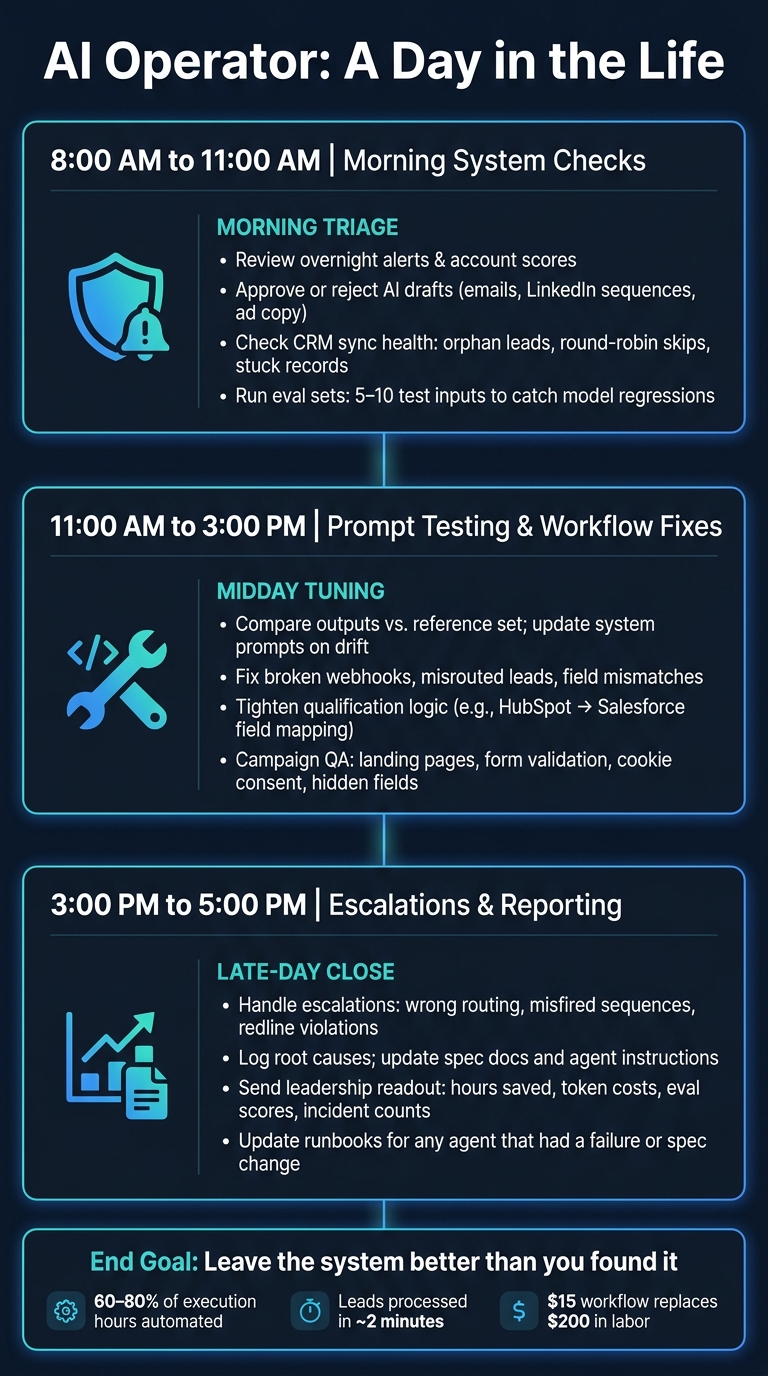
AI Operator Daily Schedule: Hour-by-Hour Breakdown
The day runs on a set rhythm: morning triage, midday tuning, and late-day reporting.
8:00 AM–11:00 AM: Morning system checks and overnight issue review
The first three hours are all about damage control and picking priorities. The operator starts by checking overnight alerts and account scores to confirm fit for your ideal customer profile and sort the day's outreach queue. They also look for performance changes against the baseline so odd patterns show up early [10].
Then they move to the approval queue for AI drafts. That includes outbound emails, LinkedIn sequences, and ad copy, all reviewed before anything goes live [10]. If a draft fits the brief, it gets approved. If not, it gets rejected or rewritten.
From there, attention turns to sync health. The operator checks for orphan leads, round-robin skips in the CRM, and records stuck between systems [4]. These quiet failures are easy to miss, which is why a manual daily check still matters. The morning block ends with a quick run of eval sets - 5 to 10 test inputs with expected outputs - to make sure recent model updates haven't caused quality regressions [2].
Once the overnight queue is under control, the operator shifts into prompt and workflow fixes.
11:00 AM–3:00 PM: Prompt testing, workflow fixes, and tool orchestration
This is the main technical block of the day. Prompt testing takes up most of it. The operator compares recent outputs with a reference set, then updates the system prompt when the language starts to drift [6]. Each prompt version gets a timestamp, which gives the team a clean rollback path if something goes wrong.
A lot of this window also goes to fixing broken webhooks, misrouted leads, field mismatches, and duplicate-lead reconcilers [5][6]. Qualification logic gets tightened too, so agents don't score low-intent contacts as high priority. Say HubSpot sends "Other" as a job title value, but Salesforce only accepts "Director." The operator builds the workaround that keeps data moving instead of letting the process stall [5].
Tool orchestration also includes campaign QA. The operator runs landing page traffic tests, checks form validation, reviews hidden fields, and confirms the cookie consent flow [5]. Something as small as a broken JavaScript listener on a form can quietly stop leads from ever reaching the CRM.
By midafternoon, the work shifts from building and patching to handling exceptions, reporting, and keeping docs up to date.
3:00 PM–5:00 PM: Escalations, reporting, and process documentation
The last block is reserved for escalations, reporting, and process updates. This is when sales or marketing flags edge cases - maybe an agent routed a lead to the wrong place, a sequence fired at the wrong time, or an output crossed a redline policy. The operator logs the root cause, updates the related spec doc or agent instructions, and closes the loop with the team [2][8].
Leadership gets a daily readout with hours saved, token costs, eval scores, incident counts, and output volume.
The final task is documentation. The operator updates runbooks for any agent that had a failure or a spec change, making sure the recovery steps are clear enough for someone else to step in and restore the workflow [2]. As David Schoenfeld puts it:
"The deliverable isn't the agents. The deliverable is the team's ability to run them." - David Schoenfeld, AI Agent Operator [2]
How this role creates measurable business impact
Where AI Operators affect revenue and efficiency
Those daily checks and fixes lead to faster revenue movement and lower operating cost. The work is tactical. The result shows up in revenue and efficiency.
The morning routing checks, webhook fixes, and eval runs mentioned earlier feed straight into pipeline metrics. When operators keep inbound bots and routing logic in good shape, leads can be processed in as little as two minutes, and stalled or risky accounts can be flagged before they drag down conversion rates [3]. That day-to-day work leads to faster response times, fewer broken syncs, and cleaner handoffs. Clean fields also make the next workflow easier to launch, and every prompt version with a timestamp gives the team a rollback path instead of a crisis [3][6].
In June 2026, Verkada used GTM AI engineers to automate roughly 80% of their SDR workflows, which helped reps book 80 to 100 meetings per month - about 4x their previous volume [6]. That kind of output depends on keeping the system steady.
On the cost side, the math is simple. A weekly competitive intelligence workflow that replaces four hours of analyst time - worth about $200 - runs for around $15 in token spend. That works out to a 40-to-1 return, and it repeats every week [2].
Once those gains are no longer being watched by one clear owner, the function stops feeling like a nice-to-have and starts looking like a gap.
When to hire or assign this function
Bring in this role when you have multiple AI workflows live and no one owns output quality.
The signs are usually hard to miss. Recurring CRM cleanup, misrouted leads, AI-driven lead scoring issues, and off-brand copy often point to the same problem: no one is accountable for what the system produces [8]. If a founder is spending 8 to 15 hours a week on manual work like lead sourcing or data hygiene, that’s time an operator and a well-built agent system should be taking off their plate [8].
This role tends to make the most financial sense at the Series B to growth stage ($10M–$100M ARR). That’s when the stack is complex enough to break, but the team is still lean enough to feel every failure [1][2]. Fractional engagements usually cost $30,000–$70,000 for a 90-day setup, and monthly retainers for continued operations range from $4,000 to $15,000 [2][3]. At that point, the role is no longer optional.
Conclusion: What an AI Operator actually delivers by end of day
By 5:00 PM, after the checks, fixes, escalations, and documentation, the operator should leave the system in better shape than they found it. In plain terms, that means updated runbooks, versioned prompts, verified integrations, and a dashboard that shows SaaS metrics like revenue, queue status, risks, and pipeline.
That matters because this role is about ownership, not random patchwork. AI only works when one person is accountable. Without that owner, workflows drift, output starts to slip, and failures can sit there unnoticed. The operator keeps prompts, workflows, and handoffs working without constant supervision. Every workflow has an owner, every change gets tested, and every failure gets logged.
Those day-to-day controls don’t stay buried in the back office. They show up in revenue. For example, Trackxi achieved 4x more trials at 51% lower cost by using an AI Operator to manage PQL signal triage and operator-approved messaging [10]. That kind of result comes from tighter oversight.
The role turns AI from scattered tests into a repeatable operating layer. The real output of the day is simple: a system the team can trust tomorrow.
FAQs
How is an AI Operator different from an AI engineer?
An AI engineer builds and maintains the underlying AI models, infrastructure, and software systems. Their focus is technical reliability and model accuracy.
An AI Operator plays a different role. It’s a business-focused job.
Instead of training models or managing infrastructure, they design, deploy, and govern workflows with existing AI tools. And their accountability is tied to business results, like sales conversions and pipeline growth.
What tools does an AI Operator use most often?
AI Operators usually work with workflow automation tools like Clay, n8n, Make, and Zapier, knowledge management tools like Notion, and CRM systems such as HubSpot or Salesforce.
They also spend time in Claude Code and on platforms like Gong. The job is to connect these tools, pass context from one system to another, and make the whole setup work like a single system.
When should a SaaS company hire an AI Operator?
A SaaS company should hire an AI Operator when it starts moving beyond test runs and small AI pilots into a production-grade setup that handles recurring, high-volume go-to-market work.
At that point, AI usually stops being “just another tool” and starts becoming part of the day-to-day engine. That shift changes the job. Someone needs to keep the system on track, connect the moving parts, and make sure the output doesn’t drift.
Some common signs show up fast:
- Disconnected AI tools
- Automated workflows that need oversight
- Human-in-the-loop prompt work and conversion tuning on a regular basis
- More complex coordination across CRM, AI orchestration, and go-to-market strategy
In plain English, this is the stage where AI work is no longer a side project. It’s part ops, part judgment, and part system management.