Stop Hiring. Start Operating. The Math on Replacing a $180,000 Hire.

Stop Hiring. Start Operating. The Math on Replacing a $180,000 Hire.
A $180,000 hire can cost far more than $180,000. From what I see in this article, the full year-one cost often lands around $225,000 to $324,000, while a managed AI + SaaS setup may cost a small slice of that and start working in days or weeks, not months.
If I boil it down, the article makes one main point: I should hire people for judgment-heavy work and use systems for repeatable work. That means looking at loaded cost, ramp time, output, turnover risk, and task type before I open a new role.
Here’s the full takeaway in plain English:
- A $180,000 salary is not the full cost. Taxes, benefits, software, recruiting, onboarding, and manager time push the number up fast.
- Ramp time hurts output. Many sales hires need 3 to 7 months before they perform at full level.
- An AI tool stack is often much cheaper. The article puts lean software costs at about $300 to $800 per month, with setup and support adding more.
- The gap gets big over time. The 3-year example shows about $786,643 for a hire versus $127,000 for a managed stack.
- Tools fit repeatable tasks. Lead enrichment, CRM updates, scheduling, follow-ups, summaries, and reporting are common fits.
- People still matter for judgment. Negotiation, hard customer cases, pricing calls, and partner work still need human input.
- The best test is task-based, not title-based. If about 70%+ of the work is repeatable and high-volume, a system may be the better move.
- Documentation comes first. If I can’t write the SOP, I’m not ready to hire or automate.
Quick Comparison
| Factor | $180,000 Hire | AI + SaaS Stack |
|---|---|---|
| Year 1 cost | $225,000–$324,000 | Lower upfront total, depending on setup and support |
| 3-year cost | ~$786,643 | ~$127,000 |
| Ramp time | 3–6+ months | 1–2 weeks |
| Best for | Judgment, trust, exceptions | Repetitive, high-volume work |
| Risk | Turnover, bad hire cost, slow ramp | Setup risk, edge-case limits |
| Scale | Add more payroll | Add tools, flows, and API spend |
My read: this is not an anti-hiring piece. It’s a cost-vs-output piece. Before I hire, I should ask a simple question: do I need a person, or do I need the work done?
The math: $180,000 employee versus an AI and SaaS operating stack
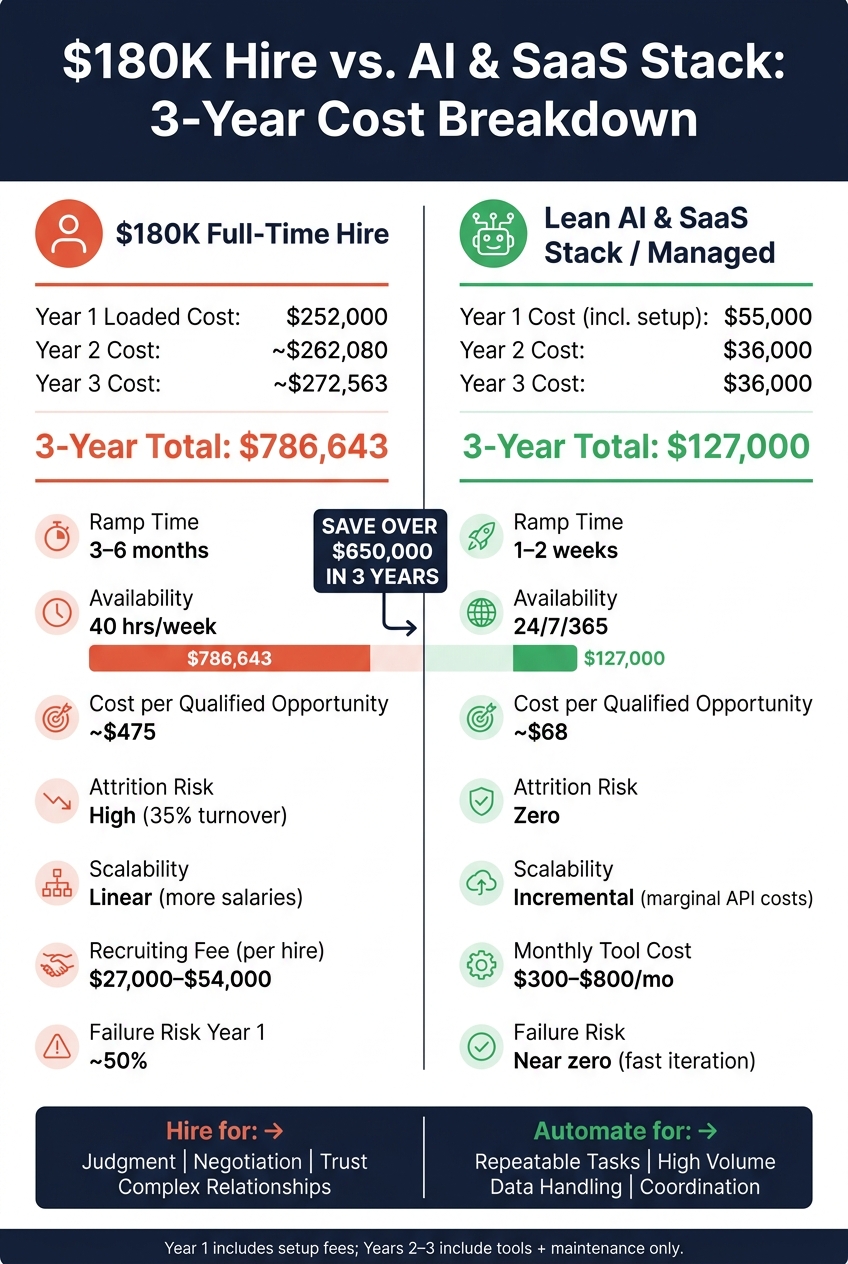
$180K Hire vs. AI & SaaS Stack: 3-Year Cost Breakdown
What a $180,000 U.S. hire really costs
Once you stop thinking in terms of headcount and start thinking in terms of output, the math changes fast.
A $180,000 salary does not stay at $180,000. In most cases, it lands closer to $252,000 to $324,000 per year after payroll taxes, benefits, recruiting, equipment, software, and management time are added in[4][8]. That’s the number that matters, especially when you consider how AI systems can reduce acquisition costs by over 60%.
And there’s another piece people often miss: ramp time. In the first year, a new hire usually takes a few months to get up to speed, which means you’re paying full cost before you’re getting full output[8].
What a lean operating stack costs per month and per year
In many cases, that same output can come from a much leaner setup.
A stack for lead gen, sales, and workflow automation might include Apollo, Clay, ChatGPT or Claude, Zapier or n8n, and HubSpot or Notion. That kind of setup usually costs about $300 to $800 per month[5][4], or around $3,600 to $9,600 per year[5].
If you want it set up the right way from day one, professional implementation usually adds a one-time fee of $15,000 to $50,000[2]. After that, monthly maintenance retainers often fall in the $2,500 to $4,000 range[8][10].
Comparison table: 3-year total cost, ramp time, and cost per output
This is where the gap gets hard to ignore. Over three years, the cost difference is big enough to change how a company operates.
| Factor | $180K Full-Time Hire | Lean AI & SaaS Stack (Managed) |
|---|---|---|
| Year 1 Loaded Cost | $252,000[4][8] | $55,000 |
| Year 2 Cost | ~$262,080 | $36,000 |
| Year 3 Cost | ~$272,563 | $36,000 |
| 3-Year Total | $786,643 | $127,000 |
| Ramp Time | 3–6 months[8][7] | 1–2 weeks[8] |
| Availability | 40 hours/week | 24/7/365[9] |
| Cost per Qualified Opportunity | ~$475[3] | ~$68[3] |
| Attrition Risk | High (35% turnover)[9] | Zero |
| Scalability | Linear (requires more salaries) | Incremental (marginal API costs)[9] |
Year 1 includes setup; Years 2 and 3 include tools plus maintenance only.
Over a three-year span, the stack keeps more than $650,000 inside the business. A managed setup that covers the same output comes in at $127,000 over that same period[8][10]. That leaves more room to spend on roles where human judgment matters most.
That price gap is a big reason some jobs make more sense to automate before a company hires for them.
sbb-itb-9cd970b
What tools can replace and what still needs people
The next question isn't whether tools cost less. It's which jobs they can safely take over.
That gap in cost only lasts when tools handle repeatable work, not relationship-heavy work. Automate the wrong things, and the savings vanish fast.
Functions tools can partially or fully absorb
The best fit for automation is routine coordination work. These are the high-frequency, low-judgment tasks that eat up most of an SDR's or RevOps coordinator's day. Think lead enrichment, CRM updates, scheduling, lead follow-up, and internal documentation.
What used to take 8 to 15 hours per 100 accounts can now run in 15 to 45 minutes with AI workflows [1].
A simple rule helps here: if tools can reliably cover 70% of a role's repeatable work, automation usually wins [4]. For SDR and BDR work, AI coverage lands at about 60% to 75% of total task volume [1]. For marketing operations and sales support, the overlap is also high [5][1][6].
Functions where human talent still drives the outcome
People still matter most when the work depends on trust, timing, and judgment. Enterprise negotiation, executive sponsorship, pricing, partnerships, and crisis response still belong with humans. AI can handle scale. It can't step into a high-stakes conversation and read the room the way a person can.
Klarna saw this firsthand. In February 2024, its OpenAI-powered assistant handled 2.3 million chats in 30 days. Then, by early 2026, the company moved back to a hybrid model after customer satisfaction fell on more complex interactions [11].
The tool managed volume. It didn't manage nuance when the moment called for human judgment.
"The goal is not fewer people. The goal is better role design: people handle judgment, tools handle volume." - Sneha Mukherjee [11]
Comparison table: replacement potential by role
Roles built around repeatable work are the easiest to replace with a managed stack. But the real call isn't about job titles. It's about tasks.
| Role | Tasks Handled by Tools | Tasks Kept by Humans | Impact on Cost & Throughput |
|---|---|---|---|
| SDR / BDR | List building, enrichment, sequencing, CRM updates, scheduling | Cold-call discovery, ICP refinement, complex replies | 60% to 75% AI coverage; removes first-year SDR attrition risk [1][5] |
| RevOps Manager | Reporting, data normalization, workflow automation, dashboard updates | GTM strategy, compensation design, data architecture | 40% to 55% AI coverage; frees senior ops time for strategic work [1] |
| Marketing Coordinator | First-draft copy, campaign scheduling, list segmentation, performance summaries | Brand judgment, creative direction, agency relationships | High task overlap; repetitive execution shifts to tools [5][6] |
| Sales Support / Admin | Follow-up reminders, meeting prep, note summarization, workflow handoffs | Escalations, exceptions, sensitive customer communications | Near-full automation on routine tasks; human needed for edge cases [4][5] |
The rule is simple: tools take volume, people take judgment. That task-level split is what the operating model will systematize next.
The operating model that cuts headcount without breaking execution
Once you know which tasks tools can take over, the next move is simple: connect those tools into one working system.
A practical stack for lead generation, sales, and internal workflows
The point isn't automation for the sake of saying you're automated. The point is getting more output at a lower cost with fewer hires.
A clean setup usually works best. Put the CRM at the center, then layer in enrichment, drafting, automation, and SOPs around it. Each tool should do ONE job well. That keeps the stack easier to run and less likely to turn into a mess.
This matters fast in outbound. AI-led outbound can contact 1,800 to 2,400 prospects per week versus 80 to 120 for a human SDR [3].
How to document handoffs, rules, and exceptions
A stack like this only holds up when every handoff and edge case is spelled out in advance. If the rules live in someone's head, things usually fall apart the minute volume goes up.
Start by documenting the basics in Notion [5]:
- ICP
- brand voice
- offer
- sequence
- banned language
- scheduling rules
Then use Zapier to connect the handoffs. For example, a new Calendly booking can automatically create a Notion entry and send a Slack notification with no manual input [6].
Some cases should NEVER go straight through automation. Messages that include "refund", "cancel", "angry", or "legal" should be flagged for human review [6][9].
Don't rush full automation. Approve all outputs for 30 days. Then move a workflow to fully automated only after it runs for a full week with no edits [5].
"You cannot delegate a function until you have personally done it well enough to write the SOP for it. Hiring before you can write the SOP is hiring a guess." - Vikas Malpani [4]
Using Most Companies Never Become Valuable as a stack planning resource
A good way to plan the stack is to map functions first, then choose AI sales tools for each part of the workflow.
Most Companies Never Become Valuable by Agile Growth Labs is a directory for SaaS and AI tools across lead generation, sales, marketing automation, content creation, and customer engagement. Founders can use it to sort tools by function, then apply the workflow logic above to connect those tools into a working operating model.
When to hire and when to operate: a decision framework
Once you’ve nailed down the stack and the workflow, the next call is pretty direct: do you hire the role or deploy the system?
Before you sign off on a senior hire, put the role through a simple filter. Compare the fully loaded cost of a full-time employee with the annual cost of a stack that can deliver the same output.
A scorecard for making the call
Before you post the job listing, score the role against three questions for the lead gen, sales, and internal workflow tasks covered above:
- Is the work mostly repeatable execution, and does it happen at high volume? If yes, automate it. As a rule, 70%+ execution and more than 500 instances per month point to a stack. Below 50 instances per month, manual work usually wins [4][12].
- Does the role require high-stakes relationship management? Strategy, judgment, emotional intelligence, and complex relationship work still need people [7][12].
- Is the process stable enough to document clearly? If you can’t write the SOP, you’re not ready to automate or hire [4].
If the role leans toward automation, run a 60- to 90-day test with a part-time operator plus the stack.
Comparison table: hire the role or deploy the stack
This table turns the choice into a direct operating decision, not a gut-level headcount debate.
| Factor | Full-Time $180K Hire | AI & SaaS Operating Stack |
|---|---|---|
| Annual Total Cost | $225,000 – $324,000 [4][12] | $3,000 – $25,000 [7] |
| Ramp Time | 90 – 180 days [7] | Days to weeks [7] |
| Failure Risk | ~50% in Year 1 [7] | Near zero (fast iteration) [7] |
| Institutional Knowledge | Leaves with the employee [13] | Encoded in the system [13] |
One number gets missed all the time: the median private-sector worker stays only 3.5 years [13].
That changes how you should think about hiring costs. The recruiting fee is usually 15% to 30% of first-year salary, which comes out to $27,000 to $54,000 for a $180,000 hire [7][12]. That’s not a one-and-done expense. It comes back every time you need to refill the seat.
A stack doesn’t resign.
Key takeaways for founders and revenue teams
The rule isn’t “hire less.” It’s hire only where judgment, trust, and complexity are the bottleneck.
Use people for judgment, negotiation, and exceptions. Use the stack for repeatable execution, data handling, and coordination. If the work is documented and repeats over and over, the stack usually wins. If the job depends on judgment and relationship management, hire.
FAQs
How do I know if a role should be automated or hired?
Map the work by frequency and judgment.
Use automation for high-frequency, low-judgment work like CRM management, lead outreach, data entry, and routine reporting. Bring in a person for high-stakes judgment, strategy, relationship management, empathy, creativity, or legal and regulatory accountability.
Before you hire, ask yourself:
- Can an agent handle 70% of the day-to-day workflow?
- Have you done the role for 90 days so you can define SOPs and edge cases?
- Will it pay for itself within 90 days?
If the role is mostly execution, automate it. If it leans on strategy, keep it human-led.
What tasks should stay with people instead of tools?
People should stay focused on work that calls for judgment, emotional awareness, and trust-based relationship management.
Tools work best on high-frequency, low-judgment tasks like data entry, scheduling, and routine reporting. People still matter most when the work gets messy or nuanced, like complex objection handling, discovery conversations, sensitive stakeholder politics, de-escalating angry customers, policy exceptions, executive oversight, creative direction, and proprietary decision-making.
What should I document before replacing a hire with a stack?
Before you swap a hire for an operating stack, do the job yourself for 90 days.
That sounds a bit old-school, but it works. You’ll spot edge cases, see where the work gets messy, and figure out what skills the role actually needs. Just as important, you can turn that hands-on work into clear SOPs instead of vague guesses.
Document things at a granular level, including:
- day-to-day functions
- your knowledge base, including ICP, voice and tone, pitch, templates, prohibited language, and scheduling preferences
- current workflows and where deals die
- human-in-the-loop approval checkpoints
This step gives you a clearer picture of the role before you hand parts of it off to systems, tools, or outside help.