The AI-Augmented Fractional Team: How 3 People Do What 12 Used To

Most agencies do not slow down because they lack talent. They slow down because too many people touch the same job.
I see the lesson like this: if you run marketing for several clients, the win is not a bigger team. The win is a smaller senior team with clear lanes, AI doing repeat work, and a human approval step on every deliverable. In the AGL model, 3 people with Tango helped do work that used to sit across 12 roles, while cutting annual team cost from about $1,200,000 to about $450,000 in the case shared.
Here’s the short version:
-
Output went up
- 4 campaigns per quarter became 10+
- 8 to 10 long-form pieces per month became 20+ targeted assets
- ~3,000 outbound emails per quarter became 12,000+
-
Turnaround got tighter
- Reporting moved from 7 to 10 business days to 24 to 48 hours
- Campaign launch time dropped from 10 to 15 business days to 2 to 5 as AI-driven ad platforms streamlined targeting and optimization.
-
The team changed
- Big in-house org became 3 senior operators
- AI handled drafts, summaries, tagging, routing, and report prep
- Humans kept strategy, client calls, and final approval
The lesson is simple: cut handoffs, not standards.
AGL runs many marketing departments with a small team using Tango. The rule stays the same every time: humans decide, machines repeat, nothing ships without approval. That is how the team puts out more work without more managers, more tool chaos, or more fixed payroll.
If you want to use this, start with 1 repeat workflow. Write it down in Tango. Assign 1 owner, 1 tool, and 1 approval point.
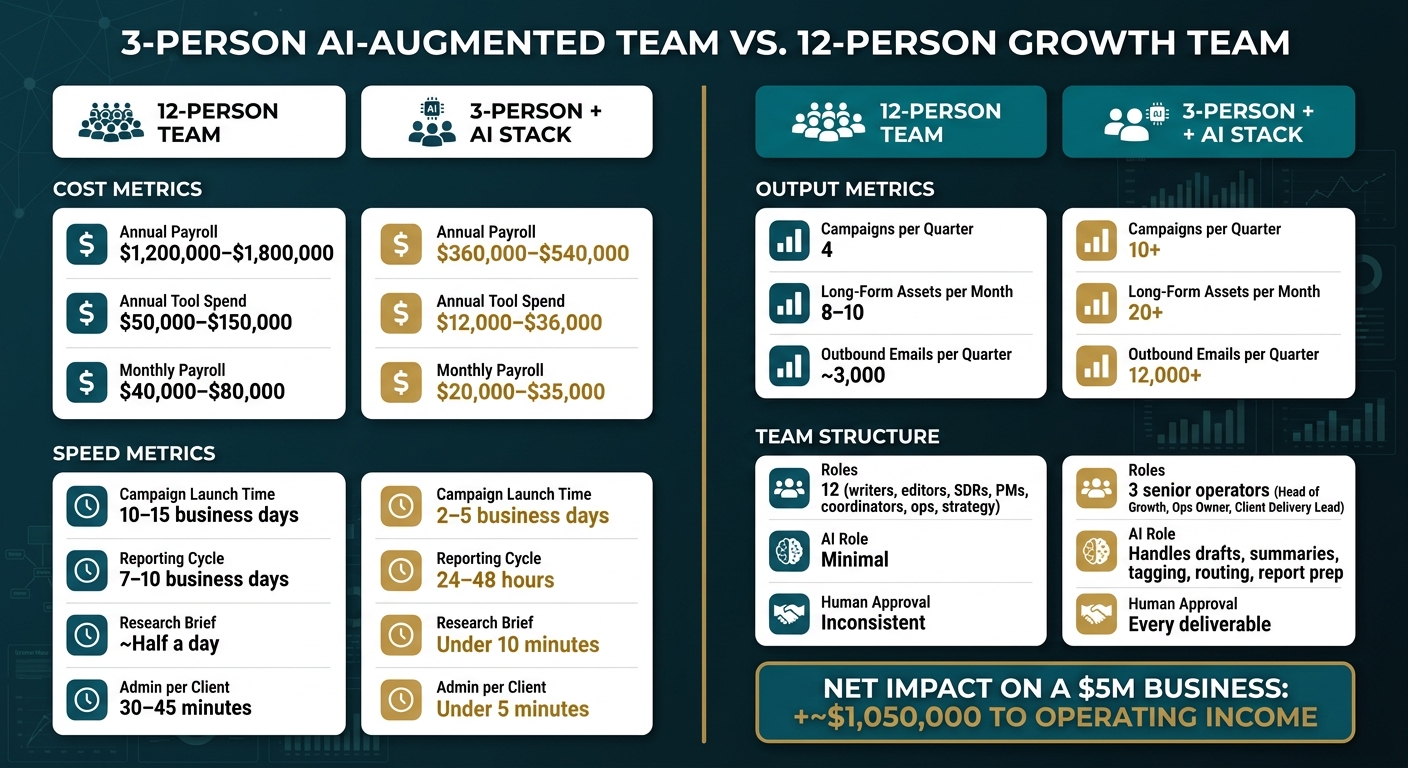
3-Person AI Team vs 12-Person Team: Cost, Speed & Output Compared
Why the 12-Person Growth Team Gets Slow and Expensive
The 12-Person Org Chart and What It Costs
Here’s the shift most agency owners miss: a bigger team does not always mean a stronger delivery engine.
A 12-person growth team often looks solid on paper. But the work is split across many roles and many handoffs. That leads to tool sprawl, context switching, and a big fixed labor bill.
The harder part is coordination. Each new hire adds more than payroll. They add meetings, checks, follow-ups, and delays. So output does not rise at the same pace as headcount. That is why EBITDA gets harder to improve even when revenue goes up [2].
At AGL, this is the exact trap Tango is built to avoid. Humans decide. Machines repeat. Nothing ships without approval. That means the team can do more work without piling on layers of management.
Where Work Slows Down Across Content, Outbound, Research, and Delivery
The slowdown shows up in the same spots again and again.
Teams spend hours on routine tasks. That includes data pulls, formatting, site crawl reviews, keyword grouping, manual data entry, and status reports. Time that should go to strategy gets burned on repeat work [2].
Research is one of the biggest drags. In the old model, a research brief can eat up half a day with manual competitor and market research. With market research platforms like CrawlQ, that same first draft can be done in under 10 minutes [1].
Reporting gets stuck too. Teams pull data from GSC and GA4, then format it into a client report by hand [2]. It is slow. It is dull. And it steals time from work the client will pay more for.
Delivery has the same problem. Manual invoicing and admin sheet updates can take 30 to 45 minutes per client in a standard setup. In AI-assisted workflows, that drops to under 5 minutes [1]. Across many clients, that gap gets big fast.
This is the lesson: the old model scales in a straight line. If you want more output, you add more people. That keeps payroll high and puts a cap on EBITDA gains even when revenue grows [2].
AGL took a different path with Tango. Small team. More output. No AI stack to babysit. Better delivery. Higher retainers.
The next section shows how 3 people split this work without losing speed.
sbb-itb-9cd970b
How AI Lets Small Teams Do Big Business | Thais Saenz
The New Model: 3 Human Roles, an AI Stack, and Clear Delegation Rules
The shift is simple. You do not need more people for every client, as AI sales tools can scale output without increasing headcount. You need clear lanes, a small set of tools, and rules on what gets done by AI and what stays with a human.
That is how AGL runs many marketing departments with a small team using Tango. Humans decide. Machines repeat. Nothing ships without approval. The lesson here is clear: speed comes from role clarity, not headcount.
What Each of the 3 People Owns
Each role has a lane. No overlap by design.
The Fractional Head of Growth owns content, outbound strategy, and KPI targets. That means positioning, channel priorities, and the high-stakes calls.
The Ops Owner owns reporting, automation, and workflow systems. That includes automations, CRM hygiene, templates, and workflow health.
The Client Delivery Lead owns delivery, client communication, and scope control. That covers client calls, deliverable reviews, scope questions, feedback translation, and escalations.
The rule is simple. Humans own decisions. AI handles execution.
Tool Stack by Function: ChatGPT, Claude, HubSpot AI, Notion AI, Zapier, Airtable, and Tango
Each tool has 1 job. That keeps the stack from turning into one more thing to manage.
| Tool | Primary Function |
|---|---|
| ChatGPT | First-draft copy, ideation, summarization, structured outputs from messy inputs |
| Claude | Long-document synthesis, rewriting large content blocks, deep analysis |
| HubSpot AI | CRM enrichment, sales email drafting, lead follow-up, pipeline support |
| Notion AI | SOP drafting, meeting summaries, internal knowledge base maintenance |
| Zapier | Cross-tool automation, trigger-based routing, repetitive handoffs |
| Airtable | Campaign tracking, content calendars, operational databases, workflow visibility |
| Tango | Captures workflows, assigns ownership, and preserves human approval |
This is the part many agencies miss. The stack should not act like a second team. It should act like a set of workers with fixed jobs. Tango is what keeps that system in line.
What AI Does vs. What Humans Review
AI handles the repeat work:
- First drafts
- Research summaries
- Lead tagging
- Task routing
- Scheduling
- Performance scoring
- Repetitive reporting
Humans handle the work that can change the client relationship. That means final editing, strategy, client-facing communication, and anything tied to brand voice, pricing, or client commitments.
That is the AGL model in plain English. A small team can put out more work because the handoffs are clear and Tango holds the approval step in place.
If you run marketing for several clients, take 1 step now: map each task to 1 owner, 1 tool, and 1 approval point inside Tango.
How 3 People Replace 12: The Before-and-After Workflows
Most agencies do not have a people problem. They have a workflow problem.
That is the big shift here. AGL does not ask 3 people to do the work of 12 by working harder. It changes the system with Tango. One person owns the work. AI handles repeat tasks. A human approves before anything ships.
Content and Outbound: From Multi-Person Production Pods to AI-Assisted Pipelines
A 12-person B2B SaaS growth team often includes writers, editors, SDRs, coordinators, ops, and strategy. The work moves through a long chain of handoffs: brief, research, draft, edit, design, upload, list build, personalization, sequence setup, and CRM updates.
That setup is slow by design. One content and outbound cycle takes 10–15 business days from brief to launch. Payroll lands at $40,000–$80,000 per month.
AGL runs the same kind of campaign with 3 people and a clear system. The result is 2–5 business days from brief to launch.
The setup is simple:
- The Fractional Head of Growth sets the angle and gives final approval.
- The Content & Research Lead uses ChatGPT or Claude for research and first drafts, then tightens the work in Notion AI.
- The Ops Owner connects HubSpot AI to the prospect list, builds personalized sequences, and uses Zapier for follow-up triggers and CRM logging.
| Dimension | Before: 12-Person Team | After: 3-Person AI-Augmented Team |
|---|---|---|
| Team size | 12 | 3 |
| Avg. turnaround | 10–15 business days | 2–5 business days |
| Monthly payroll (USD) | $40,000–$80,000 | $20,000–$35,000 |
| Monthly tools (USD) | $1,000–$3,000 | $500–$2,000 |
That is the lesson. Speed does not come from cutting review. It comes from cutting handoffs.
And AGL keeps the part that matters most. A human reviews every asset before it reaches a client or prospect. Generic AI emails do not do well, which is why we use AI tools for personalized outreach to maintain quality. Humans decide. Machines repeat. Nothing ships without approval.
The same Tango setup shortens reporting too.
Research and Reporting: Replacing Analyst Hours with Automated Data Flows
Reporting is where many agency hours disappear.
In the old model, someone logs in to HubSpot, Google Analytics, Meta, Google Ads, and LinkedIn. Then they export CSVs, merge spreadsheets, build pivot tables by hand, and turn it all into slides. That can eat up 10–30 analyst hours per month per client. It also creates a 3–10 day lag after month-end.
AGL swaps that manual loop for a fixed system.
Zapier pulls HubSpot deal data, ad spend, and leads into Airtable each week. Notion AI, ChatGPT, or Claude reads the Airtable data and drafts a 1-page narrative with top channels, cost per lead, pipeline created in USD, and any anomalies. The Fractional Head of Growth reviews it, adds context, and approves it.
After month-end, Airtable rolls up client-level metrics. Claude builds a report with sections for key metrics, what worked, risks, and next actions. Then the Content & Research Lead edits any nuanced messaging before it goes out.
The analyst role does not vanish. It shifts. Less time is spent pulling data. More time is spent reading risk and handling stakeholder talks.
A PE firm using an AI-native reporting system cut reporting cycles by ~70% by automating data extraction and normalization into Power BI [3].
That is the point for agencies. You do not need more coordinators to make reports look busy. You need a system that keeps people focused on judgment.
Operations and Client Delivery: Fewer Project Managers, More Structured Execution
The last gain is not just speed. It is less coordination work.
In the 12-person model, teams often lean on 2–4 project managers or account coordinators to track status, write meeting notes, chase approvals, and update spreadsheets. That layer keeps the machine moving, but it also adds cost and drag.
AGL replaces much of that with Tango and a set execution flow.
Airtable becomes the main delivery tracker. It holds clients, milestones, SLAs, budgets in USD, and timelines in 1 place. Notion AI turns notes into meeting summaries and action items. Zapier pushes status changes to Slack and HubSpot so people know when a milestone is hit or a task is blocked. Tango records each workflow as the team does it, which turns repeat work into SOPs and keeps approval gates in place without manual write-ups.
| Old Role (12-Person Model) | Key Responsibilities | New Owner (3-Person + AI) | Supporting Tools |
|---|---|---|---|
| Project Manager | Status tracking, timelines, follow-ups | Ops Owner | Airtable, Zapier |
| Onboarding Specialist | Onboarding docs and checklists | Content & Research Lead | Tango, Notion AI |
| Reporting Coordinator | Monthly reports and stakeholder updates | Ops Owner | Zapier, Claude/ChatGPT |
This is how AGL runs many marketing departments with a small team using Tango.
Less admin. More judgment. More output without an AI stack to babysit.
If you want stronger delivery with fewer handoffs, map 1 client workflow in Tango first. Start with the work that repeats every week.
Results, Economics, and Takeaways for Founders and Operators
The Business Case: Payroll Savings, Tool Spend, and Net Leverage
Here’s the shift.
A lot of growth teams do not have a people problem. They have a workflow problem. When the repeat work gets smaller, the cost base changes fast.
At AGL, this is the point of Tango. Humans decide. Machines repeat. Nothing ships without approval. That is how a small team can run a lot more work without adding a pile of headcount.
Three senior operators plus AI can cut a 12-person growth team from about $1,200,000 to $1,800,000 per year in payroll to about $360,000 to $540,000 per year. Tools then add about $1,000 to $3,000 per month.
| Dimension | 12-Person Team | 3-Person + AI Stack |
|---|---|---|
| Annual payroll (USD) | $1,200,000–$1,800,000 | $360,000–$540,000 |
| Annual tool spend (USD) | $50,000–$150,000 | $12,000–$36,000 |
| Reporting cycle | Several days after month-end | Same week |
On a $5,000,000 business, that can add about $1,050,000 to operating income.
That is the lesson.
More revenue does not have to mean more labor at the same rate. If AI takes on more of the repeat work as you add campaigns or clients, the team does not need to grow line by line with delivery. That gap is where the model starts to pay off.
For agency owners, this matters. It means more output, less tool chaos, and a team shape that can support stronger retainers.
What Has to Be True for This Model to Work
This only works when the system is tight.
If you cut people before you fix the work, you just make the mess smaller and harder to manage. Tango works when the playbook is clear and the handoff rules are clear too.
A few things have to be in place:
- Your workflows need to be written down. That includes content briefs, outbound sequences, reporting cadence, and delivery checklists. A tool like Notion is where that starts.
- Your CRM data needs to be clean. Bad records lead to bad outreach and weak reports.
- Each of the 3 operators needs one clear area of ownership. Not shared ownership. One name. One lane.
- Leadership has to treat AI like part of the operating system, not a side test [4].
The 3 humans also need the right mix of skills. They need domain skill. They need systems thinking. And they need to know how to work with AI. Miss one of those, and the model gets shaky fast.
Some work still stays with people.
Bespoke go-to-market strategy stays human-led. That includes market selection, pricing calls, and positioning shifts. The same goes for content in regulated fields like healthcare, financial services, or legal. Complex enterprise sales work also stays human-led, especially when it involves many stakeholders or custom contract talks.
The rule is simple. If it goes to a client, investor, or a compliance-sensitive audience, a human signs off first.
That is also the AGL frame. Tango does the repeat steps. People make the call.
Conclusion: A Blueprint for a Smaller, Higher-Leverage Team
The old model costs more because it is built to cost more.
A 12-person team brings more coordination, more handoffs, and more fixed payroll. It scales headcount faster than it scales revenue. That is a hard model to defend.
A 3-person team works differently. Each person owns a clear lane. AI handles the repeat tasks like first drafts, research summaries, data pulls, sequence personalization, report narratives, and status updates using specialized sales tools. Humans set direction. Humans review the work. Humans make the judgment calls.
Nothing ships without approval.
That is the Tango system in plain terms. It is how AGL runs many marketing departments with a small team. The payoff is simple: lower payroll, faster output, better margins, and a delivery model that does not need matching hires every time you add more work.
Start with 1 workflow. Write it down. Automate the repeat steps. Keep a human in the approval seat.
FAQs
What kinds of agencies fit this model best?
You can spot the teams that grow without piling on hires. They build a system that does the repeat work for them.
This model fits B2B SaaS companies and agencies that run growth, content, outbound, research, ops, and client delivery.
It works best when the goal is more output from a small team. That is the core of Tango. Humans decide. Machines repeat. Nothing ships without approval.
For agencies, that matters most when the work starts to stack up. Think high-volume lead gen, email outreach, data enrichment, and CRM admin. Those jobs eat time. They also pull good people into low-value work.
That’s where this model does its job. AGL uses Tango to run many marketing departments with a small team. The result is more done, stronger delivery, and no extra AI stack to babysit.
It is a strong fit for teams that care about clear results and clean CRM workflows. If your agency wants to scale client work without adding headcount, start there.
Want to see how Tango could fit your agency? Let’s talk.
How do you choose the first workflow to automate?
The first win with AI is rarely the flashiest task. It’s the task your team repeats every day without thinking.
Start by looking at your current process and find the biggest bottleneck. In most agencies, that’s the same kind of work over and over. Things like lead qualification, data entry, support ticket routing, or email follow-ups.
Pick 1 workflow that has a clear effect on client delivery and can show a result in 90 days. That matters. A small win beats a big plan that stalls.
At AGL, this is the logic behind Tango. Humans decide. Machines repeat. Nothing ships without approval. That’s how a small team can run many marketing departments without adding a messy AI stack to manage.
Before you roll anything out, clean up the data and decide what success looks like. Track a few clear KPIs. Keep it simple so your team can trust what they see.
Then expand slowly. Once your team gets used to 1 workflow, the next one gets much easier.
Action: audit your agency this week and choose the 1 repeat task that wastes the most time. That’s the best place to start with Tango.
What mistakes can break a 3-person AI team?
A 3-person AI team does not fail because the team is too small. It fails when leadership skips the planning work and rushes straight into automation.
That’s the part many agencies miss. AI is not the system. It sits on top of the system you already have. If your data is messy, your tools don’t talk, or your dashboards live in silos, output gets weak fast. So does asset control.
We’ve seen the same pattern inside agency ops. AGL runs many marketing departments with a small team using Tango. The rule is simple: humans decide, machines repeat, nothing ships without approval. That’s how you get more output without turning your delivery into chaos.
The lesson is clear. Small AI teams need clean inputs, clear goals, and tight review loops. Without that, even good automation starts to drift.
A few things tend to break the setup:
- No strategic plan before buildout
- No data audit before automation starts
- No clear goals tied to KPIs
- Split systems and siloed dashboards
- Too much setup complexity
- No human review for hard or high-empathy work
- No team training
- No plan for internal pushback
When agencies skip KPI checks, they also lose the thread. They may have workflows running, but they can’t tell what is helping, what is off, or what needs a fix. That’s a bad trade.
The better path is boring, but it works. Start with the data. Set the goal. Keep the stack simple. Train the team. Put humans on approval.
That’s the same logic behind Tango. It helps a small team run more client work without adding an AI stack to babysit. The result is stronger delivery, higher retainers, and an agency that is worth more at sale.
Take 1 action: audit your data sources and dashboards before you automate another task.