What Actually Replaces a $220K VP of Marketing at a $7M SaaS

What Actually Replaces a $220K VP of Marketing at a $7M SaaS
Most $7M SaaS companies do not need a full-time VP of Marketing. I’d replace that hire with 1 fractional marketing lead, 1 in-house demand gen manager, a few narrow specialists, and a small tool stack. This lean approach ensures you grow smart with a metrics-driven strategy rather than just adding headcount.
Here’s the short version:
- A full-time VP can cost $220,000 to $264,000+ in cash pay before benefits and equity.
- At this stage, you usually need 4 jobs covered:
- Strategy
- Pipeline execution
- Reporting
- Coordination
- The leaner setup is:
- Fractional leader for planning, budget, and CEO reporting
- Demand gen manager for weekly pipeline work
- Specialists for paid media, SEO, content, ops, or design
- Tools for CRM, analytics, dashboards, and approvals
For agency owners, the lesson is simple. Do not pay executive rates for work that ships every day. Split leadership from production.
I’ve seen this same model in how AGL runs many marketing departments with a small team using Tango. Humans decide. Machines repeat. Nothing ships without approval. That setup gives agencies more output without a pile of AI tools to watch.
If you run growth for several clients, this is the frame to keep: 1 person owns direction, 1 person owns pipeline, and the system holds the handoffs together.
What You Are Actually Paying a $220,000 VP to Do
Here’s the part many agency owners miss. A $220,000 VP is often doing 2 jobs at once.
At the $7M stage, most founders do not need one person to own every part of marketing at that price. A VP of Marketing usually handles strategy, positioning, budget, reporting, vendor management, and sales alignment. Accela's 2026 job description lists a base range of $225,000 to $260,000 [2].
The issue is simple. Those tasks do not all belong in the same bucket.
One bucket is executive work. This is the work that sets direction. It includes choosing target segments, setting budget and positioning, defining pipeline rules, and reporting performance to the CEO or board.
The other bucket is execution work. This is the work that ships every day. It includes launching ads, building landing pages, managing paid search, producing content, setting up nurture sequences, and keeping CRM data clean.
That split matters. Executive work happens weekly or monthly. Execution work happens daily.
This is where agencies get stuck too. Clients pay senior-level rates, but a lot of the work is still production. That’s a bad trade.
AGL built Tango around this exact gap. Humans decide. Machines repeat. Nothing ships without approval. So the high-value work stays with people, while the repeatable work moves through a system that can handle more output with a small team.
That is the lesson. Do not pay executive rates for production work.
The fix is not 1 lower-cost executive. The fix is a tighter mix of leadership, execution, and tools.
If you want stronger delivery without adding a big AI stack to manage, look at how Tango helps AGL run many marketing departments with a small team.
sbb-itb-9cd970b
The Replacement Model: A Fractional Leader Plus One Pipeline Owner
Here’s the shift. Most agencies do not need a full-time VP of Marketing to run client growth well.
What they need is a simple setup that covers the work a VP would do, without the full-time cost. At AGL, that same idea shows up in Tango. Humans decide. Machines repeat. Nothing ships without approval. That’s how a small team can run many marketing departments, keep output high, and avoid a messy AI stack.
This model is simple. Use a fractional marketing leader for strategy. Use 1 full-time demand gen manager for daily pipeline work.
That replaces 4 VP jobs: strategy, pipeline execution, reporting, and coordination. You keep the work covered. You cut the overhead.
Hire a Fractional Marketing Leader for Strategy, Budget, and Accountability
The fractional leader owns the top-level calls.
That includes quarterly priorities, budget allocation, positioning, sales alignment, vendor selection, and executive reporting. Their deliverables should include a quarterly growth plan, funnel definitions, weekly pipeline reviews, and monthly revenue reporting.
Pricing usually lands at $8,000–$15,000 per month for 10 to 15 hours per week, or $15,000–$25,000 per month for a senior B2B SaaS specialist working 15 to 20 hours per week [3][4].
That is still far below the loaded cost of a full-time VP. You keep strategy at the exec level. You keep execution close to the work.
For agencies, this matters. It means you can give clients senior thinking without hiring a big bench you then have to feed every month.
Make the Demand Generation Manager the Daily Owner of Pipeline Execution
The demand generation manager owns what happens day to day.
That means the campaign calendar, channel execution, lifecycle email, landing pages, lead routing, and weekly channel reporting. Just as important, they own the handoffs. Qualified leads need to reach sales on time. Follow-up needs to happen.
The fractional leader sets the target and the reason behind it. The demand gen manager owns what ships this week, who owns each task, and whether sales got the lead.
This is the daily control point. It ties strategy to campaigns and campaigns to sales.
At AGL, this is close to how Tango works in practice. One human stays on the number. The system handles repeat work. Approval stays with people. That’s how you get more done without letting things drift.
Bring in Specialists for Specific Deliverables, Not General Coverage
After those 2 roles are in place, add specialists only when you need narrow skill.
That can include paid media, SEO, copy, ops, design, and video. You can also bring in agencies when they own 1 channel from start to finish.
Keep each engagement tight:
- 1 brief
- 1 measurable output
- 1 deadline
- 1 clear definition of done
That’s the part many teams miss. If nobody owns the output, work lingers. If the scope is loose, costs spread.
The table below shows where each resource fits.
| Resource type | Best use | Cost control | Accountability |
|---|---|---|---|
| In-house demand gen manager | Pipeline ownership, CRM, sales handoffs, coordination | Fixed employee cost | High - one person owns the number |
| Fractional marketing leader | Strategy, budget, executive reporting, vendor oversight | Scoped by days/week | High - tied to quarterly deliverables |
| Specialist contractors and agencies | Specific deliverables: paid media, SEO, copy, ops, design, video | Variable, project-based | Medium - managed by demand gen manager |
Tools handle reporting and repeatable production. The next section covers the stack.
The Tools Stack That Fills the Gap Left by a Full-Time Executive
Here’s the shift most agencies miss: the tools stack is not there to “run marketing.” It is there to keep one team working from one set of numbers.
When that does not happen, things get messy fast. You get 2 dashboards saying 2 different things. A fractional lead burns time fixing reports. And the work slips from growth calls into spreadsheet cleanup.
That is why the stack has to fit the operating model. Not make a new one.
At AGL, that only works because Tango keeps execution tied to one system. Humans make the call. Machines handle repeat work. Nothing goes live without approval. That is how a small team can run many marketing departments without building a pile of tools to babysit.
Use 4 layers:
- CRM and pipeline
- Site analytics
- Executive dashboards
- Execution coordination
That setup keeps reporting clean. It also keeps decisions with people, not dashboards.
Give Each Tool One Clear Job
HubSpot should own contacts, lifecycle stages, routing, campaign records, handoffs, and pipeline reporting. Its campaign reporting can calculate contact lifecycle cost from influenced contacts and campaign spend. That helps with monthly channel-efficiency reviews. [11][12]
GA4 should own anonymous site behavior before a lead enters the CRM. That includes traffic source and campaign data, landing-page sessions, key events, form submissions, demo requests, and conversion paths.
Looker Studio should turn approved data sources into an executive dashboard. A good view shows traffic by channel, landing-page conversion rate, MQLs, SQLs, opportunities, sourced pipeline, influenced pipeline, and cost per opportunity. [8][9]
Ahrefs starts at $129/month and covers keyword research, gap analysis, backlink monitoring, and technical SEO. [6][10] Use it to build a keyword list by customer problem, intent, and funnel stage. Do not use it just to chase search volume.
ChatGPT can help with drafts, variants, research synthesis, and note cleanup. Keep human review on every output.
Use Tango to assign owners, track approvals, and keep work tied to current briefs. That is the piece many teams skip. They buy tools for reporting, but not for control.
Lock In Shared Definitions, Reporting Cadence, and Handoff Rules
Before you build a dashboard, write down what each metric means.
That sounds simple. It is not.
If 2 people report “MQLs” using 2 different formulas, you will get 2 different answers every time. No tool can fix that.
The terms that need one clear meaning are MQL for exact fit and engagement criteria, SAL for the point where sales accepts, SQL for sales-confirmed qualification with the needed proof, sourced pipeline for the first-touch attribution rule, influenced pipeline for the documented interaction rule, CAC for which costs count and for what period, and payback period for the formula and gross-margin assumption.
Each one needs one owner.
HubSpot should own lifecycle stage and opportunity amount. GA4 should own anonymous web events. Finance should own recognized revenue and gross margin.
Then run reviews at 3 levels.
Weekly, check new MQLs and SQLs, opportunity movement, stalled handoffs, and data-quality issues.
Monthly, compare channel spend against traffic, conversion rates, cost per opportunity, and pipeline contribution.
Quarterly, review target attainment, budget allocation, contractor output, and whether the current model still fits the business.
The handoff from marketing to sales needs written rules too. Spell out required fields before routing, response-time targets, rejection reason codes like poor fit, duplicate, no timing, and insufficient information, plus who settles a disputed record.
HubSpot’s lifecycle-stage automation can support those moves, but the business has to agree on the rules first. [5][7]
That is what makes the difference. A clean handoff ties the demand gen manager to a number, not just activity.
If you want the same kind of control AGL uses with Tango, start with one move: give each tool one job, then write the handoff rules before you build the dashboard.
When This Model Beats a Full-Time VP Hire
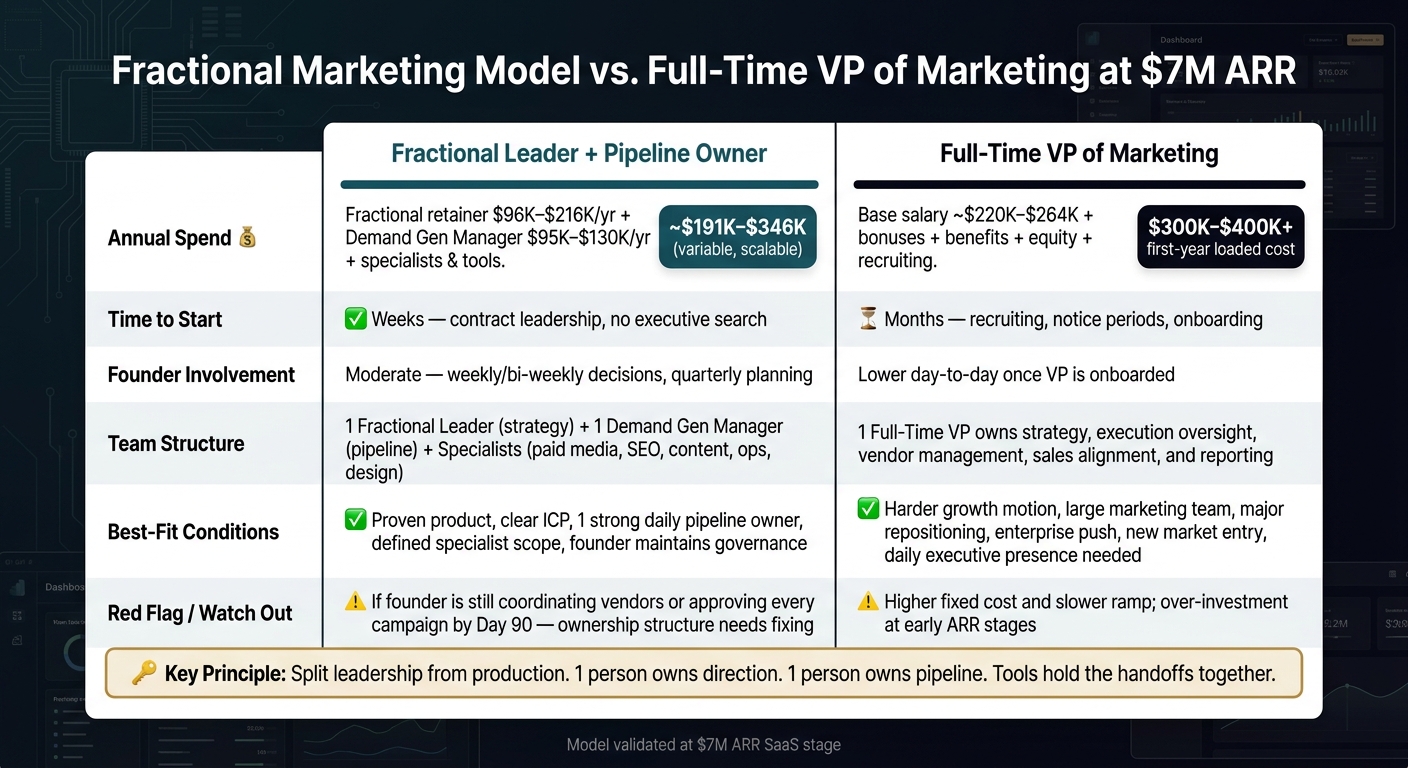
Fractional Marketing Model vs. Full-Time VP: Cost & Fit at $7M SaaS
Here’s the shift. At $7M ARR, most companies do not need a big marketing org. They need better judgment. They need someone to tighten what already works.
That’s where this model fits.
If you already have a proven product, a clear ICP, and some demand gen in motion, the job is not to build a whole team from zero. The job is to make the system sharper. That is the lesson.
At AGL, this is the core idea behind Tango. Humans decide. Machines repeat. Nothing ships without approval. That lets a small team run many marketing departments without piling on more headcount. The result for the agency is more output, less tool babysitting, and stronger delivery.
So the question is not whether marketing needs leadership.
It’s whether that leadership needs to be full-time.
This model starts to fail when the work needs daily executive presence. That usually happens during a big repositioning, an enterprise push, an launch into new countries, or when several marketing managers need day-to-day coaching. In those cases, fractional leadership can lose steam. A full-time VP can make more sense.
The clearest red flag is simple. By day 90, the founder should not still be the one keeping the whole thing together.
If the founder is still coordinating vendors, approving every campaign, or sorting out mixed reports, the setup is off. That is not a tool issue. It is an ownership issue.
The fix usually falls into 1 of 3 paths:
- Get a stronger demand gen manager
- Increase the fractional leader’s time
- Hire a full-time VP
That tradeoff shows up in cost, speed, and management load.
| Decision factor | Fractional leader + pipeline owner | Full-time VP of Marketing |
|---|---|---|
| Annual spend | Fractional retainer ($8,000 to $18,000 per month) + demand generation manager ($95,000 to $130,000 per year) + specialists, tools, and media [1][13] | About $220,000 salary at the low end; first-year cost is often higher once bonuses, benefits, equity, recruiting, and onboarding are added [14] |
| Time to start | Faster. Contract leadership can start within weeks, with no executive search | Slower. Recruiting, notice periods, and onboarding can take several months |
| Founder involvement | Moderate. Weekly or every-2-week decisions, major budget sign-off, and quarterly planning | Lower for day-to-day coordination once the VP is in place |
| Best-fit conditions | Proven product, clear ICP, 1 strong daily pipeline owner, clear specialist scope, and a founder who will keep governance in place | Harder growth motion, bigger marketing team, big repositioning, or a need for daily executive presence |
If the founder still has to push the system forward, then the model has not replaced the VP.
That’s why AGL does not treat this like a pile of freelancers. Tango works because the structure is clear. 1 person owns strategy. 1 person owns pipeline. Tools handle reporting and handoffs. Take out any 1 of those parts, and the problem becomes coordination.
If you want this setup to work, start with 1 check. At day 90, ask whether the founder is still the traffic cop. If the answer is yes, change the owner mix before you add more tools or more vendors.
FAQs
How do I know if I need a full-time VP yet?
You may not need a full-time VP of Marketing.
A lot of agencies assume more headcount is the answer. It often isn’t. If growth can be run with fractional leadership, niche contractors, and AI-led automation, a full-time exec can be too much too soon.
A better test is this: look at the system, not the title.
If your MSCI score is above 26, that’s a sign the setup may cost more than it gives back. That usually points to a build issue, not a leadership gap.
You may also see signs like:
- Fragmented data
- No clear owner for the commercial data model
- Heavy agency dependence for basic execution
That’s not a clear case for hiring a VP. It’s a sign the machine is messy.
At AGL, this is the kind of mess Tango is built to fix. Humans decide. Machines repeat. Nothing goes live without approval. That lets a small team run many marketing departments without adding layers they do not need.
What should the demand gen manager own day to day?
At a $7M SaaS company, one person often holds more of the marketing engine than the org chart shows.
That person is usually the demand gen manager.
They don’t just help with pipeline strategy. They run the day-to-day system that keeps it moving. In a lot of ways, they act like the main operator for the whole stack.
They usually own things like:
- Watching lead quality and conversion rates
- Changing targeting and messaging based on live data
- Running HubSpot, GA4, and Ahrefs, plus the work to keep those tools in sync
- Managing AI workflows and tuning them based on sales feedback
What results can this lean marketing setup realistically deliver?
Here’s the shift.
More headcount is not what makes an agency grow. A tighter system does. When AGL runs many marketing departments with a small team, the lift comes from Tango. Humans decide. Machines repeat. Nothing ships without approval.
That setup can drive clear gains. Teams may cut CAC by 20% to 50%. They may lift conversion rates by 30% or more. They may improve team output by 10% to 20% and boost sales productivity by up to 40%.
Why does this matter for agency owners?
Because this is how you add output without adding chaos. You do not need more tools to babysit. You need a system that handles repeat work, keeps the data clean, and gives your team more time to make calls that need a human brain.
That is the lesson. Lean wins when the system is tight.
With Tango, AGL turns that into more steady pipeline growth and cleaner revenue forecasts, without adding headcount. That means stronger delivery for clients, room for higher retainers, and an agency that is worth more if you ever sell it.
If your team is still doing repeat work by hand, start there. Map 1 repeat task. Put it in Tango. Keep the approval step. Then build from that.