Why $5-15M B2B SaaS Founders Should Stop Hiring VPs of Marketing in 2026

Why $5-15M B2B SaaS Founders Should Stop Hiring VPs of Marketing in 2026
Here’s the realization: at $5M to $15M ARR, most SaaS teams do not have a leadership problem. They have a work-output problem.
If I run marketing for several clients, I should read this article as a staffing lesson, not a title debate. The core point is simple: a full-time VP often shows up before the growth motion is clear. At this stage, the business usually needs owned execution, clean data, weekly tests, and pipeline accountability more than another layer of management.
The article boils it down to this:
- Judge marketing by pipeline, not job titles
- Hire for the bottleneck, not for status
- Use a growth operator, fractional CMO, demand gen help, content distribution, and AI-assisted workflows based on what is stuck
- Bring in a full-time VP only when the company has repeatable channels, team complexity, budget control needs, and a clear 12 to 18 month mandate
A few numbers make the case plain:
- In 2025, 62% of marketing leaders put pipeline dollars created in their top 3 metrics
- Median MQL-to-opportunity conversion was 13%
- Healthy CAC payback often lands around 12 to 18 months
- A common planning target is 3x to 4x pipeline coverage against quota
60- How to hire a SaaS marketing leader
sbb-itb-9cd970b
Quick comparison
| Model | Best use | Main risk | Best scorecard |
|---|---|---|---|
| Full-time VP | Repeatable channels, team to lead, more moving parts | Paying senior overhead before the motion is clear | Pipeline, forecast accuracy, CAC payback |
| Lean specialist structure | One clear execution gap | Work gets scattered if no one owns it | Qualified pipeline, conversion by channel |
| Lean / fractional model | Need senior judgment plus hands-on output | Part-time coverage can fall short if the business is too complex | Pipeline speed, output per dollar, launch cycle time |
What I like about the article is the frame behind AGL and Tango: humans decide, machines repeat, nothing ships without approval. That lets a small team run more of the marketing department, keep control, and ship more work without a bloated AI stack.
The lesson is 1 thing: named ownership beats broad oversight at this stage.
If I want the short version, it’s this: stop asking, “Do we need a VP?” Start asking, “What is the next thing blocking pipeline, and who owns it this week?”
If you want that model inside your agency, book a call with AGL.
Where the full-time VP model breaks down
Here’s the shift. At $5M to $15M ARR, marketing is less about big-team leadership and more about who owns pipeline work this week.
That’s where the full-time VP model can miss the mark. The issue is not talent. It’s fit. At this stage, 1 VP often can’t shape the whole go-to-market plan and get enough done fast enough to drive pipeline.
That’s why the real question is not the title. It’s ownership.
At AGL, this is the same point Tango is built for. Humans decide. Machines repeat. Nothing ships without approval. That setup lets a small team run many marketing departments without piling work onto 1 senior hire. The result is more output, tighter delivery, and no AI stack to babysit.
The gap between executive scope and hands-on growth work
Founders often load 1 VP with everything:
- positioning
- demand gen
- paid acquisition
- content
- product marketing
- CRM cleanup
- vendor management
- hiring
- board reporting
On paper, that looks like full ownership.
In practice, the pipeline work often has no clear owner. The VP owns marketing. But the work that drives revenue day to day does not. That includes campaign ops, list building, nurture, conversion rate work, and sales follow-up.
That gap is where growth slows.
Tango fixes this by naming the doer for each bottleneck. AGL does not leave the hard, repeat work floating between people. It gets assigned, run, checked, and improved. Fast.
How broad marketing goals hide weak accountability
This is where things get slippery.
If a VP is measured on brand or awareness, it gets easy to show motion without showing business impact. MQLs can go up while qualified pipeline stays flat. The team looks busy. Revenue does not care.
So track the numbers that show whether growth is moving:
- sourced pipeline
- conversion by channel
- cycle length
- CAC payback
One 2025 benchmark reported a median MQL-to-opportunity conversion rate of 13% across B2B SaaS, rising to 18% to 22% for more mature programs [1].
Those numbers tell the truth. Is the engine getting faster? Or just louder?
AGL’s lesson is simple. Do not pay for leadership if the pipeline-producing work still has no owner.
VP assumptions vs. actual operating requirements: a side-by-side comparison
This is not a knock on VPs. It is a stage-fit check.
A strong VP can be the right hire when the company already has a working acquisition motion, enough specialist help, and a clear job to build and run a bigger team.
But at $5M to $15M ARR, the needs often look different.
| Dimension | Traditional VP assumption | Actual requirement at $5M–$15M ARR |
|---|---|---|
| Expected outcome | Build the function and long-term strategy | Produce qualified pipeline while identifying the repeatable acquisition motion |
| Time to impact | Strategic progress before measurable revenue | Fast tests and pipeline signals within weeks, not quarters |
| Work ownership | VP leads across many functions | Each bottleneck has a named execution owner with weekly deliverables |
| Specialist coverage | 1 senior generalist coordinates most disciplines | Targeted specialists cover demand gen, content, ops, or analytics as needed |
| Accountability | Brand activity, plans, team development | Sourced pipeline, opportunity quality, conversion rates, and CAC payback |
| Cost flexibility | High fixed salary, benefits, equity, and team overhead | Fractional leadership, contractors, and systems expand or contract with evidence |
| Operating rhythm | Annual or quarterly planning | Weekly tests, channel reviews, funnel diagnosis, and fast reallocation |
| Primary risk | Hiring the wrong executive | Paying for leadership while pipeline-producing work remains unassigned |
That is the core lesson. At this stage, named execution beats broad oversight.
AGL has shown what this can look like in practice with Tango: a small team runs many marketing departments, work gets done by the leanest owner, and leaders keep control because nothing ships without approval.
The next move is simple. Match each growth bottleneck to 1 clear owner using the Tango system.
What to hire instead: a lean growth structure built around your bottlenecks
Most agencies do not need a bigger org chart first.
They need a better read on what is slowing pipeline.
That is the lesson. Hire for the bottleneck, not the title. Look at the last 90 days. Find the 1 gap that most directly slowed pipeline. Then make the first hire for the job that is blocking revenue today.
That is close to how AGL runs many marketing departments with a small team. Tango handles the repeat work. Humans decide. Nothing ships without approval. The result is more output without adding a pile of tools to manage.
Pair a growth operator with a fractional CMO for execution and senior judgment
A growth operator owns the day-to-day work.
At this ARR, the job is not to build a big leadership bench. The job is to build repeatable pipeline. This person runs weekly pipeline targets, campaign delivery, CRM hygiene, contractor coordination, and weekly reporting.
Success is not measured by how busy they look.
It is measured by:
- Qualified opportunities created
- Marketing-sourced pipeline
- Pipeline coverage
- Conversion rates
- CAC payback
The operator runs the work. The fractional CMO sets the path.
A fractional CMO should own the calls the operator should not make. That includes defining your ICP, positioning, channel focus, budget, and hiring. Most fractional CMOs work part time, often around 10 to 20 hours per week, but the right level depends on company complexity, not a fixed plan [5].
If you run an agency, this structure matters.
A full-time VP is a big fixed cost. A growth operator plus a part-time fractional CMO is often leaner. The better test is simple: which setup creates more qualified pipeline for each $1 spent?
Add demand gen, content distribution, and AI-assisted workflows where work is breaking down
Once ownership is clear, fill the next gap closest to the bottleneck.
A demand gen lead should own qualified pipeline, not raw MQL volume. Each channel test needs a clear ICP segment, a planned conversion path, a budget, and a stopping rule. One 2026 benchmark found an average MQL-to-SQL conversion rate of 13%, while top-quartile B2B SaaS programs reached about 25% to 35% [4].
That gap says a lot.
Some programs make noise. Others make revenue.
Creation and distribution are 2 different jobs. A content specialist makes the main asset, like a customer story, a research report, or an executive point of view. A distribution owner turns that asset into an email sequence, search articles, LinkedIn posts, a sales talk track, retargeting creative, and account-specific outreach.
If 1 person does both badly, the asset dies on the shelf.
If the jobs are split well, the same asset can keep working across channels and help sales use it too. That is a big part of the Tango frame. One approved input can turn into many outputs, without losing control.
AI should speed the work, not direct it. Use AI for research, drafts, repurposing, reporting, and routing. That cuts manual drag without adding another layer to manage. A useful rule is to treat AI drafts as about 70% to 80% done, then have a person refine them for insight, customer proof, factual accuracy, and brand voice [6].
That is how AGL uses Tango in practice.
Machines repeat. People judge. The payoff is stronger delivery with a small team.
Use the bottleneck-to-hire map below to pick the next move.
| Bottleneck | First hire or system | Result |
|---|---|---|
| Campaigns launch late, CRM data is unreliable | Growth operator | Faster delivery, clean reporting, execution accountability |
| ICP, positioning, or channel decisions are unclear | Fractional CMO | Better strategic direction and resource allocation |
| Insufficient qualified pipeline despite clear messaging | Demand gen lead | Qualified opportunities and pipeline coverage |
| Content is produced but rarely reaches buyers or sales | Content distribution specialist | Reused assets, audience reach, sales enablement |
| Reporting is manual and inconsistent | AI-assisted workflow system | Faster reporting, cleaner data, fewer errors |
If you want to scale client delivery without bloating headcount, start with the bottleneck. Then build the role around it, the same way AGL builds output with Tango.
How to pick the right structure for your current stage
Most agency teams do not break because of effort. They break because the next hire does not fix the next constraint.
That is the frame AGL uses with Tango. Humans decide. Machines repeat. Nothing ships without approval. That is how a small team can run many marketing departments without piling on extra tools or loose roles. The goal is simple: tie each move to pipeline, speed, and ROI.
Each hire should do 3 things:
- solve 1 named constraint
- prove it with 1 metric
- create 1 clear next step
Match each hire or system to the bottleneck it solves
Use the last 2 quarters of data to find the next constraint. Then match it to the first move.
| Current condition | Primary bottleneck | First role or system to add | Success metric | Trigger for the next hire |
|---|---|---|---|---|
| Messaging changes frequently, target accounts disagree across teams, and win/loss reasons are unclear | Unclear positioning or ICP | Fractional CMO or GTM strategist | Approved ICP, messaging, use-case priorities, and validated conversion improvement | Strategy is stable and execution capacity becomes the constraint |
| Offer is validated, but campaigns are late and initiatives lack ownership | Slow execution | Growth operator | Faster launch cycle, experiments shipped, and qualified pipeline per quarter | Repeatable execution exists but channel volume is insufficient |
| Sales team lacks enough qualified opportunities despite clear messaging | Not enough qualified demand | Demand-gen lead or focused channel specialist | Qualified opportunities, sourced pipeline, cost per opportunity, and opportunity-to-win rate | Channel economics are repeatable and additional capacity can increase volume |
| Strong ideas and assets receive little attention from target buyers | Weak reach | Content creator plus distribution owner | Target-account engagement, responses, assisted pipeline, and content reuse | Reach is established but conversion or opportunity creation remains weak |
| Reporting is slow, attribution is disputed, and lead routing is manual | Broken ops and data | Marketing-ops owner plus B2B sales automation and AI workflows | Reporting time, routing accuracy, data completeness, and campaign cycle time | Workflow volume is too high for 1 ops owner |
| Multiple segments, regions, products, and channel owners create coordination problems | Too much team complexity | Full-time VP of Marketing, once the team and budget are large enough | Cross-functional forecast accuracy, pipeline coverage, team productivity, and efficient growth | Add functional leaders only when leadership bandwidth, not strategy or basic execution, is limiting growth |
The metric column matters as much as the role column.
If you cannot report on pipeline or opportunities, fix measurement first. More headcount will not save a blurry system.
That is one reason Tango matters. AGL does not use AI to guess its way through delivery. It uses Tango to keep repeat work in order, keep approvals in place, and help a small team ship more work with less drag. The result is more output, stronger delivery, and no AI stack to babysit.
A practical sequencing model for $5M–$15M SaaS teams
Once you know the bottleneck, follow the stages in order. Do not hire 3 roles at once and hope the org chart sorts itself out.
Stage 1: Clarify the system.
If ICP, positioning, or channel economics are unclear, start with fractional strategy help. The output should be a documented ICP, ranked use cases, a messaging architecture, and a testable 90-day demand plan. A fractional CMO or GTM strategist can often do this with less fixed cost.
Stage 2: Install execution ownership.
Once priorities are clear, add a growth operator. This person runs the weekly drumbeat: campaign briefs, experiment backlogs, channel coordination, and post-campaign reporting. In plain English, this role turns strategy into weekly pipeline work.
Stage 3: Fix the biggest pipeline constraint.
If opportunity volume is low, add demand generation. If reach is weak, add content plus distribution. Pick the constraint that limits qualified pipeline the most.
Stage 4: Systematize repeat work.
After campaign and lifecycle work repeats in a stable way, add marketing ops and AI-supported workflows. By the end of 2025, 78% of companies had adopted or planned to adopt AI in their marketing-automation stack. [3] AI can speed repeat work. It does not fix unclear funnels or fuzzy ownership.
This is where AGL’s Tango model stands out. The system handles repeat steps. People still make the calls. Nothing goes live without review. That gives agencies more output without letting quality slip.
Stage 5: Reconsider executive scale.
Think about a full-time VP only after the company has a repeatable growth motion, multiple contributors or channel owners to manage, enough budget, and a real need for cross-functional leadership. Hire the VP to improve planning, forecasting, and team growth. Do not hire that person to do all the work by hand.
Here is the lesson: the right structure follows the next constraint, not the org chart you wish you had.
If you want that same model inside your agency, look at how AGL uses Tango to run many marketing departments with a small team, keep humans in control, and turn repeat work into output you can sell at a higher retainer.
When a full-time VP does make sense - and how to measure the leaner model
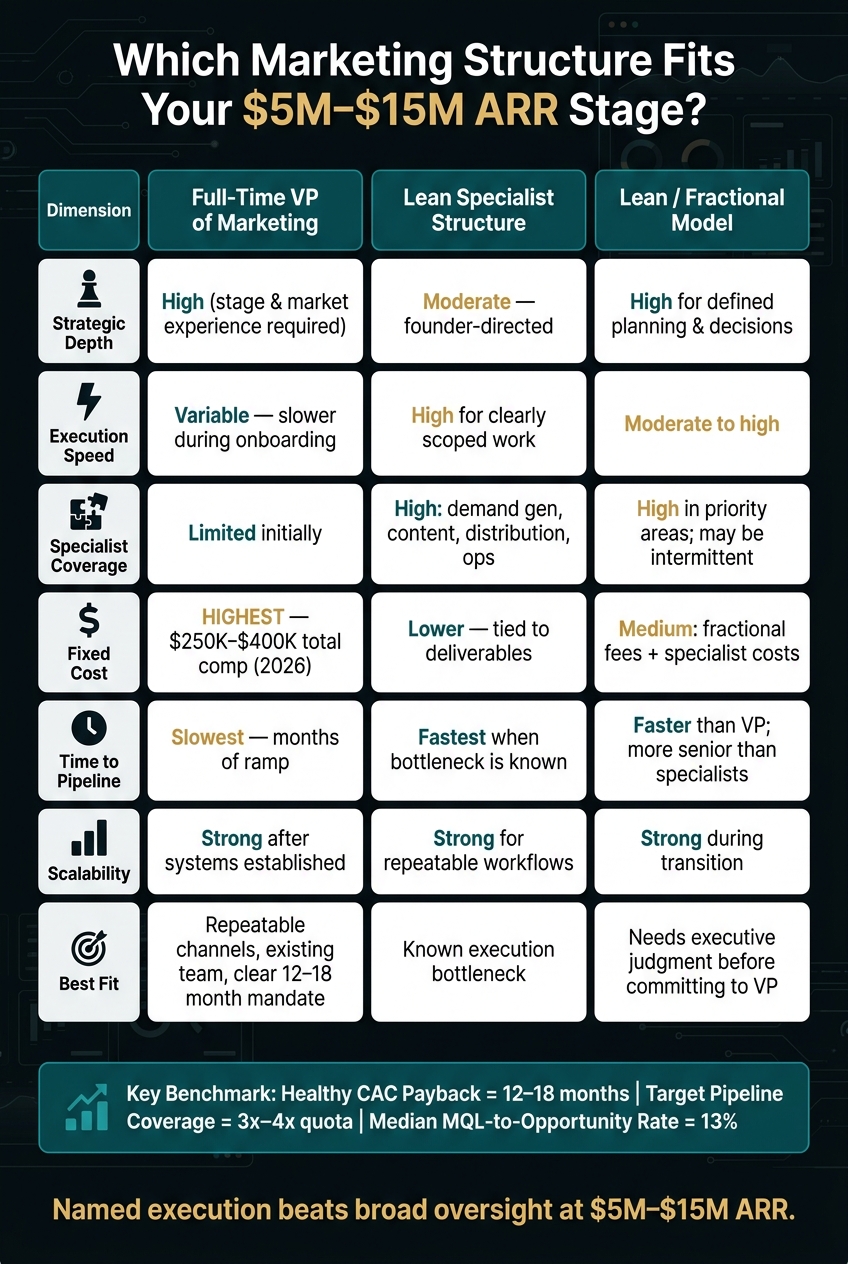
Full-Time VP vs. Lean Models: B2B SaaS Marketing Structure Comparison ($5M–$15M ARR)
Here’s the shift that matters: a VP of Marketing is not the first sign of a serious company. It’s the result of a company that already has clear demand, clear math, and clear ownership.
That’s why AGL does not rush to add a big in-house layer. We run many marketing departments with a small team using Tango. Humans decide. Machines repeat. Nothing ships without approval. That setup helps agencies and operators get more output without piling on headcount too soon.
The conditions that justify hiring a full-time VP of Marketing
A full-time VP makes sense when the business is already past the guesswork stage.
You should already have at least 1 or 2 acquisition channels that bring in qualified opportunities, not just leads, for several quarters. Your attribution should be steady. Sales and marketing should use the same terms for leads, stages, and who owns revenue.
A full-time VP also fits when you sell into many segments, many products, or many geos, and you already have a team to lead. One stage benchmark puts that team at 5–12 marketing employees for companies between $5M and $20M ARR.[2]
The clearest test is simple. Can you name the next 12–18 months in business terms?
That means you can state:
- marketing-sourced pipeline targets
- qualified opportunity rates
- CAC payback guardrails
- decision rights over budget and headcount
If you cannot spell out success that way, you are not ready for a VP.
In that case, a leaner setup will usually get to pipeline faster. That is the idea behind Tango. You do not hire senior overhead before the motion is clear. You build the motion first. Then you decide if a full-time leader should own it.
The scorecard: judge the model by pipeline, speed, and capital efficiency
If you do hire a VP, judge the model by output. Not motion. Not meetings. Not slide decks.
Watch leading indicators every week. Watch business outcomes every month.
Weekly, track new marketing-sourced pipeline, qualified opportunity rate, campaign launch cycle time, and CRM data completeness—often optimized using an AI lead-gen playbook.
Monthly, track revenue sourced by marketing and revenue influenced by marketing, lead-to-opportunity and opportunity-to-won conversion by cohort, sales-cycle length, CAC payback, channel-level cost per qualified opportunity, and budget variance vs. plan.
A useful planning benchmark is 3×–4× pipeline coverage against quota. But your own win rate and deal slippage should shape the target.[9]
Reported B2B SaaS benchmarks put healthy CAC payback in the 12–18 month range.[8] Use that as a guide, not a rule. Your own cohort data tells the better story.
This is also where lean teams often win. AGL ties the work to the same scorecard. Tango is built to move work from idea to approved execution fast, so teams can spot what is working and cut what is not. That is how lean delivery turns into stronger output.
Use this table to compare the 3 structures on the same metrics.
| Dimension | Full-time VP | Lean specialist structure | Lean / fractional model |
|---|---|---|---|
| Strategic depth | High, when the VP has relevant stage and market experience | Moderate; depends on founder direction | High for defined planning and decision points |
| Execution speed | Variable; slower during onboarding and team formation | High for clearly scoped work | Moderate to high, depending on availability |
| Specialist coverage | Limited initially unless a team is inherited or hired | High across demand gen, content, distribution, and ops | High in priority areas; may be intermittent |
| Fixed cost | Highest; compensation benchmarks for 2026 VP roles range around $250,000–$400,000 total.[7] | Lower; tied to specific deliverables | Medium; fractional fees plus specialist costs |
| Time to measurable pipeline | Slower in the first months of hiring and team formation | Often faster when the bottleneck is known | Faster than a VP for execution; more senior than specialists alone |
| Scalability | Strong after systems and budget are established | Strong for repeatable workflows | Strong during transition; may require a permanent leader as complexity grows |
| Best fit | Repeatable channels, multiple segments, existing team, clear mandate | Known execution bottleneck or unproven channels | Needs executive judgment before committing to a permanent VP |
Count the full cost on both sides.
That means salary, bonus, equity, recruiting, benefits, software, contractors, and founder time. Then compare that total to the output you get. If you want the AGL path to scale your B2B SaaS, use Tango to find the bottleneck, run the work with a lean team, and measure it against pipeline, speed, and CAC payback before you commit to a full-time VP.
FAQs
How do I know if I need a VP or a growth operator?
You can learn a lot about an agency by who owns the work. Not the plan. The work.
If your main issue is speed, channel ownership, and AI systems that your team can actually use, a growth operator is often the better pick than a VP of Marketing.
A VP usually works at the plan level. That matters. But a growth operator gets closer to the machine.
They handle the setup. They watch the numbers. They fix the flow between traffic, leads, sales, and follow-up. They care about what shipped this week, what broke, and what needs to change next.
That’s the lesson here.
A growth operator is built for execution. A VP is often built for direction.
So if your agency needs faster calls, tighter sales and marketing data, and faster AI-led changes, the operator model fits better.
This is the same idea behind Tango.
At AGL, we run many marketing departments with a small team because the system is built for output. Humans decide. Machines repeat. Nothing goes live without approval.
That setup helps agencies do more work without adding a messy AI stack to manage. It supports better delivery, stronger retainers, and a business that can be worth more when it sells.
If that sounds like the kind of setup you want, look at where your work slows down first. Then put an operator on the bottleneck.
What should I fix first if pipeline is flat?
You may not need another AI tool yet.
Most agency bottlenecks start earlier. They start with messy customer data. If your website, CRM, and billing system all tell a different story, no tool will fix that for you.
Start with an audit. Check if your customer data is complete, consistent, and accurate. Map where that data lives across each system. Then give 1 owner the job of keeping it clean.
Next, set your baseline. Track KPIs like cost per qualified lead and conversion rate before you change anything. That way, when you use Tango the way AGL does, you can see what changed and what did not.
That is the lesson. Humans decide. Machines repeat. Nothing ships without approval. Tango works best when the inputs are clean.
Take 1 action today. Audit your data sources and assign a single owner.
When does a full-time VP of Marketing make sense?
A lot of agencies assume senior marketing hires are there to make more noise.
That’s not the main job.
A full-time VP of Marketing makes sense when you need a senior leader to keep the system clean, tie marketing to company goals, and control how commercial data is set up.
Their best use is as a data owner.
That means human review over AI-led insight. It means guarding brand voice. And it means helping teams work together when change starts to hit the business.
At AGL, that same idea shows up in Tango. Humans decide. Machines repeat. Nothing ships without approval. That’s how a small team can run many marketing departments without losing control.