The First Hire of 2026 Is Not a Person. It Is a Role.

The First Hire of 2026 Is Not a Person. It Is a Role.
If no one owns your revenue workflow, adding headcount will not fix growth. My takeaway is simple: before I hire a VP, SDR, or marketer, I should first assign one clear role to own the bottleneck slowing revenue.
Here’s the short version:
- If reporting is messy and forecasts are off, I start with AI Revenue Operations
- If pipeline is low and follow-up is slow, I start with AI Sales Orchestration
- If leads come in but conversion or expansion is weak, I start with Marketing Automation and Lifecycle
- I set 3 to 5 clear outcomes for the first 90 days
- I keep the stack lean with tools like HubSpot, Clay, Apollo, Zapier, and OpenAI as part of a comprehensive AI tool stack
- I assign the work to a founder, current operator, or fractional lead before making a full-time hire
A few numbers make the case. RevOps leaders can cost $170,000 to $310,000 in base salary. New hires often take 3 to 6 months to ramp. And companies with a defined RevOps function can hit $50 million ARR about 9 months sooner.
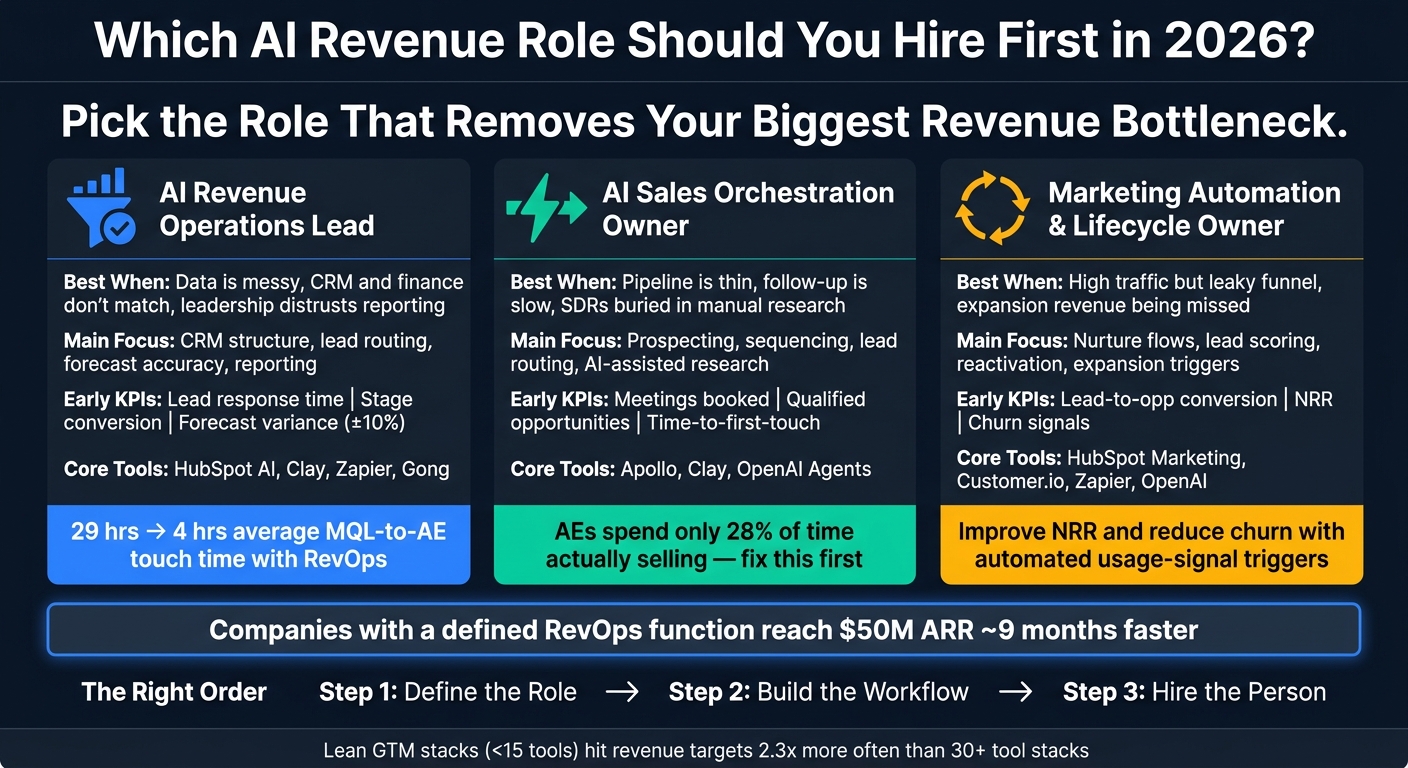
Which AI Revenue Role Should You Hire First in 2026?
If I Ran RevOps in 2026, This Is Where AI Would Go
To implement these strategies, you can discover the best AI and sales tools designed for rapid growth.
sbb-itb-9cd970b
Quick comparison
| Role | Best when | Main focus | Early KPIs | Core tools and ROI platforms |
|---|---|---|---|---|
| AI Revenue Operations | Data is messy, finance and CRM do not match | Routing, CRM structure, reporting, forecast accuracy | Lead response time, stage conversion, forecast variance | HubSpot, Clay, Zapier |
| AI Sales Orchestration | Pipeline is thin, follow-up is slow | Prospecting, routing, sequencing, research | Meetings booked, qualified opps, time to first touch | Apollo, Clay, OpenAI |
| Marketing Automation and Lifecycle | Funnel leaks after lead capture | Nurture, scoring, reactivation, expansion triggers | Lead-to-opp conversion, NRR, churn signals | HubSpot Marketing, Customer.io, Zapier |
Bottom line: I would define the missing role first, build the workflow second, and hire a person last.
The problem: unowned revenue workflows slow growth and hurt valuation
Most growth-stage SaaS companies don’t have a pipeline problem. They have an ownership problem.
HubSpot, Apollo, Gong, and Zapier are all in place. The tools exist. But no one owns the workflow from start to finish. And that gap leaks revenue.
What this looks like inside a $10M+ SaaS company
The signs are hard to miss inside a $10M+ SaaS company.
HubSpot records are incomplete because no one sets and enforces data standards. Demo requests sit unassigned for hours - or even days - because territory rules haven’t been updated since last year. Marketing reports 312 MQLs for the month, while sales only accepts 240, and no one can explain the mismatch because MQL-to-SQL definitions were never codified in the CRM itself[2][4].
That’s the core issue: the workflow has no owner.
"Your pipeline data is not bad. It is unowned." - Amir Reiter, CEO, CloudTask[3]
A revenue operations owner cuts response time in a big way. Time from MQL to first AE touch averages 29 hours in companies without one, versus 4 hours in companies with a mature function[2]. That faster first touch leads to more pipeline and a cleaner revenue story.
And no, the answer isn’t another dashboard. It’s a role with direct revenue accountability.
The pain shows up in finance too. When CRM shows $4.2 million in pipeline and finance shows $3.8 million booked, leaders burn hours reconciling spreadsheets. That’s not just annoying. It creates risk. In fact, 41% of growth-stage SaaS CFOs name forecast accuracy as their top operational risk[2].
Why hiring a person first often makes the problem worse
The first instinct is often to hire another SDR, AE, or marketing manager.
But adding headcount to an unowned system doesn’t fix the system. It just spreads the mess across more people.
In a current sales setup, AEs spend only about 28% of their time actually selling. The other 72% goes to manual research, list-building, and CRM hygiene[5]. So if you hire into that setup, you’re not scaling output. You’re scaling waste.
The cost adds up fast. Recruiting alone averages more than $4,700 per hire in the U.S., and it still takes 3 to 6 months for a new hire to reach full productivity[6].
There’s also a straight line to valuation risk. Duplicate CRM records at 8% to 15% of total contacts, plus mismatched attribution numbers, weaken the repeatability story that investors and acquirers want to see[2][4]. The better move is simple: assign one owner to the workflow.
Once you name the bottleneck, the next step is choosing which role should own it.
The solution: pick the first role based on your main growth constraint
Pick the role that removes your biggest revenue bottleneck right now. Each option below solves a different problem.
Start with the bottleneck that is costing you the most revenue today.
AI Revenue Operations Lead
This role owns the revenue data layer: CRM structure, lead routing rules, funnel reporting, and forecast accuracy across sales, marketing, and customer success. Put simply, this person fixes the data foundation behind revenue.
Use this role when leadership doesn’t trust reporting, CRM and finance are at odds, or pipeline reviews keep getting stuck in data arguments. It also makes sense when cleaner forecasts are the fastest way to improve your operating story.
The core stack includes HubSpot AI for deduplication, Clay for waterfall enrichment, and Zapier for workflow automation. Gong can wait until the data layer is clean enough to support action.
"The first RevOps hire should be an analyst-builder with platform fluency, not a senior strategist. The job for the first 12 months is to fix the pipe, not redesign the engine." - APFX Team [2]
If reporting is solid but pipeline is thin, move to sales orchestration.
AI Sales Orchestration Owner
This role owns pipeline creation across outbound and inbound: prospecting from buying signals, lead routing, follow-up sequencing, and AI-assisted research. In many cases, it works best as a small human-led team backed by AI agents that handle research, personalization, and sequencing with much lower headcount.
Use this role when your main problem is low pipeline volume, slow follow-up, or SDRs stuck doing manual research instead of selling. If faster pipeline creation is the clearest path to growth, this is usually the best first move.
The core stack includes Apollo for contact enrichment, Clay for signal-based list building, and OpenAI agents for personalization at scale.
If lead volume looks fine but conversion is slipping, lifecycle automation is the next lever.
Marketing Automation and Lifecycle Owner
This role owns what happens after a lead enters the funnel: nurture flows, segmentation, lead scoring, reactivation campaigns, often using AI-powered lead scoring, and expansion triggers based on product usage signals. The focus is automated, timely messaging, not content production.
Use this role when you have traffic and leads but the funnel leaks, or when expansion revenue is getting missed because no one is watching usage signals. It fits when better conversion and retention are the fastest way to improve NRR.
The core stack includes HubSpot Marketing, Customer.io for lifecycle messaging, Zapier for cross-tool automation, and OpenAI for dynamic content personalization.
Use this table to match the role to your bottleneck.
| Role | Bottleneck Solved | Primary KPIs | When to use | Core Stack |
|---|---|---|---|---|
| AI Revenue Operations Lead | Data silos, broken reporting, forecast fiction | Lead response time, stage conversion, forecast variance | Leadership distrusts reporting; CRM and finance disagree | HubSpot AI, Clay, Zapier, Gong |
| AI Sales Orchestration Owner | Low pipeline, slow follow-up, missed buying signals | Meetings booked, qualified opportunities, time-to-first-touch | SDRs buried in manual research; outbound volume too low | Apollo, Clay, OpenAI Agents |
| Marketing Automation & Lifecycle Owner | Poor nurture, low lead-to-opp conversion, weak expansion | Lead-to-opp conversion, NRR, churn signals | High traffic but leaky funnel; expansion opportunities ignored | HubSpot Marketing, Customer.io, Zapier, OpenAI |
How to define the role: outcomes, tools, and a lean implementation plan
Set 90-day outcomes before assigning anyone to the role
Start by defining success before you assign the role or buy software. If you skip that step, the role turns into a title with no clear job. A simple 90-day scorecard fixes that.
Map success at 30, 60, and 90 days:
- Day 30: Fix lead routing, deduplicate the CRM, and close obvious data gaps.
- Day 60: Set a weekly operating cadence with dashboards the team actually trusts.
- Day 90: Forecast accuracy is within ±10%, and attribution is trusted.
For an AI Revenue Operations Lead, that usually means a tightly managed CRM data model with less than 5% missing values [1]. If marketing automation is the bottleneck, the goal shifts a bit: lead-to-first-contact time should be under four hours, and 100% of high-value leads should route automatically based on intent signals [4].
Keep the list short. Three to five outcomes is enough. Go past that, and ownership starts to get blurry.
Build the minimum viable stack around the role
Once the outcomes are clear, build the smallest stack that can support them. Start with the data layer. Clean data comes first. Intelligence comes after that.
That means no forecasting tools or conversation intelligence platforms until the CRM is clean and handoffs are automated [4]. Otherwise, you're just layering software on top of messy inputs.
Each role can start small and expand later:
| Role | Start Here | Add Later |
|---|---|---|
| AI Revenue Operations Lead | HubSpot AI, Clay, Zapier | Snowflake/BigQuery, Gong |
| AI Sales Orchestration Owner | Apollo, Clay, OpenAI (via API) | Gong, Chili Piper, Outreach |
| Marketing Automation and Lifecycle Owner | HubSpot Marketing Hub, Apollo, OpenAI | Customer.io, Dreamdata, Segment |
The numbers back this up. Organizations with lean GTM tech stacks - fewer than 15 tools - hit revenue targets 2.3x more often than teams using 30+ tools [2]. That's a pretty clear signal: start small. Add tools only when a specific bottleneck is slowing the team down.
Assign ownership to a founder, operator, or fractional lead first
You don't need a full-time hire on day one. In most cases, the best order is simple: founder first, fractional next, full-time last.
Founders should usually own this role until the company reaches between $2M and $8M ARR [1]. Between Seed and Series A, fractional RevOps support - about $50,000 per year for an initial build-out plus monthly optimization - often makes more sense than hiring someone full time [1][7].
A full-time hire starts to make sense when the CRO is spending 4+ hours a week buried in spreadsheets, pipeline reviews take twice as long as they should, or the team has more than 10–15 quota-carrying reps.
Until then, keep it simple:
- Name one owner
- Document every workflow they build
- Set weekly reporting
- Let the system prove ROI before adding headcount
That shifts a full-time hire from a guess to a scaling call.
Conclusion: define the role first, then build headcount around the system
If board reporting takes days to put together, start with AI Revenue Operations. If pipeline is thin, start with AI Sales Orchestration. If conversion stalls, start with Marketing Automation and Lifecycle ownership.
Your bottleneck should decide the role.
Once that part is clear, org design gets a lot easier. You’re no longer hiring based on guesswork or trend-chasing. You’re hiring to fix the one thing that’s slowing revenue down.
That’s why the first hire of 2026 is a role, not a person. Pick the role that removes your biggest revenue bottleneck, then build the stack around that constraint.
This matters because ownership and systems design are what create the edge. Companies with a defined RevOps function reach $50M ARR about 9 months faster than those without one [2].
Start with the smallest AI-enabled stack that solves the problem. Tools like Clay, Apollo, and HubSpot workflows can do a lot of the heavy lifting. Build the workflow first, then add people only where the system still needs support. Prove ROI first. Then hire only where the system can’t scale any further.
That’s the highest-leverage decision in 2026.
FAQs
How do I know which role to prioritize first?
Don’t pick based on who’s shouting the loudest.
Pick the role tied to the largest repeated manual bottleneck that affects revenue, customer experience, or decision quality. Then move on the one that can win back time and revenue within 30 days.
Focus on three signals:
- Operational friction
- Revenue leakage
- Poor data maturity
If your CRM data isn’t reliable, fix the data and process first. If revenue is slipping right now, start with the digital worker that’s easiest to measure.
Can a founder or fractional operator own this role first?
Yes - often they should.
Early-stage revenue and operations work is usually uneven. Some weeks are packed with setup, fixes, and process work. Other weeks are lighter. In that kind of environment, a founder or fractional operator can be a better fit than a full-time hire.
What matters most is deep platform fluency and an operations mindset. You need someone who can connect commercial judgment with system design, then turn that thinking into workflows that help drive revenue before you add more headcount.
What should this role achieve in the first 90 days?
In the first 90 days, the goal is to build a stable, automated foundation - not chase huge revenue right away.
That means putting the revenue system in place from the ground up:
- the data model
- lifecycle stages
- lead routing
- forecasting logic
- reporting architecture
Success looks pretty clear here. Lead-to-first-contact time should stay under four hours, and the data layer should run on its own without manual input.
By that point, the foundation should be steady enough to scale.