Why Your Last VP Marketing Quit After 5 Months (And What to Do Instead)

A 5-month VP Marketing exit usually points to a setup problem, not just a hiring problem. I’d look at 4 things first: stage fit, funnel ownership, founder alignment, and data. If those are weak, the next full-time VP will likely hit the same wall.
Here’s the short version:
- Average executive tenure is 1.9 years, so 5 months is a red flag about the system
- A failed VP hire can burn $600,000 to $1,000,000+ once you count salary, search fees, severance, and lost momentum
- Many teams need a hands-on lead or fractional marketer, not a full VP
- The fix is to audit the funnel and SaaS metrics strategy, assign owners, define SaaS metrics, and set decision rights before hiring again
- At AGL, we built Tango for this exact issue: Humans decide. Machines repeat. Nothing ships without approval.
If I ran marketing for several clients, I would not treat a short VP run as proof the person failed. I would treat it as proof the machine under the role was loose. That is the lesson. Fix the system first. Then hire the lightest role that clears the bottleneck.
AGL uses Tango to run many marketing departments with a small team. That means more output, less tool babysitting, and tighter delivery. Do 1 thing this week: run a 1-page funnel ownership audit before you open another VP search.
Why Marketing Hires Fail | Start Here
sbb-itb-9cd970b
What Was Actually Broken
Here’s the part many founders miss: a short VP of Marketing run does not always mean the hire was bad. Most of the time, the business was not set up for that role in the first place.
The break usually shows up in 3 places. The company is at the wrong stage. Funnel ownership is fuzzy. And the founder is not lined up with how marketing should run.
That same pattern is why AGL built Tango the way it did. Humans decide. Machines repeat. Nothing ships without approval. It gives agencies a way to run more marketing work with a small team, without handing the whole thing over to tools.
Hiring a Senior Leader Before the Business Is Ready
Early-stage SaaS and agencies often need a doer first. Not a VP who only sets direction.
There’s a big gap between a leader who runs a team with a proven playbook and a leader who can write copy, build landing pages, set up CRM flows, and run paid campaigns. Many teams should wait on a full VP hire until demand repeats, data is clear, and sales can support the role.[2]
This is where teams get fooled. It looks like a hiring miss. It’s often a stage miss.
A strong candidate at the wrong stage can do more damage than a weaker one. Why? Because the promise is bigger. The pay is higher. And the company still can’t support the role. Even a strong operator will struggle if no one agrees on who owns each part of the funnel.
AGL avoids that trap with Tango by building the system before piling on headcount. The team sets the rules, the workflow handles the repeat work, and approvals stay with people. That means more output without adding a big AI stack to manage.
No Clear Pipeline Ownership or KPI Definitions
If MQL, SQL, and funnel ownership are not clear, sales and marketing will blame each other. Every time.
If the CRM does not hold clear rules, attribution turns into guesswork. If there is no shared reporting rhythm, board meetings turn into finger-pointing. And if marketing gets a revenue target without clear limits on what it can control, the VP gets blamed for things tied to sales cycle length or discounting.
That is not a people problem. It is a setup problem.
Tango was built for this kind of mess. AGL uses it to put steps, owners, and approvals in one place so work does not drift. The point is simple: make the machine do the repeat parts, and keep human judgment where it matters.
Founder Misalignment and Missing Operating Systems
Even when the role looks clear on paper, founder behavior can still sink it. Last-minute priority changes make clean tests and pipeline forecasts almost impossible.[1][3][4][5]
Under that, there is often no real operating system at all. The CRM has messy fields. Marketing automation stops at a newsletter. There is no set process for briefs, launches, or reviews.
Then the senior marketing lead ends up fixing tools and cleaning data instead of leading strategy.[6][7][8] That is a systems gap, not a leadership gap.
This is the lesson. Do not hire for the title before you build the system. That is the move AGL made with Tango, and it’s why a small team can run many marketing departments without chaos.
If you want stronger delivery and more output without more tool babysitting, start with the system first. That’s the current CTA.
How to Diagnose the Problem Before You Hire Again
Here’s the shift. A 5-month exit is not just about 1 person. It often shows the machine behind the role was not ready.
That matters because most agencies do not fail from lack of effort. They fail when they hire a senior marketer into a setup with weak rules, muddy ownership, and no clean data. At AGL, that is the kind of mess Tango is built to stop. Humans decide. Machines repeat. Nothing ships without approval. That is how a small team can run many marketing departments without adding chaos.
The lesson is simple. Audit the system before you hire again.
Check Whether Your Company Is Ready for a Senior Marketing Hire
Start with the basics.
Do you have a documented ICP based on customer calls or closed-won deals? Is your positioning steady? Do you have 6 to 12 months of channel data? Is there a sales follow-up SLA?
If most of that is missing, you do not need a VP to tune performance. You need a hands-on marketing leader who can build the base while still doing the work.[10][12]
That is a stage issue. Not a talent issue.
Map Who Owns Each Part of the Funnel
Next, look at ownership.
Write down every funnel stage: traffic, leads, MQLs, SQLs, opportunities, and expansion. Then assign 3 things to each stage:
- owner
- operator
- person who owns reporting
If you cannot do that fast, the problem is not hard to spot. No one owns the funnel cleanly.
This is where many teams get stuck. Mid-funnel work gets fuzzy. No one owns lead scoring. Without a marketing automation checklist, technical handoffs fail. Sales says marketing sends bad leads. Marketing says sales moves too slow. And no one agrees on what an SQL even means.[9][10]
That kind of gap kills output. It also makes any new hire look worse than they are.
Find the Real Constraint Holding Growth Back
Then find the 1 bottleneck that slows growth.
If you swap the VP but keep the same bottleneck, you repeat the same result. Pull 6 to 12 months of funnel data and look for the point where conversion falls apart.[11][12]
| Situation | Likely Diagnosis | Better Next Step |
|---|---|---|
| ICP and positioning are unclear | Systems/readiness problem | Clarify market, message, and offer before rehiring |
| MQLs exist but sales doesn't follow up consistently | Funnel ownership/process problem | Define lead handoff and sales SLA |
| Founder still makes most go-to-market decisions | Founder alignment problem | Reset decision rights and operating cadence |
| No reliable pipeline data or attribution | RevOps/data problem | Fix CRM hygiene and reporting first |
| Team needs strategy but not a full exec team | Stage/budget mismatch | Use a fractional leader instead of a full-time VP |
If your company cannot answer who buys, why they buy, how leads move, and who owns revenue, then the issue is systems readiness, not the hire.[10][12]
That is the AGL view in plain terms. Before you add headcount, fix the operating system. Tango gives that system shape. It gives clear handoffs, repeatable execution, and human approval at the end. That is how agencies get more output without babysitting a pile of AI tools.
Take 30 minutes and map your funnel owners, gaps, and 1 bottleneck before you open the next search.
What to Do Instead of Hiring Another VP
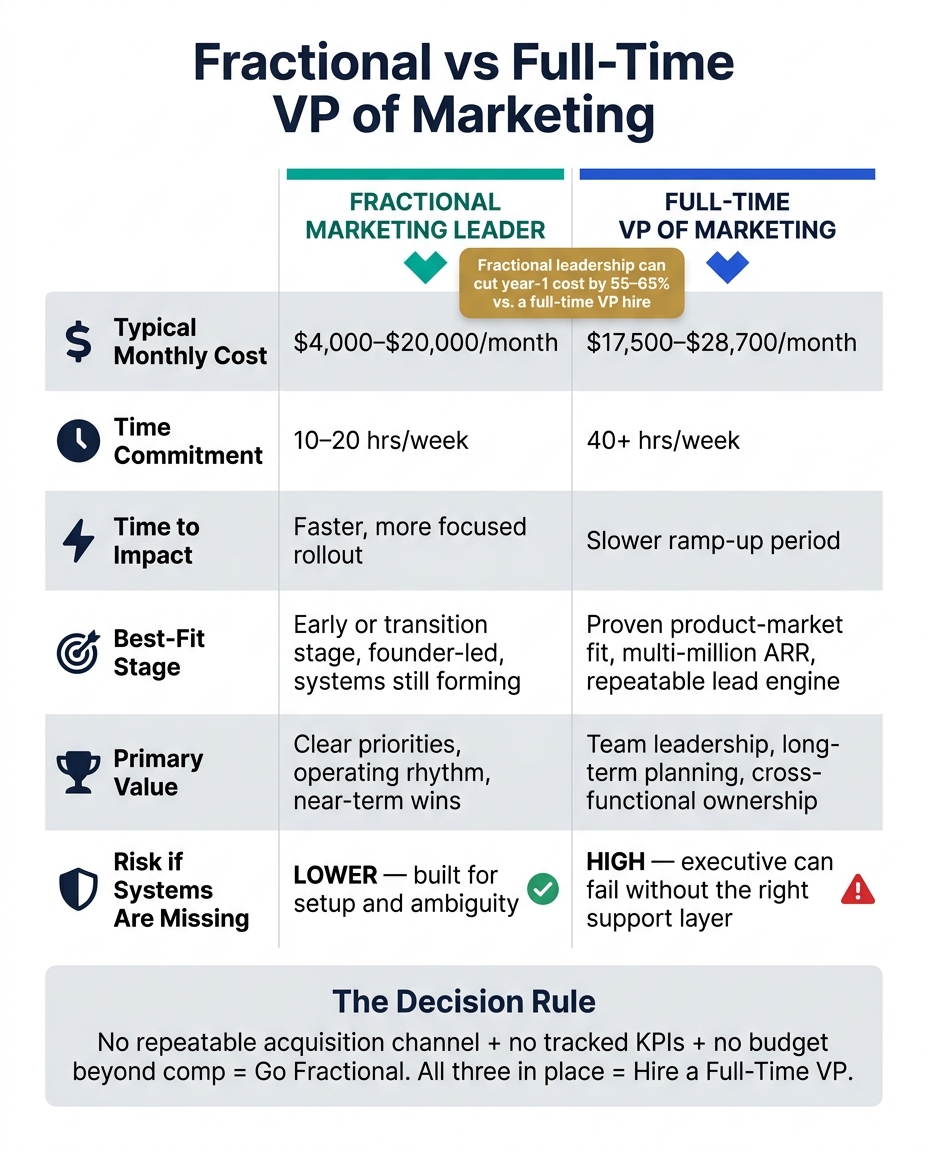
Fractional vs Full-Time VP of Marketing: Cost, Fit & Risk Comparison
Here’s the shift.
A stalled marketing team does not always need a bigger title at the top. A lot of the time, it needs a tighter system under it.
If the bottleneck is process, clarity, or ownership, not headcount, don’t hire another full-time VP.
When Fractional Marketing Leadership Makes More Sense
Fractional leadership makes sense when you need senior judgment without full-time overhead.
A full-time VP of Marketing usually costs $210,000 to $344,000 in total year-1 cost once you add salary, benefits, bonus, and recruiting fees. A fractional leader often costs $7,000 to $10,000 per month. That can cut cost by 55% to 65% and skip the extra load that comes with benefits and recruiting for a permanent hire.[20][21]
In most cases, that gives you 10 to 20 hours a week on diagnosis, priorities, and execution.
But cost is not the main point.
Stage fit is.
If sales still runs through the founder, your ICP is not fully written down, or your pipeline process is still shaky, a full-time VP often ends up building the base instead of scaling what already works. That’s where fractional leadership fits better. They step in, find the gap, build the system, and make sure owners follow through.
That directly answers the failure points from earlier: unclear ownership, weak reporting, and no steady operating rhythm.
A fractional leader can step into that mess without needing the full support layer a permanent VP needs.
| Full-Time VP of Marketing | Fractional Marketing Leader | |
|---|---|---|
| Typical monthly cost | ~$17,500 to ~$28,700 | ~$4,000 to ~$20,000 |
| Time commitment | Full-time, 40+ hrs/week | 10 to 20 hrs/week |
| Time to impact | Slower ramp | Faster, more focused rollout |
| Best-fit stage | Proven product-market fit, multi-million ARR, repeatable lead engine, clear cross-functional ownership | Early or transition stage, founder-led, systems still taking shape |
| Primary value | Team leadership, long-term planning, cross-functional ownership | Clear priorities, operating rhythm, near-term wins |
| Risk if systems are missing | High. An executive can fail without the right support layer | Lower. Fractional work is built for setup and ambiguity |
At AGL, this is the same logic behind Tango.
Humans decide. Machines repeat. Nothing ships without approval.
That lets a small team run a lot of marketing departments without adding layers too early. The result is more output, tighter delivery, and no extra AI stack to babysit while you sort out who owns what.
Use fractional leadership to steady the basics while you build the layer below.
Build a Repeatable Growth System Before You Scale Leadership
No senior hire, fractional or full-time, can scale something that does not exist yet.
Before you bring in any senior leader, your company needs a simple operating backbone in place.[13][14]
That means:
- A defined funnel
- Shared MQL and SQL definitions
- A joint KPI dashboard
- A sales and marketing SLA
- A simple test cadence
Without that, you are not hiring someone to tune a system.
You are hiring them to invent one while trying to hit goals at the same time.
That rarely ends well.
When the system is visible, the leader can tune it instead of building from scratch. That is the point.
Tango works the same way. It gives the team a repeatable way to run work, route approval, and keep output moving. That is why AGL can run many marketing functions with a small team. The system carries the repeat work. People keep control.
Once that base is in place, match the role to the job in front of you, not the title you think you should have.
Match the Role Title to the Stage of the Business
Hiring for the title instead of the need is how agencies and brands burn cash fast.
The role has to match the stage.
| Role | Primary Focus | Key KPIs | Team Management | Ideal Stage |
|---|---|---|---|---|
| Demand Gen Lead | Pipeline creation, channel performance, campaign execution | Qualified leads, CPL, MQL-to-SQL rate | Minimal to none | Early stage, sales already exists, pipeline is thin |
| Head of Marketing | Brand, product marketing, content, demand gen coordination, reporting | Pipeline contribution, campaign speed, lead quality | Small team or contractors | Needs 1 owner across channels, but not a full VP yet |
| VP of Marketing | Full marketing function, cross-functional alignment, team development | Revenue impact, pipeline health, forecast reliability | Manages a team | Proven product-market fit and multi-million ARR, sales team and operating backbone in place |
Hire the smallest role that clears the bottleneck.
If the bottleneck is pipeline volume, a strong demand gen lead is often a better pick than a VP with no system to work with. If you need 1 person to run the full marketing function but you are not ready for a VP, a Head of Marketing can fill that gap without executive overhead.[15][16][17][18][19]
This is one of the clearest lessons from how AGL works.
You do not start by stacking senior titles.
You start by building a system that lets a small team do more. Then you add the lightest layer of leadership that keeps work clear, approved, and moving. That is how you get stronger delivery, hold margin, and build an agency that is worth more when it sells.
Take 1 action now.
Write down your real bottleneck. Then hire the smallest role that fixes that. Not the fanciest title.
If you want the model AGL uses to run many marketing departments with a small team, look at Tango.
Conclusion: A Decision Framework for Your Next Marketing Leader
Here’s the big realization: a 5-month VP of Marketing exit usually tells you more about the company than the person.
Most founders read that kind of miss as a hiring issue. But the numbers point somewhere else. 40–50% of executive hires fail within 18 months, and a failed VP-level hire can cost $600,000 to $1,000,000 once you add salary, severance, recruiter fees, and lost momentum.[22][23][24] That is not just a people issue. It is a system issue.
At AGL, this is the same lesson we see again and again. Agencies do not get more output just by adding a senior title. They get more output when the system is clear. That is the point of Tango. Humans decide. Machines repeat. Nothing ships without approval. The result is more delivery from a small team, without a messy AI stack to manage.
So before you blame the hire, check the role.
Run a 1-page funnel ownership audit. Write down who owns each stage from first touch to renewal. List the metric tied to each stage. Mark where handoffs break.
Then write a role charter. Keep it plain. Define the mandate, KPIs with baselines, decision rights, budget, and first-6-month exclusions.[25][26][27]
Once that is done, the hiring call gets a lot easier.
If you do not have a repeatable acquisition channel, tracked KPIs, and budget beyond compensation, go with a fractional leader. If you do have those 3 things, hire a full-time VP.
That is the pattern. Founders hire big titles to fix system gaps. But titles do not fix missing structure. The fix is a better system first. Then the right role for the stage.
Do the audit this week. Write the charter. Then choose the role.
FAQs
How do I know if my company is ready for a VP of Marketing?
You’re ready when your agency stops running on one-off fixes and starts running on a system.
That shift matters. A VP of Marketing should make a working model move faster. They should not spend their first 6 months building the basics from scratch.
At AGL, that’s the line we watch for. We use Tango to run many marketing departments with a small team. Humans decide. Machines repeat. Nothing ships without approval. That only works when the base is already in place.
In plain terms, you’re ready when you already have:
- a mature CRM
- documented lead gen workflows
- clear KPI tracking
- central marketing data your team can reach
- a repeatable growth system
That’s the lesson. Hire a VP to speed up a system, not invent one.
If your agency wants more output without adding a messy AI stack to manage, look at how Tango helps AGL do it. That’s the next step.
When is a fractional marketing leader a better fit?
Here’s the realization: a full-time VP is not always the next smart hire.
A lot of firms think senior talent will fix slow growth. But if the team lacks clear systems, clean handoffs, and owned numbers, that hire can stall fast. You don’t need a big title first. You need a working system.
A fractional marketing leader fits better when your company is not set up to support a full-time senior exec. Hiring a full-time VP too early often leads to poor fit and turnover.
The lesson is simple. Build the machine before you buy the driver.
A fractional leader helps you set up a repeatable growth system, define clear KPIs, and make ownership clear. That is the same idea behind the Tango system at AGL. Humans decide. Machines repeat. Nothing ships without approval.
That is how AGL runs many marketing departments with a small team. More output. Less tool sprawl. Better delivery. Stronger retainers.
If your team is in that in-between stage, start there first. Build the system. Then make the full-time hire when the role has a clear job to do.
What should I fix before hiring another marketing executive?
Here’s the thing most agency owners miss: a senior hire does not fix a messy system.
If the work, data, and ownership are split up in 10 places, a new exec walks into chaos. They spend their time sorting it out instead of driving growth.
That’s why AGL starts with the system first.
Before you hire another marketing leader, check the gaps under the role. Use the MSCI. If it’s above 26, your setup is likely too broken up for a senior leader to do their best work.
Then fix the basics:
- Set clear data ownership
- Clean up and unify customer records
- Give one person clear accountability
- Define KPIs
- Build repeatable growth processes
This is the same logic behind Tango. Humans decide. Machines repeat. Nothing goes live without approval.
That setup helps AGL run many marketing departments with a small team. More output. Less tool babysitting. Better delivery.
If your operation still does not scale after that, a fractional leader may be the better next step than a full-time VP.
One move to make now: run the MSCI, then fix the 1 biggest gap before you open another exec search.