The Growth Operating System: What It Is, Why $5-15M SaaS Founders Are Installing One in 2026

Growth usually gets messy before it gets slow. Between $5M and $15M ARR, the issue is often not lead flow. It is how the team runs the work.
If I ran marketing for several clients, here is the lesson I would take from this piece: more output needs tighter rules. A Growth Operating System gives 1 shared way to build a predictable SaaS growth engine by aligning goals, metrics, owners, meetings, tests, and AI use. That is how teams cut drift, clean up handoffs, and make better calls each week.
Here is the short version:
- A Growth OS is not just tools. It is the system behind the tools.
- It includes 6 parts: target model, KPIs, planning rhythm, funnel owners, test backlog, and tool rules.
- 2026 makes this more urgent. Teams use more AI, boards want tighter forecast control, and tool sprawl keeps growing.
- The warning signs are simple: mixed numbers, weak forecasting, no clear funnel owners, and scattered AI use.
- The payoff is clear: more control, better delivery, and less founder pull-in.
I also see the agency angle all through this. AGL runs many marketing departments with a small team using Tango. Humans decide. Machines repeat. Nothing ships without approval. That is the point. More output. No AI stack to babysit. Stronger delivery. Higher retainers. An agency worth more at sale.
If I wanted to apply this fast, I would start with 1 move: map where decisions happen, where machines repeat, and where approval must stay human.
The Growth Operating System - Building Alignment, Activation, and Accountability
sbb-itb-9cd970b
What a Growth Operating System Actually Is
Here’s the shift.
Growth does not come from a stack of tools. It comes from how the team runs.
A Growth Operating System is the system behind that work. It ties together strategy, metrics, planning cadence, ownership, testing, and tools so revenue can grow week by week, month by month, and quarter by quarter.
That matters because many teams still run on founder instinct. One fire pops up. Then the next. Then the next. A Growth OS replaces that chaos with a repeatable way to operate.
A strategy deck points the team in a direction. A Growth OS tells the team how to move. It sets ownership, metrics, cadence, and what happens when performance drops.
A RevOps project fixes pieces of the machine. A Growth OS defines how the full machine runs.
At AGL, this is the same idea behind Tango. Humans decide. Machines repeat. Nothing ships without approval. That’s how a small team can run many marketing departments without losing control.
The 6 parts of a working Growth OS
The system has 6 parts.
| Building Block | What It Does |
|---|---|
| Growth strategy and target model | Defines ICP and target buyers, channels, and revenue targets. |
| KPI dashboards | Shared views of funnel and revenue performance, updated daily or near real time. |
| Weekly and monthly planning cadence | Fixed weekly and monthly review rhythm for targets, trends, and actions. |
| Clear funnel ownership | One owner per stage, with named KPIs. |
| Experiment backlog and prioritization | A ranked list of growth tests with a standard way to score, run, and review them. |
| CRM and automation stack | CRM, automation, analytics, and AI tools governed by standards and permissions. |
Each part does a different job. But they only work when they work together.
Your targets should tie back to CRM forecasts and dashboards. If you can’t measure it, it should not sit inside the operating model.
This is one of the clearest lessons agency owners can take from AGL’s setup with Tango. Output is not the same as control. You need both. More campaigns, more tasks, and more client work mean little if no one can tie them back to pipeline and revenue.
Why tools and playbooks alone are not enough
Most $5M to $15M ARR SaaS teams already have tools.
They have a CRM. They have marketing automation. They likely have a playbook someone wrote 18 months ago. And growth still comes in waves.
The reason is simple. Tools and playbooks do not run themselves.
Without rules, owners, review loops, and clear calls on what to do next, software sits idle and playbooks collect dust. Nearly 90% of B2B SaaS marketers report either moderate data silos (66.7%) or significant integration challenges (22.7%), making it hard to connect marketing activity to revenue even when the tools are in place. [2]
A Growth OS connects people, data, meetings, and actions.
That’s the lesson. The system is the product. Not the dashboard. Not the CRM. Not the doc in Notion.
Weekly reviews, test backlogs, and funnel ownership turn good intent into repeatable execution. That is how AGL uses Tango to run more client work with a small team. The machine handles repeat work. People make the calls. Approval stays with humans.
If you want that kind of control in your agency, start with 1 move: map your current client delivery to these 6 parts and find the 1 part with no owner.
Why SaaS Founders Are Installing One in 2026
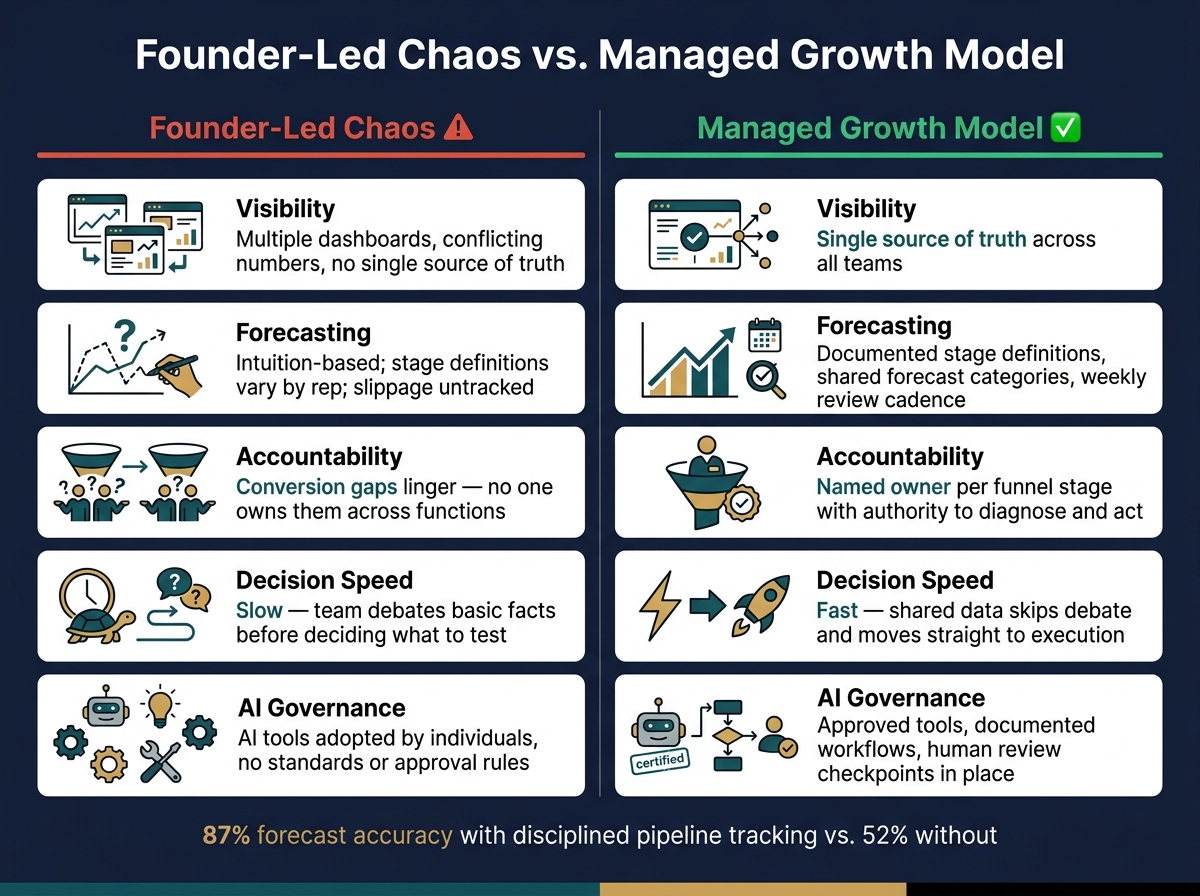
Founder-Led Chaos vs. Managed Growth OS: Side-by-Side Comparison
The operating problems that appear before growth stalls
A lot of SaaS founders think growth slows because lead flow slips.
But at the $5M to $15M ARR stage, the bigger issue is often simpler than that. The company is being run on different rules by different teams.
Marketing sees 1 set of numbers. Sales sees another. Finance has a third view. That is not a dashboard problem. It is an operating problem.
The issue is not too much data. The issue is that the rules behind the data do not match.
At this stage, teams are big enough that loose definitions start to hurt. If marketing counts an MQL 1 way and sales counts an SQL another way, the math breaks. If pipeline is tied to opportunity created date in 1 report and expected close date in another, leaders start making budget calls from numbers that look clean, but are not. [3][7][9]
That is the point where growth stops being a demand problem. It becomes a management problem.
Attribution starts to fail. So teams move budget toward what looks busy and visible, not what works best. [5]
Forecasting is where the cost shows up fast. Many SaaS companies at about $10M ARR have pipeline reports, but not forecast discipline. They can show open deals. They cannot say, with confidence, how deals tend to close by segment, stage, or rep.
No 1 owns the assumptions. No 1 tracks slippage. Then the quarter-end number lands like a surprise, good or bad. [3][9]
This is why founders put in a Growth OS. It sets shared metrics, planning rhythm, funnel ownership, test rules, and tool control in 1 place.
That is also the kind of problem AGL built Tango to handle. AGL runs many marketing departments with a small team because the operating rules are clear. Humans decide. Machines repeat. Nothing ships without approval. The point is not more software. The point is more output with less drift.
Why 2026 raises the pressure
These problems are not new.
What changed is the price of letting them sit.
At $5M to $15M ARR, gaps in operations do not stay trapped in a dashboard. They start shaping hiring plans, spend levels, and forecast quality.
Boards and investors want tighter capital efficiency, better forecast accuracy, and more output from the same team. Vertical B2B SaaS companies at $5M to $15M ARR tend to trade at 4x to 8x ARR multiples. Companies with NRR above 120% and a Rule of 40 above 40 can reach the top end of that range. [8][11]
So this is not just about cleaner reporting. It is about company value.
The gap in growth rates is also getting harder to ignore. AI-native SaaS grew about 90% median in 2025 benchmarks. Traditional B2B SaaS grew about 30%. [6][10]
That gap creates pressure. If a team cannot find top-line speed, it has to run the business with more control and less waste.
AI adds another layer. It now needs written workflows, approval paths, and quality checks. Companies already overspend 25% to 30% on unused software and IT spend. They also have visibility into only about 60% of the apps in use. [4]
So what happens if a team piles on AI tools with no rules?
You get duplicated work. Mixed brand output. Murky ownership.
A Growth OS fixes that by setting clear boundaries:
- When AI can be used
- What human review must happen
- How output is checked against performance standards
That is the same logic behind Tango. AGL does not ask teams to babysit a messy AI stack. The system gives structure first. Then automation follows. That leads to stronger delivery, more room for higher retainers, and a business that is worth more at sale.
Founder-led chaos vs. a managed growth model: a side-by-side look
Here is what changes after a Growth OS goes in.
| Dimension | Founder-Led Chaos | Managed Growth Model |
|---|---|---|
| Visibility | Multiple dashboards, conflicting numbers, no single source of truth | Single source of truth |
| Forecasting | Intuition-based, stage definitions vary by rep, slippage untracked | Documented stage definitions, shared forecast categories, weekly review cadence |
| Accountability | Conversion gaps linger because no one owns them across functions | Named owner per funnel stage with authority to diagnose and act |
| Decision speed | Slow - team debates basic facts before deciding what to test | Fast - shared data means the team skips debate and moves to execution |
| AI governance | AI tools adopted by individuals, no standards or approval rules | Approved tools, documented workflows, human review checkpoints in place |
The big shift is not the dashboard.
It is the model behind the dashboard.
Speed comes from clear strategy, set rhythm, named owners, and rules people follow. That is how AGL gets more done with a small team inside Tango.
If you want that kind of output without adding more tools to manage, look at how Tango works.
The Core Parts of a SaaS Growth Operating System
Strategy, metrics, and planning cadence
Most SaaS teams do not have a growth problem first. They have a decision problem.
That is the shift. A Growth OS is not a stack of tools or a pile of dashboards. It is a small set of rules that helps the team make the same call in every room.
A Growth OS starts with 3 operating documents: a 1-page Growth Thesis, an ICP and Motion Playbook, and a Pricing and Economics Rules document.
These are not slide decks. They are decision rules.
Budget calls, hiring requests, and channel tests should all tie back to them. That is how you stop sales, marketing, and finance from pulling in 3 directions.
The Pricing and Economics Rules document covers pricing rules, discount limits, approval thresholds, and target economics.
The ICP and Motion Playbook sets firmographics, the buying committee, and negative ICP.
That last part matters most. It tells the team who not to chase.
Without that line, sales and marketing drift toward any account that replies. With it, they stay on accounts that fit the model.
Strategy only starts to work when you turn it into a small set of tracked metrics.
Here, the metrics layer cuts strategy down to 4 numbers reviewed on a fixed cadence: ARR, NRR, pipeline coverage, and CAC payback.
The point is not more dashboards.
It is fewer calls made from memory or guesswork.
| Cadence | Focus | Owners | Decision Produced |
|---|---|---|---|
| Annual | Targets and budget | Founder, CRO, VP Marketing, Finance | Annual growth plan, segment targets |
| Quarterly | Channel and motion review | Founder/CEO, CRO, VP Marketing/Growth, Head of CS, RevOps/Finance | Quarterly plan, updated experiment roadmap |
| Monthly | Plan vs. actual | Growth leadership | Course corrections: budget shifts or hiring holds |
| Weekly | Flags and decisions | Marketing, Sales, CS, RevOps owners | Decision log, updated experiment backlog, action items |
The weekly meeting is where the system starts to move.
A weekly growth meeting should end with decisions, owners, and deadlines. The output is a short decision log: what changed, why, and who owns it. [15][18][21]
This is also where the AGL view matters. AGL runs many marketing departments with a small team using Tango. Humans decide. Machines repeat. Nothing ships without approval.
That same pattern fits here. The meeting makes the call. Tango helps carry it out. The team does not need to babysit a messy AI stack.
Funnel ownership, experiment loops, and decision rules
Growth slows down when everyone touches the funnel but no one owns it.
A better rule is simple: each funnel stage has 1 owner, 1 KPI, and 1 handoff rule.
When each stage has a clear owner, growth stops leaning on the founder to patch every gap. [17][20][23]
Handoff rules must be plain and enforced in the CRM.
Not in a slide deck. Not in someone’s head.
For example, SDRs must respond to new MQLs within 2 business hours during U.S. working hours, and unworked leads are auto-escalated or reassigned. [25]
That is what a real operating rule looks like. It is clear. It is timed. It can be checked.
Ownership sets the lanes. The experiment backlog decides what gets changed inside those lanes.
The backlog is 1 list. Teams often keep it in Notion, Airtable, or a project tool.
It holds every test across marketing, sales, product, and CS. Each item includes the hypothesis, owner, priority, and result.
That matters more than it may seem. A single list keeps tests from getting lost in Slack, random docs, or side chats.
Prioritization uses ICE or RICE scoring. That way, the team is clear about why 1 test gets time and budget before another. [22][24][16][19]
This is close to how Tango works in practice. You do not want 10 people making 10 one-off AI moves for 10 clients.
You want 1 system.
AGL’s frame is simple. Humans make the call. Tango handles the repeat work. A named owner stays on the hook for the business result.
Tooling and AI execution standards
At the $5M to $15M ARR stage, the core stack is not huge.
You need a CRM for pipeline and win-rate data, a BI tool or shared scorecard for NRR and CAC payback, and a project tool for the experiment backlog and decision log.
Tools break down when the team does not share definitions or review them on a set cadence.
That is why AI cannot sit off to the side.
AI only helps when it works inside the same rules as the rest of the growth system. It should sit inside the Growth OS as a workflow input with a defined scope, a human approval step, and a measured output.
Without standards, AI can increase output and confusion at the same time.
The better pattern is clear: unify GTM data, confirm stack readiness, phase AI deployment, and keep human-in-the-loop review before anything ships. [14][13][12]
That is the same model AGL uses with Tango.
AGL runs many marketing departments with a small team because Tango handles repeat work inside fixed rules. The team does not chase tools all day. They stay focused on output, delivery, and client results.
| Dimension | Ad-Hoc AI Usage | AI Inside a Growth OS |
|---|---|---|
| Tool selection | Team members choose tools independently | Approved tool list with documented use cases by role |
| Output review | Inconsistent and owner-dependent; no quality standard applied | Defined human review checkpoint before anything ships; quality standard enforced at the workflow level |
| Performance tracking | Rarely measured against business outcomes | Output tied to experiment metrics and reviewed in the weekly cadence |
| Ownership | Unclear; work is attributed to AI | Named human owner responsible for measured business output |
That is the lesson here.
A Growth OS works when rules beat memory, owners beat group effort, and AI stays inside approval lines.
If you want your agency to run more like AGL, start with 1 move: put every weekly growth decision into a single log, then run execution through Tango with human approval before anything ships.
How to Tell If You Need One and What to Expect
You can learn a lot about a growth system by looking at the meeting, not the model.
If your team meets every week but still leaves with loose tasks, mixed forecasts, and no clear owner for the next move, that tells you something. The issue is not effort. The issue is the missing operating layer.
For agency owners, this should sound familiar. At AGL, the same pattern shows up when an agency is trying to run many client programs at once with a small team. That is why Tango matters. Humans decide. Machines repeat. Nothing ships without approval. That is how you get more output without building an AI stack you now have to manage.
A quick readiness check for $5M–$15M SaaS teams
If the system above feels familiar, use this quick test to see if your team needs one now.
Use these 4 questions to judge whether you need a Growth OS.
Can you forecast next quarter's new ARR within 10%–15% and explain the variance? If the answer changes by person, your forecast is not disciplined. Companies using consistent pipeline metrics and tracking hit 87% forecast accuracy compared to 52% for those without disciplined tracking. [27]
Do you know which 1–3 channels and segments produce your highest CAC payback? Not the ones with the most volume. The ones with the best payback. If your team cannot tell the difference, you are likely chasing volume instead of durable growth.
Does each part of the funnel have a named owner, and does your weekly growth meeting end with decisions rather than action items? If the meeting skips weeks or ends with a to-do list no one closes, the operating layer is missing.
Is AI usage governed or scattered? If team members are using their own AI tools with no shared rules or review process, you are adding output without adding control.
If 2 or more answers are no, you need a Growth OS. The team is ready for a shared way to run growth.
What changes after you install a Growth OS
The first shift is operational.
Handoffs get cleaner. Gaps between teams get smaller. The weekly meeting starts ending with decisions instead of status updates. Funnel owners stop waiting for the founder to spot the issue.
Then the revenue side starts to move. Not all at once. Week by week, the process starts to stack.
That is the lesson here. Growth gets better when the system gets tighter.
AGL built Tango around that idea. A small team can run many marketing departments because the system handles the repeat work, the review flow, and the handoffs. The people still make the calls. The machine does the repeatable parts. That gives agencies stronger delivery, more output, and room for higher retainers.
Conclusion: The Case for a Growth OS in 2026
In 2026, the question is not whether growth needs structure. It is whether your company has it.
This shift builds over time. Each week of review. Each closed experiment loop. Each documented decision. It all adds operating discipline that founder instinct alone cannot copy at scale.
Companies putting in a Growth OS in 2026 are doing it because growth is now too complex to run from memory. The cost of staying ad hoc, in lost pipeline, weak attribution, and founder bottlenecks, is now higher than the cost of building the system. [1][26][28]
That is the same reason agencies move to Tango. More output. No AI stack to babysit. Stronger delivery. Higher retainers. A firm worth more when it sells.
If you want that kind of operating system inside your agency, book a call with AGL to see Tango in action.
FAQs
How long does it take to install a Growth OS?
Agency owners often think a growth system starts with more tools.
It doesn’t.
It starts with clean data, clear owners, and a simple way to check what ships. That’s why founders should plan for about 90 days to install a Growth Operating System. A phased rollout cuts disruption while the team shifts how work gets done.
At AGL, this is how Tango gets put in place. Humans decide. Machines repeat. Nothing ships without approval. That setup lets a small team run many marketing departments without adding an AI stack to babysit.
A typical 90-day plan covers:
- a data audit and cleanup
- assigning data stewards
- setting quality checks
- launching monitoring dashboards
That lesson is simple. Do the setup in phases. If you rush the system, the system breaks. If you stage it, your team can adjust without chaos.
Who should own a Growth OS in a SaaS company?
A lot of agency ops get slow for 1 simple reason. Too many people own the same thing.
The Growth Operating System needs 1 owner. Not a group. Not a committee. 1 person.
That keeps decisions clear. It keeps blame clear too. This owner runs the commercial data model and makes sure the system stays on track.
The lesson is simple: when ownership is split, work stalls. When 1 person leads, the team can move.
Most teams still need support around that owner. Governance often includes:
- A Data Owner who sets direction and watches data quality
- A Data Steward who keeps standards in place and fixes issues
- A Data Custodian who handles infra, security, and backups
This is how Tango works in practice. Humans decide. Machines repeat. Nothing ships without approval.
If you want your agency to run more client work with a small team, start by naming 1 owner for the system.
What should we fix first if growth feels messy?
The first fix is often not a new tool. It’s seeing where your agency has let the stack start running the work.
At AGL, that lesson shaped how we built Tango. Humans decide. Machines repeat. Nothing ships without approval. That’s how a small team can run many marketing departments without adding more software to babysit.
Start by auditing your foundation, not chasing quick fixes.
Look at your customer data first. Where does it live? Who can get to it? Do you own it outside your vendors, or are you renting access to your own client knowledge? That one check tells you a lot.
Then use the Marketing Stack Complexity Index to spot silos, integration debt, and workflow friction. This is where the mess shows up. You’ll see where work slows down, where handoffs break, and where your team burns time on repeat tasks.
If net revenue retention is below 100%, put retention ahead of acquisition. That sounds simple. But many agencies do the opposite. They chase more top-of-funnel work while the back door stays open.
From there, standardize processes and assign clear ownership for your data model. If no one owns the model, no one owns the outcome. That’s when reporting slips, output stalls, and client trust starts to weaken.
Take 1 action: audit data ownership, check retention, and mark 1 person who owns the model.