Growth OS vs Marketing Playbook: The 3 Structural Differences That Matter

Most agencies do not hit a wall because they need more ideas. They hit a wall because docs do not run work.
If I had to sum up the whole piece in 30 seconds, it is this:
- A marketing playbook tells your team what to do
- A Growth OS tells your team how work gets picked, owned, reviewed, and measured
- The 3 gaps that matter are planning, decision rules, and feedback loops
If your team still sets priority in meetings, tracks tests by hand, and reviews results after the month is done, you do not have a run system. You have docs.
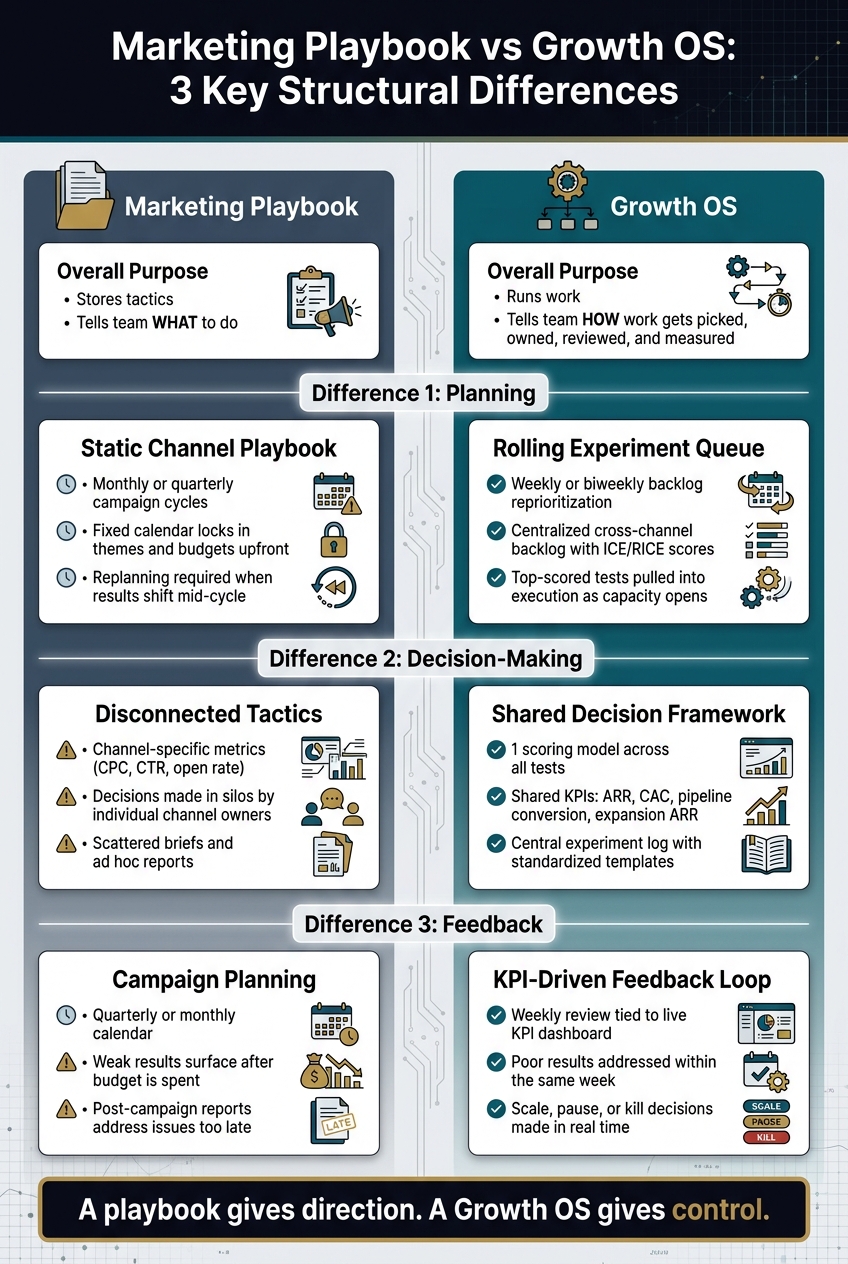
Marketing Playbook vs Growth OS: 3 Key Structural Differences
The Growth Operating System - Building Alignment, Activation, and Accountability
sbb-itb-9cd970b
Quick Comparison
| Area | Marketing Playbook | Growth OS |
|---|---|---|
| Main job | Stores tactics | Runs work |
| Planning | Monthly or quarterly calendar | Weekly or biweekly test queue |
| Decisions | By channel owner | By shared scoring model |
| Ownership | Loose | Named owner and reviewer |
| Feedback | Ad hoc | KPI review on a set rhythm |
| Data link | Separate from docs | Tied to dashboard and test log |
I see the lesson as simple: a playbook gives direction, but a Growth OS gives control.
That is why AGL built Tango. We run many marketing departments with a small team. Humans decide. Machines repeat. Nothing ships without approval. If your agency wants more output and stronger delivery without more tool sprawl, start with the run system. Start with Tango.
What Each Model Looks Like in Practice
Here’s the shift.
A marketing system is not the same as a pile of docs. One runs work. The other stores it.
That gap matters more as an agency grows. AGL learned this by running many client marketing teams with a small crew inside Tango. Humans decide. Machines repeat. Nothing ships without approval.
What a Growth OS Includes
A Growth OS is a linked workspace, not a static folder.
Its core databases are the ICP/positioning set, experiment backlog, SOP library, and KPI dashboard. The experiment backlog drives what gets worked on first. Each row is a test with fields for hypothesis, target metric, channel, owner, status, and an ICE score.
A filtered view sorts tests by score so the best bets move to the top of the weekly planning queue. Ownership is clear. Every experiment has an owner and a reviewer. Status stages like Idea → Planned → In Progress → Complete stay the same across the team.
The KPI dashboard ties the system together. It pulls in MQLs, pipeline in USD, CAC, and trial-to-paid conversion rate. Then it links each metric back to the experiments that shaped it.
That structure shapes 3 things:
- Planning
- Decision-making
- Feedback
This is why the parts matter. They change how work gets planned, approved, and measured.
What a Marketing Playbook Usually Includes
A standard marketing playbook is document-based.
It often has a channel strategy deck, a campaign calendar spreadsheet, and email and ad templates. Those items usually sit apart from live performance data. There is no experiment backlog. No ICE scoring. No built-in link between a campaign row and the KPI dashboard.
It documents work. It does not run it.
So what happens? Priority gets set in meetings. Feedback gets passed by hand. That split is why playbooks slow down when teams need faster calls and tighter feedback.
Example: System-Led Coordination at Agile Growth Labs
Agile Growth Labs runs its marketing through Tango, its own coordination system.
Work comes in through standard intake forms. It gets routed and assigned on its own. Then it moves through set workflow stages: Strategy → Draft → Build → QA → Launch → Measurement.
Nothing moves to "Launch" unless QA and approval fields are done. That keeps execution steady and cuts errors as the team grows across client accounts.
This is the lesson. A system that runs the work will beat a doc set that only describes it.
If you want stronger delivery without babysitting an AI stack, start with the structure. Map your work into clear stages, add owners and reviewers, and make sure nothing ships without approval. That is the current CTA.
Difference 1: Static Channel Playbooks vs. an Operating System for Experiments
Most agencies do not have an effort problem. They have a system problem.
A playbook tells a team what to do by channel. A Growth OS tells the team how to test, decide, and ship. That sounds like a small shift. It is not. It changes how fast work moves and how often a team learns.
At AGL, this is the heart of Tango. Humans decide. Machines repeat. Nothing ships without approval. That is how a small team can run many marketing departments at once without getting stuck in admin work.
How Work Gets Planned and Shipped
With the system in place, the first big shift is how work moves.
In a playbook, work sits on a monthly or quarterly calendar. So if something changes in the middle of the cycle, the team has to replan. You might map out a Q4 LinkedIn awareness campaign or a monthly newsletter send. If results shift 2 weeks in, decisions slow down because the plan was fixed first.
A Growth OS swaps that fixed calendar for a rolling experiment queue.
Every item enters the same backlog. A landing page test. An outbound email variant. The same rules apply to all of them. In one workspace, each test has a hypothesis, target metric, owner, and score. Then the team pulls the top item into execution as soon as there is room, not when the calendar says it is time.[1][2]
| Dimension | Marketing Playbook | Growth OS |
|---|---|---|
| Planning rhythm | Monthly or quarterly campaign cycles | Weekly or biweekly backlog reprioritization |
| Experiment backlog | Campaign task lists per channel | Centralized cross-channel backlog with ICE or RICE scores |
| Hypothesis tracking | Implicit or missing; learnings in scattered reports | Explicit hypothesis fields and stored learnings |
| Ownership | Channel owners responsible for activity delivery | Named owners responsible for experiment outcomes and decisions |
| Stop-or-scale criteria | Evaluated after the campaign ends, often subjectively | Defined before launch with quantitative thresholds |
This is why Tango matters for an agency owner.
You are not managing 5 separate client calendars and hoping each one stays on track. You are running 1 system for testing, review, and shipping. That means more output from a small team, less tool babysitting, and stronger delivery across accounts.
Why This Changes Execution Speed
The win is not just faster launch speed. It is faster decisions.[3][4][5]
When stop-or-scale rules are set before a test goes live, the team does not need another meeting to figure out what happens next. The result tells you. That trims wasted time and keeps energy on learning instead of scheduling.
So a hypothesis from a weekly growth meeting can move fast. It can be planned in the next few days and go live by the end of the week, especially for marketing copy, onboarding emails, or outbound sequence variants. A campaign calendar usually moves slower because themes, budgets, and creative need to be locked in first.[1][2]
That is the lesson here: speed comes from a shared system, not from working harder.
AGL uses Tango to make that system run. The team sets the rules once, routes work through one queue, and keeps approval in human hands. That is how a small team can ship more work for more clients without turning the agency into a mess.
If you want to see how that kind of system can fit your agency, book a call with AGL.
Differences 2 and 3: Shared Decision Frameworks and KPI-Driven Feedback Loops
Difference 2: Disconnected Tactics vs. Shared Decision Frameworks
Here’s the shift most agencies miss.
Scale does not come from adding more channel moves. It comes from giving every client team the same way to decide what matters.
In a basic marketing playbook, each channel owner makes calls inside their own lane. Paid looks at CPC. Email looks at open rate. Social looks at CTR. Those calls happen in pieces, not as one system. So the team can stay busy and still drift apart.
A Growth OS works in a different way.
It uses 1 scoring model for every move. Each test gets judged by ARR or pipeline impact, confidence, effort, and time to learn.
| Dimension | Disconnected Tactics | Shared Decision Framework |
|---|---|---|
| Decision scope | Channel-specific campaigns | Cross-channel experiments ranked by business impact |
| Decision criteria | Local metrics like CTR, CPC, or open rate | Shared KPIs like ARR, CAC, pipeline conversion, and expansion ARR |
| Ownership | Individual channel owners | Cross-functional teams using a common scoring rubric |
| Documentation | Scattered briefs and ad hoc reports | Central experiment log with standardized templates |
| Learning reuse | Stays within one channel or team | Applied across accounts, business units, or portfolio companies |
This hits hardest when you run many accounts.
Why? Because a shared rubric cuts down on back-and-forth. It also cuts founder dependency inside portfolio companies. When the decision logic lives in a system, not in 1 person’s head, new team members can suggest and rank tests without waiting for approval at every turn.
That is a big part of how AGL runs many marketing departments with a small team using Tango. Humans decide. Machines repeat. Nothing ships without approval.
The gain is simple. More output. Less chaos. No AI stack to babysit.
But a scoring model is only half the job. The team still needs a fast way to learn what worked.
Difference 3: Campaign Planning vs. KPI-Driven Feedback Loops
This is where most plans slow down.
Campaign planning ties work to the calendar. That means weak results often show up after the money is gone and the month is over.
A KPI-driven feedback loop cuts that delay down to within a week. [6][7][8]
Teams connect a small set of main KPIs, like ARR, CAC, pipeline conversion, and expansion ARR, to a live dashboard they review every week. Then each review asks the same 3 things:
- Which tests are moving the numbers?
- Which ones are not?
- Where should time and budget go next?
| Dimension | Campaign Planning | KPI-Driven Feedback Loop |
|---|---|---|
| Planning rhythm | Quarterly or monthly calendar | Weekly review tied to a live KPI dashboard |
| Primary metrics | Impressions, clicks, leads generated | ARR, CAC, pipeline conversion, expansion ARR |
| Budget decisions | Based on historical allocation | Based on measured KPI impact from active experiments |
| Response to poor results | Addressed in a post-campaign report | Addressed within the same week via scale/pause/kill decisions |
| Expansion ARR tracking | Often treated separately from acquisition | Tracked as a distinct lever alongside net-new pipeline |
A Growth OS also tracks expansion ARR next to new pipeline. That keeps acquisition and retention in the same loop.
That matters more than it sounds.
A lot of teams split new business from account growth. Then no 1 group sees the full picture. A Growth OS keeps both on the same board, so budget and effort go where the business gets paid.
This is also where Tango shows up in plain terms. The system keeps the scorecard, the review rhythm, and the repeat work in 1 place. So AGL can move faster across many client accounts without turning delivery into guesswork.
What These Two Differences Mean for Scale
Put these 2 shifts together and the effect is clear.
Shared decision rules cut random work. Weekly KPI reviews cut slow reactions. The team spends less time escalating small calls and more time pushing budget and effort toward what is working.
That is how an agency gets stronger delivery with a smaller team.
Look at your last 10 marketing decisions. If they were not ranked by the same score and checked in a weekly KPI review, start there.
Conclusion: Which One Do You Actually Need?
Here’s the realization: most teams do not stall because they lack ideas. They stall because the work has no run system.
That is the split.
A marketing playbook tells your team what to do. A Growth OS tells your team how to run the work. So the real choice is not theory. It is which setup your team can run well, every week.
At AGL, this is the shift that matters. We run many marketing departments with a small team by using Tango. Humans decide. Machines repeat. Nothing ships without approval. That is how more work gets done without adding an AI stack to babysit.
Use the 3 differences above as a quick check.
Key Points to Carry Forward
A playbook is enough when the main issue is clarity. Think pre-Series A. Think 1 to 2 channels. Think a team that needs to line up ICP, messaging, and tactics that already work.
A Growth OS is needed when the drag comes from priority, handoff, and learning speed. That shows up a lot in multi-channel SaaS teams, agencies, and PE-backed operators. The work is not just bigger. It moves in more places at once.
You have outgrown your playbook when decisions are not ranked by 1 scoring model, reviewed in a live KPI dashboard, and saved in a shared experiment log. Miss 2 of those, and you are not running a system. You are running a document.
That is the lesson. A playbook gives direction. A Growth OS gives control.
If your agency wants more output, stronger delivery, and higher retainers without more tool sprawl, start with the run system. Start with Tango.
FAQs
When is a playbook no longer enough?
There’s a point where a playbook stops being the thing that helps you grow.
That point comes when growth depends on owning and using data every week, not just repeating the same channel moves. A playbook can tell a team what to do. It can’t run the loop.
If insight does not move into a clear system, things get messy fast. You lose the thread. Teams act on guesses. Reports sit in silos. Testing slows down.
That is where AGL made a different bet.
With Tango, the goal is not just to document tasks. The goal is to turn data into a working loop with clear KPIs, dashboards, feedback, and testing. Humans make the calls. Machines handle the repeat work. Nothing goes live without approval.
That matters even more when vendors or tools change. If a platform swap can lock up your data or wipe out past performance, scale starts to crack. Your team spends more time patching holes than driving results.
A playbook helps people follow steps.
An operating system helps an agency keep learning, keep shipping, and keep control.
That’s the lesson. If you run marketing for several clients, don’t just ask whether your team has a process. Ask whether your data stays in motion inside a system your team controls.
Take 1 look at your current reporting loop today. If KPIs, dashboards, feedback, and testing are not tied together, that’s the place to start with Tango.
How do I build a Growth OS without overcomplicating my team’s workflow?
You may not need more tools. You may need fewer handoffs.
Most agency stacks get messy one app at a time. A new tool goes in. A new step gets added. Then your team spends more time moving data than using it. That is why AGL starts with the stack audit first, not the shopping list.
The lesson is simple: fix the flow before you add more software.
Start by auditing your current stack to spot bottlenecks. Look for places where work stalls, data gets retyped, or your team has to patch things by hand. Then keep the system modular. Connect tools to one central CRM hub through APIs so data stays in sync and manual handoffs drop.
That is a core part of Tango. Humans decide. Machines repeat. Nothing ships without approval. AGL uses that setup to run many marketing departments with a small team. The result is more output without an AI stack to babysit.
Roll changes out in phases. Start with 1 area, like lead generation. Set naming rules and data formats early. Define clear KPIs. Put 1 owner in charge of the data model so the system stays lean and useful.
If you want stronger delivery and higher retainers, start there. Audit your stack this week and map every handoff into your CRM first.
What KPIs should a Growth OS track first?
Start with the numbers that tell you if the account is worth more next quarter than it is today.
That means MRR, CLV, NRR, and CAC first.
Those 4 show revenue health fast. They help you see if you are growing the client, keeping good revenue, and buying growth at a sane cost. If those numbers are weak, more dashboards will not save you.
Then track the operating numbers that show how fast your team can act.
Look at time-to-insight first. A good target is under 2 days. If it takes longer than that to spot a shift, fix a drop, or push a next step, the team is moving too slow.
After that, watch the support metrics that keep delivery clean:
- Data quality scores
- Conversion rates
- Lead velocity
- Response times
This is the same logic AGL uses in Tango. Humans decide. Machines repeat. Nothing ships without approval. That setup helps a small team run many marketing departments without adding a messy AI stack to manage.