Growth Consultant vs Growth Operator: A Founder's Decision Framework

Growth Consultant vs Growth Operator: A Founder's Decision Framework
Most growth hires fail for 1 simple reason: the role does not match the bottleneck.
If I run marketing for many clients, I do not start with title. I start with the jam in the system.
- If I do not know what to do next, I need a growth consultant
- If I know the plan but it does not ship, I need a growth operator
- If I am entering a new market, I may need consultant first, operator next
- If my CRM is messy, lead follow-up is slow, or no one owns pipeline, I need an operator
- If ICP, messaging, or GTM are still fuzzy, I need a consultant
The split is simple. One role gives direction. One role runs the work.
AGL sees this every day. We run many marketing departments with a small team using Tango. Humans decide. Machines repeat. Nothing ships without approval. That is how we keep output moving without more tools to babysit.
Quick comparison
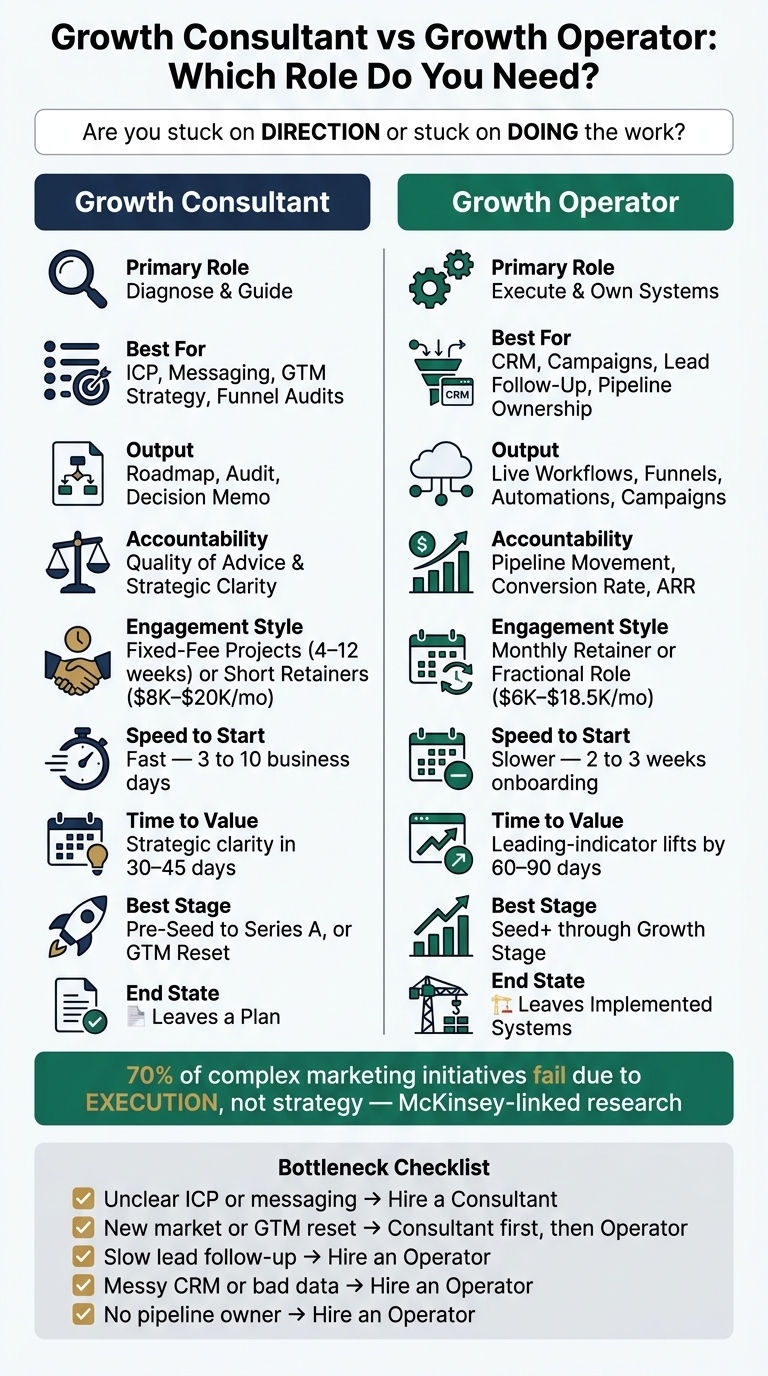
Growth Consultant vs Growth Operator: Side-by-Side Comparison
| Check | Growth Consultant | Growth Operator |
|---|---|---|
| Main job | Find the problem and set the plan | Build, run, and improve the work |
| Best for | ICP, messaging, GTM, funnel bottlenecks | CRM, campaigns, follow-up, pipeline ownership |
| Output | Audit, roadmap, decision memo | Live systems, workflows, tests, campaigns |
| Measured by | Quality of advice | Movement in pipeline, conversion, revenue |
| Usual term | 4 to 12 weeks or short retainer | Monthly retainer or fractional role |
| Best stage | Pre-seed to Series A, or reset work | Seed and up, once direction is clear |
Here is the lesson I want agency owners to keep: do not buy advice when the problem is output, and do not buy execution when the plan is still fuzzy.
One stat says a lot. Research tied to McKinsey says 70% of complex marketing work fails because of execution, not strategy. So if the plan looks fine and the work still stalls, the answer is not another memo. It is ownership.
That is also where Tango fits. AGL uses it to help a small team do more across many accounts. More output. Stronger delivery. No AI stack to babysit.
If I want the right hire, I ask 1 question first: Are we stuck on direction, or stuck on doing the work?
Then I fix that.
sbb-itb-9cd970b
What each role actually does
Here’s the key realization: these 2 roles may sound close, but they solve 2 very different problems.
If you mix them up, you don’t just hire the wrong person. You buy the wrong kind of help.
That matters even more for agencies. AGL runs many marketing departments with a small team using Tango. Humans decide. Machines repeat. Nothing ships without approval. That setup works because each role is clear. Strategy stays clear. Execution keeps moving.
Growth consultant: strategy, diagnosis, and decision support
A growth consultant looks at the business, finds the growth problem, sets priorities, and helps leaders make calls.
Their job is strategy, not day-to-day ownership.
Bring in a consultant when you need direction, not more hands on the work.
Their work often includes market positioning, ICP refinement, pricing input, funnel audits, GTM strategy, and tool picks. What you get is usually a roadmap, an audit, or a decision memo your team can use.
The consultant is on the hook for the quality of the recommendation. They are not on the hook for moving the metric after that.
So this role helps most when the problem is clarity, not capacity.
Growth operator: execution, systems, and metric ownership
When the problem is not the plan, but the follow-through, the role changes.
A growth operator works inside your team and tools. They run the work. They own results.
Use this role when you already know what needs to happen but need someone to build it, run it, and keep it moving.
That can mean:
- Building and running HubSpot or Clay workflows
- Running tests
- Fixing lead routing
- Keeping CRM data clean
- Launching outbound or lifecycle campaigns
- Owning pipeline or revenue goals
A consultant leaves you with a plan. An operator leaves you with working systems.
That’s the split.
And it ties straight to how AGL works. Tango handles repeat work. The team reviews, decides, and approves. That lets a small team act like a much bigger one across many client accounts. More output. Less tool babysitting. Better delivery.
An operator’s success is measured by business results like qualified lead flow, pipeline created, conversion lift, or revenue contribution.
That’s also why operators are often hired on a retainer or fractional basis. The work does not stop after setup. Systems get better over time. Tests give you more data. The account gets stronger as the work stacks up.
| Dimension | Growth Consultant | Growth Operator |
|---|---|---|
| Primary role | Diagnose and guide | Execute and own systems |
| Output | Strategy, roadmap, recommendations | Built workflows, funnels, automations |
| Accountability | Advice quality and strategic clarity | Business outcomes and system performance |
| Engagement style | Fixed-fee, time-boxed projects | Retainer, fractional, or ongoing |
| End state | Leaves a plan | Leaves implemented systems |
If you want the right fit, start with 1 simple move: name the bottleneck first. Is the client stuck because no one knows what to do next, or because no one is doing the work? That answer tells you which role to buy.
Growth consultant vs growth operator: side-by-side comparison
Most agencies do not have a people problem first. They have an ownership problem.
That is why this choice matters. A growth consultant gives direction. A growth operator takes that direction and runs the work. If you mix those 2 jobs, you get nice plans, slow output, and weak follow-through.
Use this table to separate advice from execution. That split shows up in strategy, delivery, cost, and stage.
| Dimension | Growth Consultant | Growth Operator |
|---|---|---|
| Strategy scope | High - market, ICP, GTM design, pricing | Medium–High - channel and experiment strategy within an agreed GTM |
| Execution scope | Light - plans, diagnostics, frameworks | Full - build, run, and optimize growth systems and campaigns |
| Accountability | Insight quality and clarity of direction | Movement in metrics: qualified pipeline, conversion rate, ARR |
| Speed to start | Fast - can kick off within 3–10 business days on a defined brief | Slower - usually 2–3 weeks of onboarding into tools, data, and team workflows |
| Time to value | Strategic clarity in 30–45 days; revenue impact depends on execution | Early leading-indicator lifts by 60 days; clearer metric trends by 90 days |
| Engagement length | Time-boxed projects (4–12 weeks) or short retainers | Ongoing monthly retainers or fractional roles (3–12+ months) |
| Best-fit stage | Pre-seed to Series A for GTM/positioning; later-stage for targeted audits | Seed+ through growth stage for pipeline and revenue system ownership |
Strategy, execution, and accountability
Consultants start with diagnosis. They look at customer interviews, win/loss data, and funnel audits and testing. The output is a sharper ICP, clearer positioning, and a ranked list of channel bets. Not a live campaign.
Operators step into that plan and do the work. They run sequences. They sort accounts in HubSpot or Clay. They launch lifecycle programs and test new plays. A consultant is judged by clarity. An operator is judged by movement in qualified pipeline, demo-to-close rate, and ARR.
This is the same split AGL uses with Tango. Humans decide. Machines repeat. Nothing ships without approval. That lets a small team run many marketing departments without turning strategy into busywork.
Speed, cost structure, and team integration
Consultants start fast because the scope is set up front. In the U.S., consultant projects often run $15,000 to $50,000+. Ongoing advisory retainers often run $8,000 to $20,000 per month. [1][2][4][6] For many agencies, that means a fixed project cost without long-term headcount risk.
Operators act more like headcount. Fractional operators usually run $6,000 to $18,500 per month. [3][5][7][8][9] They need real onboarding. Tool access. Data cleanup. Clear targets with sales and product. That takes more time at the start, but the gains build as the system gets tighter.
AGL leans into that operator model with Tango. The point is not more software to manage. The point is more output from a small team, with approval gates in place, so delivery gets stronger without adding a messy AI stack to babysit.
Stage-fit from early traction to scale
Stage matters more than most founders realize. A pre-seed team that hires an operator before it nails ICP and positioning will waste that operator on the wrong audience. A later-stage team that hires a consultant while the CRM is messy and pipeline is stuck may get sharp direction, but not the lift they need in-market.
Earlier-stage teams usually need a consultant to answer what to build and who to target. Once the ICP is clear and the funnel is in place, an operator can take over. Mature teams often use both. A consultant resets the plan. An operator keeps the machine moving.
AGL has seen this play out in practice. When the bottleneck is decision-making, strategy helps. When the bottleneck is output, Tango helps a small team execute across many client accounts with more control and less drag.
Next, use your bottleneck to choose the right role.
A founder's decision framework
Most hiring calls feel like people calls. They are not. They are bottleneck calls.
This is where a lot of founders get turned around. They compare job titles, not the actual jam in the system. The table above starts to help only when you name the bottleneck first. Then the role choice gets a lot simpler.
Start with the bottleneck: unclear strategy or broken execution
Strategy issues look like this: unclear ICP, weak positioning, or a funnel that moves up and down with no clear reason.
Execution issues look different. Lead follow-up is slow. CRM data is messy. No one owns the pipeline day to day.
Leads contacted within 5 minutes convert far better than those contacted after 30 minutes. Yet average response times are still much slower [10][11][12]. That is not a strategy miss. That is an operator-shaped gap in pipeline ownership.
At AGL, this is the kind of split that matters. Humans decide. Tango repeats the work. Nothing ships without approval. So if the plan is sound but the machine is not moving, you do not need more advice. You need someone to own the flow.
Once you know the bottleneck, use the next 5 checks to make the call.
| Bottleneck | Best-fit role |
|---|---|
| Unclear ICP, messaging, or funnel | Consultant |
| New market or GTM reset | Consultant first, then operator |
| Slow lead follow-up or poor response time | Operator |
| Messy CRM or bad data hygiene | Operator |
| No experiment cadence or pipeline owner | Operator |
Criteria founders should score before hiring
Score 5 areas: strategy clarity, team readiness, KPI ownership, 90-day urgency, and operating leverage.
Here is the simple read:
- Highest uncertainty in strategy points to a consultant.
- Highest gap in execution or ownership points to an operator.
This is the same lesson AGL uses across client accounts. When the problem is direction, set the call. When the problem is throughput, build the system owner around Tango.
Common hiring mistakes and red flags to watch for
Before you sign, check for these failure points.
- Vague deliverables or no named KPI owner.
- No handoff plan between advice and execution.
- No 30-, 60-, and 90-day success markers.
If ownership is unclear, the hire is premature.
Conclusion: match the role to the bottleneck, not the title
Here’s the big shift: the hire is not about status. It’s about flow.
Once you see the bottleneck, the choice gets simple. Consultants help founders make better growth calls. Operators turn those calls into working systems with numbers you can track.
McKinsey-linked research suggests 70% of complex marketing initiatives fail because of execution, not strategy.[13] So when the plan is fine but work keeps stalling, you do not need another strategy pass. You need someone who can make the machine run.
That is why AGL built Tango. We run many marketing departments with a small team by matching the role to the constraint. Humans decide. Machines repeat. Nothing ships without approval. That setup helps teams get more out the door without adding AI systems that automate growth to manage by hand.
For agency owners, the lesson is plain. If strategy is muddy, bring in a consultant. If delivery is breaking, bring in an operator. Match the role to the bottleneck you have, then use a system like Tango to keep output moving with control.
If you want stronger delivery without more headcount drag, look at the constraint first. Then fix THAT.
FAQs
Can one person handle both roles?
It often clicks late: the same person who can get a business off the ground can also become the thing that slows it down.
It depends on your stage and your team capacity. Yes, 1 person can handle both strategy and execution in theory. But doing both well usually creates founder dependency. And that puts a cap on scale.
Growth needs 2 things at once. It needs clear positioning. It also needs steady execution. When 1 person owns both, process docs are often the first thing to slip.
That matters more than most agency owners think. If the work lives in 1 person’s head, the business gets harder to grow, harder to hand off, and harder to sell.
At AGL, that’s the gap Tango helps close. Humans decide. Machines repeat. Nothing ships without approval. That setup lets a small team run many marketing departments without building a messy AI stack or tying delivery to 1 founder.
If you want more output without more chaos, start with 1 move: separate decision-making from repeat work.
When should I hire a consultant first, then an operator?
You need to split 2 jobs that agencies often lump together.
Hire a consultant first when you need a clear plan. That means finding funnel bottlenecks, tightening market position, or setting your go-to-market approach.
At AGL, that split matters because Tango handles repeat work, not judgment. Humans decide what to do. Machines do the repeat steps. Nothing goes live without approval.
Then bring in an operator once the plan works and the system is set. That person runs tests, manages tools like HubSpot or Clay, and owns pipeline or revenue targets.
That is how a small team can run many marketing departments. The lesson is simple: strategy first, execution second. If you want stronger delivery without more tool chaos, start by fixing who owns each job.
Current CTA: See how Tango helps AGL run more client work with a small team.
What if I’m not sure what my real bottleneck is?
A lot of agency owners look for the next tool first.
That’s usually the wrong place to start.
If you’re not sure where your bottleneck is, audit the work before you buy anything. Don’t guess. Check your data. Check your workflows. Look at how work moves from one step to the next.
Review your lead gen, sales, support, and analytics. You’re looking for friction. That often shows up in manual tasks, split-up systems, or follow-ups that happen late or not at all.
At AGL, this is the first move in Tango. Humans decide what matters. Machines repeat the steps. Nothing ships without approval. That’s how a small team can run many marketing departments without adding an AI stack to manage.
If you want a simple way to score the mess, tools like the Marketing Stack Complexity Index (MSCI) can help. It can flag issues like tool overlap and integration debt.