Revenue Operating System: The 6 Components Every $5M+ SaaS Needs Wired
Revenue Operating System: The 6 Components Every $5M+ SaaS Needs Wired
Here’s the realization: at $5M ARR, revenue slips less from bad channels and more from loose handoffs.
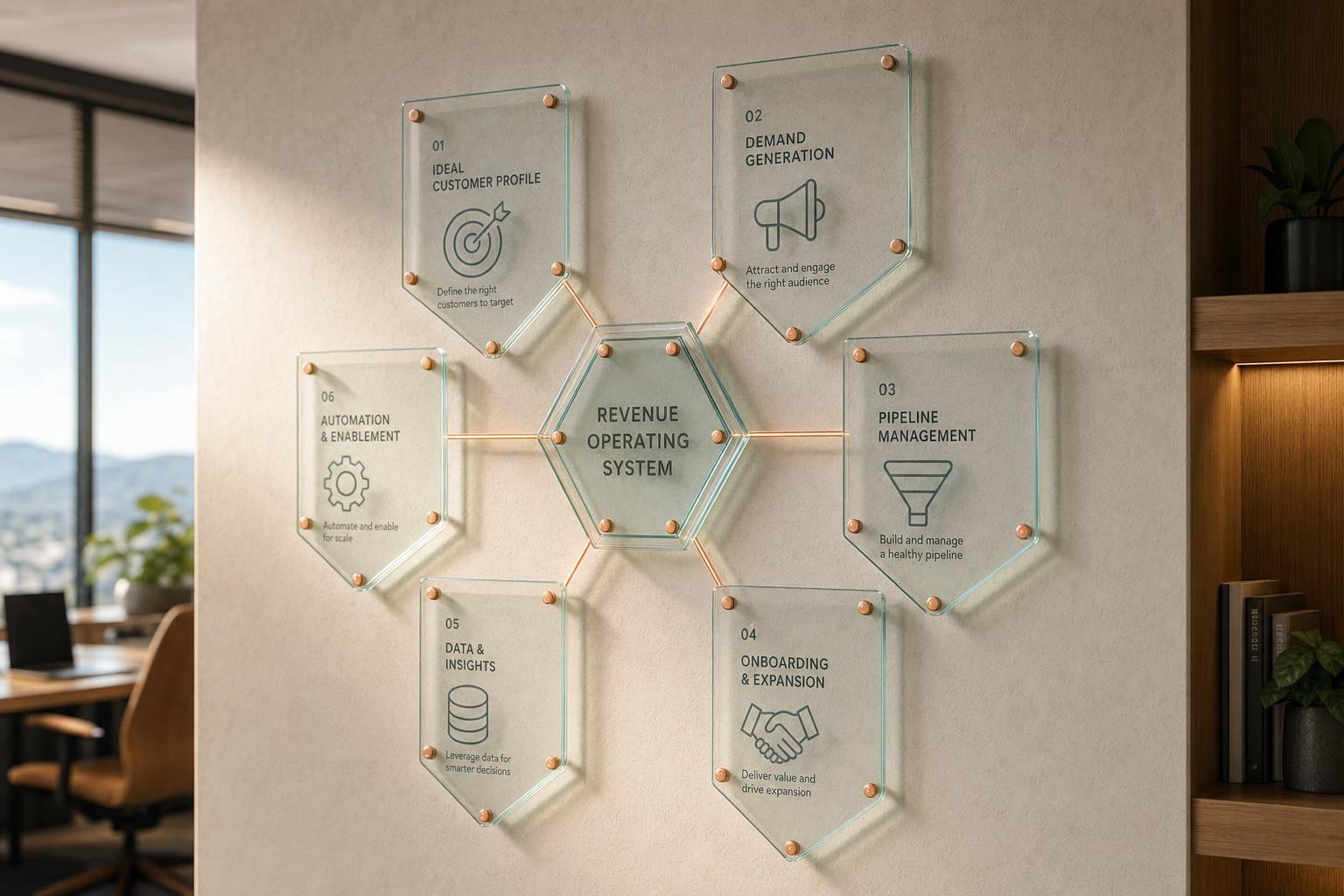
If you run marketing across several clients, this is the part that changes the game board. A SaaS company past $5 million ARR needs 6 parts tied to 1 revenue model: ICP, demand gen, pipeline, AI lead-gen playbooks, onboarding and expansion, data and forecasting, and RevOps-owned automation. When even 1 part is loose, you get slower lead follow-up, weak forecasts, and churn that should have been seen earlier.
A few numbers make the point fast:
- ICP-fit accounts win 68% more often
- High-intent leads answered within 5 minutes can close at 21% to 32%
- Median SaaS first-touch time is still 48 minutes
- Strong RevOps teams see 23% higher forecast accuracy, 28% lower CAC, and 12% shorter sales cycles
- Healthy NRR starts near 105% and strong NRR reaches 120%
The lesson is simple. Revenue at this stage is a rules problem. AGL runs many marketing departments with a small team using Tango. Humans decide. Machines repeat. Nothing ships without approval. That is how the team gets more output, keeps delivery tight, and avoids an AI stack to babysit.
If I were checking this article for what matters most, I would look for these 6 parts first:
- Positioning and ICP
- Demand generation
- Sales pipeline rules
- Onboarding, retention, and expansion
- Data, attribution, and forecasting
- Tech stack automation and RevOps ownership
One lesson: a half-wired revenue system will leak money even when each team looks busy.
One action: take a hard look at your handoffs and start wiring your Revenue Operating System, 1 connection at a time.
AI Ops: How We Run RevOps for 30 SaaS Companies at Once | Jake Toepel, CTO at LeanScale
sbb-itb-9cd970b
What 'Wired' Actually Means at $5M+ ARR
At $5M+ ARR, growth stops being just a traffic or pipeline job. It becomes a wiring job.
That’s the shift. The agencies that hold up at this stage are not just doing more work. They run a system where teams use the same terms, read the same data, and know who owns the next move.
Wired means shared definitions, shared data, shared workflow triggers, and shared accountability that stop revenue leaks. Marketing, sales, CS, finance, and RevOps all agree on what an MQL is, what makes a deal closed-won, and who takes the next step when a customer shows a churn signal.
Here’s what that looks like in practice.
A demo request hits your form. In a wired system, that event enriches the record, routes it to the right rep within minutes, logs the source in the CRM, and starts a qualification workflow. The trigger starts the action. The SLA is clear. No one is guessing.
That’s the lesson here: scale breaks when teams use the same tools but different meanings.
The definitions you lock in first matter a lot:
- ICP
- lead stages
- MQL
- SQL
- opportunity exit criteria
- closed-won
- churn
- NRR
- attribution rules
Your metric formulas need to match too. ARR, MRR, CAC, and ACV should mean the same thing on every dashboard.
Without 1 dataset, teams miss where value leaks across the funnel.[4] And the leaks are rarely dramatic at first. They look small. A lead sits untouched. Sales qualifies 1 way, marketing another. A promise made in the sale never gets passed to CS. A spreadsheet starts telling a different story than the CRM.
Then the cost shows up. Longer sales cycles. Lower win rates. Surprise churn.
At $5M+ ARR, you have enough volume for small leaks to turn into material loss in CAC, conversion, and retention.[4] Even 1 fuzzy handoff between sales and CS can do damage. If the success team does not know what was promised in the sale, churn stops being a mystery. It becomes the result of a broken system.
This is a big part of how AGL runs many marketing departments with a small team using Tango. Humans decide. Machines repeat. Nothing ships without approval. The point is not more tools. The point is a system that keeps work moving, keeps handoffs clear, and cuts the drift that hurts delivery.
Start with 1 move: wire your positioning and ICP first.
1. Positioning and ICP Definition
Here’s the realization: most agencies do not have a lead problem. They have a filter problem.
Your ICP is not a nice deck for a quarterly meeting. It is the rule that tells your team who should get attention and who should not. In a wired RevOS, ICP works like routing logic. It shapes who buys, who grows, and who stays.
It should cover firmographics, tech stack, buying signals, and deal economics. If that filter is loose, everything after it gets messy. Routing slips. Scoring gets fuzzy. Onboarding starts with the wrong clients.
The numbers make that plain. ICP-fit accounts win 68% more often than non-ICP accounts[7]. But only 18% of pipeline in 2024 matched ICP in a large opportunity study[9]. And the median B2B SaaS company still gets 31% of its pipeline from non-ICP accounts[7].
That is not a sales miss. It is a definition miss.
At AGL, this is one of the first things Tango helps make usable. Humans set the rule. Machines repeat the checks. Nothing moves without approval. That is how a small team can run many marketing departments without letting bad-fit accounts slip through and waste time.
Positioning comes next. Once you know who you want, you need a plain story your whole team can use. That story should answer 4 things: who the product is for, what it does for them, why it is different from other options, and why buyers should believe it[6].
This is not fluffy brand work. It is part of your revenue system.
When positioning is vague, sales reps make up their own pitch. Then CS gets clients who expected something else. After that, churn is not a shock. It is the outcome you set up.
A simple ownership model keeps this from drifting:
- Product Marketing or Marketing owns ICP and positioning
- RevOps puts it into CRM and routing rules
- Sales and CS check it in the field
- The CEO or CRO signs off on big changes
Keep it in 1 source of truth. Check it every quarter. If you do not, the loudest story in the room starts to replace the facts.
The handoff rules are what make this work day to day. Marketing should pass leads only when they meet the written ICP rules and show a qualifying intent signal. Sales should confirm ICP fit in discovery and log it in CRM fields before moving the deal ahead. CS should wait to start onboarding until the closed-won deal has a written success plan tied to the positioning promise.
That structure pays off. B2B teams with documented ICP-based segmentation see 1.7x higher marketing-sourced conversion than teams without it[8].
One lesson here: if ICP lives only in a slide, it will fail. It has to live inside the way work moves.
If you want the AGL way, start with 1 move: audit your last 20 opportunities, mark which ones matched ICP, and then build that rule into your CRM the way Tango would. That is how you get more output, tighter delivery, and a team that does not waste hours on the wrong accounts.
2. Demand Generation Engine
Here’s the shift. Demand gen is not a pile of channels. It is a system for turning signals into pipeline.
Once ICP is set, the job gets simple. Catch the right signal. Route it to the right person. Confirm fit. Then count it as pipeline. That path needs to be written down in CRM and automation.
A paid LinkedIn campaign is a good example. An MQL should go to the right SDR pod. The rep should reply within 2 business hours. And the lead should move forward only after discovery shows fit. If that path is fuzzy, leads sit. Or they bounce around. Or they get counted too early.
This is where Tango helps AGL run a lot with a small team. Humans decide the rules. Machines handle the repeat work. Nothing ships without approval. That means more output without a messy AI stack to babysit.
Speed is a big deal here. Bigger than most teams think.
Responding to a high-intent inbound lead within 5 minutes can lead to close rates of 21% to 32%, versus about 12% for next-day replies. [12][14] Yet the median first-touch time in SaaS is still 48 minutes, and only 24.6% of teams reply in under 5 minutes. [13]
That gap is where pipeline slips away.
High-intent actions like these should move in near real time:
- demo requests
- pricing page visits
- product signups
Each one should trigger an alert, assign an owner, and move fast. Lower-intent downloads can go into a normal follow-up cadence.
But speed alone will not save the system. You also need reporting that shows where the leak happened. If not, you are just moving bad process faster.
Your dashboard should track demand, pipeline, and revenue health. That means metrics like volume, conversion, coverage, velocity, booked ARR, win rate, and forecast accuracy. [11] One benchmark source found median pipeline coverage at 3.2x, MQL-to-SQL conversion at 13%, SQL-to-won conversion at 22%, and marketing-sourced revenue at 36% of total. [10]
Those numbers give you a clean gut check. If your MQL-to-SQL rate is well under 13%, the issue is usually one of 3 things:
- scoring
- routing
- ICP definition
That is the lesson. Demand gen works when routing, speed, and feedback loops work together.
AGL uses Tango to keep that loop tight across many client accounts. Sales disqualification data feeds back into scoring and targeting. So if one content offer keeps pulling in non-ICP accounts, the campaign gets fixed that same month. Not next quarter. That is how you get stronger delivery and defend higher retainers.
Take 1 step today. Check your highest-intent path. Pick demo requests or pricing page visits. Then map the full route from trigger to owner to qualification inside CRM.
If you want a team that can run more marketing departments without more headcount, AGL and Tango are built for that.
3. Sales Pipeline Architecture
Here’s the shift.
A pipeline is not a CRM view. It is a control system.
Once demand gen sends the lead to the right place, the pipeline decides if that lead turns into revenue you can trust. A lot of $5M+ SaaS companies still let reps decide what a stage means. That creates forecast noise. It also hides missed revenue.
The fix is stage discipline.
Each stage needs a clear entry rule and a clear exit rule. Those rules should tie to buyer actions, not rep gut feel. If 1 rep calls a deal Discovery after 1 call, and another waits for a full pain review, the stage means nothing. Then the forecast means nothing too.
This is where AGL’s Tango system matters. Humans decide the rules. Machines repeat the checks. Nothing ships without approval. That is how a small team can run many marketing departments and still keep output tight.
A Series B SaaS company rewrote its stage definitions around exit criteria and rebuilt its forecast in Salesforce. It moved from ±25% forecast variance to ±6% in 2 quarters.[2] That kind of change happens when every Discovery deal means the same thing across every rep, using the same ICP and qualification language set earlier.
The math is simple.
Weighted pipeline = deal amount × stage probability, and those probabilities should come from past data.[15] Without fixed stage definitions, weighted pipeline is just a nice-looking guess, lacking the SaaS metrics needed for accuracy.
The split is simple too:
- Marketing owns lead qualification
- Sales owns stage movement
- Any rejection needs a reason code
- That data should feed scoring and targeting back upstream
You also need a few guardrails in place:
- Exit criteria for each stage
- Required fields before a stage can change
- Stage-age alerts so deals do not sit untouched
- Closed-lost reason codes so losses teach the system something
If you run new business, expansion, and renewals, keep them in separate pipelines. They move at different speeds. They need different stage rules. Put them in 1 view, and coverage ratios get warped. Risk gets harder to see.
That is the lesson.
If you want stronger delivery, better forecasts, and a setup that lets a small team do more without an AI stack to babysit, build stage rules first. That is how AGL uses Tango to help agencies run more work, keep quality high, and earn higher retainers.
One action: audit each pipeline stage today and write 1 exit rule for each before you touch anything else.
4. Onboarding, Retention, and Expansion Lifecycle
Here’s the shift. The sale is not the finish line. For an agency, it is the point where delivery has to start fast and clean.
That is how AGL runs many marketing departments with a small team using Tango. Humans decide. Machines repeat. Nothing ships without approval. The handoff is not a loose email or a Slack note. It is a system.
After stage exit rules, the next control point is post-sale handoff.
Closed Won should start a new workflow, not a manual handoff. The same exit rules that move a deal forward should also start implementation ownership. When a deal closes, CRM should create the onboarding project, assign a CSM, and sync the account into CS on its own.[16][18][21]
That matters for one simple reason. The first client call should be about doing the work. Not re-learning the deal.
So the handoff needs to bring over:
- contract terms
- success criteria
- champion map
- scope
- implementation notes
That way, the first customer meeting is about execution, not discovery.[17][19][20]
The timing also needs to be tight. Best-practice SLAs are clear: internal AE-to-CSM transfer within 24 hours, warm intro email within 48 hours, and a joint kickoff call within 3 to 5 business days.[16][21][22]
This is the lesson. If onboarding starts by hand, client trust drops by hand too.
Retention works the same way. Health scores should track workflow completion, active users vs. licensed seats, feature breadth, renewal date, and billing status.[26][28]
A login alone does not mean the account is safe. If a client logs in but never finishes the set of actions that brings value, that account is at risk. The score should show that as a renewal timing flag and an expansion priority, not just a usage stat.
That is where many teams miss the plot. They look at activity. They should look at progress.
Healthy NRR starts around 105%. Strong NRR reaches 120%.[23][24]
Expansion also belongs inside CS. Track Expansion MRR apart from new business. That includes seat growth, plan upgrades, add-ons, and usage overages. Then roll it into NRR.[25][29][30]
If CS only owns renewals, money gets left on the table. Measure CS on expansion MRR and NRR, not just logo retention.[27]
This is a big part of the Tango system at AGL. The machine moves the account data, tasks, and owners. The human team makes the call, sets the plan, and approves what goes out. That is how you get more output without a messy AI stack to babysit. It also helps you deliver more, hold higher retainers, and build an agency worth more when it sells.
That lifecycle data should feed forecasting, attribution, and expansion reporting. If that view takes more than 1 screen, the system is not wired.
One action: map your Closed Won trigger today. Make sure it creates the onboarding project, assigns the owner, and carries the deal context into CS with no manual gap.
5. Data, Attribution, and Forecasting Layer
Here’s the shift: lifecycle data is not a reporting task. It is how an agency runs like 1 team, even when many people touch the account.
If marketing, sales, and finance each tell a different revenue story, speed drops. Trust drops too. Then every meeting turns into a numbers check instead of a decision.
AGL deals with this by using Tango as the operating system behind delivery. Humans decide. Machines repeat. Nothing ships without approval. That matters here because the same rule applies to data. If the handoff logic is messy, the output is messy too.
Use CRM as the system of record, billing as the revenue source, and the warehouse as the shared truth layer.[31][32][33]
That setup keeps each system in its lane.
- CRM tracks accounts, contacts, and opportunities
- Billing tracks what got paid
- The warehouse gives every team the same read on performance
The big rule is simple. Every account, contact, opportunity, and subscription needs 1 shared ID across CRM, product, and billing. Without that, a lead can turn into an opportunity under 1 ID and a customer under another. Or revenue gets counted 2 times. Or not at all.[34][36]
Once identity is clean, attribution gets less messy.
Use 3 models for 3 jobs:
- first-touch for demand source
- multi-touch for pipeline influence
- revenue attribution for closed-won
Do not force 1 model to answer all 3. It won’t. That is where teams start arguing over reports instead of reading them. Keep ownership tight too. Marketing owns sourced pipeline. RevOps and finance own booked ARR.[33][35]
Executive dashboards should show pipeline coverage, stage conversion and aging, ARR and NRR by cohort, churn and expansion, and revenue by source.[37]
Each metric needs 3 things:
- a plain-English definition
- a refresh cadence
- 1 person who explains variance
That last part matters more than most teams think. If no one owns the number, no one trusts the number. And if a leader needs a second tab to check a metric, this layer is still broken.
When CRM, product, and billing share 1 customer ID, forecast, CS, and finance all read the same account in real time. That is the point. Not more dashboards. More agreement.
This is also where Tango helps agencies punch above their size. AGL runs many marketing departments with a small team because the repeat work is mapped, checked, and routed the same way every time. The payoff is more output, stronger delivery, and no AI stack to babysit. Data should work the same way. Clean inputs. Clear owners. One revenue story.
If leaders still read the same numbers in different ways, the system is still split.
Then the next gap is automation and RevOps ownership.
Want to see how AGL uses Tango to run more client work with a small team? Let’s talk.
6. Tech Stack Automation and RevOps Ownership
Here’s the shift: the stack does not get messy because teams move fast. It gets messy because no one owns the rules.
Once the data model is clean, RevOps should own the rules, automations, and reporting layers that keep the other 5 parts tied to 1 revenue model [38][40][42].
That means RevOps owns the architecture, admin rights, and change management for the core stack. This includes CRM, marketing automation, CS, billing, and BI or warehouse systems.
IT owns security and compliance.
RevOps owns how the systems connect. It sets which system owns each object, how syncs work, and what happens when data conflicts show up. Standard fields and lifecycle stages keep sales, marketing, and CS working from the same model.
This is also where automation starts to pay off.
A demo request should create an SDR task within 15 minutes. A usage drop below a set threshold should trigger a CS risk alert before the account slides toward churn. These are system-set SLAs. They cut the manual chasing that slows teams down [39][41][43].
The payoff is clear. Companies with strong RevOps teams see 23% higher forecast accuracy, 28% lower CAC, and 12% shorter sales cycles than peers with split GTM systems [44].
At AGL, this is the kind of work Tango is built to handle. Humans decide the rules. Machines repeat the steps. Nothing ships without approval. That lets a small team run many marketing departments without adding an AI stack to babysit.
Governance matters just as much.
Every new field, tool, or integration should need:
- a documented request
- an impact check
- RevOps sign-off before launch
Without that gate, the stack turns into clashing rules, duplicate records, and reports no one trusts. A light intake process keeps testing open without breaking production.
If the stack still needs heavy manual review, it is not wired yet.
When 1 function owns the wiring, reconciliation drops and forecast variance gets tighter.
Find the weakest ownership gap in your stack. Then fix that first.
Book a call to see how AGL and Tango help agencies run more client marketing with a small team.
Revenue Operating System Scorecard: Find Your Gaps
Here’s the shift. Most $5M+ SaaS companies are not missing a revenue system. They already have one. It’s just wired halfway.
That matters because half-wired systems leak money in quiet ways. A handoff breaks. A dashboard lies. A rep works from 1 set of stage rules while finance uses another. The issue is not building more. It is finding the first leak that costs the most.
Use this scorecard to spot where the wiring is weak.
Score each part as Missing, Partially Wired, or Fully Wired based on 3 things:
- who owns it
- how it connects to the rest of the system
- whether reporting is clean and trusted
The goal is not a perfect score. The goal is to find the first expensive leak.
| Component | Missing | Partially Wired | Fully Wired |
|---|---|---|---|
| 1. Positioning & ICP | ICP lives in someone's head; no written definition | ICP documented but not used in CRM, campaigns, or pipeline reviews | ICP tiered, built into CRM fields, and measured by win rate and NRR |
| 2. Demand Generation | No source-level targets; sporadic campaigns | Channels defined but attribution is single-touch; handoff SLAs inconsistent | Multi-touch attribution, documented lead definitions, and shared funnel dashboard |
| 3. Sales Pipeline | Stage definitions vary by rep; forecasts built in spreadsheets | Stages exist but entry/exit criteria aren't enforced; forecast variance of 30–40% | Strict stage criteria, stage-based close probabilities validated against history, +/- 10% forecast variance |
| 4. Onboarding & Retention | No standard onboarding; expansion is reactive | Onboarding checklist exists but no time-bound milestones or activation criteria | Documented lifecycle stages, clear owners per stage, health scores tied to expansion |
| 5. Data & Attribution | No central data model; finance and sales use different ARR numbers | Some integrations exist but syncs are fragile; reports not trusted | Single source of truth, clean CRM data, reliable NRR/GRR/pipeline and segment-level reporting |
| 6. Tech Stack & RevOps | No clear owner for the operating model; automations are ad hoc | RevOps exists, but governance is informal and architecture/integration rules aren't consistently enforced | RevOps owns architecture, integration, and governance; processes and tools follow one governance model |
Do not try to fix all 6 at once.
Start with the gap that loses the most money. One 2026 GTM benchmark found that B2B SaaS companies commonly leak between $1M and $2M in annual revenue from GTM gaps, with slow lead response and poor routing among the largest contributors. [45]
That is the lesson AGL keeps proving with Tango. You do not need a bigger team to patch every weak point at once. You need 1 clear system, 1 clear owner, and repeatable workflows that machines can run while humans check the work before anything goes live. That is how AGL runs many marketing departments with a small team. More output. Less tool babysitting. Better delivery.
Next, map the workflows and dashboards that close the highest-risk gap.
The Systems, Workflows, and Dashboards That Keep Revenue Connected
Most agencies do not lose money in one big miss. They lose it in handoffs.
That is the big shift here. Revenue stays tied together when your team agrees on definitions, runs clear workflows, and checks a few live dashboards. That is how AGL runs many marketing departments with a small team using Tango. Humans decide. Machines repeat. Nothing ships without approval.
Start with the handoff.
Set up an operationalized ICP in CRM. Use a stage model with forced entry and exit rules. Then use Closed Won triggers to start onboarding on their own. That means the system should create the project, assign the CSM, and kick off the welcome sequence right away. Use Gainsight, Vitally, or ChurnZero for CS. Use HubSpot workflows or Salesforce Flows for the handoff.[51][53]
This is where Tango does the repeat work. AGL used that setup to keep delivery moving without adding tool chaos. The point is simple. Your team should not babysit steps a system can run the same way every time.
After that, check account health.
A health score shows if the setup works in practice or just looks neat in a report. Score usage, engagement, support, and commercial signals on a 0 to 100 scale. Weight the score by segment. Then tie the score to action. If it drops below 50, create a CSM task and send an internal alert.[52][56]
That part matters. A score with no next step is just decoration.
Health scores show who needs help. The MRR waterfall shows if the whole system is growing or leaking.
Build an MRR waterfall that shows New, Expansion, Contraction, and Churned MRR. That makes it plain where growth comes from. It also shows if contraction is building before churn hits. Pair that with multi-touch attribution so you can tie campaigns to pipeline and closed-won revenue.[46][54]
Build the waterfall in Looker, Tableau, or Metabase. Pull data from Stripe, Chargebee, or Zuora. Then put it into every monthly business review and board report.[48][47]
Do not cram all of this into 1 giant exec dashboard.
Keep 3 operating views. Give each view 1 owner. Give each view 1 cadence.
| Dashboard | Cadence | Metrics | Owner |
|---|---|---|---|
| Pipeline & Forecast | Weekly | Pipeline velocity, coverage ratio, forecast vs. actual | RevOps / CRO |
| Retention & Expansion | Monthly | NRR, GRR, MRR waterfall by cohort and segment | CS / RevOps |
| SLA & Operating Health | Daily | Speed-to-lead, routing accuracy, data quality score | RevOps |
The targets are clear: NRR of 110% to 130%, GRR above 90%, and forecast accuracy within ±10% of actual.[48][50]
None of this holds together without 1 owner.
RevOps should own the GTM map, intake process, and change rules across Salesforce, HubSpot, Gainsight, and the warehouse. That keeps metric definitions lined up. It also keeps the setup from drifting as the team and tools change.[49][55]
That is the lesson. Connected revenue is not magic. It is a system.
If you want the same kind of output AGL gets with Tango, start with 1 handoff this week. Make it automatic. Keep human approval in place. Then build from there.
Unwired GTM vs. a Revenue Operating System: Side-by-Side Comparison
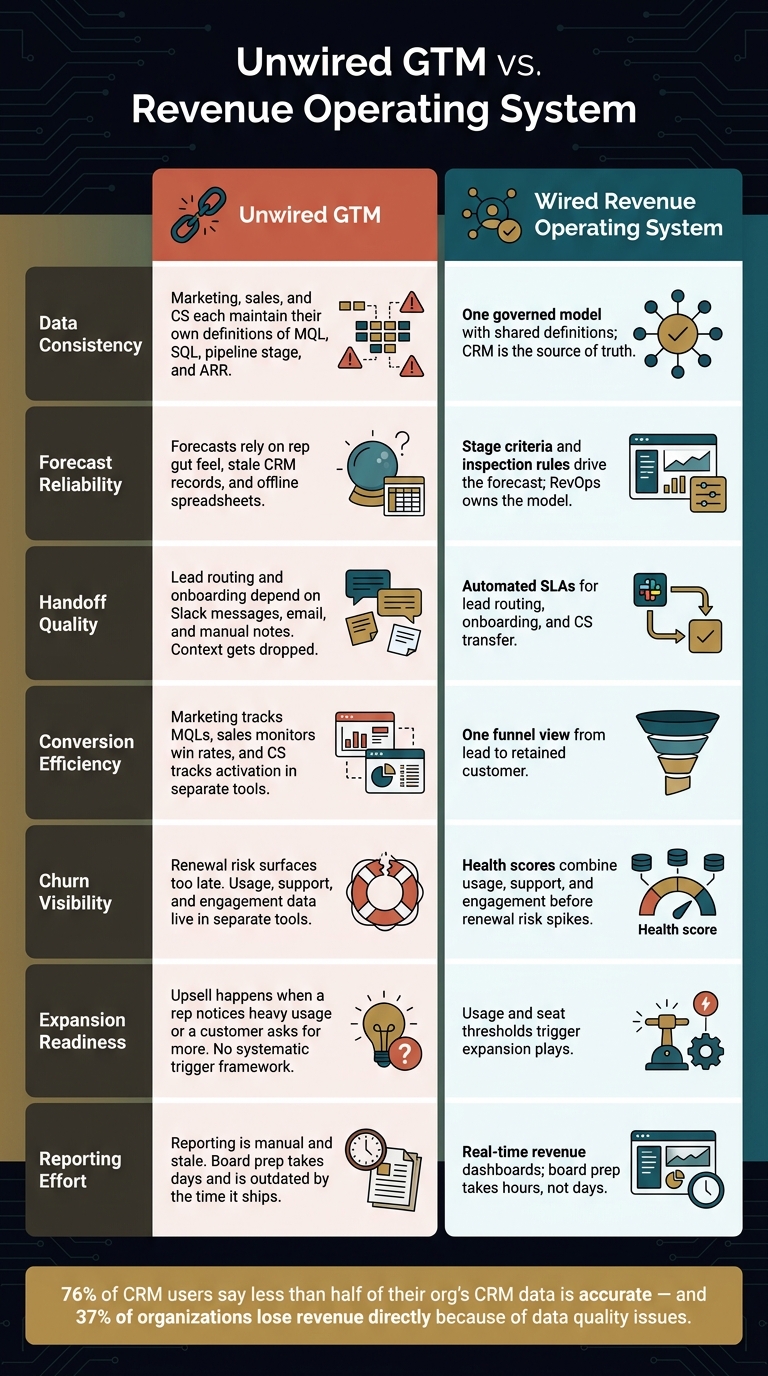
Unwired GTM vs. Revenue Operating System: 7-Point Comparison
Here’s the shift most agencies miss: growth problems often look like channel problems. But the leak is usually the system behind the work.
When GTM is unwired, teams work from different facts. That shows up in 3 places fast: bad data, slow handoffs, and churn that hits out of nowhere. A Revenue Operating System fixes that by giving every team one model, one flow, and one view of revenue.
According to Validity's 2025 CRM data management report, 76% of CRM users say less than half of their organization's CRM data is accurate and complete, and 37% of organizations lose revenue directly because of data quality issues.[59][60]
At AGL, this is the lesson behind Tango. Humans decide. Machines repeat. Nothing ships without approval. That’s how a small team can run many marketing departments without the usual mess of disconnected tools and manual follow-up.
Use these 7 checks to see where your revenue system is still split.
| Dimension | Unwired GTM | Wired Revenue Operating System |
|---|---|---|
| Data consistency | Marketing, sales, and CS each maintain their own definitions of MQL, SQL, pipeline stage, and ARR. | One governed model with shared definitions; CRM is the source of truth. |
| Forecast reliability | Forecasts rely on rep gut feel, stale CRM records, and offline spreadsheets. | Stage criteria and inspection rules drive the forecast; RevOps owns the model. |
| Handoff quality | Lead routing and onboarding depend on Slack messages, email, and manual notes. Context gets dropped. | Automated SLAs for lead routing, onboarding, and CS transfer. |
| Conversion efficiency | Marketing tracks MQLs, sales monitors win rates, and CS tracks activation in separate tools. | One funnel view from lead to retained customer. |
| Churn visibility | Renewal risk surfaces too late. Usage, support, and engagement data live in separate tools. | Health scores combine behavioral segmentation, support, and engagement before renewal risk spikes. |
| Expansion readiness | Upsell happens when a rep notices heavy usage or a customer asks for more. No systematic trigger framework. | Usage and seat thresholds trigger expansion plays. |
| Reporting effort | Reporting is manual and stale. Board prep takes days and is outdated by the time it ships. | Real-time revenue dashboards; board prep takes hours, not days.[57][58] |
The pattern is simple. Unwired GTM creates split truth. A Revenue Operating System creates one.
That matters for agencies with several clients. If each client has 1 version of lead stages, handoffs, and reporting in your team’s head, output slows down. If each client has a wired system, your team moves faster and spend less time fixing avoidable misses.
Pick the first leak you see. Then wire that workflow and dashboard the Tango way.
Conclusion
Here’s the shift. At $5M ARR, growth stops being about hustle and starts being about rules.
Before that point, teams can get by with loose handoffs and gut feel. After that, small gaps turn into lost revenue. One team says one thing. Another team does something else. The leak starts there.
Companies that keep growing past this mark connect positioning, demand gen, pipeline, lifecycle, data, and automation to 1 shared set of rules. That is the model. Each part feeds the next. That is what wired means. No isolated wins. No messy handoffs.
The payoff shows up in the numbers. B2B companies with tightly aligned GTM operations report 24% faster 3-year revenue growth and 27% faster 3-year profit growth than companies stuck in silos.[3][1][61] One Series B SaaS at about $18M ARR rewired its data model and handoffs, then grew ARR 47% in 12 months while forecast accuracy climbed from 68% to 91%.[5] That is not a channel win. That is a systems win.
At AGL, that’s the same idea behind Tango. Humans decide. Machines repeat. Nothing ships without approval. That’s how a small team can run many marketing departments without adding a pile of tools to manage. More output. Better delivery. Stronger retainers. More value when the agency sells.
Pick the 1 part your team keeps bypassing. Find the first broken handoff. Fix that first break.
Then move to the next.
Current CTA: Take a hard look at your handoffs and start wiring your Revenue Operating System, 1 connection at a time.
FAQs
Where should we start if our RevOS is only half-wired?
It usually hits all at once. Your client does not have a data problem. They have a control problem.
Customer data sits in 5 places. The team can see some of it. No one can use it without help from 3 other people. That slows every move. It also keeps the agency stuck in cleanup work instead of growth work.
Start with an honest audit of the customer data. Look at where it lives, who can reach it, and whether the team can act on it on their own.
Do not try to fix the whole mess in 1 pass. Pick 1 owner for the commercial data model. Then stack the work in the order that touches revenue first.
That usually means:
- usage
- billing
- support
This is the same thinking behind Tango at AGL. Humans decide. Machines repeat. Nothing ships without approval. That is how AGL runs many marketing departments with a small team and keeps output high without adding more tools to manage.
The lesson is simple. Do not start with more data. Start with clear ownership and the few data feeds that change revenue.
If you want to see how AGL uses Tango to do this at scale for clients, book a call.
Who should own the Revenue Operating System internally?
A lot of agencies think a revenue system is a tool set. It’s not. It’s an owner problem.
A Revenue Operating System should be owned by 1 person. Not a committee. Not a shared doc. 1 person.
That person owns the commercial data model. They make sure the parts connect. They make sure the system helps the business grow.
This is how AGL runs many marketing departments with a small team using Tango. Humans decide. Machines repeat. Nothing ships without approval. That only works when 1 clear owner keeps the system tight.
Other people still matter. Data owners, stewards, and custodians each have a job. They help with governance and data quality.
But the full line of duty should sit with 1 leader. That leader should be tied to goals, daily performance, and growth.
How do we know if handoffs are hurting revenue?
You can spot a weak client account before the numbers tank. It usually shows up in the handoff.
When marketing, sales, and customer success don’t pass clean data and context to each other, revenue slips through the cracks. Not in one big moment. In small misses that stack up.
Common signs are easy to spot:
- Inconsistent follow-up
- Slow response times
- Missing data
- Manual report reconciliation
Then the bigger waste shows up. Teams send duplicate messages. Ads retarget current customers. High-value leads get missed.
That’s the lesson. Bad handoffs don’t just slow work down. They make paid traffic worth less.
At AGL, this is why Tango matters. Humans decide. Machines repeat. Nothing ships without approval. That means lead data, audience rules, and reporting logic move the same way every time across the client account.
The result is simple. More output from a small team. Fewer gaps between teams. Stronger delivery for clients. And less time spent babysitting a messy AI stack.
When data does not flow cleanly between systems, conversion chances drop and customer acquisition costs go up.