The 100-Day PE Portco Growth Install: A Full Public Playbook

The 100-Day PE Portco Growth Install: A Full Public Playbook
Most 100-day plans miss for 1 reason: the board buys a growth story, but the GTM system still runs on habit.
If I run marketing for several clients, this is the lesson I take from this playbook: the first 100 days are not for adding more stuff. They are for putting 1 clear revenue system in place. That means I need to:
- check actual revenue against the deal model
- find where pipeline, pricing, handoffs, or retention break using funnel bottleneck detection tools
- pick only 3 to 5 moves that can change revenue inside 100 days
- install rules, owners, dashboards, and review loops the team can run every week
The numbers tell me why this matters. Revenue growth drove 71% of value at exit in 2024 PE deals, up from 64% in 2023. The article also points out that value work tied to execution has been linked to 2 to 3 points higher IRR.
The clearest part for me is this: good GTM is not more activity. It is a system.
That fits how AGL works. We run many marketing departments with a small team using Tango. Humans decide. Machines repeat. Nothing ships without approval. That gives us more output, less drag, and tighter delivery across accounts.
So my read is simple.
If I want year-1 value, I should do 3 things:
- Find the truth fast with baseline metrics, funnel math, and deal data.
- Pick the few moves that matter instead of trying to fix all of it.
- Install the weekly system so work moves from lead to revenue without guesswork.
AGL has seen this model work because Tango keeps the repeat work tight while people keep control. That is how a small team can run more accounts, hold stronger delivery, and support higher retainers.
My next move is simple: I should map 1 client account from demand gen to reporting, mark every step that still depends on memory, Slack, or manual follow-up, and then see where Tango can keep that motion tight.
If I want to see how AGL installs that kind of system, book a call and see Tango in action.
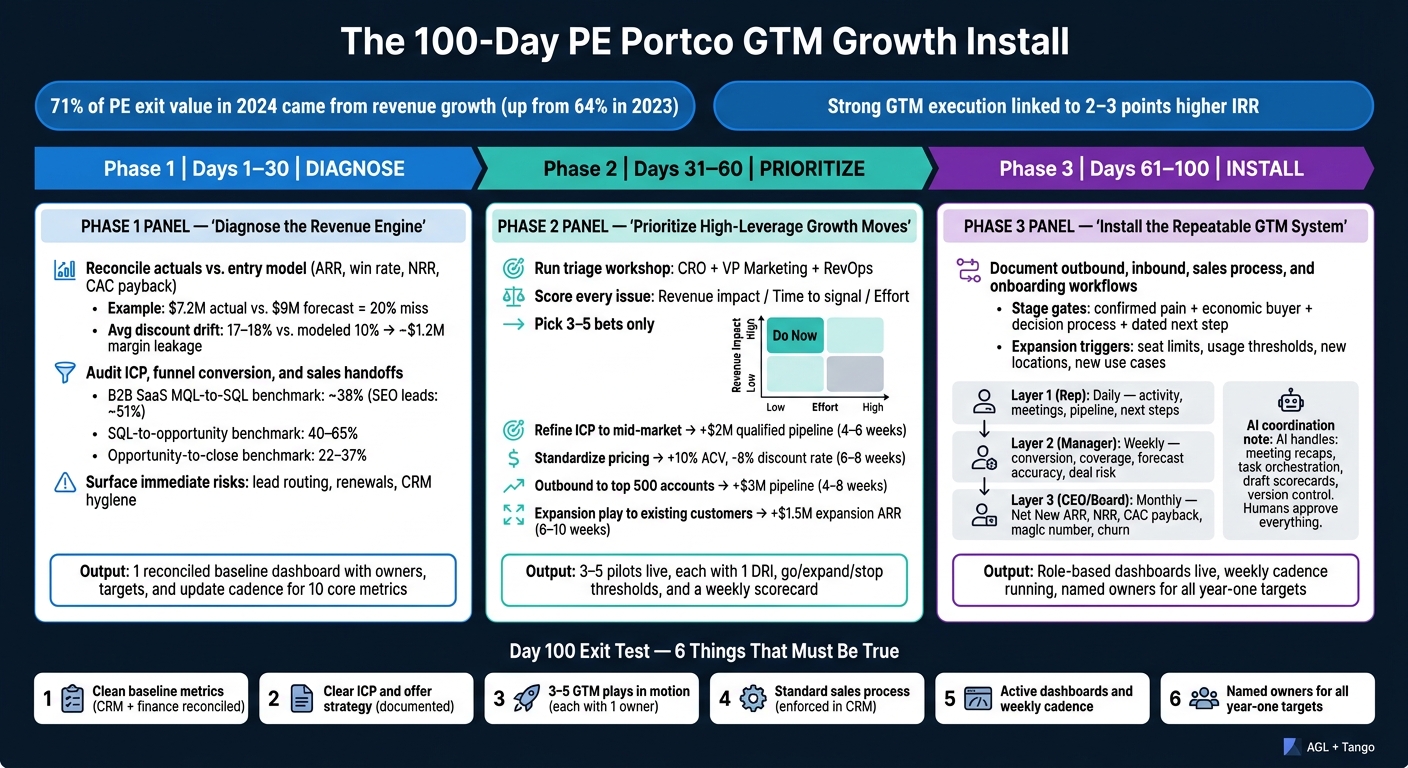
The 100-Day PE Portco GTM Growth Install: Phase-by-Phase Playbook
255 Inside the PE Playbook: Post-Acquisition Strategy with John Bisack
sbb-itb-9cd970b
Phase 1, Days 1–30: Diagnose the Revenue Engine and Stabilize the Baseline
The first 30 days are not for big moves. They are for getting to the truth.
That matters more than most teams think. A lot of agencies and operators walk into a new account or portfolio company with a plan in hand. Then the numbers tell a different story. That gap is where the work starts.
At AGL, this is the same idea behind Tango. Humans decide. Machines repeat. Nothing ships without approval. You do not fix a messy revenue engine by adding more tools. You fix it by building 1 shared view the team trusts, then using that view every week.
Reconcile Actual Performance Against the Entry Model
Start with the investment thesis. Pull each revenue assumption and line it up against current actuals.
That includes ARR by segment, pipeline coverage, win rate, sales cycle, gross retention, NRR, CAC payback, and discounting. Then build a dollar-based variance bridge. You need to see, in plain terms, where the plan broke.
A 20% forecast miss, with $7.2M actual vs. $9M forecast, points to a structural issue.
Discounting is often where margin slips away. Quietly. If reps cut deals case by case with no clear rules, average discounts can drift to 17%–18% against a modeled 10%. On a mid-sized book, that can mean about $1.2M in annualized margin leakage.[3][4]
That is the kind of number you want in front of the team by week 2. It ends the abstract pricing debate fast.
Use the dashboard below as the Day 30 baseline. Give each metric 1 owner, 1 target, and 1 update rhythm.
| Metric | Current Value | Target | Owner | Update Cadence |
|---|---|---|---|---|
| Total ARR | $27,500,000 | $32,000,000 | VP Finance | Monthly |
| Pipeline Coverage (Quarter) | 2.1x quota | 3.5x quota | VP Sales | Weekly |
| Win Rate (Overall) | 19% | 25% | Sales Ops Lead | Weekly |
| Avg Sales Cycle (New Logo) | 94 days | 70 days | Regional Directors | Monthly |
| Gross Retention | 87% | 92% | VP Customer Success | Quarterly |
| Net Revenue Retention (NRR) | 104% | 115% | VP Customer Success | Quarterly |
| CAC Payback | 24 months | 18 months | VP Marketing | Quarterly |
| Avg Discount on New Deals | 17% | ≤10% | VP Sales | Monthly |
| Forecast Accuracy (Prior Quarter) | -22% vs. actual | ≤5% variance | CRO | Monthly |
| SQL→Closed-Won Conversion | 21% | 28% | Sales Ops Lead | Weekly |
This becomes the weekly operating view for the CEO, CRO, and PE sponsor.
The bridge shows where performance broke. Interviews show why.
NRR gives useful context too. Median NRR for private B2B SaaS sits around 100%–106%, and top-quartile companies are above 120%.[12][13] So 104% is not a crisis. But it does tell you expansion is not yet a steady growth driver. At exit, that matters.
Audit ICP, Positioning, Funnel Conversion, and Sales Handoffs
Once the numbers are clear, move to the next question: why is this happening?
Pull the last 50–100 closed-won and closed-lost deals. Segment them by industry, company size, and deal shape. Then look for the cluster where win rates are higher and cycles are shorter.
That cluster is usually your actual ICP. And it often does not match the one in the board deck.[4]
Next, pair the data with 8–12 short interviews. Talk to customers and lost deals. Learn what buyers cared about, who they compared you against, and what almost killed the sale.
This is where message gaps show up. Marketing may lead with platform breadth. Buyers may care more about time-to-value or regulatory coverage. That disconnect is a positioning issue. You will see it in funnel conversion before you see it in revenue.
On funnel math, the benchmark ranges help. B2B SaaS MQL-to-SQL conversion averages around 38%, and SEO-driven leads can hit 51%.[6][9] If your MQL-to-SQL rate is below 13%–15%, the usual cause is ICP mismatch or weak qualification.[10][11]
SQL-to-opportunity should land between 40%–65% in a healthy pipeline. Opportunity-to-close usually sits between 22%–37%.[7][8][10] Map your actual numbers against those ranges. Flag each stage where you sit outside the band.
Sales handoffs need the same level of review. Interview SDRs, AEs, and CSMs on their own. Ask how each team decides a record moves to the next stage.
The answers often do not line up.
A common issue is simple. One rep marks any demo as an opportunity. Another waits for confirmed budget. That kind of mismatch drives forecast misses, longer cycles, and lower close rates.
The fix is plain:
- Write down the real criteria for MQL, SAL, SQL, and opportunity
- Set SLAs for each handoff, like MQL contacted within 24 hours
- Enforce the rules with CRM validation checks[2][14]
These findings should shape where Phase 2 gets more time and spend.
Surface Immediate Risks and No-Regrets Fixes
By Day 30, sort the issues into 2 buckets. Structural problems go in 1. Cleanup items go in the other.
Handle routing, renewals, discounting, and CRM hygiene first.
The usual near-term risks are familiar. Leads go to the wrong place. Renewals have no clear owner or date. Discounts chip away at margin. CRM records are so thin that pipeline reports cannot be trusted.
This is where clean process work pays off. In 1 PE-backed roll-up, standardizing CRM stage definitions and routing rules cut CAC by 15%, increased marketing-generated pipeline by 20%, and shortened average sales cycles by 10%. That helped drive an 8-figure EBITDA gain over 2 years.[14]
That is the Tango logic in practice. Humans set the rules. Machines handle the repeat work. Output goes up, but control stays with the team.
So make the fixes that carry little downside:
- Fix lead routing
- Clean the pipeline
- Put renewal ownership on a named person with a date
- Cap discounts at a clear number and document it
These are no-regrets moves. They are fast. They are low risk. And they steady the baseline so the next set of growth changes has a fair shot to work.
If you run marketing for several clients, take 1 account this week and build this Day 30 view. Start with the variance bridge. Then run it through a Tango-style operating rhythm: humans decide, machines repeat, and nothing ships without approval.
Phase 2, Days 31–60: Prioritize the Highest-Leverage Growth Moves
Here’s the shift. Phase 2 is not about fixing everything. It is about picking the few moves that can change revenue inside 100 days.
That is how AGL works too. We run many marketing departments with a small team using Tango. Humans decide. Machines repeat. Nothing ships without approval. The point is simple: more output, less waste, and faster proof on what should get more budget.
Phase 1 showed where the engine leaks. Phase 2 turns that into 3 to 5 bets that can move pipeline, ACV, win rate, or retention in the 100-day window. Now the job is to choose the moves that can show lift fast enough to earn more spend.
Run a triage workshop with the CRO, VP of Marketing, and RevOps lead. Put every Phase 1 issue into 4 buckets:
- Do now
- Validate first
- Sequence later
- Drop
Score each option on revenue impact, time to first signal, and effort required. Then build a comparison table like the one below.[5][1]
| Lever | Expected Impact | Time to Impact | Required Resources | Risk | Decision |
|---|---|---|---|---|---|
| Refine ICP to mid-market segment | +$2M qualified pipeline | 4 to 6 weeks | 1 RevOps, 1 marketer, sales manager | Low | Pilot now |
| Standardize core pricing | +10% ACV, -8% discount rate | 6 to 8 weeks | Deal desk, finance, sales enablement | Medium | Pilot now |
| Outbound to top 500 accounts | +$3M pipeline, +10% meetings | 4 to 8 weeks | 2 SDRs, tooling budget | Medium-high | Pilot now |
| Expansion play to existing customers | +$1.5M expansion ARR | 6 to 10 weeks | CSM team, marketing support | Low | Plan next |
Refine ICP, Positioning, Offer Design, and Pricing
Most teams miss this part. Growth does not come from more activity first. It comes from a tighter fit.
Use the Phase 1 findings to narrow the segment, message, and price points that leak the least and close the fastest.
By Day 45, define the best-fit ICP: firmographics, buying triggers, pain signals, and disqualifiers.[15]
Use CRM and billing data to compare win rate, sales cycle, ACV, and NRR by segment. Then put your focus on the segment where all 4 are strongest.[15]
Turn the top 3 to 5 customer outcomes into a positioning statement. Then simplify offers around the main use cases and retire weak legacy packages.[15]
Pricing leakage often comes from uneven discounting, not list price. Use a pocket price waterfall to find the top 2 discount categories that drive most margin loss. Then set CRM approval thresholds.[19][20][21]
This is very close to how Tango keeps agency work tight. You set the rule once. The machine handles the repeat work. A human checks the edge cases. That gives you more control without adding a messy AI stack to babysit.
Once the offer is sharper, route demand to the segment and motion most likely to convert.
Choose the Demand Generation and Pipeline Plays to Scale First
Not every growth motion fits every funnel. The right move depends on math and team room.
If inbound converts well but volume is low, scale content, paid demand, or use Albacross for deanonymizing web traffic. If SDR capacity is underused and the ICP is clear, pilot outbound first.[16]
For outbound, define clear targets for dials, connect rate, meeting rate, and qualified pipeline within 6 weeks.[17] For ABM, define success before launch with pipeline, deal size, win rate, and cycle-time thresholds.[18]
AGL uses the same logic. We do not chase every channel at once. We pick the motion most likely to show a fast signal, run it through Tango, and keep humans in approval. That is how a small team can support many client programs without the wheels coming off.
With the first motion picked, the next job is to assign owners and define the scorecard that decides whether to scale it.
Set Initiative Owners, Weekly Scorecards, and Pilot Success Criteria
Every initiative needs a single Directly Responsible Individual (DRI). That one person owns planning, execution, and weekly reporting. Shared ownership means no one is on the hook.
Track input and output metrics for each initiative in CRM dashboards. Set go, expand, and stop thresholds before launch.[5][1]
The rule is simple:
- If a pilot hits the mark, expand.
- If it partly hits, revise and extend.
- If it falls far short, stop and move the budget.
That discipline is where small teams win. AGL has seen it first hand with Tango. Humans make the call. Machines handle the repeat work. The team stays lean, delivery gets stronger, and the agency can take on more without losing control.
If you run marketing for several clients, take 1 workshop this week and force every growth idea into the 4 buckets. Then name 1 DRI for each pilot.
Phase 3, Days 61–100: Install the Repeatable GTM System
Here’s the shift in Phase 3. You are no longer testing for signs of life. You are building the system your team will run after day 100.
Phase 2 showed which plays win. Phase 3 turns those plays into rules, workflows, and review loops. This is where GTM stops being person-dependent and starts working the same way every week.
At AGL, this is the point where Tango starts to matter most. Humans decide. Machines repeat. Nothing ships without approval. That’s how a small team can run many marketing departments without adding an AI stack to babysit.
Stand Up Outbound, Inbound, Sales Process, and Onboarding Workflows
Start with outbound. Write down the target-account list, sequence, channel mix, objection responses, SLA, and SDR-to-AE routing rules. Then track reply rate, meeting rate, and pipeline created per sequence every week.[22]
For inbound, set routing by territory, segment, or source conflict. Watch time to first touch, accepted lead rate, meeting set rate, and conversion by source.[24]
For the sales process, do not let deals move on gut feel. A stage moves only when there is confirmed pain, an economic buyer, a decision process, and a dated next step. Proposal approvals also need rules for discount thresholds, legal review triggers, and margin guardrails.[23]
For onboarding and expansion, define the path from kickoff to setup to first value. Then add training, adoption confirmation, and the CS-to-sales handoff. Expansion should come from signals you can see, like a seat limit reached, usage thresholds, a new-location rollout, or a new use case. Set clear rules for when CS brings an upsell to sales.[24]
This is one clear lesson: good GTM is not a pile of plays. It is a set of rules people can run without guessing.
That is also how Tango works inside AGL. The machine handles the repeat steps. The team keeps control of judgment calls. The result is more output, tighter delivery, and less drift across clients.
Once these workflows are fixed, you can make performance easy to see by role.
Build the Reporting Stack from Rep View to Board View
A 3-layer reporting stack keeps each team looking at the right numbers at the right time.[27][28][29]
Reps need a daily view of activity, meetings set, pipeline created, stage progression, and next steps by account.
Managers need a weekly view of conversion by stage, pipeline coverage, aging deals, forecast accuracy, rep productivity, and deal risk.
The CEO and board need a monthly view of Net New ARR, NRR, CAC payback, magic number, churn, burn versus plan, and execution risk.[27][28][29]
This matters because cadence is not about more meetings. It is about faster decisions. Rep activity should roll up into manager action, then into CEO and board control.
| Meeting | Frequency | Owner | Inputs | Outputs | Core Metrics |
|---|---|---|---|---|---|
| Rep pipeline standup | Daily | Sales manager | CRM stage data, next steps | Deal actions | Pipeline by stage, activity |
| Pipeline review | Weekly | Sales leader | CRM data, call notes | Forecast update, deal actions | Coverage, stage conversion, slip rate |
| Demand-gen performance review | Weekly | VP Marketing | Campaign data, lead source report | Budget and channel decisions | MQLs, CPL, meeting rate by source |
| Deal desk or pricing review | Weekly | RevOps lead | Pending proposals, discount log | Approved deals, pricing exceptions | Discount rate, margin by segment |
| Monthly operating review | Monthly | CRO | All GTM data | Revised forecast, initiative status | Net New ARR, NRR, CAC payback, win rate |
| Board/PE sponsor update | Monthly | CEO | Operating review output | Board decisions, resource calls | Net New ARR, NRR, magic number, churn, burn |
AGL uses Tango to keep this cadence moving without extra drag. Scorecards get drafted. Notes get pulled together. Follow-ups get flagged. People still make the call. That is the whole model.
Use AI-Enabled Coordination to Ship Work Without Adding Overhead
AI works best here as a coordination layer, not a decision-maker. In a human-in-the-loop workflow, AI assembles work artifacts, drafts scorecards, summarizes meetings, updates trackers, and flags missing follow-ups. Humans approve before anything ships.[25][26]
Use AI for internal coordination only:
- meeting recaps
- task orchestration
- research synthesis
- draft scorecards
- version control for operating docs
Customer-facing and strategic decisions stay with people.[25][26]
That is the Tango system in plain English. Machines handle the repeat work. Humans keep control. AGL uses that setup to run many marketing departments with a small team, keep delivery strong, and help agencies grow output without piling on tools.
If you want that same setup in your agency, start with 1 thing: document the rules for how work moves from lead to revenue, then use Tango to keep that motion tight.
Conclusion: The 100-Day Growth Install Checklist for Year-One Value Creation
Here’s the big shift.
The first 100 days are not for endless study. They are for putting in a system the company can run. By day 100, the portco should have a clean baseline, a short focus list, and a GTM system that does not need daily rescue.
That is how year-one value gets built.
The pattern is simple. First, find the truth. Then pick the few moves that matter most. Then install a repeatable system with clear owners. That is how AGL runs many marketing departments with a small team using Tango. Humans decide. Machines repeat. Nothing ships without approval.
When that system is in place, the team can stop guessing and start moving.
Use the checklist below as the Day 100 exit test.
What Should Be True by Day 100
By day 100, 6 things should be done.
Clean baseline metrics. CRM and finance use 1 reconciled baseline.
Clear ICP and offer strategy. ICP, offers, and pricing are narrowed and documented.
Prioritized GTM plays in motion. 3 to 5 growth plays are live. Each has 1 owner, clear output metrics, and a stop-or-scale call.
Standard sales process. Sales stages, exit criteria, and discount guardrails are enforced in CRM.
Active dashboards and weekly operating cadence. Role-based dashboards are running, and scorecards go out before each review.
Named owners for year-one targets. Every year-one target has a named owner and board-visible accountability.
This is the lesson.
Value creation in year 1 does not come from more activity. It comes from a system that makes the right work happen every week. That is the point of Tango. It helps a small team produce more, keep approvals tight, and build delivery that can hold higher retainers.
If you want to see how AGL installs that kind of system, book a call and see Tango in action.
FAQs
What should I fix first in the first 30 days?
The first 30 days are not about moving faster. They’re about seeing the business clearly.
If your agency runs marketing for several clients, you know this already: bad inputs wreck good work. That’s why AGL starts with the base layer inside Tango. Humans decide what matters. Machines handle the repeat work. Nothing goes live without approval.
In this first stretch, the job is simple. Build a clean operating view and get clear on the money.
Start by auditing customer data across billing, support, and marketing systems. Then check revenue data against records you can verify. If the numbers don’t match, the rest of the plan will drift.
Next, map the customer journey from start to finish. Look for retention friction points. Find where people stall, drop off, or stop getting value.
Then define the product engagement actions that link to long-term success. Not every click matters. Some actions signal that a customer is on track to stay. Those are the ones to watch.
From there, set baseline KPI dashboards. Keep them simple. You need a starting line before you can judge progress.
That’s the lesson: don’t scale guesswork. AGL uses Tango to build this kind of clean system early, so a small team can run many marketing departments with more output and tighter delivery.
Take 30 minutes today and list the systems, records, and customer actions you trust most. That’s where the cleanup starts.
How do I choose the right 3 to 5 growth moves?
Most agencies don’t need more channels first. They need a cleaner engine.
Start by auditing your current go-to-market work. Look for the spots where deals slow down, handoffs break, or client work eats too much time. That’s usually where the next 90 days should go.
Then pick moves that can show clear results in 90 days. Good places to start include:
- improving retention
- refining pricing
- automating sales and support workflows
This is the same way AGL thinks about growth with Tango. Humans decide. Machines repeat. Nothing ships without approval. That lets a small team run many marketing departments without adding an AI stack to manage.
The lesson is simple: fix what already leaks before you add more traffic.
If your sales process is slow, a new channel won’t save it. If pricing is off, more leads won’t fix margin. If support is messy, retention drops no matter how much demand you create.
Tie each move to a core metric. Think Net Revenue Retention or customer acquisition cost. That way, every change connects to growth you can track and repeat.
Pick 1 bottleneck, tie it to 1 core metric, and map how Tango could take the repeat work off your team this quarter.
What metrics should I track by Day 100?
By Day 100, most agencies see the same thing: growth looks messy until the right numbers sit in one place.
That’s the point of a balanced scorecard. It gives you a simple way to run the account, report to the client, and spot trouble before it spreads. At AGL, this is how Tango helps a small team run many marketing departments at once. People make the calls. Machines handle the repeat work. Nothing goes live without approval.
Track 3 areas: financial health, acquisition efficiency, and customer retention.
Start with MRR and NRR. Those 2 numbers show if revenue is holding up and growing the right way. Then watch CAC and your LTV-to-CAC ratio. That tells you if the client’s unit economics still make sense, not just if leads are coming in.
You also need to watch churn. A client can look fine on the surface and still be losing ground underneath. That’s where predictive health scores help. They flag at-risk accounts early, so your team can step in before the damage shows up in revenue.
Bring all of it into 1 dashboard. That gives you a clear view of growth, makes reporting easier, and helps your team move faster without adding more tools to manage.
If you want that kind of output without building an AI stack from scratch, look at how AGL uses Tango to run more client work with a small team.