When to Hire, When to Fractional, When to Automate (Decision Tree)

When to Hire, When to Fractional, When to Automate (Decision Tree)
Most agency hiring mistakes start before the hire. I do not start with a role. I start with the job, the number, and the deadline.
If I need to choose between a full-time hire, a fractional expert, or automation, I use 3 tests:
- Is the work repeat work with clear rules? If yes, I look at automation.
- Does the work need daily ownership or high-level judgment? If yes, I look at a person.
- If it needs a person, is that need daily or part-time? That tells me full-time or fractional.
At AGL, this is how Tango works. Humans decide. Machines repeat. Nothing ships without approval. That is how we run many marketing departments with a small team, more output, and no extra AI stack to babysit.
Here is the short version:
- Pick full-time when the work is daily, tied to core performance, and sits across teams.
- Pick fractional when I need senior judgment for a set scope, not a full seat.
- Pick automation when the task is stable, high-volume, and low-risk.
- Pick hybrid when software does the repeat steps and a person owns exceptions and approval.
A few numbers from the piece make the point:
- SHRM reported a 39-day median time-to-fill for nonexecutive roles in 2026.
- A 500-task per month workflow at 4 minutes per task takes about 33 hours per month.
- A $1,500 setup that saves $1,000 per month pays back in 1.5 months.
- McKinsey found only 27% of people at firms using generative AI said all AI output gets reviewed before use.
The lesson is simple. Use the lowest-cost model that can own the result without losing control.
If I were making this call today, I would take 1 workflow, write the target, baseline, owner, and review date, then choose the smallest next step.
The Decision Tree: How to Choose the Right Path
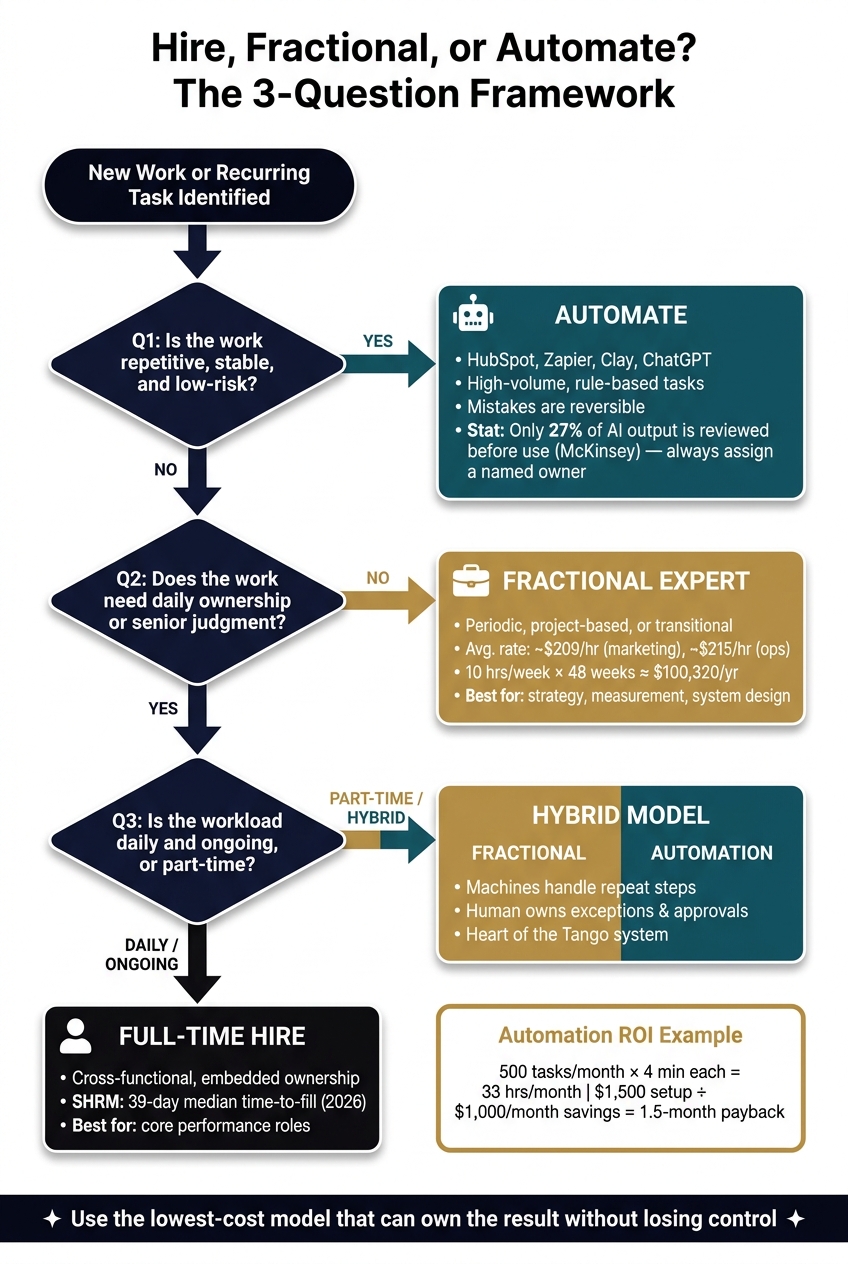
Hire vs. Fractional vs. Automate: The 3-Question Decision Tree
Here’s the shift: not all work needs a hire.
Some work needs software. Some needs a part-time senior operator. Some needs a full-time owner. The right pick is the one that fixes the issue at the lowest total cost and still gives you usable output.
That means looking at 3 things before you decide: cost of delay, cost to own it, and what happens if it fails.
At AGL, this is how Tango works in practice. Humans decide. Machines repeat. Nothing ships without approval. That’s how a small team can run many marketing departments without adding a messy AI stack to manage.
Run through 3 questions in order. Each answer cuts down the options until you land on automation, a person, or both.
Question 1: Is the Work Repetitive, Stable, and Low-Risk?
Say yes when the task is repeatable, predictable, frequent, and low risk.
Think HubSpot lead routing, Zapier updates, Clay enrichment, and ChatGPT drafts. High volume work with few edge cases is a good fit for automation. So are mistakes you can reverse fast.
Say no when the process changes a lot, depends on unwritten context, or can cause real damage if it breaks.
A pricing exception is not a bot task. A touchy client issue is not a bot task. A compliance call should not sit in an automated queue without a human approval gate.
McKinsey found that only 27% of respondents at organizations using generative AI said employees review all AI-generated content before it is used[1][2]. That gap adds risk fast when the output is customer-facing or published outside the company.
If the task fails this test, move it to human ownership.
Question 2: Does the Work Need Daily Ownership or Senior Judgment?
Pick a person when the work needs coordination across teams, frequent judgment, relationships, or clear ownership of the result.
Owning pipeline goals needs a person. Rebuilding a broken RevOps process needs a person. Deciding how to shift a tight paid media budget needs a person.
If the work sits inside weekly decisions, it often points to a full-time role.
If the work only needs review now and then, like checking attribution logic or approving a quarterly demand plan, a fractional operator may be enough.
Urgency matters too.
A short, high-stakes issue can justify a fractional expert even if the long-term workload would never support a full-time hire.
If you need a person, the next step is simple. Decide if the workload fits full-time or fractional coverage.
Question 3: Full-Time, Fractional, or Hybrid?
Choose full-time when the work is ongoing, cross-functional, and tied to core performance.
Choose fractional when you need senior skill but not every week.
Choose hybrid when software handles the repeat steps and a person owns exceptions, approvals, and metrics.
That hybrid model is the heart of Tango.
Automation can route leads and enrich data. A human can handle exceptions and watch high-value accounts. You keep output high without turning the whole system over to software.
Use the lowest-cost model that can own the result.
| Decision factor | Automate | Fractional expert | Full-time hire |
|---|---|---|---|
| Pattern | High volume and predictable | Periodic, project-based, or transitional | Daily and ongoing |
| Judgment | Low to moderate, with defined rules | High | High and organization-specific |
| Exceptions | Few and measurable | Many, handled by the expert | Frequent and deeply connected to company context |
| Main risk | Bad automation, data errors, false confidence | Scope ambiguity or insufficient availability | Overhiring, fixed cost, and unused capacity |
If you run marketing for several clients, this matters more than it first seems.
The wrong model eats margin. The right one lets a small team do more, keep control, and sell stronger work at a higher price. AGL uses Tango to make that call every day. Your next step is to take 1 recurring task and run it through these 3 questions before you assign it.
sbb-itb-9cd970b
Full-Time vs. Fractional: How to Choose the Right People Model
Here’s the shift many agency owners miss: not every growth problem needs a hire.
Sometimes you need a person in the seat every day. Sometimes you need senior help for a set window, then you move on. That choice matters because fixed cost piles up fast. And if you hire when you only needed part-time help, you end up paying for idle hours.
At AGL, this is where Tango changes the math. Humans decide. Machines repeat. Nothing ships without approval. That means a lot of work that looks like it needs a full team can often run with a smaller crew and tighter scope. The lesson is simple: buy ownership when the work is daily. Buy judgment when the work is not.
If the work needs a person, the next call is whether it needs a seat or a retainer. Full-time fits recurring value that can carry fixed cost. Fractional fits high-value work that does not need daily coverage.
Use the table below to compare fixed cost, flexibility, and ownership.
| Factor | Full-time hire | Fractional expert |
|---|---|---|
| Workload | Sustained, recurring, near full-time | Part-time, project-based, or transitional |
| Ownership | Embedded daily owner | Scoped ownership; defined in writing |
| Hiring time | Usually slower to produce value because recruiting and onboarding take time. SHRM reported a 39-calendar-day median to fill nonexecutive roles in 2026.[4] | Often faster if the right specialist is available |
| Flexibility | Low after hiring; fixed headcount | High; hours, scope, and duration can be adjusted |
| Annual cost structure | Salary, benefits, payroll taxes, recruiting, equipment, and management overhead | Retainer or project fee, usually without employee benefits; may require renewal |
| Key risks | Overhiring, underutilization, fixed-cost exposure | Limited availability, knowledge loss, and unclear accountability |
BLS data shows full-time compensation costs more than salary alone, so compare total cost against a fractional retainer, not base pay.[3]
Choose Full-Time When Ownership Is Ongoing and Embedded
A full-time hire makes sense when the role cannot be batched into planned sprints.
The pattern is simple. The role is not fixing a one-time issue. It is running and improving a system the business needs all the time. If you cannot point to a steady backlog of high-value work, and a need for someone during normal business hours, the case for full-time gets weak fast.
This is where agency owners get in trouble. They hire for volume before they fix the system. AGL takes the other route. Tango handles repeat work. The team keeps decision-making and client judgment in human hands. That setup lets a small team run many marketing departments without adding headcount too early.
If the role does not need daily ownership, move to fractional.
Choose Fractional When You Need Senior Expertise Without a Full-Time Seat
Fractional help often costs less and starts faster when the company needs senior judgment for a set period, not daily execution.
That person can set strategy, build a measurement model, and put the operating system in place before you hire execution staff. Think of it like bringing in an architect before you hire more builders. You do not need that architect in the office all day forever. You need the plan done right.
A 2026 fractional-work survey reported average hourly rates of approximately $209 for marketing and $215 for operations, with an overall executive average of $223 per hour across 546 respondents.[5] At $209 per hour, a marketing fractional engagement running 10 hours per week for 48 weeks equals roughly $100,320 in annual fees.[5]
That math works only if the scope stays part-time. If the company needs someone available every day, fractional coverage creates continuity gaps that can cost more than they save.
At AGL, this is why Tango matters. It holds the repeatable parts in place, so fractional talent can focus on decisions, systems, and direction instead of getting dragged into task churn. That is one reason a small team can produce more output without an AI stack to babysit.
If the function becomes daily work, it belongs in a full-time seat.
Set Scope, Decision Rights, and Exit Criteria Before You Start
No matter which path you pick, set the rules before day 1.
Define the business outcome. Set the baseline metrics. Write down what this person can decide on their own. Write down what still needs founder approval. List what tools and systems they can access.
This matters even more for fractional work. “Improve marketing” is not a scope. "select two acquisition channels, build a 90-day testing plan, establish pipeline attribution, and train the internal marketer by a specific date" is.
You also need an end point. Put a review on the calendar at 30, 60, or 90 days. Do not let the role drift. Build first. Then decide if the function is clear enough for full-time execution.
That is how AGL uses Tango too. First define the system. Then let machines handle the repeat steps. Then keep humans on approvals and client calls. That is how agencies get more delivery from a small team, protect margin, and build a firmer business.
Take 1 role on your team this week and ask 2 things: does it need daily ownership, or just senior judgment for a set period? Then map it into either a seat or a retainer before you add cost.
If the work is repetitive and rule-based, test automation next.
When to Automate and When to Keep a Human in the Loop
Here’s the shift: automation is not a tool choice first. It’s a work design choice first.
At AGL, that matters because the Tango system works on a simple rule. Humans decide. Machines repeat. Nothing ships without approval. That’s how a small team can run many marketing departments without piling on more headcount or another AI stack to manage.
If a task still needs to happen after the people-vs-model call, score automation next. Start with the workflow itself. Then look at frequency, exception rate, error cost, and build effort. That keeps the call grounded in ROI and risk, not hype around software.
Use full automation for predictable, low-risk work. Use human-in-the-loop when software gets the draft or prep work done, but a person still checks it. Keep work manual when the process is rare, messy, or high-stakes.
Before you build anything, map the trigger, inputs, rules, outputs, owner, and failure points. This is where most teams skip ahead and pay for it later.
A process that runs 500 times per month and takes 4 minutes each eats about 33 hours of labor every month. If automation costs $1,500 to set up and saves $1,000 per month, the payback period is 1.5 months. That math works.
Use this table to score a workflow before you build it:
| Process frequency | Time per task | Exception rate | Error cost | Implementation effort | Maintenance effort | Expected payback period |
|---|---|---|---|---|---|---|
| Daily or more | 5–15 min | Low (under 10%) | Low to moderate | Low | Low | Under 3 months |
| Weekly | 15–60 min | Moderate (10%–25%) | Moderate | Moderate | Moderate | 3–6 months |
| Monthly or less | Any | High (over 25%) | High | High | High | Often uneconomical |
| High-volume, rules-based | Short | Low | Low | Moderate | Low | Usually favorable |
| Low-volume, judgment-heavy | Long | High | High | High | High | Usually keep human-led |
Payback = (build + training) ÷ (monthly labor savings + error-cost savings − software and maintenance).
Which Tasks Fit HubSpot, Zapier, Clay, and ChatGPT
Once a workflow passes the payback test, use the smallest tool that can do the job.
- HubSpot handles CRM triggers and follow-up tasks.
- Zapier moves data between apps.
- Clay enriches prospect records.
- ChatGPT drafts, summarizes, and classifies text.
That’s the Tango logic again. Don’t build a giant machine when a small one will do.
Where Automation Should Not Run Without Human Approval
Some tasks should always stop for review. Pricing. Contracts. Refunds. Customer claims. High-value lead calls. Legal or compliance-sensitive messages. Confidential information. Anything tied to employee status. [6]
For example, automation may flag an enterprise account as high priority. A sales leader should still approve any change to that account’s qualification status.
An AI system may draft a reply to a customer claim. An authorized employee should still check the facts and approve the commitment.
Every automated workflow needs a named owner. Not a team. Not a shared inbox. One person.
That owner should:
- limit permissions
- record inputs, outputs, and timestamps
- manage an exception queue
- run periodic audits
- watch for failures
- update rules
- approve changes
- decide when to pause the workflow
Without a named owner, broken automations can quietly harm data quality and client trust.
Start small. Pick the smallest workflow you can reverse fast. Set a review date 2–4 weeks out. If exceptions go up or customer-facing errors show up, stop it or redesign it.
Before launch, document the owner, the approval point, the monitoring metric, and the review date.
If you want the same setup AGL uses to run more client work with a small team, look at the Tango system and start with 1 workflow that saves time without removing human approval.
Score the Decision and Pick the Smallest Next Step
A Simple Budget, ROI, and Risk Worksheet
Here’s the shift: the best agency call is often not the biggest move. It’s the smallest step that gets the job done.
That matters if you run marketing for many clients at once. At AGL, that’s the rule inside Tango. Humans make the call. Machines handle repeat work. Nothing goes live without approval. That setup helps a small team run many marketing departments without piling on headcount too early.
After you narrow the path to hire, fractional, or automate, use a scorecard to pick the smallest workable next step.
Score the need on a 1 to 5 scale across 8 areas: urgency, workload, complexity, budget capacity, expected ROI, reversibility, ownership requirement, and data sensitivity.
The scores do not make the call for you. They show the tradeoffs. Then you choose the smallest move that can still produce the result.
Compare each option on 12-month fully loaded cost. That means wages, benefits, taxes, recruiting, onboarding, equipment, software, training, and manager time.
For fractional help, use planning ranges. U.S. estimates put retainers at about $6,000 to $15,000 per month and hourly rates at $150 to $350[8].
For automation, count the full picture:
- implementation
- integrations
- licenses
- security review
- training
- maintenance
- monitoring
- human approval time
Then calculate expected value with this formula:
hours saved × fully loaded hourly cost + incremental gross profit − ongoing tool or service cost
Only count time savings if that time can move into revenue, retention, delivery, or labor cuts. If saved time just disappears into the day, it does not count much.
Next, calculate payback period. Divide implementation cost plus initial management cost by monthly value.
Also look at cost of delay. This is where many agency owners miss the plot.
If a broken lead-routing process delays $30,000 of monthly qualified pipeline, and leadership thinks there is a 25% chance that delay will hurt bookings in a real way, the risk-adjusted monthly cost is $7,500. Over 3 months, that is about $22,500 before you even count brand or ops fallout.
Need a plain example? A Zapier integration that connected Gong sales data to HubSpot saved more than 15 minutes of admin work per sales call, made room for more than 63 additional calls per month, and led to a 5% increase in average monthly revenue[7].
That’s the kind of result agencies want. A tight workflow. Less admin drag. More room for revenue work. That is also the logic behind Tango. Build the repeatable system once. Keep people on the calls that need judgment.
If your score still points to more than 1 path, start with the lower-cost option and set a review date.
Final Checklist: Outcome, Workflow, Owner, Review Date
Pick the option that gives you measurable value with the least cost and risk.
Before you commit to a hire, a retainer, or a workflow build, make sure you can answer these:
- Outcome and baseline: What exact result are you trying to fix, and what are the current numbers for volume, cycle time, error rate, cost, and revenue impact?
- Workflow: Have you mapped the steps, handoffs, approval points, and failure modes?
- Effort, cost, and risk: Does your estimate include implementation, management time, and cost of delay, not just the monthly fee? What is the data sensitivity, customer impact, and cost of a wrong output?
- Option: Have you picked the smallest workable move, such as a documented playbook, a short fractional engagement, a limited automation pilot, a full-time hire, or a hybrid model?
- Owner: Is 1 internal person accountable for results, exceptions, and the call to keep going or stop?
- Review date and escalation: Have you set a clear 30-, 60-, or 90-day checkpoint, and defined what should trigger human review, more budget, a pause, or a shift in operating model?
The lesson is simple. Small, well-scoped systems usually beat big bets.
That’s how AGL uses Tango to run many client programs with a small team. More output. No extra AI stack to babysit. Better delivery. Room for stronger retainers.
Take 1 workflow, score it, and choose the smallest next step today.
FAQs
How do I know if a task is safe to automate?
You do not grow an agency by adding more tools. You grow it by deciding what your team should stop doing by hand.
A task is usually safe to automate when it repeats, eats up time, and does not need much judgment. That covers work like manual data entry, lead scoring, customer health checks, and routine follow-up emails.
At AGL, that is the point of Tango. Humans decide. Machines repeat. Nothing ships without approval. That is how a small team can run many marketing departments without adding an AI stack to babysit.
Before you scale anything, get your data clean and in the same format. Then test 1 use case in a 30- to 60-day pilot. Keep human oversight in place so your team can watch results, catch mistakes, and make changes fast.
If you want more output without more busywork, start there. Pick 1 repeat task and run it through the Tango system this month.
When should I choose fractional instead of full-time?
You do not need a full-time hire the moment work gets hard.
A fractional expert makes sense when you need sharp guidance or a senior point of view, but you do not need that person in the seat 5 days a week.
That usually happens in a simple spot.
The work is too hard for your current team or your automations. But there is still not enough of it to justify a full-time role.
So instead of adding payroll too soon, you bring in a specialist for the exact gap in front of you. Maybe that is strategy. Maybe that is channel help. Maybe that is a short-term push tied to 1 client need.
This is one of those calls that keeps an agency lean without slowing delivery. It also fits the same idea AGL uses with Tango: humans decide, machines repeat, nothing ships without approval.
That matters because the goal is not to hire more people by default. The goal is to put the right level of skill on the right work. That is how AGL runs many marketing departments with a small team.
If you are looking at work your team cannot handle well, but you are not ready for a full-time seat, start with a fractional expert.
What should I measure before making the call?
You can’t judge a new system if your starting point is fuzzy.
That’s why the first move is simple. Audit what you have now. Build a baseline before you change a thing. At AGL, that matters because Tango works best when the team knows what humans should decide and what machines should repeat. If the starting data is messy, the output gets messy too.
Start with Customer Acquisition Cost (CAC) by channel and by segment. Then track how much time your team spends on manual, repeat work. After that, check your data. It needs to be accurate, consistent, and standardized. No guesswork. No mixed fields. No half-clean CRM.
Next, pick 5 to 7 KPIs tied to your goal. Keep it tight. If you track everything, you learn nothing.
Good KPI picks include:
- Lead conversion rate
- Sales cycle length
- MRR
- NRR
Use those numbers as your benchmark for future ROI. That gives you a clean before-and-after view, which is how AGL uses Tango to run many marketing departments with a small team and still keep approval in human hands.