Fractional CMO vs Full-Time VP: The Real Math at $6M ARR

Fractional CMO vs Full-Time VP: The Real Math at $6M ARR
At $6M ARR, the right hire is the one your team can use now. Not the one with the bigger title.
I see 3 clear paths in this piece:
- A fractional CMO fits when execution is already covered and you need senior direction
- A full-time VP fits when marketing needs daily internal ownership
- A bridge model fits when you need help now but the long-term role is still not clear
The math is simple.
- A fractional CMO at $180,000 annual cost needs about $225,000 in bookings to break even at 80% gross margin
- A full-time VP at $350,000 needs about $437,500
- At a $60,000 ACV and 25% close rate, that means about $900,000 in pipeline for the fractional hire and $1,750,000 for the VP
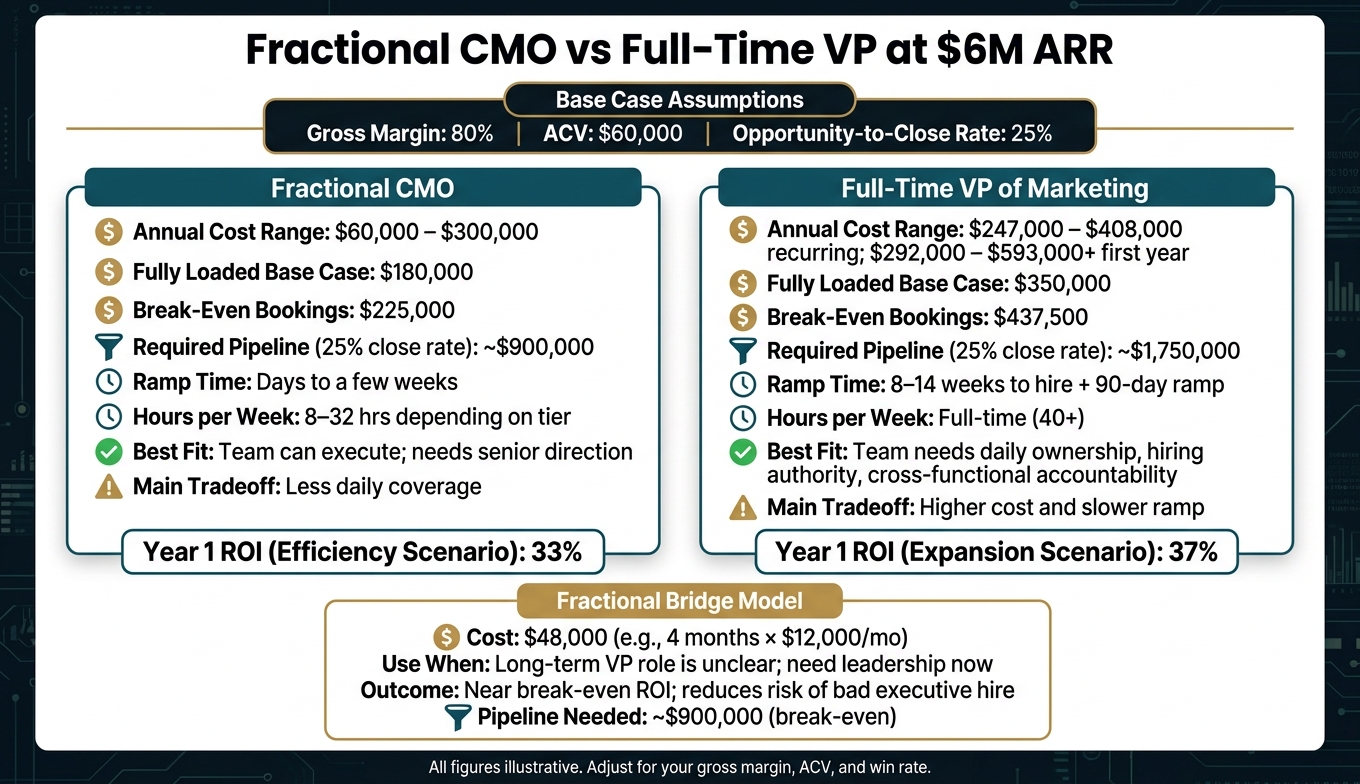
Fractional CMO vs Full-Time VP: Cost & ROI Comparison at $6M ARR
What is a Fractional Chief Marketing Officer (CMO) & What Do They Do?
sbb-itb-9cd970b
Quick Comparison
| Option | Best fit | Year 1 cost | Break-even pipeline | Main tradeoff |
|---|---|---|---|---|
| Fractional CMO | Team can execute but needs direction | $60,000 to $300,000 | About $900,000 in base case | Less daily coverage |
| Full-time VP | Team needs daily ownership and hiring | About $292,000 to $593,000+ first year | About $1,750,000 in base case | Higher cost and slower ramp |
| Fractional bridge | You need leadership now before a full search | Varies by term | Can be break-even or near it | Not a long-term org answer by itself |
My main takeaway is simple: buy ownership, not title.
That is the same rule I see at AGL. We run many marketing departments with a small team using Tango. Humans decide. Machines repeat. Nothing ships without approval. When ownership is clear, output goes up and the team does more without adding a pile of tools.
Use this piece to check the math, name the gap, and pick the lower-risk hire.
Fractional CMO vs. full-time VP: cost, scope, and first-year economics
Here’s the thing most teams miss: this choice is not about job titles. It’s about who can own the work every day, and how much that ownership costs in year 1.
For agency owners, that matters even more. AGL runs many marketing departments with a small team using Tango. Humans decide. Machines repeat. Nothing ships without approval. That setup works because the role is clear. The same rule applies here.
The lesson is simple: pick the level of ownership you need, then check if the pipeline can pay for it.
The core decision is operator vs. strategist with budget authority.
Fractional CMO: retainer range, weekly hours, and decision rights
A fractional CMO is a part-time senior marketing leader. Most are hired on a monthly retainer. That retainer usually covers strategy, priority setting, pipeline reviews, and oversight of execution.
Published pricing guides place experienced fractional CMOs in the U.S. at roughly $5,000–$25,000 per month, depending on seniority, scope, and how much operating involvement is expected.[4][5] In practice, the tiers look like this:
| Fractional CMO tier | Monthly cost | Annualized cost | Est. hours/week | Typical scope |
|---|---|---|---|---|
| Advisory / focused strategy | $5,000–$8,000 | $60,000–$96,000 | 8–12 | Positioning, quarterly planning, KPI review, executive guidance, limited vendor oversight |
| Hands-on leadership | $10,000–$15,000 | $120,000–$180,000 | 12–20 | Marketing roadmap, pipeline reviews, channel prioritization, agency management, weekly sales alignment |
| High-involvement fractional | $18,000–$25,000 | $216,000–$300,000 | 20–32 | Near-embedded leadership during a launch, repositioning, or major growth initiative |
This tier works best when execution is already covered. If no one is there to do the work, senior advice alone will stall.
That is one reason AGL uses Tango the way it does. The system lets a small team run output across many accounts without building a messy AI stack to babysit. The human sets direction. Tango handles repeat steps. The result is more output with tighter control.
The main risk with a fractional CMO is slow response time. If sales needs something fast, or a launch changes midweek, that leader may not be available right away.
Spell this out in the contract:
- Response-time expectations
- Guaranteed hours
- Who owns production between sessions
Full-time VP of Marketing: why base salary is not the real number
A VP of Marketing in the U.S. often lands around $180,000–$260,000 in base salary at a SaaS company, with total cash compensation reaching $200,000–$330,000 after bonus.[3]
But base salary is not the number that matters. First-year cash cost is.
That cost includes recruiting, onboarding, benefits, and employer taxes.
| Full-time VP cost category | Recurring annual cost | First-year cash cost |
|---|---|---|
| Base salary | $180,000–$260,000 | $180,000–$260,000 |
| Target cash bonus (15%–30% of base) | $27,000–$78,000 | $27,000–$78,000 |
| Employer payroll taxes | $15,000–$25,000 | $15,000–$25,000 |
| Benefits | $25,000–$45,000 | $25,000–$45,000 |
| Recruiting or executive-search fee | --- | $25,000–$90,000+ |
| Signing bonus or relocation | --- | $0–$75,000 |
| Onboarding and initial tools | --- | $5,000–$20,000 |
| Illustrative total cash cost | $247,000–$408,000 | ~$292,000–$593,000+ |
Recruiting fees alone can run 15%–25% of first-year base salary for contingency search, and 25%–35% for retained executive search.[3]
Equity is separate. Model that on its own based on your cap table and vesting terms.
A full-time VP also does not solve execution by magic. They still need people around them. Add 2 specialists at $90,000–$130,000 each, plus tools and media budget, and total marketing spend can move far past the VP's pay.
This is the same math agency owners face when they scale delivery. One senior hire without a repeatable system can get expensive fast. AGL’s Tango model helps avoid that trap. It gives you a way to run more work with fewer moving parts, while keeping human approval in place.
Who owns strategy, channels, and team management
This is the real tradeoff. Not price. Ownership depth.
A fractional CMO can own the marketing system. That may include strategy, priorities, channel tests, and vendor direction.
A full-time VP can own all of that, plus the daily rhythm inside the company. That includes hiring, team management, cross-team friction, and being there when sales or product needs help now, not next week.
| Responsibility | Fractional CMO | Full-time VP of Marketing |
|---|---|---|
| Marketing strategy | Owns within agreed scope | Owns as an internal executive |
| Pipeline reviews | Runs or facilitates recurring reviews | Owns the ongoing operating rhythm with sales and finance |
| Channel oversight | Prioritizes channels, manages agencies | Builds the channel portfolio, manages internal and external owners |
| Team hiring | Can define roles and advise on selection | Owns hiring plan, performance management, and org design |
| Cross-functional access | Depends on cadence and CEO support | Available as part of the internal leadership team |
| Flexibility | Easy to expand, reduce, or end | Higher commitment, slower to change |
At $6M ARR, a fractional CMO makes sense when strong channel executors are already in place. In plain English, you have people who can do the work, and you need senior direction.
A full-time VP makes more sense when the company needs daily internal ownership, hiring authority, and steady cross-functional accountability.
That’s the lesson to carry forward: buy the amount of ownership your team can use right now. Not the title that looks best on paper.
AGL has seen the same pattern in practice. When the system is clear and the repeat work is handled in Tango, a small team can run a lot. That creates stronger delivery, supports higher retainers, and builds an agency that is worth more at sale.
Use these cost bands in the break-even math below. If you want the same kind of output model inside your agency, look at how Tango fits your delivery stack.
The real math: break-even revenue, pipeline, and ROI
At $6M ARR, this choice is less about seniority and more about payback.
That’s the part many founders miss. A fractional CMO and a full-time VP can both look right on paper. But the better hire is the one that gets to break-even with less drag and more output.
All examples below are illustrative. Swap in your own gross margin, ACV, win rate, sales cycle, ramp time, and fully loaded cost.
Base case assumptions used in this section:
- Gross margin: 80%, in line with recent SaaS benchmark data [6][7]
- ACV: $60,000
- Pipeline and conversion: $1,200,000 in incremental qualified pipeline the leader can reasonably influence for the fractional CMO, and $2,400,000 for the full-time VP, at a 25% opportunity-to-close rate
- Ramp and cost: 3-month ramp and $180,000 fully loaded annual cost for the fractional CMO; 6-month ramp and $350,000 for the full-time VP
The formulas founders should run
Start with break-even bookings. This tells you how much new business marketing leadership must help produce to cover its own cost on a gross-profit basis.
Break-even bookings = Annual leadership cost ÷ Gross margin
At an 80% gross margin, the fractional CMO needs $225,000 in incremental bookings ($180,000 ÷ 0.80). The full-time VP needs $437,500 ($350,000 ÷ 0.80).
At a $60,000 ACV, that works out to about 3.75 additional customers for the fractional CMO and 7.3 additional customers for the VP. In plain English, that rounds to 4 deals and 8 deals.
You can call this break-even bookings or break-even new ARR. Just be clear about what is and is not in the model. This math excludes sales comp, implementation, support, churn, and discounting unless you add them.
Next is required qualified pipeline. This backs into pipeline from your win rate.
Required pipeline = Break-even bookings ÷ Opportunity-to-close rate
At a 25% conversion rate, the fractional CMO needs $900,000 in qualified pipeline. The full-time VP needs $1,750,000.
If conversion drops to 20%, those numbers rise to $1,125,000 and $2,187,500. If conversion improves to 30%, they drop to $750,000 and about $1.46 million.
That swing matters. Small changes in conversion can change the whole hire math. So don’t run one neat model and call it done. Run a low case, base case, and high case.
Do the same across 3 operating views: an efficiency case, an expansion case, and a transition case.
Then look at marketing leadership ROI.
ROI = [(Incremental bookings × Gross margin) − Leadership cost] ÷ Leadership cost
Use a tight attribution rule. Count sourced pipeline. Discount influenced pipeline. Leave out deals that likely would have closed anyway. If you need a rule, give 50% credit to influenced pipeline.
Also model ramp on its own. Track the cash cost during ramp, the pipeline made during ramp, the bookings that close inside the year, and the pipeline that may not close until after year-end.
3 scenarios at $6M ARR: efficiency, expansion, and transition
These 3 cases show how the math changes based on what the business needs.
Scenario 1 - Efficiency (fractional CMO).
Use the fractional model when the team can ship but lacks clear direction. The gap is not effort. The gap is focus, pacing, and conversion discipline.
In this case, the fractional CMO does not add headcount. They improve what is already in motion. Assume $180,000 in annual cost, $1,200,000 in incremental qualified pipeline, and a 25% opportunity-to-close rate.
That yields $300,000 in bookings and $240,000 in gross profit, for a 33% ROI. Break-even sits at $900,000 in pipeline, so the base case leaves a $300,000 cushion.
This is close to how AGL works with Tango. A small team runs many marketing departments at once. Humans decide. Machines repeat. Nothing ships without approval. The lift comes from better output from the team you already have, not from piling on more software or more hires.
Scenario 2 - Expansion (full-time VP).
Use the VP model when marketing needs daily internal ownership. More channels need hands-on management. Product marketing is thin. And the company expects to add 2 or 3 marketers in the next 12 months.
Assume $350,000 fully loaded, a 6-month ramp, and $2,400,000 in incremental qualified pipeline during year 1. At a 25% conversion rate, that becomes $600,000 in bookings and $480,000 in gross profit, or a 37% ROI.
The case for the VP is not just the extra ROI points. It is operating capacity. A VP can hire, manage, and run quarterly planning and forecasting. They can also own channels in a way a fractional leader often can’t match day to day.
Scenario 3 - Transition (fractional CMO as bridge).
Use the bridge model when you need senior marketing leadership now, but the long-term VP role is still fuzzy.
Here, the fractional CMO is not only a pipeline driver. They are also building the operating system. Over 12 months, that leader can document how planning, reporting, messaging, and channel ownership should work. That can help the later VP ramp faster.
Assume $180,000 in cost and $900,000 in qualified pipeline, which is right at break-even. That produces $225,000 in bookings and $180,000 in gross profit, so direct first-year ROI is roughly break-even.
The point here is risk control. A VP who walks into a documented system tends to ramp faster, make fewer early mistakes, and cost less to replace if the hire is off.
That’s also where Tango fits. It gives the agency a repeatable way to run the work before a full internal leader is in place. AGL uses that setup to keep output moving with a small team, without forcing the client to babysit an AI stack or guess how the work gets done.
The table below shows the first-year outcomes side by side.
| Scenario | Leadership cost | Incremental pipeline | Bookings | Gross profit | ROI |
|---|---|---|---|---|---|
| Efficiency (fractional) | $180,000 | $1,200,000 | $300,000 | $240,000 | 33% |
| Expansion (full-time VP) | $350,000 | $2,400,000 | $600,000 | $480,000 | 37% |
| Transition (fractional) | $180,000 | $900,000 | $225,000 | $180,000 | ~0% |
All figures are illustrative. Results depend entirely on your actual opportunity-to-close rate, ACV, gross margin, and attributable pipeline.
If you run marketing for several clients, do this next: build this model once in Tango, then swap in each client’s numbers before you recommend a hire.
Ramp time, channel ownership, and execution risk
Here’s the part many teams miss: cost does not decide the hire on its own.
What decides it is this: who gets the work out the door every day.
That’s where hiring risk shows up. A plan on paper is nice. Shipped work is what counts.
Fractional CMO: faster start, less daily coverage
A fractional CMO can usually start in days or a few weeks. That speed matters when the team needs direction now, not 3 months from now.
The first 30 days should work like a 30-day diagnostic. That means reviewing funnel conversion, defining your ICP, channel economics, attribution, team capacity, and agency contracts. By day 30, a strong fractional leader should give you a ranked 90-day roadmap with owners, dependencies, budget, target metrics, and clear decision rights.
The tradeoff is daily coverage. Most fractional engagements run 10 to 20 hours per week, which is enough for strategy and oversight, but not full daily coverage.[10]
That gap is fine if someone inside the company already runs execution day to day. That could be a demand gen manager, a marketing ops lead, or a steady agency partner. Without that person, the plan can sit still instead of turning into shipped work.
This is where AGL’s model helps. AGL runs many marketing departments with a small team using Tango. Humans decide. Machines repeat. Nothing ships without approval. That means the strategy does not die in a doc. It moves into output, without giving the agency a big AI stack to babysit.
If daily coordination already exists inside the company, this setup tends to fit best.
Full-time VP: deeper ownership, slower ramp
A VP search usually takes 8 to 14 weeks. In most cases, you should plan for 60 to 120 days from kickoff to start date.
Then comes ramp time. The first 90 days are often ramp, not output. Measurable pipeline impact often does not show up until months 4 to 6, and in more complex teams it can take longer.[2]
That delay is the price of deeper ownership.
A full-time VP is there every day. That matters when marketing needs close coordination across the week. They can manage direct reports, join recurring sales and product meetings, fix same-day issues, and keep work moving from quarter to quarter.
If the team needs to hire several people, run product launches with sales, and keep lifecycle and demand gen lined up every week, that daily presence is the value.
Responsibility matrix: channel and team ownership by role
Use the matrix below to split strategy ownership from execution ownership.
A common miss in fractional setups is simple: the leader gets the goal, but not the budget, data, or people needed to hit it.
| Marketing function | Fractional CMO: accountable | Full-time VP: accountable | Typical execution owner | Required internal support |
|---|---|---|---|---|
| Positioning and messaging | Fractional CMO | Full-time VP | Product marketing lead, contractor, or agency | CEO, product, sales, customer success, customer interviews |
| Annual marketing planning | Fractional CMO | Full-time VP | Marketing operations or program manager | CEO, finance, sales leadership, board-approved goals |
| Pipeline targets and forecast | Fractional CMO, with CEO oversight | Full-time VP | Marketing operations and channel owners | Sales leader, finance, CRM data, agreed attribution rules |
| Paid acquisition | Fractional CMO | Full-time VP | Paid media specialist or agency | Budget owner, marketing ops, creative, landing-page support |
| Content and SEO | Fractional CMO | Full-time VP | Content lead, writer, SEO specialist, or agency | SMEs, product marketing, legal review, customer proof |
| Product marketing | Fractional CMO | Full-time VP | Product marketing employee or contractor | Product, sales, customer success, research access |
| Lifecycle and retention marketing | Fractional CMO | Full-time VP | Lifecycle marketer or marketing automation specialist | CRM administrator, customer success, product analytics |
| Marketing operations | Fractional CMO | Full-time VP | Marketing operations specialist or contractor | RevOps, sales ops, CRM administrator, data governance |
| Sales enablement | Fractional CMO | Full-time VP | Product marketing or enablement owner | Sales leadership, account executives, call recordings, win/loss data |
| Marketing hiring | Fractional CMO recommends and helps select | Full-time VP owns | CEO and recruiting function execute process | Compensation band, interview panel, approved headcount |
| Performance management | Fractional CMO manages within agreed scope | Full-time VP owns directly | VP or designated people manager | CEO, HR, documented goals and feedback process |
| Executive reporting | Fractional CMO | Full-time VP | Marketing operations or finance analyst | CEO, finance, sales, consistent metric definitions |
One practical note on hiring: in some companies, a fractional CMO can directly manage employees. In others, the CEO keeps formal people management, and the fractional leader works through priorities, influence, and meeting rhythm.[8][9]
Spell that out before the work starts.
That one step can save a lot of confusion later.
Which hire is right at $6M ARR
At $6M ARR, the hard part is not finding marketing help. It’s knowing what kind of help your company can use well.
That’s the frame here. One hire gives you room to think. The other gives you daily control. The lower-risk choice depends on where the real gap sits.
Choose a fractional CMO when flexibility and senior strategy come first
Choose a fractional CMO when execution is already in place and you need senior help with priorities, attribution, and channel calls. This also fits if you are still testing your ICP, positioning, channel mix, or whether sales-led or product-led growth is the right model.
Hiring a full-time executive before you know which segment can scale is a real risk. A fractional CMO engagement at $10,000 to $18,000 per month gives you senior leadership while keeping room to adjust [1][11].
That makes this path a fit when strategy is the missing piece, not day-to-day execution.
This is also close to how AGL works with Tango. The system handles repeat work. People make the calls. Nothing goes live without approval. That lets a small team run many marketing departments without building a big AI stack to manage.
Choose a full-time VP when the company needs daily internal ownership
Choose a full-time VP when marketing needs daily internal ownership, not part-time strategy. This matters more when many channels must run from one shared pipeline plan, sales and marketing keep falling out of sync, or the CEO spends too much time sorting marketing priorities.
Use a full-time VP only if the job will include hiring, coaching, pipeline reviews, launch coordination, and managing direct reports. If that VP would spend most weeks giving advice to a small team and sitting in a few meetings, you are paying for time you will not use.
That makes the VP the better fit only when management load, not advice, is the main bottleneck.
AGL has seen this same split in practice. When the need is output with control, Tango helps a small team do more work without more headcount. When the need is daily people management, a system alone will not fix that.
The sequenced model and a go/no-go scorecard
If the answer still feels mixed, use a short bridge before making a permanent hire. A fractional CMO can spend 90 to 180 days setting up the operating system before the search for a permanent leader starts.
A 4-month fractional engagement at $12,000 per month costs $48,000. That cost can make sense if it stops a bad executive hire or shows you that the real bottleneck is somewhere else.
Score each factor from 0 to 2:
- 0 = absent
- 1 = partial
- 2 = clear
| Decision factor | Scoring question | Interpretation |
|---|---|---|
| Ownership scope | Does marketing need permanent daily accountability across several functions? | High scores favor a full-time VP |
| Internal execution capacity | Can current staff and partners run a clear plan without daily executive management? | High scores favor a fractional CMO |
| Incremental gross profit | Can expected gross profit beat the hire's fully loaded 1st-year cost? | High scores mean the hire can pay for itself. Low scores favor waiting |
| Speed of evidence | Does the company need strategic clarity within 30 to 90 days? | High urgency favors a fractional CMO |
| Weekly execution management | Are daily priorities, coaching, and cross-team calls the main bottleneck? | High scores favor a full-time VP |
| 12-month budget feasibility | Can you fund the hire without hurting runway? | Low scores favor a fractional engagement or waiting |
Back up each score with pipeline reports, CEO time logs, approved headcount, and budget forecasts.
Then rank both options against your current pipeline, headcount, and runway.
One clear lesson sits underneath all of this: hire for the constraint you have now, not the org chart you hope to have later.
That is the same logic behind Tango. Humans decide. Machines repeat. Nothing ships without approval. The result for agencies is more output, better delivery, and less overhead to manage.
Use the scorecard now. Then pick the lower-risk hire based on what your numbers say today.
FAQs
How do I know if my team can support a fractional CMO?
Start with the setup, not the title. A fractional CMO does their best work when the basics are in place.
Check 3 things:
- A clean data base
- Systems that work together
- Clear goals
If those 3 pieces are there, a fractional CMO can use good data to guide the plan. If not, they can get stuck fixing bad tracking and scattered systems instead of driving growth.
That’s the same idea behind Tango at AGL. Humans decide. Machines repeat. Nothing ships without approval. The point is simple: keep the system clean so the team can spend time on work that moves the account.
Your team also needs enough time and skill to carry out the work. If your staff can’t handle the day-to-day tasks, the plan will stall. In that case, you may need to train your team or bring in specialists.
What costs should I include beyond salary for a full-time VP?
Look past base pay and the math changes fast.
A full-time VP of Marketing does not cost just their salary. You also need to count benefits, training, overhead, and the cost to recruit and hire them in the first place.
Then there’s the stack and spend they manage.
That often includes lead gen tools, campaign spend, and sales enablement platforms. Those costs sit under their watch, but they still hit your P&L.
And if that person leaves, the meter starts again.
Turnover can bring the same hiring and ramp costs back a 2nd time. It can also slow output across client work while a new leader gets up to speed.
When does a bridge model make more sense than hiring a VP now?
A lot of agencies don’t need a full-time VP first. They need a bridge.
That’s the shift. If the real issue is a skill gap or a slow system, a bridge model often makes more sense than hiring a full-time leader right away.
For agencies like AGL, that matters. A small team can run many marketing departments when the work is set up the right way. That’s what Tango does. Humans decide. Machines repeat. Nothing ships without approval.
This model fits when you need to clean up data governance, audit marketing infrastructure, or put AI-led automation in place to cut customer acquisition costs. You fix the weak spots first. You keep the team lean. And you build a better base for the full-time hire that may come later.