Building a Growth Engine Without a VP of Growth: The Fractional + AI Stack

Building a Growth Engine Without a VP of Growth: The Fractional + AI Stack
Most agencies do not need a full-time VP of Growth first. They need a system.
If you run marketing for several clients, the math is simple. A full-time VP of Growth can cost $220,000 to $350,000+ per year. A fractional growth leader often costs $8,000 to $15,000 per month. Then you pair that person with tools like HubSpot, Clay, ChatGPT, and Looker Studio to handle the repeat work.
Here’s the lesson: humans decide, machines repeat, and nothing ships without approval.
What this looks like in practice:
-
The person owns judgment
- ICP
- messaging
- funnel diagnosis
- test priority
- sales and marketing alignment
-
The stack owns repeat work
- list building
- CRM workflows
- outbound drafts
- dashboard updates
- content drafts
-
The team runs 1 weekly rhythm
- 1 dashboard
- 1 KPI tree
- 1 meeting
- 1 owner per task
At AGL, this is how we run many marketing departments with a small team using Tango. The point is not more tools. The point is more output, less tool babysitting, and a cleaner way to grow.
If you want the short version, it’s this: split judgment from repeat work, put approval rules in place, and run the same meeting every week.
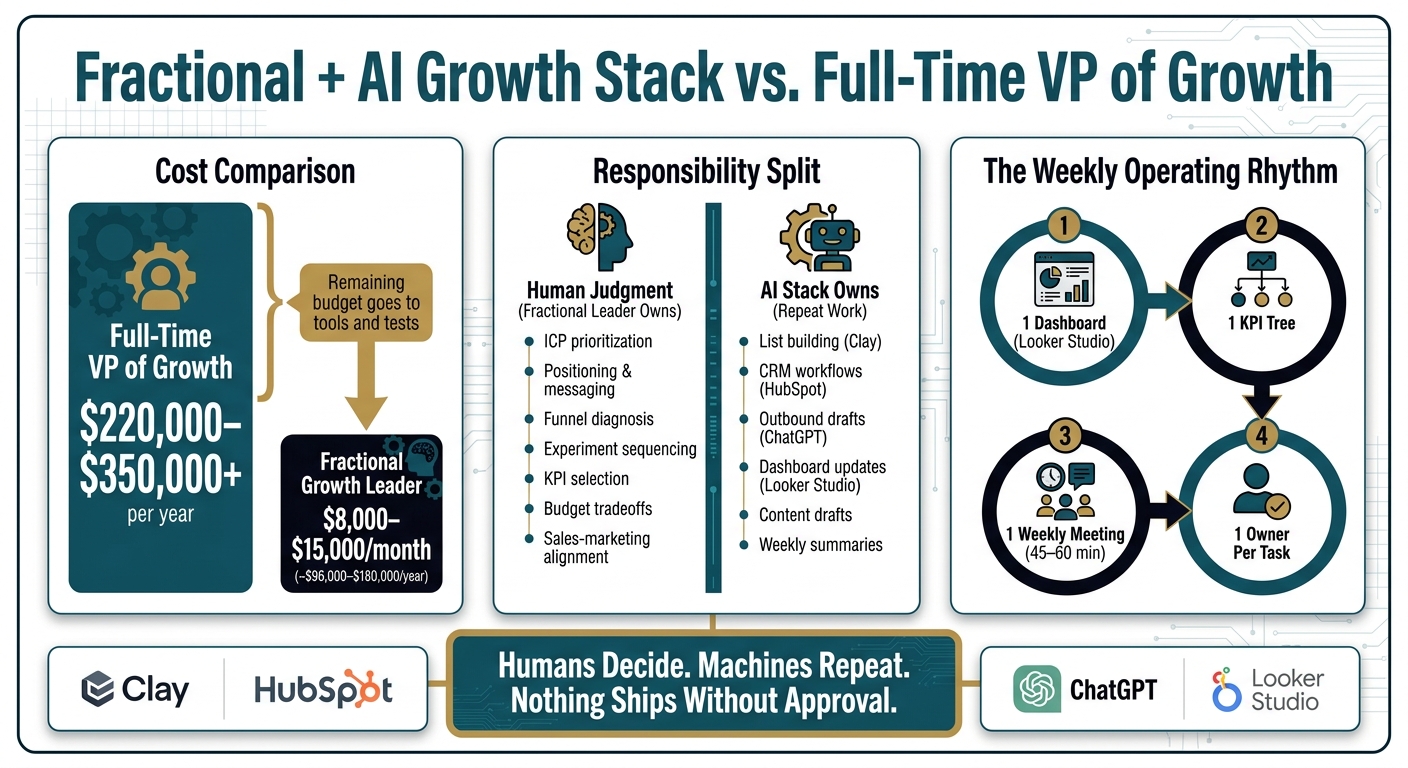
Fractional vs. Full-Time VP of Growth: Cost & Role Breakdown
Fractional AI Support for Faster, Smarter Business Growth
sbb-itb-9cd970b
Step 1: Define What the Fractional Growth Leader Owns
Most agencies do not hit a team limit first. They hit a decision limit first.
That is the shift here. If the wrong work stays with people, your team slows down. If the right work stays with people, and the repeat work moves into Tango, you can run more client marketing with a small team.
Start with ownership. Be plain about what the fractional growth leader owns.
Growth Responsibilities That Require Human Judgment
The split is simple. The leader owns judgment. The stack owns repeat tasks.
A fractional growth leader should personally own growth strategy, ICP prioritization, positioning and messaging, funnel diagnosis, experiment sequencing, KPI selection, budget tradeoffs, and sales-marketing alignment.
Those calls set the rules for everything that follows.
A dashboard can show that demo bookings dropped. But it cannot decide why. The leader has to sort out whether the issue is targeting, messaging, sales process, pricing, product fit, or a market shift.
The same goes for MQL-to-SQL friction. A tool can show the gap. The leader fixes it by setting shared definitions, KPIs, and meeting rhythm.
This is the core lesson. Humans decide. Machines repeat. Nothing ships without approval.
That is how AGL runs many marketing departments with a small team using Tango.
How Fractional Leadership Changes Your Cost Structure
Once ownership is clear, cost gets easier to compare.
The big gain is lower fixed cost. The other gain is start-up speed. A fractional leader can begin with a diagnostic in weeks, not months.
For an agency, that matters. You do not need to staff every client like a full in-house department just to get senior thinking in place.
Where Agile Growth Labs Fits
Agencies need more than a person. They need a system.
AGL uses this model with Tango to turn ownership into repeat work that a small team can run across many client accounts. The result is more output, steadier delivery, and stronger margins.
If you want to run more client departments without adding a stack you have to babysit, start with our newsletter to scale B2B SaaS and services: define the judgment calls first. Then let Tango handle the repeat work under human approval.
Step 2: Assign Repeatable Growth Work to the AI Stack
Here’s the shift. Most agency work does not need more people. It needs a clean split between judgment and repeat work.
That is how AGL runs many marketing departments with a small team using Tango. Humans decide. Machines repeat. Nothing ships without approval. That split is what keeps output high without giving your team more tools to babysit.
ICP Research and Messaging Systems
Start with buyer language. Pull it from sales transcripts, CRM notes, win-loss reasons, interviews, and reviews.
Then feed that data into ChatGPT with a set prompt. Have it find the top problems buyers mention, group them by role and company size, and include verbatim quotes for each problem. From there, AI can draft segment-level ICP profiles and messaging frameworks, including problem statements, value props, objection responses, and proof point suggestions.
The fractional leader still owns the call. They approve the segments, adjust the story based on roadmap and LTV/CAC, and lock a small set of core ICP profiles to test.
AI can refresh these docs each month with new data. But only the leader should approve big changes, like adding or dropping a core segment.
Once those profiles are approved, use them in Clay, HubSpot, and content drafts.
CRM Workflows, Outbound, and Reporting
Once the ICP is locked, wire it into HubSpot and Clay.
Set plain entry and exit rules for Lead, MQL, SQL, Opportunity, and Customer. Then let automation handle the repeat tasks:
- Route inbound leads to the right owner
- Create follow-up tasks when an MQL sits untouched
- Trigger nurture when deals stall
- Flag pipeline that has not moved in a set number of days
For outbound, Clay can build and enrich lists based on ICP filters set by the fractional leader. That includes industries, revenue bands, U.S.-based locations, tech stack data, and hiring activity.
ChatGPT can write personalized first lines from each contact's LinkedIn profile and recent company content. Before full sends go out, a human should spot-check a sample. The fractional leader should also review the targeting logic from time to time to make sure the filters still match the ICP.
On the reporting side, Looker Studio pulls it together. Connect HubSpot, ad platforms, and web analytics into 1 dashboard built around a simple KPI tree. Start with pipeline and revenue. Then go to acquisition by channel. Then stage conversion rates. Then retention, if it matters for that client.
AI can also draft a weekly summary so the meeting starts with the numbers already on the screen.
Experiment Planning and Content Production
Once reporting is live, use AI to build the test backlog.
Give it funnel data and recent customer interview themes. AI can suggest experiment ideas to improve demo-to-opportunity conversion. It can also turn those ideas into a standard test template with a hypothesis, target metric, segment, sample size, and approval thresholds.
The fractional leader still owns the scoring model, often ICE or PIE. They choose what runs in the next sprint. They set the approval thresholds.
After results come in, AI can summarize what happened and suggest next steps. But the scale-or-stop call stays with the leader.
The same rule applies to content. AI can draft landing page hero sections, email variants, and content outlines using approved ICP profiles and brand voice rules. A human reviews every piece before it goes live, most of all anything that makes direct claims about performance or pricing.
That is the Tango system in practice. The stack drafts and summarizes. The fractional leader decides what ships.
If you want this to work across several clients, start with 1 thing this week: move 1 repeat growth task into the stack, then lock the approval rule before anything goes live.
Step 3: Build the Operating System and Weekly Cadence
Most agencies do not need more tools. They need 1 steady rhythm.
That is the shift. The stack does not run the work. The rhythm does. At AGL, Tango gives the team that rhythm. Humans make the calls. Machines do the repeat work. Nothing goes live without approval. That is how a small team can run many client marketing departments without chaos.
The lesson here is simple: build 1 operating system your whole team uses every week.
Set Up the Core Dashboard and KPI Tree
Start with 1 top-line metric. Use net new MRR or total revenue. Then work down from there.
For a B2B team, the KPI tree should include pipeline coverage, stage conversion rates, average sales cycle length, and source-level performance. Pipeline coverage should start at 3.0x at quarter open and fall to 2.5x mid-quarter[1].
Build 1 dashboard with 4 views:
- top-line vs. target
- pipeline health
- funnel conversion
- acquisition by source
Add churn and net revenue retention only if the business is focused on retention.
This is not a side report. It is the same growth system from Step 2. Same inputs. Same logic. Same source of truth.
Each metric needs 1 named owner. That person gives notes and next steps. Use the same Looker Studio dashboard in the weekly meeting every time.
One rule matters a lot. Sales and marketing must use the same definitions.
If 1 person says "MQL" means one thing and another person means something else, the dashboard turns into noise. Write down what each stage means, who updates it, and when.
That dashboard then becomes the meeting agenda.
Run a Weekly Growth Meeting With Clear Owners
Pick 1 weekly time slot and protect it. Keep the meeting to 45 to 60 minutes[2][3][4][5][6][7][8][9].
The fractional growth leader runs the meeting. The internal team handles follow-up work.
Keep the agenda the same each week:
- 10 to 15 minutes on dashboard movement vs. plan. Numbers only.
- 10 to 15 minutes on the biggest funnel bottleneck.
- 10 to 15 minutes on experiment results.
- 10 to 15 minutes on next actions, with named owners and due dates[2][3][4][6][7][9].
Every task needs 1 owner and 1 deadline before the meeting ends. No loose ends. No group ownership.
For the bottleneck review, use 3 simple checks:
- Where is the drop-off?
- Is the issue volume, conversion, or velocity?
- Is it tied to 1 channel or 1 segment?
This is how AGL keeps work moving inside Tango. The meeting sets the calls. The system carries the repeat steps into the next sprint.
Set Basic Rules for Data and AI Use
This part is not flashy. It is what keeps the whole machine honest.
For CRM hygiene, use required fields and picklists instead of free text where you can. Make source capture required on every lead record. Run weekly enrichment workflows to keep contact data current. Flag records older than 12 months for a data audit[10][11][12].
Give data ownership to 1 person. That person checks for duplicates, stage drift, and missing attribution on a set schedule.
For AI use, keep the rule blunt: AI drafts. Humans approve.
Write down the prompts, approval steps, and workflow owners. That way, any operator can trace how each metric was made. That is the point of Tango. You get more output without babysitting a messy AI stack.
If you want this to work for clients, do 1 thing next: set up the dashboard and book the same weekly growth meeting for the next 4 weeks.
Conclusion: A Clear Model for Growth Without a Full-Time VP
Here’s the shift. Growth does not come from hiring the biggest title in the room. It comes from clear ownership, a tight system, and work that gets done every week.
That is the model AGL uses with Tango.
A fractional growth leader owns strategy and accountability. The AI stack handles repeat work. A weekly operating rhythm keeps execution tight.
For agency owners, that changes the math. A full-time VP of Growth often costs $220,000 to $350,000 per year in total pay. A fractional leader costs less and lets you put more budget into tools and tests instead.[13][14][15][16][17]
The lesson is simple: humans decide, machines repeat, and nothing ships without approval.
That is how AGL runs many marketing departments with a small team using Tango. Clay fills in data. ChatGPT drafts and sums things up. HubSpot runs lifecycle marketing automation work. Looker Studio keeps reports up to date without manual spreadsheet pulls.
The payoff is clear. You get cleaner data, faster decisions, and less guesswork without adding headcount. You also get more output without building an AI stack your team has to babysit.
If you want to put this to work, start with 1 move. Define ownership. Then run the same weekly growth meeting for 4 weeks from 1 shared dashboard and 1 KPI tree. That cadence is what makes the stack work like an engine.
FAQs
How do I know if I need a fractional growth leader?
You need a fractional growth leader when one thing becomes clear: more tools do not create more control.
A lot of agencies hit this point. The team is busy. The stack keeps growing. But the system behind it still lacks clear direction. That’s where a fractional growth leader steps in.
At AGL, that work runs through Tango. Humans make the calls. Machines handle the repeat work. And nothing goes live without approval. That’s how a small team can run many marketing departments without the usual mess.
You’ll likely need this kind of help when your team can’t guide a complex, AI-driven growth system, or when your data is so split up that it can’t show clean results.
The signs tend to show up fast:
- Tool overlap
- Integration debt
- Lead qualification that changes from one client to the next
- Outbound content that feels uneven
- Unclear ownership
- A tech stack that does not map back to revenue goals
This is the core lesson: growth breaks when no one owns the system. A fractional growth leader fixes that by tying people, process, data, and tools back to output.
If that sounds close to where your agency is now, look at how AGL uses Tango to help a small team deliver more work with tighter control.
What tasks should stay human versus move to AI?
Here’s the shift: the best agencies do not hand strategy to AI. They use AI to do the repeat work, while people keep the calls that shape the account.
That’s how AGL runs many marketing departments with a small team using Tango. Humans decide. Machines repeat. Nothing ships without approval.
Keep human ownership for judgment-heavy work. That means defining and approving ICP and messaging, choosing experiments, reading results, and handling complex talks or client relationships.
Use AI for repeatable, data-heavy tasks. That includes research, lead scoring, outreach drafts and follow-ups, CRM updates, scheduling, routine funnel analysis, experiment variations, and reporting.
The lesson is simple: give AI the labor, not the judgment.
That split is what makes Tango work. It helps a small team produce more without adding an AI stack to manage by hand. Your team stays in control. Your delivery gets stronger. And you still review outputs and refine targeting before anything goes live.
If you want a setup like that in your agency, look at how Tango fits your workflow.
How long does it take to set up this growth system?
Most agencies think a growth system starts when the tools go live.
It doesn’t.
It starts when the base is clean, the rules are set, and the team knows what machines can repeat and what people still need to check. That is how AGL runs many marketing departments with a small team using Tango. Humans decide. Machines repeat. Nothing ships without approval.
A growth system usually takes a few months to get right. A 30- to 60-day pilot is often the first step. It gives you a safe way to test the first tools, cut risk, and see if the system can do the job.
Some of the slow part is plain setup work. CRM cleanup and core system integrations can take weeks. That part is not flashy. But it matters, because bad inputs lead to bad output.
After setup, progress tends to build over 3 to 6 months. That is when the system gets better through monitoring, refinement, and quarterly retraining.
That’s the lesson: don’t judge the system too early. First you build the base. Then you train the loop. That is the Tango system in practice, and it is how AGL helps agencies get more output without a pile of tools to manage.
If you want to test this the smart way, start with the 30- to 60-day pilot and measure what the system can handle before you scale it.