How Much Is a Marketing Agency Worth? How Delivery Systems Change Your Multiple

A marketing agency’s value starts with normalized earnings × a multiple, and that multiple depends on whether clients and profits will stay after the founder leaves. I would check who owns client relationships, who approves work, and whether margins hold without founder input before putting a price on an agency.
AI alone does not fix founder dependence. If client rules and past decisions still live in your head, more tools leave the same gap.
I focus on shared client context. Agile Growth Labs (AGL) calls its system Portable Delivery Intelligence: client knowledge, work steps, and approval rules that the team can use without the founder. AGL’s target is 18–25 accounts per account manager, compared with 4–8. That is a capacity target, not a promised sale multiple.
<u>The test is whether the work holds up.</u> Check client retention, rework, margins, and founder involvement together. Written steps alone do not prove that earnings will last.
Next step: Run the free calculator.
How to Sell a Marketing Agency: Valuation, Deal Structure and Earnout Traps
sbb-itb-9cd970b
How Agency Valuation Works: Normalized Earnings × Multiple
An agency’s enterprise value (EV) equals normalized EBITDA × a valuation multiple, so buyers assess both earnings and the risk of keeping those earnings after a sale. Normalized EBITDA removes one-time items and adjusts for costs the buyer would face, including market-rate pay to replace the founder’s work.[6][2]
Valid add-backs include documented personal travel, excess owner pay, and one-time legal fees that will not recur. Recurring delivery costs stay in the calculation. If the founder runs key parts of the business, buyers deduct the cost of replacing that role. That labor is not free.[6][2]
The earnings measure matters, too. Seller’s discretionary earnings (SDE) can overstate what a buyer keeps when the owner handles sales or client work that someone else must take over.
| Valuation basis | Calculation base | Limitation | Fit for a $2M–$10M recurring-service agency |
|---|---|---|---|
| Seller’s discretionary earnings (SDE) | Net profit plus the owner’s full pay and benefits, plus valid add-backs | Does not deduct the cost of replacing the owner’s work | Best suited to smaller, founder-led agencies; less useful when the business must run without the founder. |
| Normalized EBITDA | EBITDA adjusted for one-time expenses and market-rate replacement pay | Requires clean books and proof for each adjustment | Strongest basis for judging earnings that can last after the agency changes hands. |
| Revenue multiple | Agency fee revenue, excluding pass-through media spend | Ignores margins and delivery costs | A cross-check for high-growth agencies or strategic acquisitions, not a replacement for earnings analysis. |
The multiple rises as client concentration, owner dependence, retention risk, and handoff risk fall.[6][2] Any multiples used are illustrative, not promised sale terms. The delivery system gives buyers evidence to test whether a risk discount is warranted.
Enterprise value is not seller proceeds. To calculate closing proceeds, start with EV, add cash, subtract debt, and adjust for working capital. Taxes, fees, and any earnout or rollover affect how much the seller gets now versus later.[6] Buyers test handoff risk by checking how client work gets done.
1. Founder-Dependent Agency
Owner dependence
Founder dependence can lower an agency’s sale multiple because buyers need to trust that earnings will hold after the owner leaves. When client history sits in private messages and routine calls need the founder’s input, buyers see a business that may struggle without its owner.
An inbox is not a delivery system. Move client context into shared records. Give account managers the main client relationships 12–18 months before a sale.[4][3]
Delivery quality and continuity
Repeated briefings and informal reviews make quality depend on memory, not a clear process. That weakens the case for a higher multiple.
Document the 5 core workflows: onboarding, scoping, kickoff, weekly delivery, and invoicing. Add QA checks and clear points where approval is needed.[10]
Capacity and margin durability
When growth depends on more senior staff, higher revenue does not prove the team can carry more work.
Track accounts per employee, margins, utilization, and rework. Revenue growth alone does not show gains in team capacity.[2][10] Buyers need this proof before they reduce a founder-risk discount.
Transfer risk and valuation
Run a 2-week founder-free test. Note where decisions, delivery, or client messages stall.[11]
Avoid counting the same risk twice. Once earnings reflect the cost to replace the owner, price only the client and knowledge risk that remains.[4][3]
The next section shows the delivery proof buyers can check before paying a higher multiple.
2. Agency With Repeatable Delivery
Owner dependence
Repeatable-delivery agencies can support a higher multiple when work moves without the founder. The key is not more AI. It is shared client context that lets account leads own client relationships, an operations lead approve scope and staffing, and the team record decisions where others can find them [4].
Test whether routine work, approvals, and client decisions keep moving without founder input [10][12].
Delivery quality and continuity
Shared delivery records help another team member run the work. They should include client context, brief history, client-specific rules, approval gates, and human QA checks.
Keep delivery decisions in those records so buyers can check that the work can change hands [3][4]. Then test whether the team can serve more clients without hiring at the same rate.
Capacity and margin durability
Buyers should review accounts per employee, account complexity, utilization, realization, retention, and margin. More accounts only matter if margin and retention hold [4][9].
Transfer risk and valuation
A buyer-ready playbook should spell out who owns each task, how delivery runs, and when to ask for help. This reduces handoff risk and can lower the risk discount buyers apply to the multiple.
Across 21 agency transactions, trailing-12-month EBITDA multiples ranged from 2.65x to 12.64x. Management depth and the ability to grow helped explain that spread [7].
Delivery Evidence Buyers Can Verify
Build the diligence file from operating records, not a pitch deck. Use 2–3 years of client revenue, staffing, delivery, and invoicing records to show which gains hold up over time. [4] Buyers need to see whether normalized earnings can hold after the founder steps back. That evidence supports a stronger multiple.
Buyers should check the records, not just hear the story.
| Criterion | Metric | Supporting artifact | Buyer test |
|---|---|---|---|
| Owner dependence | % of new business closed by founder; % of client escalations handled by owner | CRM history; escalation logs; founder’s calendar | Check who led the last 5 pitches and which decisions needed founder help. [4][2] |
| Management depth | Leadership tenure; business decisions made by non-founders | Org chart; role descriptions; P&L responsibility docs | Check whether the agency can run for 30 days without the founder. [2][10] |
| SOP adoption | % of recurring tasks that follow written SOPs; employee adherence rates | Operator playbooks; workflow ownership maps; SOP library | Compare completed task records with SOP requirements. [10] |
| Client context and approvals | Rework rate; defect frequency; turnaround by service tier | Account maps; client rules; revision history; quality control logs | Follow a deliverable from brief to release. Check human QA and approval, including for AI-assisted work. [4][6] |
| Capacity and margins | Accounts per employee by role, complexity, and tier; utilization; billing realization; service-line gross margin | Staffing mix schedules; timesheets; invoices; payroll and contractor costs | Count revision work and senior escalation time. Compare margins as account loads grow without hiring at the same rate. [4][9] |
| Retention and renewals | Gross revenue retention; renewal rate; client tenure | Revenue cohorts; contracts; renewal history | Separate retained revenue from expansion. Check whether older accounts renew, shrink, or leave. [4] |
| Client concentration | Recurring revenue share; largest-client and top-client concentration | Client revenue schedule; contracts; termination and assignment terms | Confirm that contracts back recurring fees. Check the risk if a major client leaves. [4][6] |
A 2-week founder absence can reveal work that still depends on the owner. Log every time the founder steps in. A quiet inbox alone proves nothing. [6]
Compare account loads with quality, turnaround, retention, and margins over the same period. More accounts do not prove better output per employee if rework eats up the gain. [4][9]
Check billing realization, the amount billed against the standard value of hours worked, alongside utilization. Together, these measures help show where the team does more work than it bills for. Confirm that growth without hiring at the same rate kept these measures intact. [4][9]
Let the buyer choose the account and task. Documents alone are not proof. The employee must be able to find the client context, follow the workflow, and finish without founder input. [10][11] If that test fails, the multiple should still reflect founder risk.
Final Verdict: A Stronger Multiple Needs Proof
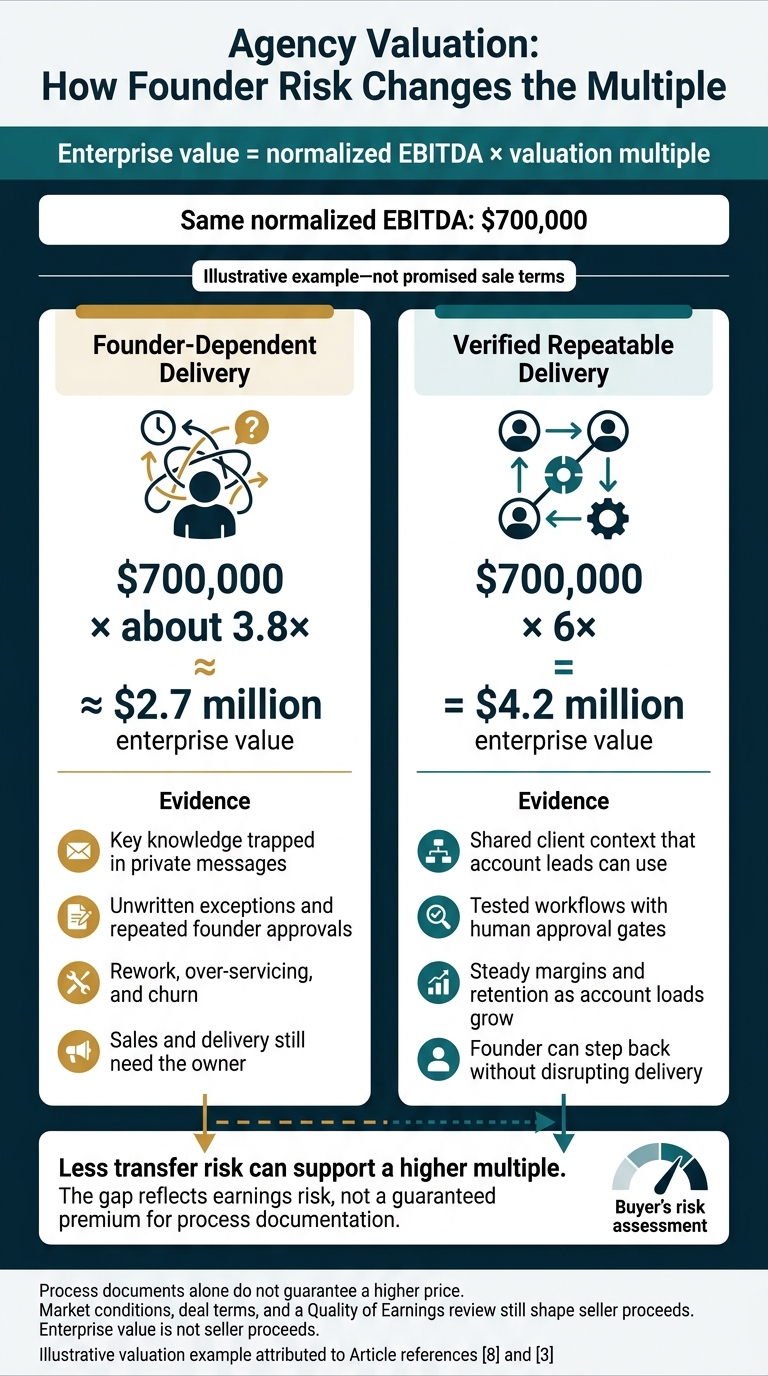
Agency Valuation: How Founder Risk Changes the Multiple
Buyers may pay a higher multiple when they can verify that delivery runs without the founder. Shared client context, steady margins, and clear approval rules can reduce buyer risk, but process documents alone do not guarantee a higher price or prove that the agency can run without its owner.
Two agencies can each earn $700,000 in normalized EBITDA, yet command different multiples when one has verified that delivery can run without its founder. An about 3.8× multiple implies a $2.7 million enterprise value; 6× implies $4.2 million. The gap reflects earnings risk, not a guaranteed premium for process documentation. [5][1]
| Evidence of scalable delivery | Evidence of delivery risk |
|---|---|
| Shared client context that account leads can use | Key knowledge trapped in private messages |
| Tested workflows with human approval gates | Unwritten exceptions and repeated founder approvals |
| Steady margins and retention as account loads grow | Rework, over-servicing, and churn |
| Founder can step back without disrupting delivery | Sales and delivery still need the owner |
The pricing logic is simple: less transfer risk can support a higher multiple.
Fix the weakest proof point in 1 live service before you expand. If work stalls at founder sign-off, record how the founder makes each call. Then give a qualified delivery lead the right to make those calls. Keep human QA. Remove reliance on 1 person.
Steady margins, repeatable quality, and less founder dependence can support a higher multiple. They cannot guarantee it. Market conditions, deal terms, and a Quality of Earnings review still shape what the seller takes home. [7][8]
FAQs
How do I choose a realistic valuation multiple?
Start with Seller’s Discretionary Earnings (SDE) for smaller, owner-run agencies. Use Adjusted EBITDA for agencies with a strong management team. Then compare closed agency sales with a similar size, service mix, and client concentration. Generic industry averages won’t give you the same fit.
Next, adjust the multiple for risk. Written workflows, strong leaders, recurring revenue, high margins, and clean books support higher multiples. Heavy owner involvement, project-based revenue, and poor records tend to lower them.
Set the earnings figure first. Apply the multiple after.
How long must delivery improvements hold to convince buyers?
Plan for 12 to 18 months to show buyers that better delivery holds up over time. Prove that your agency runs on written systems, not the owner stepping in to save the day.
Use that time to move client relationships to your team, set clear workflows, and show that leaders can run the agency without your daily input. A track record buyers can check, with steady results and client retention, can help support a higher valuation multiple.
Which delivery risks should I fix before selling?
Before you sell, make sure the agency can run without you. Hand off your duties. Turn knowledge held by a few people into written workflows and quality checks. If 1 client brings in more than 15%–20% of revenue, spread that risk across more clients.
Check utilization, realization rates, and margins to see whether more work means more hires. Match bank deposits to tax returns and your general ledger. Make sure formal, enforceable contracts cover all client work.
These steps give buyers fewer reasons to worry and help support a stronger valuation.