Agency P&L Transparency: What a $15K/mo Retainer Actually Costs to Deliver

A $15,000 retainer is only good if it leaves margin after labor, tools, meetings, and overhead.
I see 1 clear lesson in this piece: hours decide profit. A healthy $15,000/month account should often land around 50% to 60% gross margin and 15% to 25% net margin. But the same retainer can drop from 19% net profit to -7% net profit when hours climb from 143 to 215 with no fee change.
Here’s the short version:
- Revenue is not profit
- Direct labor can hit $6,000 to $7,500
- Tools can add $500 to $1,500
- Overhead at 30% adds $4,500
- Scope creep can turn a good account into a loss
- AGL uses Tango to cut repeat work with a small team
- Humans decide, machines repeat, nothing ships without approval
A simple account view makes the point fast:
| Scenario | Revenue | Direct Costs | Gross Margin | Net Profit |
|---|---|---|---|---|
| Controlled scope | $15,000 | $7,625 | 49% | $2,875 |
| Scope creep | $15,000 | $11,520 | 23% | -$1,020 |
What I take from this is simple. If you run marketing for several clients, you should not judge an account by retainer size. You should judge it by <u>planned hours vs. actual hours</u>, by role, every month.
AGL’s angle is clear. Tango helps a small team run more client work by cutting repeat admin and handoff drag. That helps protect margin without piling on more staff or more tools to watch.
1 action to take now: review 1 active $15,000 account this month, compare planned hours to actual hours by role, and fix the scope before margin slips.
Retainer Pricing for Agencies: The Margin Math (2026) | GigRadar
sbb-itb-9cd970b
The Real Cost Buckets Behind a $15,000 Retainer
Here’s the part many agency owners miss at first: a $15,000 retainer can look big on paper and still get thin fast.
The reason is simple. The money does not sit in one pile. It gets split across labor, coordination, tools, and overhead before profit shows up. That is why AGL built Tango. Humans decide. Machines repeat. Nothing ships without approval. The point is more output from a small team, without extra stack work to manage.
Strategy, Account Management, and Specialist Labor
A common monthly labor mix for 1 $15,000 account looks like this:
| Role | Typical Monthly Hours | Internal Cost/Hour | Estimated Monthly Cost |
|---|---|---|---|
| Senior strategist | 6–10 hrs | $70–$100 | $600–$1,000 |
| Account manager | 15–25 hrs | $40–$60 | $600–$1,500 |
| Specialists (paid media, SEO, content, design) | 50–80 hrs combined | $35–$70 | $2,500–$4,000 |
Most of the hours sit with production. That means media buyers, SEO analysts, writers, and designers.
Those roles often run at 70–85% utilization, so most of their week is already spoken for.[11][12][5][8] Then the extra asks start to roll in. A small buffer of 10–20% for unplanned work can push direct labor on 1 account to $6,000–$7,500.
And that is just direct labor.
It does not yet count the work around the work. Meetings. Reporting. Revisions. Those hours add up fast, and they are part of delivery whether the client sees them or not.
Tools, Reporting, Meetings, and Revision Cycles
A lot of agencies scope deliverables. They do not always scope the time it takes to move those deliverables through the system.
On a $15,000 retainer, repeat meetings alone can eat 6–10 hours of account manager time and 2–4 hours of strategist time each month. That puts coordination cost at about $500–$1,000 before any hands-on production starts.
Then layer in the rest:
- 8–12 hours of reporting and analysis
- 8–12 hours of revisions across content, creative, and implementation
Put together, those tasks can hit 25–35 hours per month and cost another $1,300–$2,200 in direct labor.[11][12][5][13][8]
Tools add more weight.
A single $15,000 account often carries $500–$1,500 per month in software allocation once you count it cleanly. That can include SEO tools, reporting platforms, project management seats, AI writing tools, call tracking, and analytics suites.[2][14][3]
This is where many agency P&Ls get fuzzy. If tool spend gets dumped into broad overhead, account margin can look better than it is. In some cases, agencies overstate gross margin by 3–10 percentage points on single accounts.[2][14][3]
This is one reason AGL uses Tango. The system cuts repeat production work so the team does not need to keep stacking tools and labor just to keep pace. That helps protect delivery without turning operations into a mess.
Overhead and the Hidden Cost of Running the Agency
Overhead is where a “good” account can stop looking good.
Leadership pay, finance, HR, recruiting, sales, admin, training, and internal software all have to get paid from client revenue. None of that sits on a client timesheet. But all of it is part of the account math.
On a $15,000 retainer, a 30% overhead rate means $4,500 per month in overhead allocation.
Here is the simple version:
- If direct delivery costs are $7,000, gross profit is $8,000 (53%)
- After $4,500 in overhead, net profit is $3,500 (23%)
- If scope creep pushes direct costs to $9,000, gross profit drops to $6,000 (40%)
- After the same overhead allocation, net profit falls to $1,500 (10%)
That lands below the 15–25% net margin target many agency owners want.[2][14][3][9]
So the lesson is clear. A client can look fine at gross margin and still be weak after overhead.
That is the frame AGL works from with Tango. Small team. More output. Human review on every ship. Less repeat labor. Stronger delivery. Better room for the retainer to stay worth it.
If you want to see where margin slips in your own book, map each $15,000 account into these same buckets before you touch pricing.
A Sample P&L for a $15,000 Retainer
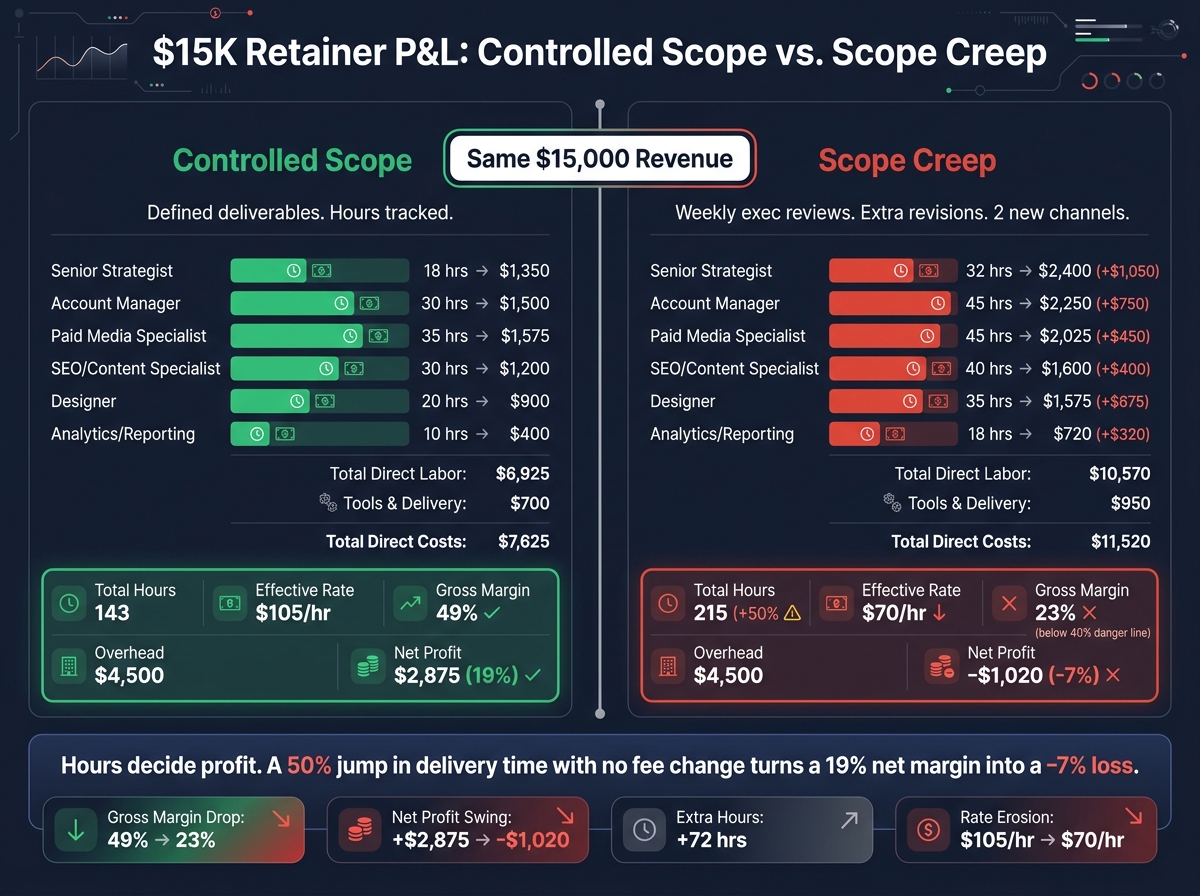
$15K Retainer P&L: Controlled Scope vs. Scope Creep
A $15,000 retainer can look solid on paper and still go bad in the work. That’s the shift most agency owners miss.
The fee is not the story. The hours are the story.
At AGL, this is why Tango matters. Humans decide the plan. Machines repeat the busywork. Nothing ships without approval. That setup helps a small team run more client work without adding chaos, extra tools, or hidden labor.
Here’s what that looks like in a monthly account P&L.
Scenario 1: A Healthy Account With Controlled Scope
Assume a U.S.-based digital marketing agency serving a B2B SaaS client. Scope is defined, hours are tracked, and the team sticks to the plan.
| Cost Line | Monthly Amount |
|---|---|
| Senior strategist (18 hrs @ $75/hr) | $1,350 |
| Account manager (30 hrs @ $50/hr) | $1,500 |
| Paid media specialist (35 hrs @ $45/hr) | $1,575 |
| SEO/content specialist (30 hrs @ $40/hr) | $1,200 |
| Designer (20 hrs @ $45/hr) | $900 |
| Analytics/reporting support (10 hrs @ $40/hr) | $400 |
| Total direct labor | $6,925 |
| Tools and delivery costs (allocated) | $700 |
| Total direct costs | $7,625 |
| Gross profit | $7,375 (49%) |
| Overhead allocation (30% of revenue) | $4,500 |
| Net profit | $2,875 (19%) |
These are fully loaded costs: salary, payroll taxes, and benefits divided by available hours.[6][18] The 143 total hours across all roles produce an effective billable rate of about $105/hour ($15,000 ÷ 143 hrs).
Gross margin lands at 49%. That sits just inside a healthy band. Net margin at 19% falls within the 15% to 25% target, which gives the account room to help the agency instead of draining the team.
This is the kind of account AGL aims to run with Tango. Clear scope. Tight approval flow. More output from a small team. No AI stack to babysit.
The same account can flip fast when scope grows.
Scenario 2: How Scope Creep Turns the Same Retainer Unprofitable
Now take the same $15,000 retainer. Same client. Same team. But this time, the client pushes for weekly executive reviews, extra revision rounds, and 2 new channels added at no extra fee.
| Role | Scenario 1 Hours | Scenario 2 Hours | Cost Increase |
|---|---|---|---|
| Senior strategist | 18 hrs → $1,350 | 32 hrs → $2,400 | +$1,050 |
| Account manager | 30 hrs → $1,500 | 45 hrs → $2,250 | +$750 |
| Paid media specialist | 35 hrs → $1,575 | 45 hrs → $2,025 | +$450 |
| SEO/content specialist | 30 hrs → $1,200 | 40 hrs → $1,600 | +$400 |
| Designer | 20 hrs → $900 | 35 hrs → $1,575 | +$675 |
| Analytics/reporting | 10 hrs → $400 | 18 hrs → $720 | +$320 |
| Total direct labor | $6,925 | $10,570 | +$3,645 |
| Tools and delivery | $700 | $950 | +$250 |
| Total direct costs | $7,625 | $11,520 | +$3,895 |
| Gross profit | $7,375 (49%) | $3,480 (23%) | |
| Overhead allocation (30% of revenue) | $4,500 | $4,500 | - |
| Net profit | $2,875 (19%) | –$1,020 (–7%) |
Total hours rose from 143 to 215. That is a 50% jump in delivery time with no jump in revenue. The effective billable rate fell from $105/hour to about $70/hour. Gross margin dropped from 49% to 23%, well under the 40% danger line.[14][9][4][22]
The client is happy. The team is busy. The account loses money.
That’s the lesson.
If your agency does not control scope at the task level, your retainer is not fixed. It is just delayed overwork.
This is also where Tango changes the math. AGL uses it to cut repeated work, keep approvals tight, and stop extra requests from spreading across the team. That leads to more output without stuffing more hours into the account. The payoff is simple: stronger delivery, better retainers, and an agency that is worth more if you sell.
The Key Numbers to Track Every Month at the Account Level
Catch scope creep early by tracking account-level metrics, not just firm-wide averages.
Track these 4 numbers each month:
- Planned vs. actual hours by role. Set a monthly hour budget per role when the retainer is signed. Then compare it to actual logged hours each month. If the gap keeps showing up, scope is drifting.
- Direct labor cost per client. Multiply actual hours by each role's fully loaded cost rate. This is the main number on the account P&L, and many agencies either do not track it or track it too loosely.[6][18]
- Client-level gross margin. Revenue minus direct labor and tool allocation, divided by revenue. Track it monthly by client. Many agencies aim for 50% to 60%+ at the firm level and often 60% to 70%+ at the account level.[6][17][1][18] Below 40% is a warning sign.
- Net margin by client. After applying your overhead allocation rate, often 30% to 40% of revenue,[15][21] what is left? Healthy targets sit at 15% to 25% net margin. Anything below 10% means the account is taking more than it gives back.[2][19][7][20]
That is the minimum monthly dashboard for any $15,000 retainer.
One move to make now: review 1 active $15,000 account, compare planned hours to actual hours by role, and see if the margin still works under the surface.
How to Protect Margin Without Underdelivering
Most margin problems do not start with bad work. They start with work that looks small from the outside and turns into a time sink on the inside.
That is why AGL treats margin like an operating issue, not just a pricing issue. With Tango, the team can run many client accounts with a small crew because the system cuts repeat admin work. Humans decide. Machines repeat. Nothing ships without approval. That keeps delivery strong without piling on more payroll.
Scope Each Deliverable in Hours, Not Just Outputs
A line like "8 blog posts per month" sounds clear.
It is not.
The client sees 8 posts. Your P&L sees labor.
So scope the labor first. Then set the retainer. For those 8 posts, the math might look like this: 2 hours for a content strategist to plan topics and briefs, 3 hours per post for a writer, or 24 hours total, and 1 hour per post for an editor, or 8 hours total. That is 34 hours for blog content alone, before meetings, reporting, and revisions.[10][26][27]
Do the same for:
- Strategy calls
- Campaign builds
- Reporting
- Revision rounds
Then add a 10% to 20% buffer before pricing. That covers meetings, revisions, and carryover work.[10][28]
Once hours are plain, the next call gets easier. You can staff better. You can price with more confidence. You can spot thin margin before it turns into a bad account.
Use Capacity and Utilization Data to Reset Pricing or Scope
When you track hours by account, the account starts telling the truth.
If actual hours beat scoped hours for months, and they run past your buffer, the problem is plain. The retainer is underpriced or the scope is too big. Guessing will not fix that.
A good line in the sand is gross margin below about 50% to 55%.[23][24][25] At that point, reset the deal. Show the logged hours, loaded rates, and margin. Put the numbers on the table.
If the client pushes back on price, trim the scope. Or move extra asks into separate pricing.[29] Both are better than eating the overrun month after month.
One of the fastest fixes is often meetings and reporting. A weekly deep-dive call can become biweekly. A live update can become async. Small changes like that can win back hours without making the client feel like service dropped.
And if price will not move, then your system has to waste less.
Use a Coordination System to Get More Done With the Same Team
Good scoping protects margin on paper. Good coordination protects it in daily work.
The drag is rarely one huge mistake. It is the pileup of small messes. Unclear handoffs. Approval notes spread across tools. Repeat status pings. Rework from crossed wires.
That kind of friction can eat up 15% to 60% of admin workload across a delivery team.[30][31] That time is not billable. It cuts straight into margin.
The fix is simple to say and hard to do by hand. Standardize handoffs. Put task ownership in one place. Set approval rules before work starts.
That is where Tango fits. It gives AGL one way to run delivery across many accounts with the same team. The system handles the repeat work. People still make the calls. People still approve the output. But the back-and-forth drops. The team ships more. Delivery stays tight. Agencies can push for higher retainers and build a firm that is worth more at sale.
Agencies that run this way often see utilization improve by 10 to 20 percentage points.[16][30] That is not a small gain. That is the kind of change that protects margin without cutting service.
If you want to protect margin, start with 1 move. Map 1 client deliverable into hours by role, then run it through Tango as the default way work gets handed off and approved.
Conclusion: What a $15,000 Retainer Is Really Worth
Most agencies think a $15,000 retainer means growth.
It does not.
It only means something after delivery cost and overhead. The number that counts is margin after delivery.
That shifts the whole way you look at an account. The main issue is not the fee on paper. It is what stays left after labor, team time, tools, and overhead. That is why hour control is the margin lever.
So here is the lesson. Scope in hours, not just outputs. Then track actual hours against plan every month. If an account drops below your margin floor, rescope it or reprice it.
At AGL, this is where Tango matters. AGL runs many marketing departments with a small team by using Tango to keep work tight, repeat tasks, and hold the line on approvals. Humans decide. Machines repeat. Nothing ships without approval.
That is how better coordination cuts the gap between scoped work and shipped work. Clean handoffs help. Fast approvals help. The same team gets more out the door without burning more hours.
A $15,000 retainer is worth only the margin it leaves.
One move to make now: review 1 client this month by planned hours vs. actual hours, then fix the scope before the margin slips.
FAQs
What counts as direct costs on a $15,000 retainer?
A $15,000 retainer can look strong on paper and still hide weak margins.
The fix is simple. Count every cost tied to delivery, not just payroll.
Direct costs on a $15,000 monthly retainer include:
- strategist, account manager, and specialist labor
- software and tools used for delivery
- project-specific setup, integration fees, and needed hardware or cloud infrastructure
- variable costs like payment processing fees
- meeting time and overhead
That last part matters more than most agency owners think. A client may look profitable until you count the hours spent in status calls, internal handoffs, and admin work.
At AGL, this is where Tango helps. Humans decide. Machines repeat. Nothing ships without approval. That means the team can see what delivery costs, cut waste, and keep output high without adding more tools to manage.
How should I set a margin floor for client accounts?
Start with a simple math check: what does each account cost you to deliver?
Add up specialist labor, strategist time, account manager time, software, reporting overhead, and revisions. That number is your baseline. It sets the floor for your margin.
At AGL, this is one reason Tango matters. A small team can run many marketing departments because machines handle the repeat work, and humans make the calls. Nothing ships without approval. That setup helps protect margin without adding more tools to manage.
A good benchmark is 80%+ gross margin. Once you slip below 70%, agency value can take a hit.
Keep a close eye on the inputs that move that number:
- Acquisition cost
- Infrastructure costs
- Usage patterns
That keeps pricing tied to profit, not guesswork.
If you want stronger delivery with less tool sprawl, look at the Tango system AGL uses now.
When should I reprice or rescope a retainer?
You don’t reprice a retainer because a client feels busy. You do it when the numbers change.
Reprice or rescope when your internal data shows the client is using more, using less, or using the work in a different way than the deal assumed. The same goes for delivery costs. If labor, tools, or infra now cost more than the value you priced, the old retainer stops making sense.
At AGL, this is the kind of call Tango helps make clear. The system shows what the client consumes, what the team delivers, and where time starts to drift. Humans make the call. Machines repeat the tracking. Nothing ships without approval.
Review account ROI on a set cadence. Then act when the account turns unprofitable, when usage shows the client needs an upgrade, when at-risk behavior shows up, or when revisions and support keep going past your first estimate.
If your team is doing more than the retainer pays for, don’t wait. Pull the data, reset the scope, and move the account to the right price.