The 10/80/10 Rule for Delegating to AI Agents

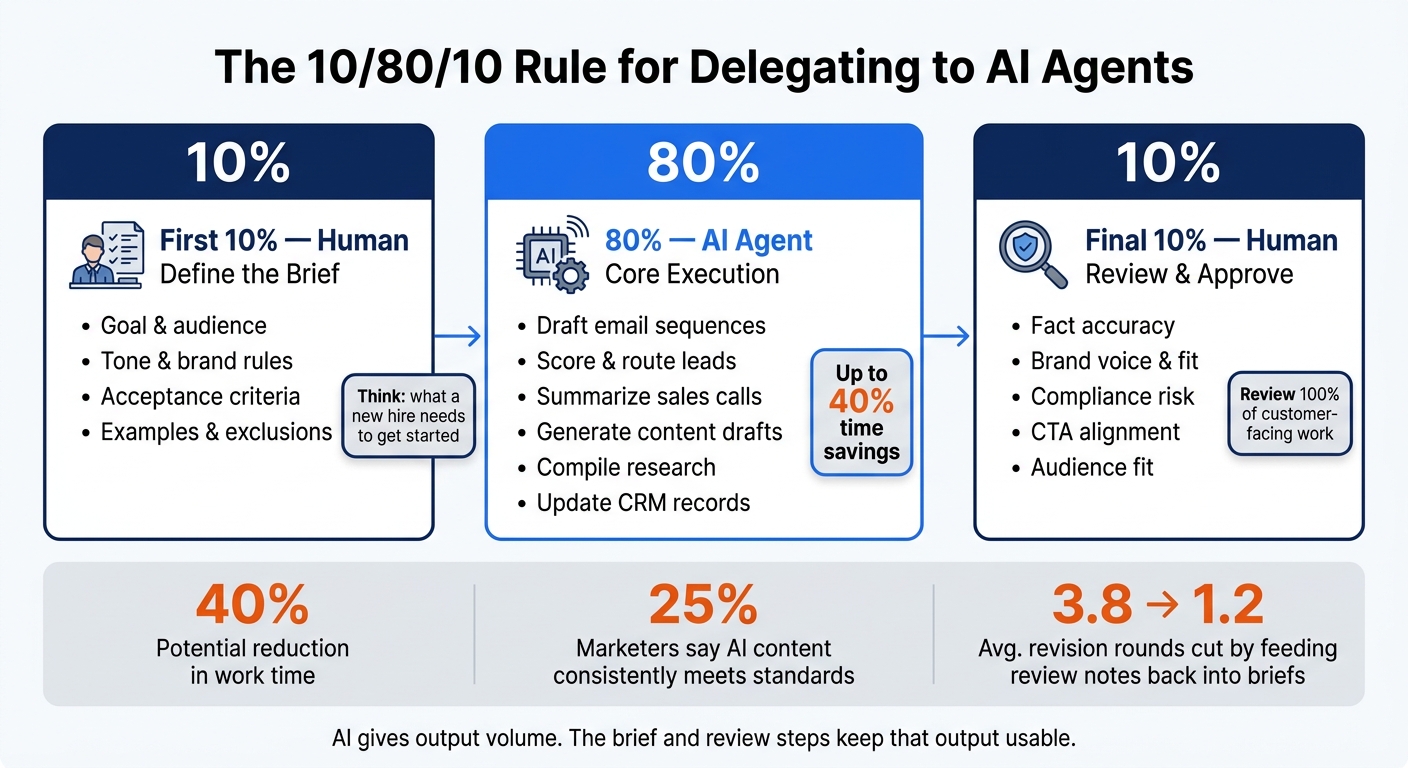
AI should do the middle of the job, not the whole job. That’s the point of the 10/80/10 rule: I set the brief, AI handles the bulk of the work, and I review the final output before it goes out.
Here’s the short version:
- First 10%: I define the goal, audience, tone, rules, and examples.
- Middle 80%: AI drafts, sorts, summarizes, researches, or updates records.
- Final 10%: I check facts, voice, fit, and risk before anything is sent or published.
Why does this matter? Because AI may cut work time by up to 40%, but only 25% of marketers say AI content consistently meets their standards. So the issue isn’t just speed. It’s whether the output is safe to use.
This model works well for SaaS teams that use AI for:
- Sales outreach
- Lead scoring and routing
- Content drafts
- CRM updates
- Market and competitor research
A few rules make it work:
- I only hand off tasks that can be done from a clear brief.
- AI can draft, but it should not send or publish on its own.
- I review 100% of customer-facing work.
- For low-risk repeat tasks, I can spot-check 10% to 15% after the process is stable.
- I track revision rounds, acceptance rate, and time saved so the workflow gets better over time.
One useful data point from the article: one team cut average revisions from 3.8 rounds per deliverable to 1.2 by feeding review notes back into the brief.
If I had to sum it up in one line, it would be this: AI gives me output volume; the brief and review steps keep that output usable.
The 10/80/10 Rule: How to Delegate Work to AI Agents
Stop Prompting, Start Delegating: A Physician’s Guide to AI Agents
sbb-itb-9cd970b
How to Build a 10/80/10 Workflow
Build the workflow around three choices: the brief, the AI’s job, and the human sign-off. Once those are set, the process gets much easier to repeat.
Define the First 10%: Inputs AI Can Work From
The brief should act like a context packet: the goal, audience, source data, tone, and a few strong examples. That’s what stops the AI from guessing. [2][1][4]
Set acceptance criteria, exclusions, and constraints in the same place. Be plain about what “done and good” means, and spell out what the agent must never do. If your brand never leads with pricing before a discovery call, say so. The same goes for language. Words like “delve,” “leverage,” “seamlessly,” and “groundbreaking” are common AI defaults worth cutting. [7] Use U.S. conventions for dates, currency, and spelling.
A good rule of thumb: hand off tasks that a new hire could finish from the brief alone. Keep strategy work and relationship-heavy work with humans. [9]
Assign the 80% to AI Agents With Clear Boundaries
Once the brief is in good shape, the AI should handle core execution: repeatable, pattern-based work like drafting email sequences, enriching lead records, summarizing sales calls, generating content drafts, and compiling research using AI sales tools. This is where teams save time, but it only works if the agent’s limits are clear. [4][6]
The brief should define the agent’s authority and approval limits. A simple rule works well here: draft freely, but never send or publish without approval. In CRM-connected workflows, that might mean the agent can fill in fields or stage a record, while a human confirms it before the record moves down the pipeline.
Reserve the Final 10% for Human Judgment and Approval
The last review should be a focused quality check, not a full rewrite. Humans should check factual accuracy, brand voice, compliance risk, CRM field accuracy, and audience fit. Match the depth of review to the level of risk, not just routine. Spot-check 10–15% of low-risk recurring tasks, but review 100% of anything customer-facing. [9]
For high-risk workflows, keep an approval log. Track which outputs changed, why they changed, and how many revision rounds they needed. That gives you data you can use to improve the brief over time. One agency lead using this approach cut average revision cycles from 3.8 per deliverable to 1.2 by feeding review notes back into their brief templates. [2] When an agent makes a mistake, the fix should go into the SOP - not just into that one output.
| Review Category | What to Check | Action |
|---|---|---|
| Always review | Customer-facing content, pricing, commitments, judgment calls | Full human review before publish or send |
| Spot-check | Recurring tasks with steady past quality | Review 10–15% of outputs |
| Automate after validation | Formatting, data transformation, structural tasks with clear logic | Verify logic once, then automate |
With the workflow defined, the next step is applying it to sales and marketing tasks.
Applying the 10/80/10 Rule to SaaS Sales and Marketing Work
Use 10/80/10 for repeatable SaaS tasks like outreach, lead qualification, content drafts, CRM updates, and research. In SaaS sales and marketing, it looks like this.
Sales Outreach and Lead Qualification With ChatGPT, Claude, and HubSpot AI
The sales team starts by setting the rules. They define the ICP, messaging goals, qualification criteria, and any claims the system must avoid. That standing brief then guides ChatGPT, Claude, or HubSpot AI workflows.
From there, the agent researches prospects, drafts personalized first-touch emails and follow-up sequences, scores inbound leads using AI tools for real-time lead qualification, and routes qualified accounts to the right rep. HubSpot AI manages enrichment, lead scoring, and routing inside the CRM.
A senior rep or sales manager reviews drafts for high-value accounts, deals with edge cases, and approves sends. Clear fits can move through auto-routing, while borderline leads go to a person for review. [10] When that setup is tuned well, it can cut manual review volume by 60–70% while keeping accuracy in place. [10]
The same handoff pattern works for marketing content and CRM tasks too.
Content Drafting and CRM Updates With Human Approval Checkpoints
Marketers do the upfront setup by loading the brief with the target audience, CTA goals, brand voice anchors, and examples of past content that already sounds right. Then AI drafts blog sections, landing page copy, meta descriptions, and CRM notes.
The final review is focused, not broad. The reviewer checks facts, strips out generic AI phrasing, tightens the voice, and makes sure the CTA fits the campaign goal. For CRM updates, a person signs off on stage changes and opportunity notes before anything moves ahead. The payoff is clear: fewer rewrites and closer brand fit.
This same setup also fits research work, where speed helps, but judgment still sits with people.
Marketing Research and Competitive Monitoring Without Losing Strategic Control
The human sets the scope first: target market, buyer personas, approved source types like analyst reports, customer interviews, and public pricing pages, plus the decision the research needs to support.
AI then gathers sources and groups findings by theme. That gives teams a faster way to move through market signals without getting buried in raw notes.
The human checks key facts, reviews source credibility, and decides what the findings mean for pricing, positioning, or campaign priorities. AI brings the data to the surface; humans decide what to do with it.
These workflows work best when tools, approvals, and handoff rules are defined next.
Tools, Governance, and Rollout Plan
Where ChatGPT, Claude, HubSpot AI, and Agent Workflows Fit
Once the workflow is set, assign each tool to one clear stage. Following a marketing automation checklist ensures no steps are missed during setup. One tool, one job. That keeps things clean and makes it much easier to spot errors.
Use ChatGPT and Claude for briefing support, analysis, and draft generation. Use Projects to store brand guides, audience profiles, and standing instructions.
HubSpot AI works best inside the CRM for lead scoring, note summaries, and field updates. For multi-step execution, agent workflows like Salesforce Agentforce can watch intent data and auto-draft follow-ups [5][1].
Set clear rules for who can auto-send and who needs approval first. Add handoff triggers too, like a positive reply or a pricing-page visit, so the task goes back to a human reviewer [11].
A Simple Pilot Plan for Teams at $10M+ in Revenue
Start with one workflow that has high volume, low risk, and is easy to review - like CRM note summaries or personalized outreach tools [11][3]. Before launch, lock in the prompt template, the approval rule, and who owns final sign-off.
Track draft acceptance rate, escalation rate, rework cycles, and time to completion [11]. Review 100% in month one, 50% in month two, and 20% in month three [8]. Scale only after the AI draft acceptance rate stays above 60% on a consistent basis [11][12].
Only expand agent authority after output quality stays steady.
Comparison Table: How 10/80/10 Applies Across Workflows
Use the table below to match each workflow with the right tool, inputs, and level of review.
| Workflow | First 10% - Human Inputs | 80% - AI Tasks | Final 10% - Review Focus | Typical Tools |
|---|---|---|---|---|
| Sales Outreach | ICP, tone, value prop, offer | Research leads, draft multi-step sequences | Personalize intro, verify data, approve send | Apollo, HubSpot AI, Claude |
| Lead Qualification | Scoring rules, intent triggers | Enrich data, score leads, route accounts | Spot-check categorization of high-value fits | HubSpot AI, Apollo |
| Content Drafting | Angle, goal, brand voice doc, examples | Generate outline, first draft, variations | Fact-check, remove AI-isms, align CTA | ChatGPT, Claude |
| CRM Updates | Required fields, format rules | Summarize calls, log notes, update fields | Verify accuracy before stage changes | HubSpot AI |
| Marketing Research | Competitor list, approved sources, decision context | Gather sources, group findings by theme | Check source credibility, interpret what the findings mean | ChatGPT, Claude |
Conclusion: Delegate More Work to AI Without Giving Up Control
The 10/80/10 rule keeps people in charge at the start and the end of AI work. You set the brief, let AI handle the bulk of the task, then review everything before it goes live. The first 10% sets the standard. The middle 80% brings speed. The final 10% guards the parts AI still struggles to judge well: brand voice, accuracy, and fit with the business goal.
That setup matters because speed by itself doesn't give you output you can trust. AI can move fast, sure. But fast and right are not the same thing. That's why every AI task needs two things: a strong brief and a real review.
The next move is simple. Pick one high-volume workflow, build the brief, run the 10/80/10 process, and track what happens. Focus on metrics like:
- Revision time
- Cycle time
- Conversion impact
Used this way, AI helps you produce more without giving up human control.
The teams that get the most from AI stay in charge of the brief and the final call.
FAQs
How do I know what tasks to delegate to AI?
Use a delegation-readiness assessment before handing a task to AI.
A task is usually a good fit when:
- The outcome is clear
- The inputs are specific
- The result can be reversed
- Checking the work takes less time than doing it yourself
- The process can be used again
That’s the sweet spot. You know what “done” looks like, you can give clean source material, and if the output misses the mark, you can fix or discard it without much pain.
Skip tasks that depend on human judgment, empathy, trust, or high-stakes actions that can’t be undone. If the cost of a mistake is high, AI shouldn’t be the one making the call.
A simple way to run this is the 10/80/10 framework. Start with the first 10% yourself: define the goal, spell out the constraints, and set the standard for what a good result looks like. Then let AI handle the middle 80% - the draft, the sorting, the summary, the heavy lifting. After that, take the final 10% back: review, edit, and approve the output before it goes anywhere.
What should I include in an AI brief?
Include the desired outcome, the context, the constraints, the allowed inputs, the exact output format, the level of authority, and the acceptance criteria.
Spell out what the agent needs to know before it starts. Also state what it should avoid, what sources or tools it may use, what needs your sign-off, and when it should pause for a check-in.
Add this line exactly as written: "If unsure, stop and ask rather than guess."
When can I reduce human review?
Only cut back human review after the AI agent has shown it can handle small, low-risk tasks without causing trouble. Start with narrow permissions on work that's easy to undo and simple to correct. Then widen its role bit by bit once its accuracy stays steady over time.
Keep humans in the loop for work that depends on judgment, subject-matter expertise, taste, or brand direction. And here's a simple gut check: if reviewing the AI's work takes as much time as doing it yourself, that task should stay with a person.