Why Your Growth Team Feels Broken (5 Structural Diagnostics)

Why Your Growth Team Feels Broken (5 Structural Diagnostics)
Most growth teams do not fail from weak effort. They fail from weak structure.
If your team misses pipeline goals while paid, SDR, and RevOps all look busy, I would check 5 things first:
- Ownership: if 1 KPI or decision has no single owner, work slows down
- Channel alignment: if each channel chases its own goal, revenue can still miss
- Sales handoff: if leads sit for 24 to 48 hours, good intent fades
- Reporting: if teams do not trust the numbers, they stall on budget and pipeline calls
- Incentives: if people get paid on volume, quality drops
The article’s lesson is simple: before I blame the team, I fix the system. That is the same frame AGL uses with Tango. Humans decide. Machines repeat. Nothing ships without approval. That is how AGL runs many marketing departments with a small team, keeps output high, avoids more tools to babysit, and builds stronger delivery that supports higher retainers.
For agency owners, the point is clear. If each client team can hit local goals while pipeline or ARR still misses, the setup is broken. Start with 1 owner, 1 pipeline view, 1 handoff rule set, 1 scorecard, and 1 shared metric.
One action: audit those 5 areas this week and fix the loudest break first. If you want that kind of output without more tools to babysit, look at how AGL uses Tango to run more client marketing with a small team.
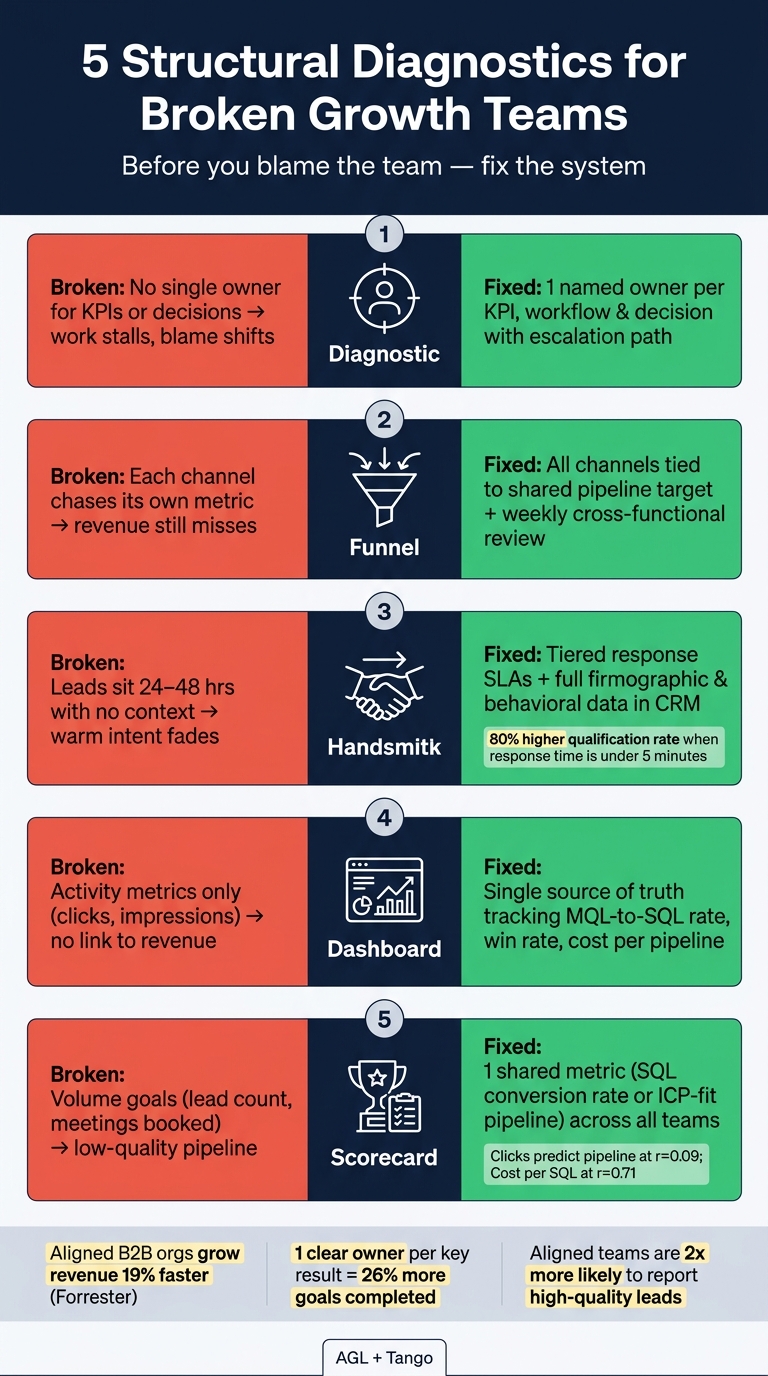
5 Growth Team Diagnostics: Broken vs. Fixed Systems
Your Growth Team Is Broken. Here's the Fix.
sbb-itb-9cd970b
Diagnostics 1 and 2: Ownership Gaps and Channel Silos
Here’s the thing most agencies miss: scale does not break from lack of effort. It breaks when no one owns the full result.
That is why AGL can run many marketing departments with a small team. Tango keeps the repeat work moving. Humans make the calls. Nothing ships without approval. That setup works because every metric, workflow, and handoff has a clear owner.
1. No single owner for a metric, workflow, or decision
Ask yourself this. If pipeline quality drops next week, who is supposed to spot it, explain it, and fix it first?
If the answer is “everyone” or “it depends,” you have an ownership gap.
This shows up all the time in B2B SaaS. Paid, lifecycle, and SDR all touch pipeline. But no one owns pipeline quality from start to finish. In agencies, retention, spend efficiency, and revenue often sit with different people.
The result is predictable. Decisions slow down. Work gets done twice. People point fingers.
One owner does not mean one doer. It means one person is on the hook for the result. That person can pull in others, move work forward, and flag blockers fast. No need to wait for a group call.
Use an accountability chart that gives 1 owner for each KPI, workflow, and decision. Add a backup. Add an escalation path. Then use a RACI matrix for the messy parts so approvals and final calls are clear.
| Dimension | Unclear Ownership | Single Accountable Owner |
|---|---|---|
| Decision speed | Stalls while people wait for "the right person" | One owner acts and escalates |
| Execution quality | Duplicated work, conflicting instructions | Coordinated contributors, clear handoffs |
| Problem detection | Issues surface late; nobody actively scanning | One person tracks the outcome end to end |
| Accountability | Blame shifts between teams on misses | Named owner explains and fixes the gap first |
Review the chart every quarter.
Teams change fast. Channels shift. Offers change. Headcount moves. A clean org chart in Q1 can be wrong by Q2.
At AGL, this is part of the Tango system. The machine handles repeat steps. But a human owner still decides what matters, checks the output, and approves the next move. That is how you get more output without building an AI stack your team has to babysit.
Clear ownership helps. But it still falls apart if each team is chasing a different number.
2. Channel teams optimize for their own numbers instead of revenue
Channel silos do not start with bad intent. They grow bit by bit.
Paid chases spend efficiency. Organic chases traffic. Lifecycle chases opens and clicks. Outbound chases activity. Partnerships chase partner-sourced leads.
Each team can look good on paper. The full funnel can still miss.
That is the warning sign. Every channel report is green, but pipeline or revenue is flat. That means you have a channel-by-channel model, not a revenue model.
A revenue-first model keeps channel ownership. But it ties every team to the same pipeline target.
Paid, organic, lifecycle, outbound, and partnerships should review the same pipeline dashboard together. They should plan around the same audience. They should agree on where each channel matters most in each stage.
A shared messaging brief helps too. Keep it simple:
- Core audience
- Pain points
- Value proposition
- Proof points
- Approved language
That cuts back-and-forth. It also keeps ads, email, and outbound from sounding like 3 different companies.
| Dimension | Channel-by-Channel Model | Revenue-First Model |
|---|---|---|
| KPI ownership | Each team wins locally; revenue can still miss | Shared pipeline and revenue targets connect all channels |
| Planning cadence | Separate team meetings, separate priorities | Weekly cross-functional review around one pipeline number |
| Messaging | Conflicting or inconsistent across ads, email, outbound | Common brief standardizes audience, offer, and proof points |
| Reporting | Fragmented dashboards by channel | One integrated scorecard across the full funnel |
This is another place where Tango matters. AGL does not use automation to let channel teams run wild. It uses Tango to keep execution tight across channels while humans check the message, the offer, and the handoff. That leads to stronger delivery and gives agencies room to hold higher retainers.
Check this now. Which channel gets credit? Which channel drives revenue?
If those 2 answers do not match, the gap will show up in reporting and handoffs. Start there.
Action: map 1 owner to each KPI and put every channel lead on the same weekly pipeline review.
Diagnostics 3 and 4: Broken Handoffs and Weak Reporting
Here’s the thing most agencies miss. More leads do not fix a weak pipeline. Clean handoffs and clear reporting do.
At AGL, this is where Tango does a lot of the heavy lifting. Humans set the rules. Machines move the work. Nothing ships without approval. That is how a small team can run many marketing departments without the usual mess.
3. The marketing-to-sales handoff is slow, inconsistent, or missing context
This break shows up in a very plain way.
A rep opens the CRM. They see a new MQL. And all they have is a name, an email, and “downloaded white paper.” No company size. No industry. No page history. No sign of the problem that brought the lead in.
So the rep burns the first 5 to 10 minutes just trying to figure out who this person is. A warm lead goes cold fast.
That is a system problem, not a rep problem.
The next sign is disputed MQL quality. Marketing says it hit the MQL goal. Sales says the leads are junk. Without one shared MQL/SQL definition that covers firmographics, role, and intent signals, that fight never stops.
Speed matters too. Responding to a demo request in under 5 minutes is linked to an 80% higher qualification rate than the roughly 42-hour industry average [1].
The fix is simple. Write the MQL/SQL definition with sales. Put it in the CRM. Include firmographic filters, role, and intent signals like pricing-page visits or demo requests.
Then set the handoff rules:
- Route leads in the CRM by territory, segment, and lead source
- Set response SLAs by intent level
- Require lead fields before a record enters the sales queue
Those required fields should include company, role, lead source, last content touched, and at least 1 behavioral signal.
This is where Tango fits. It can route, check fields, and trigger next steps. Your team does not have to babysit an AI stack. Your team just approves the system and runs it.
| Dimension | Broken Handoff | Documented Handoff |
|---|---|---|
| Routing method | Manual, via spreadsheet or email | Automated by territory, segment, and lead source |
| Lead data | Name and email only | Full firmographic and behavioral context |
| MQL/SQL definitions | Undefined or disputed | Jointly written, embedded in CRM fields |
| Response-time SLA | None; depends on individual discipline | Written tiers, monitored weekly |
| Follow-up consistency | Varies by rep | Standardized next-action triggered by routing rules |
The metric this fixes is simple: response time and qualified-opportunity rate.
If the handoff is fast but the team still does not know what to do next, the next crack is reporting.
4. Reporting exists but does not support decisions
Most teams do not lack reports. They lack reports that help them act.
A lot of growth teams still stitch numbers together on Friday and make Monday calls on stale data. The slide deck shows impressions, clicks, and email open rates. But it does not show how many clicks turned into qualified opportunities. It does not show if the work is driving revenue.
That is the gap.
Decision-grade reporting ties spend to pipeline, close rate, and retention.
Start with 1 source of truth. Get clear on what counts as a lead, MQL, SQL, opportunity, and closed-won across marketing, sales, and customer success. Then connect ad platforms, marketing automation, and CRM so every team is pulling from the same numbers.
After that, build dashboards around the metrics that guide choices:
- MQL-to-SQL rate
- SQL-to-opportunity rate
- sales cycle length
- win rate
- cost per pipeline dollar
At AGL, this is part of the Tango system too. The machine handles the repeat work. The team reviews the output. That setup helps a small crew keep output high and delivery tight across many clients.
| Dimension | Activity Reporting | Decision-Grade Reporting |
|---|---|---|
| Primary metrics | Emails sent, clicks, impressions | MQL-to-SQL rate, win rate, cost per pipeline dollar |
| Data source | Multiple disconnected tools, stitched manually | Single source of truth (CRM or data warehouse) |
| Timeliness | Weekly or monthly lag | Near-real-time or daily refresh |
| Attribution | Inconsistent across teams | Agreed model, consistently applied |
The review rhythm matters as much as the dashboard. A weekly review of 45 to 60 minutes works well. Use the same funnel metrics each time. End with 3 to 5 decisions. Assign each one to an owner.
That turns reporting from a pile of charts into a management system.
When marketing and sales review the same data together, handoff fights show up faster. And they get solved with data, not opinion.
The metric this fixes is pipeline velocity and win rate.
Action: write 1 shared MQL/SQL definition this week, set a tiered response SLA, and build 1 dashboard that connects spend to pipeline to close rate before your next growth review.
Diagnostic 5: Incentives That Reward the Wrong Behavior
Here’s the part many agencies miss: bad output does not always come from bad people. It often comes from a bad scoreboard.
If the scorecard pays for the wrong thing, the team will chase the wrong thing. That is not a character flaw. It is a system flaw. And once the operating system is set, incentives decide what people do next.
At AGL, this is where Tango matters. Humans decide the target. Machines repeat the work. Nothing ships without approval. That setup helps a small team run many marketing departments. But it only works if the scorecard points everyone at the same goal.
Volume goals create low-quality pipeline and internal conflict
When marketing is pushed on lead count, the easy move is broad reach. More forms. More names. More noise.
When sales is pushed on meetings booked, the easy move is speed. Book first. sort it out later.
Both teams can hit target. The client can still miss revenue.
That gap shows up in behavior and in the data. A 2026 Unbounce report found that incentive misalignment drives sales-marketing friction, and aligned teams are twice as likely to report high-quality leads. [5]
Paid ads show the same thing. Clicks barely predicted pipeline at r = 0.09. Cost per SQL had a much tighter link at r = 0.71. [4] So if you pay teams for volume, you push them toward a number that has little to do with pipeline.
| Dimension | Volume Incentives | Quality Incentives |
|---|---|---|
| Marketing metric | Lead count or MQL volume | SQL conversion rate, ICP-fit, pipeline contribution |
| Sales metric | Meetings booked or fast bookings | Closed-won revenue, win rate, customer quality |
| Customer success metric | Gross renewal count | Net revenue retention, expansion, churn-adjusted retention |
| Paid media behavior | Optimized for cheap clicks | Optimized for cost per SQL and downstream revenue |
| Typical outcome | Top-of-funnel grows, close rates fall | Funnel grows more slowly, but more opportunities convert |
This is one clear lesson: the metric shapes the behavior.
If you reward cheap clicks, you get cheap clicks.
If you reward booked meetings, you get booked meetings.
If you reward qualified pipeline, you get more of the work that leads to revenue.
AGL has seen this play out inside Tango-driven delivery. When the workflow is built around downstream numbers, the team does not waste time chasing pretty dashboards. The machine handles the repeat work. The human team checks fit, reviews output, and aims at pipeline quality. That is how you get more output without adding an AI stack to babysit.
How to redesign incentives around qualified pipeline
The fix is not more pressure. It is a better scorecard.
Drop isolated team scorecards. Use a shared one tied to qualified pipeline, win rate, and retention. Marketing should own pipeline quality, not just volume. Sales should own conversion and revenue, not just activity. Customer success should own net revenue retention and expansion, not just ticket closure.
You also need 1 shared KPI. Pick a number that forces all teams to chase the same result, like SQL conversion rate or pipeline from ICP-fit accounts. [3][6]
That changes the conversation fast. Now marketing and sales have to agree on what a good lead is before either team gets credit.
For owners, the same rule applies at the top. Leadership metrics should track what the business values most: EBITDA margin, cash flow, and revenue efficiency, not top-of-funnel activity. [7][8]
A bigger pipeline number can look good in a deck. It means very little if close rates slip, retention drops, or revenue efficiency gets worse.
AGL built Tango for this kind of control. Humans set the standards. Machines handle the repeat tasks. Approval stays with the team. That helps agencies deliver more, hold quality, push retainers higher, and build a firm that is worth more at sale.
Action: audit your scorecard this week. If each team can hit its goal while revenue misses, the scorecard is broken. Pick 1 shared metric that marketing, sales, and customer success all affect, and bring it into your next operating review.
Conclusion: Run These Five Diagnostics Before You Blame the Team
Here’s the big realization: a growth team can look slow even when the people are good.
That usually means the problem is not talent. It’s the system. When ownership is fuzzy, channels work apart, handoffs break, reporting stays messy, and incentives push the wrong behavior, even a sharp team will drag.
Use the same symptom → cause → fix lens here.
- Ownership gaps stall decisions.
- Channel silos push local metrics over revenue.
- Broken handoffs leak leads and context.
- Weak reporting makes data hard to use.
- Misaligned incentives reward volume over quality.
This is the same idea AGL uses with Tango.
AGL runs many marketing departments with a small team because the system is clear. Humans decide. Machines repeat. Nothing ships without approval. That setup helps the team move faster, keep output high, and avoid the usual mess that piles up when process lives in 10 places.
The lesson is simple: don’t blame people for a system issue.
Start where friction is loudest. If sales is upset about lead quality, begin with incentives and handoffs. If campaigns feel slow, start with ownership and channel alignment. Then treat each fix like a 30- to 90-day test with 1 before-and-after metric.
Some changes show up fast. Others build over a few quarters. Forrester’s alignment research shows that aligned B2B organizations grow revenue 19% faster and are 15% more profitable than misaligned peers.[9] Teams that assign 1 clear owner per key result complete 26% more goals on average.[2]
Tighten ownership. Clean up the handoff. Fix reporting. Align incentives. Then measure what changed.
Fix the structure first, then judge the team.
If you want that kind of output without more tools to babysit, look at how AGL uses Tango to run more client marketing with a small team.
FAQs
How do I find the biggest structural issue first?
Start with a simple realization: most agency stack problems are not tool problems. They’re system problems.
That’s why the first move is an audit. Review your data touchpoints and lead management systems. Look for data gaps, integration debt, and ownership silos. If data breaks between tools, or no one owns the handoff, your team pays for it later.
At AGL, this is the kind of mess Tango is built to clean up. Humans decide. Machines repeat. Nothing ships without approval. That’s how a small team can run many marketing departments without adding more tools to babysit.
Next, use the Marketing Stack Complexity Index (MSCI). It’s a 50-point diagnostic that gives you a clear read on stack bloat. If your score is above 26, your system may cost more to maintain than the value it delivers. That gives you a clean place to start.
Run the audit. Score the stack. Then use that result to cut what slows delivery.
What should our one shared metric be?
Your agency gets better when marketing and sales stop chasing 2 scoreboards.
Use Cost per Qualified Lead (CPQL) as the 1 shared metric.
It gives both teams 1 result to own together: qualified leads at a cost you can keep.
That matters more than most teams think. If marketing tracks lead volume and sales tracks close rate, people pull in different directions. CPQL fixes that. It lines up incentives, makes ownership clear, and shows how well your growth team, systems, and lead routing are working.
This is the same kind of thinking behind Tango at AGL. Humans decide. Machines repeat. Nothing ships without approval. That setup helps a small team run many marketing departments without adding more tools to manage.
Pick CPQL as your shared metric. Then review it with both teams in the same meeting, every week.
How fast should sales follow up on new leads?
There’s a simple shift a lot of agencies miss: speed is not just support. It’s sales.
Aim for a first response within 60 seconds. Any response that takes longer than 120 seconds should be flagged for review.
That window matters more than most teams think. Once a lead comes in, interest starts to drop fast. If no one replies right away, the odds of a close go down.
This is where AGL’s Tango system helps. Humans decide. Machines repeat. Nothing ships without approval. That means your team can stay fast without adding more tools to babysit.
With Tango, automated systems or AI agents can handle that first touch 24/7 when interest is highest. Your team stays in control. The lead gets a prompt reply. And your agency can run many client marketing departments with a small team.
Set the rule now: first response in 60 seconds, review anything past 120 seconds, and let Tango handle the repeat work.