The Real Cost of NOT Having a Revenue OS (Case Study: $6.4M SaaS)

The Real Cost of NOT Having a Revenue OS (Case Study: $6.4M SaaS)
Most agency owners do not lose client growth from bad ads or bad sales calls first. They lose it in the gaps between teams.
I’d sum this case study up in 3 numbers:
- $520,000 per quarter lost from weak lead handoffs
- $576,000 per year tied to moving NRR from 103% to 112%
- Up to $2.6 million per year at risk from weak forecast control
The lesson is simple. A Revenue OS is not about adding more tools. It is about making sales, marketing, and CS run from the same rules, same data, and same owner path.
At AGL, that is why we use Tango. Humans decide. Machines repeat. Nothing ships without approval. That is how we run many marketing departments with a small team, keep output high, cut tool mess, and keep client work tight.
If I were auditing 1 client today, I would check 4 things first:
- lead routing speed
- forecast rules
- handoff data from sales to CS
- who owns renewals and expansion
That is where the money leaks first.
And that is where Tango helps fix the system behind the work.
Book a call if you want to see how AGL uses Tango to run more client work with a small team and tighter control.
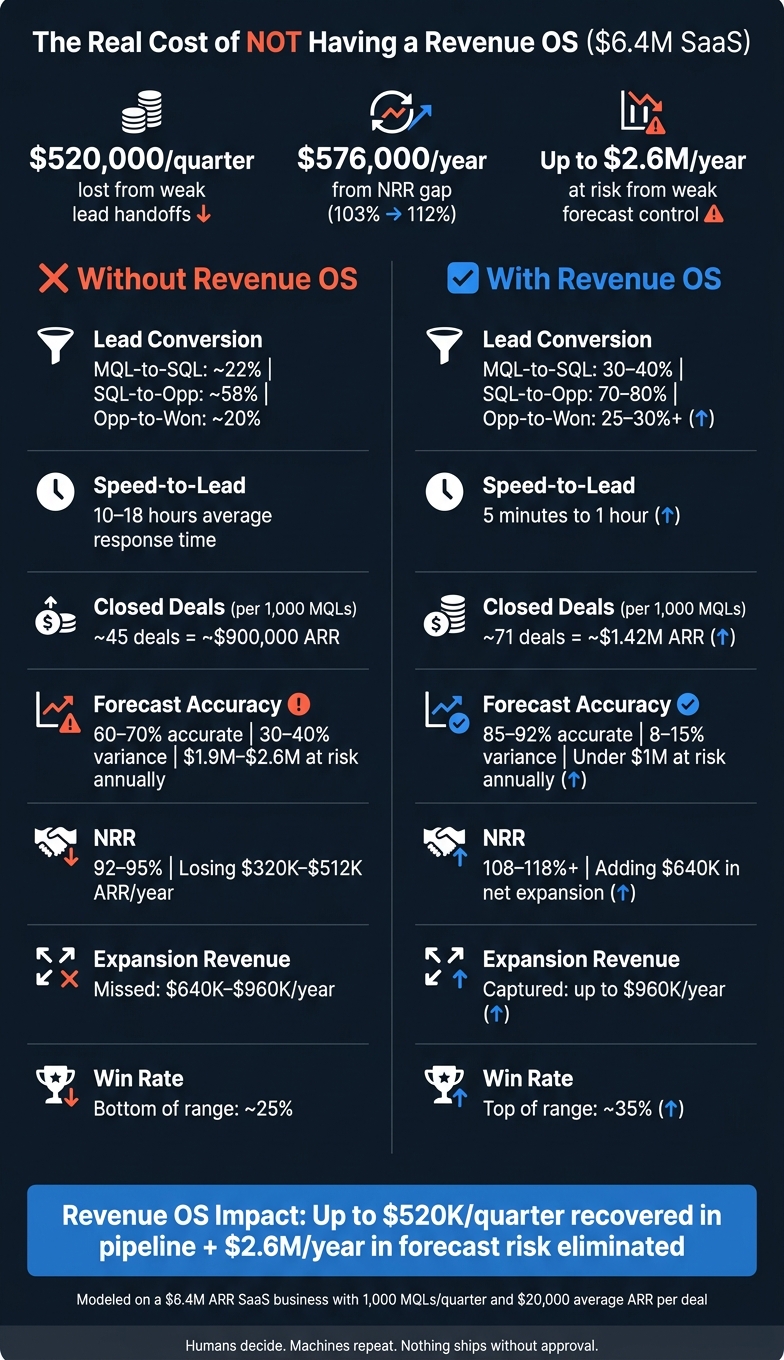
Revenue OS vs. No Revenue OS: The Real Cost for a $6.4M SaaS
The SaaS & Revenue Operations Metrics to Measure for Growth
sbb-itb-9cd970b
Where Revenue Leaks First: Pipeline Visibility and Lead Handoffs
Here’s the part many agencies miss: revenue loss rarely starts at close. It starts upstream, when teams look at different numbers and no 1 person can see the full path from lead to deal to renewal.
That’s why AGL built Tango around 1 rule: humans decide, machines repeat, nothing ships without approval. When you run many client marketing departments with a small team, that rule matters. It gives you more output without adding another AI stack to babysit.
How Fragmented Reporting Hides Pipeline Risk
Marketing, sales, and CS often work from separate systems. Marketing pulls from ad dashboards and marketing automation. Sales lives in the CRM and spreadsheets. CS tracks renewals somewhere else.
So leadership ends up doing report cleanup instead of pipeline management.
The first leak shows up in visibility. Deals sit in 1 stage for 2x the average time. Active opps go 30+ days with no contact and still show up as healthy in the forecast.[3][5][6] Then the problem moves fast into lead routing once new leads hit SDR queues.
| Metric | Current State (No Revenue OS) | Benchmark Range | Implied Lost ARR Per Quarter |
|---|---|---|---|
| MQL-to-SQL conversion | ~22% | 30–40% | ~$520,000 |
| SQL-to-opportunity rate | ~58% | 70–80% | ~$200,000 |
| Opportunity-to-Closed Won | ~20% | 25–30%+ | ~$180,000 |
| Speed-to-lead (inbound) | 10–18 hours | 5 minutes to 1 hour | ~$300,000 |
| Opportunities with a named decision-maker and next step | ~45% | 70–80% | ~$150,000 |
Modeled on a 1,000-MQL quarterly funnel and $20,000 average ARR per deal.
The lesson is simple. Bad reporting hides bad handoffs.
These gaps don’t come from a lead problem. They come from slow routing, mixed scoring, and weak ownership. The system can’t tell which leads matter, who owns them, or what is happening inside each deal.
Tango fixes that by putting 1 operating layer across the work. AGL uses it to run more accounts with a small team, keep delivery tight, and give every client 1 clear view of what needs action.
What Broken Lead Handoffs Cost in Missed SQLs and Deals
A shared queue sounds harmless. It isn’t.
Inbound demo requests sit there. SDRs grab leads by hand. There are no routing rules tied to territory, account size, or intent. A hot lead that comes in at 9:00 AM may not get a call until late that day, or even the next morning.
That delay costs money.
Research shows that companies responding within an hour are 7x more likely to qualify leads than those waiting longer, and 60x more likely than those waiting 24+ hours.[7][9][11]
Now look at the math. With 1,000 MQLs per quarter and $20,000 average ARR per deal, a well-routed funnel at 35% MQL-to-SQL, 75% SQL-to-opportunity, and 27% opportunity-to-Closed Won produces about 71 closed deals. That is about $1.42 million in potential new ARR.
At an actual 22% MQL-to-SQL rate, that same pool produces about 45 closed deals. That is about $900,000.
The gap is about $520,000 per quarter.[4][8][10]
That loss comes from 3 things:
- slow follow-up
- mixed scoring
- unclear routing ownership
Scoring drift makes it worse. Marketing automation may score on email clicks. The CRM may score on firmographic fit. So a buyer with high intent can look weak in 1 place and never get pushed to the front in another.
In plain English, the team is looking at the same lead and seeing 2 different stories.
In practice, 35–50% of B2B sales go to the vendor that responds first.[10] If your client loses that speed edge, they lose more than SQLs. Forecast trust drops. Close-rate confidence drops too.
That is the AGL point here. More pipeline does not fix a broken handoff. A better system does. Tango gives agencies that system, so the right lead gets seen, routed, and acted on before revenue slips away.
Action: audit 1 client’s inbound handoff today. Check time-to-first-touch, routing logic, and whether sales, marketing, and CS are looking at the same pipeline view. If they aren’t, start there with Tango.
The Cost of Bad Forecasts and Lower Win Rates
Here’s the realization: most forecast problems do not start in finance. They start in the gaps between people, systems, and deal facts.
That matters fast. When handoffs break, the pipeline stops being a clean view of what is real. One bad forecast miss can then turn into a full-quarter planning mistake. And win rates slip too, because weak deals stay in the number while better deals get less focus.
At AGL, this is why Tango matters. Humans decide. Machines repeat. Nothing ships without approval. That setup helps teams run more accounts with a small crew, while keeping pipeline views tied to what is happening now, not what someone hopes will happen.
Why Manual Forecasting Creates Expensive Planning Errors
Manual forecasting sounds normal. But look at what it is made of: rep commits, manager calls, and finance rollups. None of that is the same as live deal proof.
Each layer adds its own slant. Reps push high. Managers smooth it out. Finance stretches the trend line. What you get is a forecast built on guesswork, not deal evidence.
About 79% of B2B sales organizations miss their quarterly forecast by more than 10%[16][17][19]. And manual forecasting misses by 25% to 40%[1][18].
For a $6.4M ARR business, that is not small.
- A 25% quarterly miss is about $400,000 off target
- A 40% quarterly miss is about $640,000 off target
That miss does not stay on the revenue line. It spills into hiring, CAC payback, and budget calls.[12][16][20] If the business is overstated by $500,000, leaders may hire too soon and spend too much. If it is understated, teams stay short-staffed and good deals sit without support.
This is the lesson. Forecasts fail when the system rewards opinion over proof.
Tango fixes that by making the repeat work happen the same way each time. That gives AGL a cleaner operating view across many client accounts, without adding a messy AI stack to manage.
How Weak Deal Visibility Lowers Closed-Won Revenue
Weak deal visibility turns forecasting into a coin toss.
If there are no clear stage exit rules and no basic deal signals, weak deals look strong. A leader may not know that 30% of committed deals have had no meetings in the last 21 days. Or that several deals depend on just 1 contact. The forecast stays the same, headcount plans stay the same, marketing spend stays the same, and the quarter still closes $600,000 short.
That is not a sales talent issue. It is a control issue.
Poor pipeline inspection also hurts coaching. If reps spend 10%–15% of their time on low-probability deals instead of high-intent ones, win rate can drop by 3 to 5 points. Mid-market SaaS win rates usually sit between 25% and 35% for qualified opportunities[13][14][15]. So when inspection is weak, teams slide to the bottom of that range fast.
The table below shows what that exposure looks like in a $6.4M ARR business:
| Forecasting Method | Accuracy | Variance From Actual | Revenue at Risk (Annual) | Annual Impact |
|---|---|---|---|---|
| Manual Commit + Manager Gut | 60–70% | 30–40% | $1.9M–$2.6M | Premature hiring, inflated budgets |
| CRM Rollup Only | 70–80% | 20–30% | $1.3M–$1.9M | Stale pipeline data, inconsistent stage weighting |
| Revenue OS–Driven Forecast | 85–92% | 8–15% | Under $1M | Deal-level risk scoring, real-time signals, enforced stage criteria |
The gap is simple. Guesswork puts as much as $2.6M at risk each year. A Revenue OS-driven model cuts that to under $1M before you even count the extra cost of early hiring or bad spend plans.
This is where AGL’s model stands out. Tango helps enforce the boring but hard parts:
- standard stage definitions
- a named decision-maker and close plan before commit
- weekly checks on activity recency, stakeholder coverage, and deal age
That is how a small team can run many marketing departments without chaos. More output. Stronger delivery. Less tool babysitting. Better retainer logic. A business that is worth more when it sells.
One action: audit your current commit forecast this week and flag every deal missing a decision-maker, close plan, or recent activity. That is the current CTA.
Retention, Expansion, and Accountability Losses After the Sale
Here’s the shift most agencies miss: the sale is not the finish line. It is the start of the next revenue system.
That matters because the same blind spots that hurt pipeline also hurt retention. After close, the leak gets bigger. If the client handoff is messy, revenue slips out in slow, quiet ways.
At AGL, this is why Tango matters. Humans decide. Machines repeat. Nothing ships without approval. That same setup that keeps pre-sale work clean also keeps post-sale work from falling apart.
How Disconnected Customer Handoffs Drive Churn and Suppress NRR
When the deal closes, CSMs often get very little. Maybe a contract value. Maybe a start date. Maybe a short use case.
What’s missing is the stuff that matters. Discovery notes. Stakeholder maps. Promise details. So onboarding starts cold.
Without a Revenue OS, the handoff runs on random Slack messages, email threads, or spreadsheets. That sounds small. It is not.
Weak onboarding drives churn and contraction fast. On a $6.4M ARR base, running at 92% to 95% NRR means losing $320,000 to $512,000 in ARR each year before a single new logo is counted.[21][22][24]
Growth-stage SaaS companies with a set post-sale motion hit a median NRR of around 108%, and top-quartile teams get above 118%.[21]
That gap is not theory. It is money left on the table.
Without product usage tied to commercial workflows, upsell happens only when customers ask. Moving from 95% to 110% NRR on a $6.4M base creates a swing of about $960,000 per year. That means going from losing $320,000 to adding $640,000 in net expansion.[23][24]
At AGL, the lesson is simple. If the handoff is loose, retention drops. Tango helps lock the process so the next team gets the full picture, not scraps.
Once the handoff breaks, the next problem shows up fast. No one owns renewals, risk signals, or expansion timing.
Why Unclear Ownership Weakens Execution Across the Funnel
The handoff issue is also an ownership issue. Sales thinks the job is done. CS owns onboarding but not enough control. Finance tracks renewals in siloed spreadsheets.
That creates a pattern you can see coming.
Renewals get touched 30 days before expiration instead of 90 to 120 days out. That leaves little time to fix value gaps or run an expansion cycle.[28][29][30]
Churn that was clear 6 months earlier, through declining logins, lower feature use, or a disengaged champion, goes untouched because no one owns the signal.[27]
Here’s where post-sale ownership breaks and what it costs:
| Revenue Area | Current Owner | Data Source | Known Issues | Impact on ARR |
|---|---|---|---|---|
| Onboarding | CS & Implementation | Project tools, email, CRM notes | No standard handoff fields; discovery notes often missing | Slower time-to-value; estimated $200,000 to $300,000 ARR at risk each year[25][26] |
| Renewals | CS, Sales, Finance | CRM, billing system, spreadsheets | Renewal dates split across systems; no automated playbooks; risk signals not tied in | Sub-100% NRR; $300,000 to $500,000 ARR lost vs. healthy retention marks[27][28][29][30] |
| Expansion | CS & Sales | CRM (partial), product analytics (partial) | Expansion chances are not made in a steady way; upsell owner is unclear | $640,000 to $960,000 in yearly expansion potential missed[23][24] |
The pattern is the same in every row. Too many owners. Split data. Known issues. No clear person to fix them.
A Revenue OS fixes that with 1 owner, 1 workflow, and 1 data source for each post-sale motion. That makes execution visible before small gaps turn into ARR loss.
This is the same reason AGL can run many marketing departments with a small team. Tango keeps the work clear, repeatable, and checked by people before anything goes live.
If renewals and expansion have no single owner or shared data source, the stack is missing the Revenue OS layer.
Want to see how AGL uses Tango to run more client work with a small team and tighter control? Book a call.
What a Functional Revenue OS Puts in Place
Here’s the shift: most revenue leaks do not start with bad people or weak effort. They start with a missing system.
That’s the layer a Revenue OS puts in place. It gives your team shared data, automation, forecasting, and governance. At AGL, this is the kind of work we run through Tango. Humans decide. Machines repeat. Nothing ships without approval. That’s how a small team can run many marketing departments without the usual mess.
The Core Components: Shared Data, Workflow Automation, Forecasting, and Governance
Shared data comes first.
Fieldpath has multiple ARR figures across teams because there is no single revenue data model. One schema for accounts, contacts, opportunities, subscriptions, and product usage fixes that. Now everyone works from the same number.
That leads to faster reporting, less cleanup, and a clearer view of pipeline. It also pulls in product usage, support, and contract signals, so CS can spot churn risk and expansion paths in one place.[34][37][33]
Workflow automation fixes the lead routing leak.
For Fieldpath, that means rules for ICP tier, segment, geography, and rep capacity. Add SLA alerts when a lead sits untouched for more than 4 business hours, and the untouched rate drops to 0% to 2%.
That change has a dollar impact. With an $18,000 ACV and a 20% SQL-to-close rate, saving those leads adds $115,000 to $173,000 in annual ARR without more marketing spend.[35][36]
Forecasting replaces AE spreadsheets with a live system.
Fieldpath moves from manual guesses to commit, best case, pipeline, and renewals tied to live opportunity data. That pulls forecast variance from about ±7% to ±3%.
It also cuts into the $250,000 to $400,000 quarterly miss shown earlier in this case study.[2] Gartner says fewer than 45% of sales teams reach forecast accuracy above 75%.[31]
Governance keeps the other 3 parts in place.
For Fieldpath, that means standard stages, shared funnel terms, and named owners for pipeline reviews, forecast calls, QBRs, and CS risk reviews.
Companies with mature RevOps functions achieve 15% higher win rates and 19% faster revenue growth than siloed organizations.[32]
That’s the lesson. A Revenue OS is not another tool. It is the operating layer that keeps each team working from the same playbook. That is also the point of Tango. It gives agencies more output, less manual repeat work, and stronger delivery with a small team.
Where Revenue Leaders Should Audit Their Stack First
Check your stack in this order: data, routing, forecast, then ownership.
| Audit Area | Signal of a Gap | Revenue OS Fix |
|---|---|---|
| ARR reconciliation | Multiple ARR figures across Sales, Finance, CS, and billing | One revenue data model with shared account and subscription IDs |
| Lead follow-up | High-fit MQLs sitting in queues or missing the SLA | Automated routing rules + SLA breach alerts |
| Forecast accuracy | Manual forecasts missing bookings and renewals by too much | Structured forecast categories tied to live opportunity and renewal data |
| Funnel definitions | "SQL" and "Renewal at risk" mean different things across teams | Standardized lifecycle stages with documented entry/exit criteria |
| Post-sale ownership | Risk surfaced late or through disconnected signals | Defined CS playbooks with automated renewal and risk triggers |
Pick the row tied to your biggest leak. Then fix that first with the same rule we use at AGL: set the system, let Tango handle the repeat work, and keep humans in control of every call.
FAQs
What is a Revenue OS?
A lot of agencies think growth comes from adding more tools.
It usually doesn’t.
A Revenue OS is what you get when sales, marketing, and customer success run from 1 shared system across the full customer journey.
That matters because disconnected tools slow teams down. Data gets stuck. Handoffs get messy. Forecasts turn into guesswork.
A Revenue OS fixes that. It uses real-time data and automation to line up workflows, cut silos, tighten forecasting, and make ownership clear.
At AGL, this is the kind of thinking behind Tango. Humans decide. Machines repeat. Nothing ships without approval. That’s how a small team can run many marketing departments without drowning in tools.
The lesson is simple: revenue grows better when every team works from the same system.
When data turns into clear next steps, SaaS teams move faster, report cleaner, and scale with more control.
How do I know where revenue is leaking first?
Start with a simple realization: most agency growth problems do not start in lead gen.
They start in the handoffs. In the gaps between tools. In the missed signal nobody saw in time.
So begin with a full audit of your data touchpoints and workflows. Map where data comes in, where it moves, and where it breaks. This is how AGL runs many marketing departments with a small team using Tango. Humans decide. Machines repeat. Nothing ships without approval.
Then get clear on CAC by channel and segment. Not just top-line CAC. Break it out so you can see which client type, offer, or source is doing the work, and which one is just eating budget.
Next, review conversion rates at each funnel stage. Look for the drop-off points. If prospects click but do not book, that tells you one thing. If they book but do not close, that tells you another. The lesson is simple: the leak is usually smaller and more specific than it first looks.
You also need to watch for early churn signals. Small shifts often show up before the account is at risk:
- lower feature usage
- fewer logins
- more support tickets
- payment issues
These signs matter because they show where delivery may be slipping before the client says a word.
Then use the Marketing Stack Complexity Index (MSCI) to spot integration debt and data silos. That is often where the root cause sits. One tool says 1 thing. Another says something else. The team fills in the blanks by hand. That slows delivery and makes reporting shaky.
AGL fixed this with Tango by cutting repeat work across accounts while keeping human review in place. That gave the team more output without adding more tools to manage.
Do 1 thing next: audit your funnel, churn signals, and MSCI on 1 client this week. That is often enough to show where the stack is slowing your agency down.
If you want the same setup AGL uses with Tango, book the current CTA.
What should I audit before building a Revenue OS?
You can spot a lot about an agency by how fast it can answer a simple revenue question.
Not with guesses. Not with 5 tabs open. With one clean view.
That’s the shift. If you want to run many client accounts with a small team, your data setup has to do more than store records. It has to help people decide fast, while Tango handles the repeat work and humans approve what goes out.
Audit your revenue data and systems from end to end. List every source. Check where data gets stuck, split, or lost. Make sure you can export what you need and connect through APIs.
Then look at record quality. Customer data should be clean and match the same format across tools. Each record should map to 1 person or company, with clear ownership and rules for who can change what.
This matters because bad data slows everything down. Good teams don’t just add more tools. They make the stack easier to trust.
You also need to test integration readiness. If a client needs near real-time reporting, your systems have to support that. Your core KPIs should update on their own, trigger alerts, and let your team drill into the cause without manual digging.
That’s how AGL runs many marketing departments with a small team. Tango repeats the manual steps. Humans review the output. Nothing ships without approval.
The result is more output, stronger delivery, and no AI stack to babysit.
Action: map every revenue data source for 1 client today, then mark 3 things: what connects, what breaks, and what still needs a human to patch it.