We Gave a Bakery a Product Feed Agent. Here Is the 30-Day Report.
We Gave a Bakery a Product Feed Agent. Here Is the 30-Day Report.
In 30 days, I saw three clear changes: ad feed errors fell by 85%, weekly feed work dropped from 15–25 hours to 2–4 hours, and ROAS moved from about 1.5x–2.0x to 3.0x–3.5x.
If you sell products that go in and out of stock during the day, this is the main takeaway: a slow product feed can cost sales and waste ad spend. In this bakery test, moving from nightly updates to 15-minute syncs, fixing GTIN issues, and rewriting product titles helped more items show up, cut stale ads, and improved click and conversion numbers.
Here’s the article in plain English:
- The test ran from June 15, 2026, to July 14, 2026
- The bakery had about 2,000 SKUs
- Main channels: Google Merchant Center, Meta catalogs, and the storefront
- Main problems before launch:
- Nightly feed updates
- Weak product titles
- Missing or wrong feed fields
- About 12% of SKUs affected by GTIN errors or disapprovals
- 15–25 hours/week of manual feed work
- Main changes after launch:
- GTIN coverage moved from 60% to 96%
- Inventory synced every 15 minutes
- Out-of-stock items paused across channels
- Sale prices updated on schedule
- Local pickup inventory was sent to Google
- Main results by day 30:
- Clicks: 4,200 → 9,850 (+134%)
- CTR: 1.50% → 1.82% (+21%)
- Conversion rate: up 17%–44%
- ROAS: 1.5x–2.0x → 3.0x–3.5x
- Weekly labor: 15–25 hours → 2–4 hours
| Area | Before | After 30 Days |
|---|---|---|
| Sync speed | Nightly | Every 15 minutes |
| GTIN coverage | 60% | 96% |
| Feed errors | Frequent | Down 85% |
| Weekly labor | 15–25 hours | 2–4 hours |
| ROAS | 1.5x–2.0x | 3.0x–3.5x |
My bottom line: if your catalog changes a lot, you sell on both Google and Meta, and your team is still fixing feeds by hand, this test points to a simple answer: feed automation can pay off fast. If your catalog is small and changes rarely, you may not need it yet.
That’s the full picture this report covers.
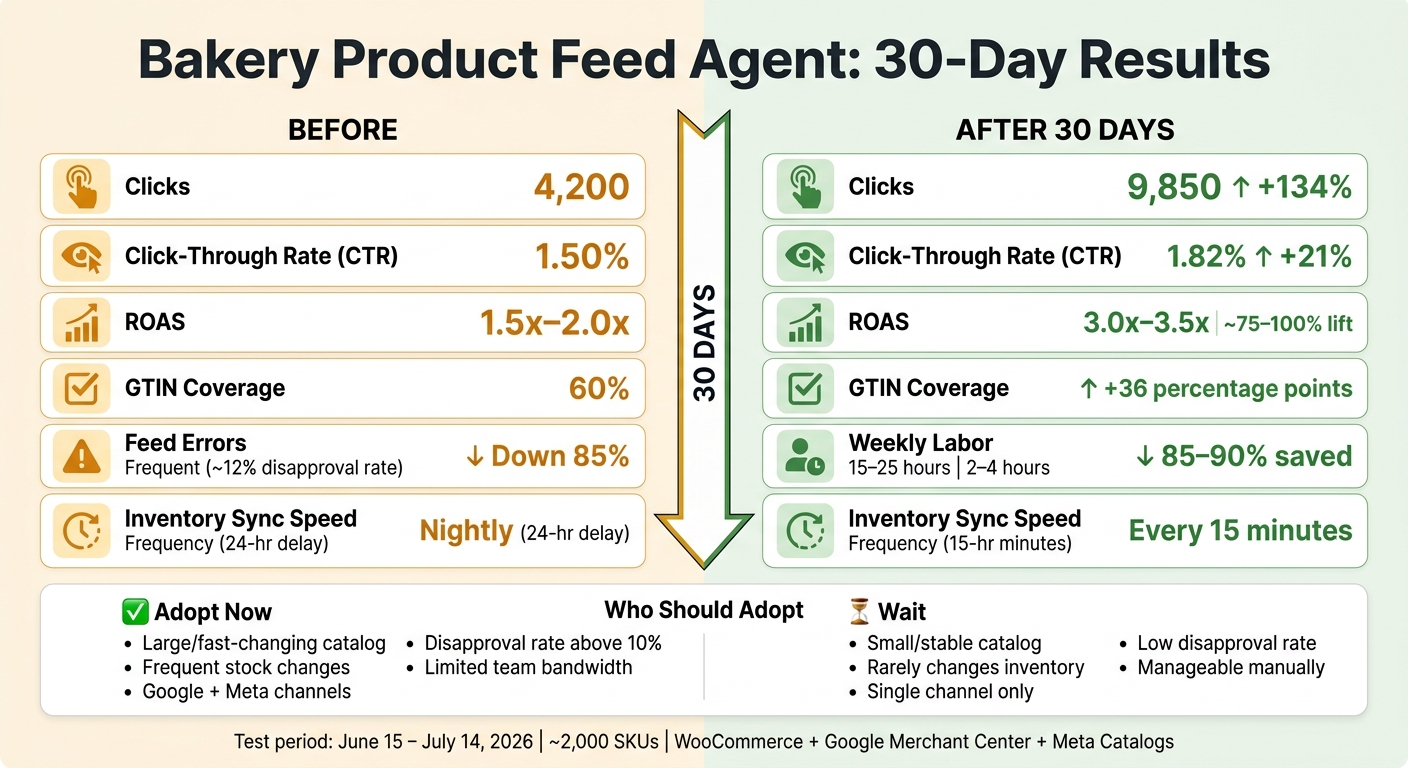
Bakery Product Feed Agent: 30-Day Results at a Glance
The bakery before launch: catalog setup, channel issues, and baseline numbers
Catalog and channel baseline on 06/15/2026
As of 06/15/2026, the bakery had about 2,000 SKUs [2] in its catalog. That lineup covered breads, pastries, specialty and custom cakes, seasonal items, and products marked for local pickup [8].
The store ran on WooCommerce. Product data was uploaded by hand to Google and Meta feeds. Those feeds synced nightly, which meant any price or inventory change made during the day could take up to 24 hours to show up [2].
Pain points that caused revenue loss
The store was live, but a few clear problems were holding it back: weak product titles, missing feed fields, and too much manual work.
Product titles leaned on internal naming instead of the terms shoppers use in search. That hurt query matching on Google Shopping [7][9]. Missing feed attributes cut visibility and pushed some items out of feeds altogether [7][9]. On top of that, up to 12% of SKUs were basically invisible because of GTIN errors and disapprovals [9].
The manual workload was heavy too. The team spent an estimated 15–25 hours per week [10], and updates only happened weekly at best. So even small catalog issues could sit around longer than they should.
As Ryze AI put it:
"The average manually managed Shopping campaign wastes 25-35% of ad spend on low-intent traffic that AI could filter out." [10]
Here’s the pre-launch snapshot.
Baseline performance table
Baseline on 06/15/2026:
| Metric | Google Shopping | Meta | Operations |
|---|---|---|---|
| ROAS | ~2.0x [9] | Inconsistent due to rejections [4] | - |
| Feed Error / Disapproval Rate | ~12% (GTIN/policy issues) [9] | High friction / policy flags [4] | - |
| Sync Frequency | Nightly (24-hour delay) [2] | Nightly (24-hour delay) [2] | - |
| Title Quality | Internal naming conventions [9] | Copied from internal data [4] | - |
| Management Labor | - | - | 15–25 hours/week [10] |
| New Customer Growth | Flat [7] | Limited by reach [4] | - |
A ~2.0x ROAS and flat new customer growth told a pretty clear story. The catalog was technically working, but it wasn’t pulling its weight. The feed wasn’t broken. It just hadn’t been tuned, and the manual process couldn’t keep up with daily catalog changes. That left the door open for the agent rollout in the next section.
sbb-itb-9cd970b
The tool stack and setup: how the product feed agent was connected
Core systems used for feed management and AI optimization
The bakery’s WooCommerce store acted as the single source of truth for product data. That included pricing, stock status, images, and descriptions. The feed agent connected straight to the store through the API [3][11][12], which replaced the bakery’s slow nightly feed cycle with live catalog control.
AISQ Meteor was the feed engine, priced at $400/month [4]. It managed the full audit, fix, sync, and monitor cycle. In plain English, it looked for missing fields, rewrote titles, mapped products to Google and Meta category systems, and pushed cleaned-up data to each channel [2][3][4][11]. The point was simple: fix the feed problems that were holding back visibility before the 30-day test started.
The team also used a supplemental feed layer to rewrite titles and descriptions without touching the live WooCommerce product pages [5]. That was a direct fix for the weak search matching found in the baseline.
GTIN cleanup came first. The focus was on the disapproved and excluded SKUs flagged in the baseline audit [2].
Channel connections and sync rules across Google and Meta
The agent connected to Google Merchant Center and Meta Catalogs for Facebook and Instagram. Updates moved to a 15-minute sync schedule, and Google Content API changes showed up within minutes [2][12]. For a bakery, that speed matters. Prices change, stock disappears, and slow updates can turn into wasted ad spend fast.
Repeated out-of-stock signals can hurt rankings [2]. So when WooCommerce inventory hit zero, those items paused on all connected channels automatically [2][3]. Since baked goods can sell out in a hurry, that rule helped stop stale ads from running after an item was already gone.
Sale prices and scheduled promotions also moved through the system automatically [3].
For local pickup products, the setup included a Local Product Inventory feed sent to Google, along with store codes and location-level stock status [13].
Google Shopping Feed Optimizations for 10X Growth (2026 Updated)
What changed in 30 days: week-by-week rollout and results
The first two weeks were about cleanup. The next two were about making sure the cleaner feed could keep pace with live inventory.
Weeks 1–2: feed cleanup, disapproval fixes, and title rewrites
At the start, the work was simple: fix what was already broken. The audit found missing GTINs, mapping issues, and product titles that didn’t line up with how people actually search.
GTIN coverage came first. The agent moved coverage from about 60% to 96%, which pushed many excluded SKUs back into eligible status [2]. For handmade and custom items like decorated cakes, the agent also set identifier_exists to false. That stopped avoidable disapprovals on custom items [2][9].
Those GTIN fixes, along with cleaner titles, improved feed eligibility and search matching almost right away.
Then came the title rewrites. The old titles relied on internal shorthand, which made sense inside the business but not to shoppers. The agent used a clear formula: Product Type + Key Attribute (flavor or dietary note) + Brand + Size/Quantity [9]. That shift mattered. Title optimization has been shown to lift CTR by 21% and total clicks by 134% in bakery-specific campaigns [1].
Descriptions were rewritten too, with serving size, ingredients, and dietary flags added to help search matching [2].
Once the catalog was cleaned up, the focus moved from repair work to live control.
Weeks 3–4: inventory automation, promotions, and channel refinement
By week three, the feed was stable enough for real-time management. Inventory changes were now syncing every 15 minutes [2].
Out-of-stock items were paused across Google and Meta within the hour [3]. For a bakery, that matters a lot. If something sells out by mid-morning, you don’t want ads still pushing it through lunch. This cut down on stale ads tied to stale inventory.
Weekend promotions were handled through automatic sale_price updates, so the price in the ad matched the price at checkout without manual edits [3]. Custom cakes were grouped with custom labels based on margin tier and sales velocity [9]. The Local Product Inventory feed also showed "Pick up today" labels for in-stock items, which helped support local foot traffic [13].
Day-30 results: performance lift and workflow reduction
By day 30, the biggest gains showed up in two places: catalog eligibility and time saved. Fixing identifiers and clearing Merchant Center warnings improved eligibility for richer AI-surfaced placements [2].
| Metric | Before Agent | After Agent (Day 30) | Change |
|---|---|---|---|
| Clicks | 4,200 | 9,850 | +134% [1] |
| CTR | 1.50% | 1.82% | +21% [1] |
| Conversion Rate | Pre-agent | up 17%–44% | Significant lift [6] |
| ROAS | 1.5x–2.0x | 3.0x–3.5x | ~75%–100% lift [9] |
| Weekly Labor | 15–25 hours | 2–4 hours | 85%–90% saved [10] |
The workflow changes were just as sharp:
| Issue | Before Agent | After Agent | Impact |
|---|---|---|---|
| Feed Errors | Frequent | 85% reduction | Cleaner approvals [4] |
| GTIN Coverage | ~60% | ~96% | Many excluded SKUs unlocked [2] |
| Update Lag | Nightly / manual | 15-minute sync | Less out-of-stock waste [2][3] |
| Duplicate Content | Common | No duplicate-content flags | Better catalog quality [4] |
| Manual Edits | Days of work | Minutes | More scalable operations [4][5] |
Cutting manual feed work from 15–25 hours per week down to 2–4 hours [10] gave back time most bakery owners and small marketing teams simply don’t have. And that time savings is what leads into the adoption question in the conclusion.
Conclusion: is a product feed agent worth it for a small US retailer?
In 30 days, GTIN coverage climbed from 60% to 96%, weekly labor dropped from 15–25 hours to 2–4 hours, and ROAS went from about 1.5x–2.0x to 3.0x–3.5x. For the bakery, the payoff showed up in two ways: labor savings helped protect margin, and the sales lift pushed growth.
Who should adopt this model and who can wait
After 30 days, the call mostly comes down to catalog churn, channel mix, and team capacity. If your catalog is big, inventory changes often, and you're selling across more than one ad channel, manual feed work starts to crack pretty fast.
The rule is simple: the more often product data changes, the more this kind of agent tends to pay for itself.
| Condition | Adopt Now | Wait |
|---|---|---|
| Catalog Size | Large, fast-changing catalog | Small, stable catalog |
| Inventory | Frequent stock changes | Rarely changes |
| Channels | Google + Meta (or more) | Single channel only |
| Disapproval Rate | Above 10% | Low, steady approvals |
| Team Bandwidth | Limited; feed work takes hours | Manageable manually |
If your catalog is small and changes only once in a while, manual updates are still doable, and the tool may not earn its keep.
Key lessons from the bakery's 30-day test
The test makes three things stand out.
First, a single source of truth lets each fix do double duty. One correction can improve paid campaigns and AI shopping surfaces at the same time.
Second, identifier coverage came first. Moving GTIN coverage from 60% to 96% made about one-third of the catalog newly eligible for high-intent placements [2]. That's the base layer. Without it, better titles and cleaner descriptions can only do so much.
Third, feed work isn't just about sales. It's also about time. Labor savings cut the audit-fix-syndicate-monitor loop from days to minutes [2][4]. The revenue side came from better eligibility, stronger titles, and real-time sync. For a bakery dealing with fast-moving stock, local pickup items, and feeds across Google and Meta at the same time, manual upkeep wasn't just tedious - it was the bottleneck the agent removed.
Feed optimization is an operating process, not a one-time cleanup.
FAQs
How much setup did the agent require?
Setup is usually pretty fast. In many cases, it takes less than 5 minutes to install the tool and sync your catalog.
From there, you connect your ecommerce store, and the agent starts auditing and mapping your product data for channels like Google and Meta.
A lot of tools also work without changing the data in your source store. So you can skip messy spreadsheet work and avoid manual feed upkeep. Once setup is done, the agent will usually audit, fix, and monitor feed health on its own.
Would this work for a smaller catalog?
Yes. An AI product feed agent can work very well for smaller catalogs because it handles audits, fixes, and syndication automatically while helping keep product data accurate.
Even if you only have a small number of items, updating them by hand can eat up time and lead to mistakes. For a local bakery, that might mean better product descriptions, cleaner variant grouping, and more complete key attributes. The result is that products are easier to find across Google and Meta, without changing the original ecommerce platform.
How soon can results show up?
Results can show up as early as the next day after AI-optimized updates go live. For some retailers, supplemental feeds lead to an almost immediate bump, with early lifts in traffic and conversion rates often showing up within 2 weeks.
Bigger gains - like stronger multi-channel sales and better search rankings - usually take about 6 weeks.
One thing matters a lot here: data accuracy. If your feed data is unreliable, platforms may cut back your visibility.