Reddit Is Now AI Infrastructure. Your Blog Still Isn't.

Reddit has become a top-tier resource for AI systems like ChatGPT and Google Bard, while most blogs remain ignored. Here's why:
- Reddit's Value to AI: Its Q&A threads, upvote system, and structured data make it perfect for training AI. Deals with Google and OpenAI bring Reddit $203 million annually in licensing revenue.
- Why Blogs Fall Behind: Blogs lack structured data, APIs, and community validation. Most are built for outdated SEO, not AI systems, and block AI crawlers with restrictive settings.
- Impact on SaaS and Content Publishers: AI-driven answers are replacing traditional search. Companies cited in AI responses see a 35% traffic boost, while others lose visibility.
- Fixing the Problem: Blogs need machine-readable formats (
llms.txt, JSON-LD), AI-enhanced workflows, and integration into SaaS and AI ecosystems to stay relevant.
Bottom Line: To compete in the AI-driven content space, blogs must evolve into AI-friendly data sources or risk becoming obsolete.
Optimize Existing Blog Posts for GEO (Without Rewriting Everything)
The Gap: Why Most Blogs Are Not AI-Ready
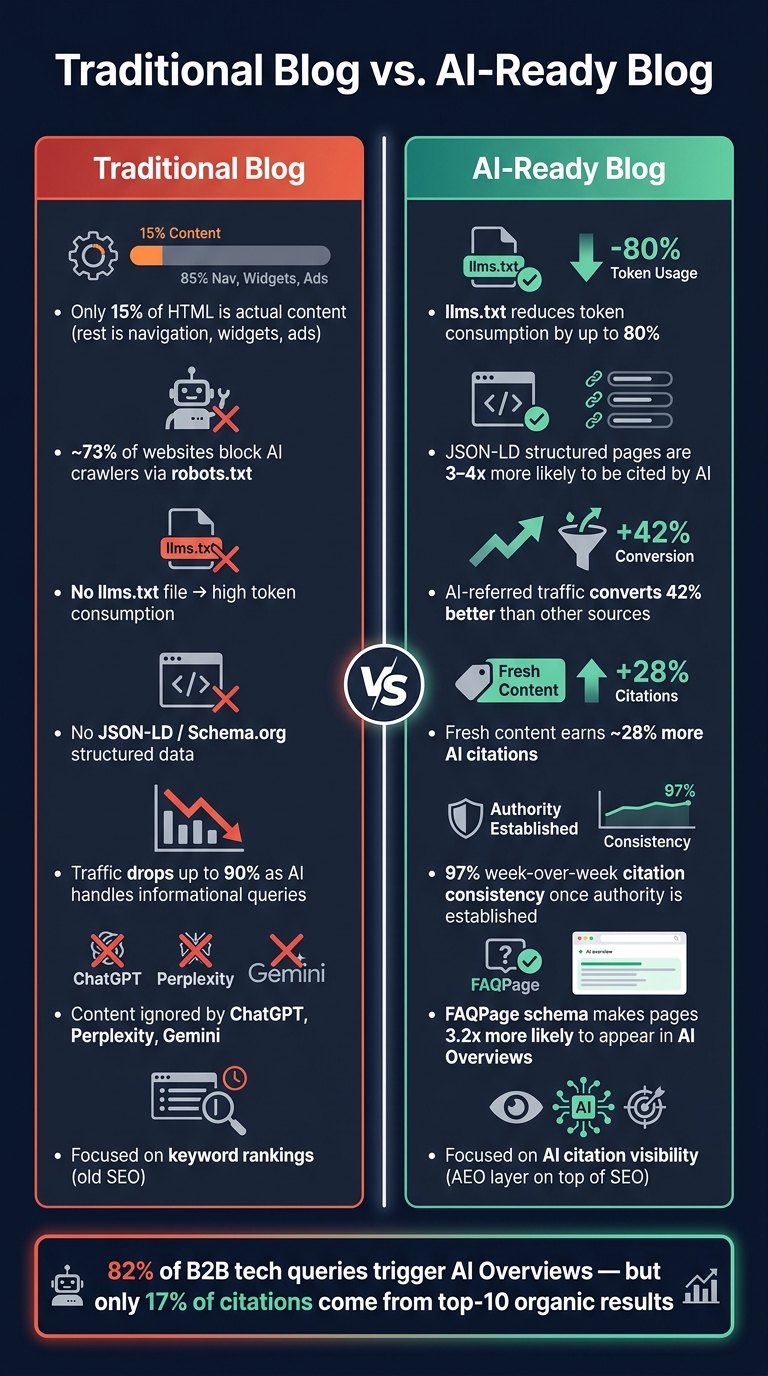
Traditional Blog vs. AI-Ready Blog: Key Differences & Stats
Technical Shortfalls of Standard Blog Setups
Unlike the clean and structured data flow of platforms like Reddit, blogs often struggle with technical inefficiencies and organizational silos. Most blogs are designed with human readers and Google’s crawler in mind - not AI systems. As a result, they're cluttered with navigation elements, scripts, banners, and ads. This forces AI agents to process content through lossy conversions, often missing key information [2][3].
Another issue is the lack of structured metadata, such as Schema.org JSON-LD or YAML frontmatter, which provides crucial details like authorship, update timestamps, and content relationships [1][3]. On top of that, many blogs rely on client-side JavaScript to load metadata, which AI crawlers might miss unless server-side rendering is implemented [1]. Additionally, restrictive robots.txt files block AI crawlers like GPTBot or ClaudeBot on about 73% of websites [6]. Salvador Morales of Agentikas Labs summed it up well:
"Blocking AI bots today is the 2026 version of 'I don't want to be on Google.'" [1]
Most blogs also lack an llms.txt file, which could provide AI systems with clean Markdown content. Implementing this simple fix could reduce token consumption by up to 80% [3].
These technical gaps highlight a deeper operational disconnect within blog management teams.
Why Content Teams and AI Strategy Do Not Connect
Blogs often operate without a unified AI strategy, leading to fragmented efforts. Content teams tend to focus on metrics like the number of articles published, rather than tracking how often their content is cited or recommended by AI systems. This focus on quantity over quality undermines their potential to deliver real value [4]. At the same time, SEO managers may lack automation expertise, while engineers often fail to consider search intent. This disconnect results in what’s been called "Mirage Content" - posts that appear substantial but lack original insights or data [5]. Lina Rafi of AI People Agency explained it well:
"The engineering challenge is not getting the LLM to write well - it is giving the LLM something worth writing about." [5]
These misaligned priorities not only hurt content quality but also make it harder to monetize effectively.
How the Lack of AI Integration Limits Blog Monetization
Blogs that provide only basic information saw traffic and revenue drop by as much as 90% in 2025, as AI systems began delivering faster, more direct answers [11]. Today, AI-powered answer engines handle 40% of informational queries without directing users to external websites [8]. However, there’s a silver lining: traffic referred by AI - where visitors arrive because an AI system cited your content - converts 42% better than other sources [9]. As noted by the Editorial Team at The Blog Herald:
"AI Overviews didn't kill blogs. They performed a stress test... exposing the gap between publishers who had readers and publishers who had traffic." [11]
Once a domain establishes authority with AI systems, its citation dominance remains steady, with a 97% week-over-week consistency [10]. This stability underscores the importance of adapting to AI-driven content ecosystems.
How to Turn Your Blog Into AI Infrastructure
Transforming your blog into AI infrastructure bridges the gap between traditional content silos and platforms designed for machine readability. Unlike Reddit's AI-ready ecosystem, most blogs lack the structural setup to support AI integration. To close this gap, you need to focus on three key areas: creating a machine-readable data foundation, implementing AI-driven content workflows, and connecting your blog to SaaS and AI systems.
Step 1: Build a Machine-Readable Data Foundation
One of the biggest challenges lies in the cluttered HTML structure of most blogs. On a typical WordPress page, only 15% of the HTML is actual content - the rest is filled with navigation elements, widgets, and other distractions that make it hard for AI crawlers to extract useful information [12].
Here’s how to fix it:
- Add an
llms.txtfile to your site’s root directory. This file provides AI assistants with a clear, machine-readable overview of your site’s content and highlights key pages. - Offer a Markdown version of every post at
/posts/[slug].md. Markdown strips away unnecessary template elements, making your content easier for AI platforms like ChatGPT and Perplexity to process [2][12]. - Use JSON-LD markup for structured data types like
Article,FAQPage, andHowTo. Structured pages are 3 to 4 times more likely to be cited by AI systems than unstructured ones [13].
Agentikas Labs demonstrated this in 2026 by building a dual-channel system: Schema.org for crawlers and WebMCP for browser-based agents. They even registered callable tools like search_posts and get_post to allow direct JSON access instead of relying on HTML scraping [1]. Ali Ibrahim, a software engineer at Agentailor, summed it up perfectly:
"The web was built for browsers. It's being rebuilt for agents. Might as well build for both." [2]
Additionally, use stable @id references in your JSON-LD (e.g., /#author or /#organization) to unify data across pages into a cohesive knowledge graph, rather than treating each page as a standalone document [13].
Once your blog is machine-friendly, the next step is to streamline your content creation process with AI-native workflows.
Step 2: Adopt a Multi-Agent Content Pipeline
Making your blog readable by AI is just the start - your content production process also needs to evolve. A multi-agent pipeline breaks down tasks like research, drafting, review, and publishing into specialized stages, avoiding the pitfalls of relying on a single AI tool to handle everything [15].
Here’s how it works:
- Dedicated Critic Agent: Many teams skip the review phase, but deploying a critique agent can catch errors for as little as $0.01–$0.02 per run [15].
- Optimize Content Structure: Start each H2 section with a concise, 40–60 word summary. This improves LLM citations, as 44.2% of citations come from the first 30% of the text [19].
- Include Statistics and Sources: Adding stats boosts citations by 37%, while sourced claims increase them by 40% [7].
Ryan Law, Director of Content Marketing at Ahrefs, shared his 2026 workflow:
"AI content wasn't good enough. Now it is... I use Claude Code and 23 custom skill files, chained together, to generate publish-ready article drafts in six to twelve minutes." [16]
This approach dramatically reduces costs. The price per article drops from $400–$800 to $150–$300, and production timelines shrink from weeks to just 48–72 hours [14].
Step 3: Connect Your Blog to SaaS and AI Systems
Optimizing production is important, but the real value comes from integrating your blog into broader SaaS and AI workflows. Treat your blog as a knowledge backend that powers AI features and workflows.
Here’s how to do it:
- Store Content in a Vector Database: Use tools like Pinecone or Weaviate to enable Retrieval-Augmented Generation (RAG). This allows your product’s AI features to pull accurate information directly from your blog, avoiding generic or incorrect responses [5][19].
- Optimize Page Speed: Pages with a First Contentful Paint under 0.4 seconds average 6.7 AI citations, while slower pages (over 1.13 seconds) drop to just 2.1 [19].
- Automate Internal Links: Guide AI agents toward high-value pages like pricing, demos, and sign-up forms to ensure the traffic AI sends you converts effectively [18].
Victor Hoang, Co-Founder & CMO at Rework, emphasized the importance of content as an AI resource:
"The RAG corpus is as important as the LLM. Before you invest in AI content tools, invest in building the source material the AI will draw from." [14]
AI Tools That Make Blogs More Competitive
With a strong data foundation and an efficient multi-agent pipeline in place, specialized AI tools are now helping bridge the gap between traditional blogging methods and AI-powered platforms. These tools not only improve the technical aspects of your blog but also address challenges related to monetization and visibility.
Tools for Structuring and Enriching Blog Content
Once your content is machine-readable, certain tools can take optimization further to make your blog more AI-friendly. Unlike traditional SEO that focuses on individual pages, modern AI engines assess your site's overall topical relevance. VizzEx Pro stands out by analyzing your blog as a connected network, identifying 13 different semantic relationships between posts to build "horizontal" topical authority. This approach aligns with Google's Helpful Content System, which evaluates inter-page relationships rather than isolated page signals [22].
For faster indexing, tools like RankReady and Akii automate llms.txt creation and Markdown endpoints (e.g., /post-slug.md), allowing AI crawlers to process content up to 10 times faster than standard HTML [21][24]. RankReady also automates FAQPage schema markup, making pages 3.2 times more likely to appear in Google AI Overviews [21]. Meanwhile, Positional focuses on improving content quality by providing insights into term frequency, readability, and sentiment, while also surfacing "Unanswered Questions" from SERP data [20].
"The first time we used Positional's toolset... We went from position #6 to #1 with the changes and increased our organic search traffic to the page by 400%." - Nate Lee, CEO and Co-Founder, Speedscale [20]
Analytics and Lead Generation Tools Powered by AI
Once your content is optimized, modern analytics tools can help identify where your blog is missing out on AI citations. The goal of analytics has shifted - it’s no longer just about ranking on Google’s first page but about becoming a source that AI platforms reference. Generative Engine Optimization (GEO) platforms now track "AI visibility gaps", showing where competitors are being cited in ChatGPT, Perplexity, or Gemini responses while your brand is left out [25]. Instead of focusing solely on keyword rankings, these tools reveal the specific prompts users are inputting into AI systems, allowing you to target high-intent conversational queries ahead of your competition [25].
Fresh content is particularly effective, earning approximately 28% more AI citations than older posts [21]. Tools like RankReady include a freshness scanner that flags posts older than 60 days and updates dateModified timestamps in bulk to signal recency to AI engines [21].
"Traditional SEO is about getting your page to rank. AI search is about getting your passage cited. LLMs don't send users to your site. They summarize an answer and pick sources." - Max Mitcham, Co-Founder, Trigify.io [7]
AI Agents That Automate Blog Operations
Autonomous publishing agents are revolutionizing blog management by handling the entire content pipeline, from keyword research to publishing, with minimal manual effort. Rankable and Balzac are two standout examples. Rankable can automatically publish long-form articles (1,500 to 5,000 words) directly to platforms like WordPress or Webflow [23]. On the other hand, Balzac focuses on GEO optimization, cutting monthly content costs from around $5,200 to $79 [27]. It also incorporates "anti-slop" rules to eliminate generic AI-generated phrases, increasing the likelihood of content being cited by AI search engines [27].
For teams already using AI tools like Claude or ChatGPT, Quillly simplifies the publishing process. It uses the Model Context Protocol (MCP) to publish directly to platforms like Ghost, Webflow, or WordPress without requiring any manual copy-pasting. The Pro plan starts at $9/month [26].
| Tool | Primary Function | Starting Price |
|---|---|---|
| VizzEx Pro | Semantic relationship analysis across posts | - |
| RankReady | llms.txt generation & FAQPage schema |
- |
| Positional | Content optimization & SERP gap analysis | Unlimited |
| Rankable | Autonomous SEO research & publishing | $49/mo (Pro) |
| Balzac | GEO-optimized content with anti-slop rules | $79/mo |
| Quillly | MCP-based publishing from AI assistants | $9/mo (Pro) |
"Since we started using Balzac, we've seen a 130% increase in organic traffic from Google, without adding work for our team." - Pierre-Yves Orban, Co-founder, Javry [27]
Conclusion: What It Takes to Build an AI-Ready Blog
Reddit transformed itself into a cornerstone of AI infrastructure by capitalizing on its structured, high-volume, community-driven data. You can apply the same mindset to your blog by treating it as a strategic data and citation resource, not just a content outlet.
The trend toward AI-driven answers is gaining momentum. Today, 82% of B2B technology queries trigger AI Overviews, a significant jump from 36% just a year ago. Yet, only 17% of those citations come from pages ranking in the top 10 of organic search results [28].
"SaaS buyers now read AI answers before they read SaaS websites. If your blog posts are not built for extraction, your competitor wins the citation, the click, and the demo." - Surge Growth Digital [28]
This shift underscores the need to rethink how blogs are structured. To build an AI-ready blog, consider the following key strategies:
- Answer-focused structure: Use question-based headings and provide concise, 40–60 word answers directly below. Pair this with proper FAQPage or HowTo schema to make your content extraction-friendly.
- Frequent updates: Refresh your content every 13 weeks to maintain relevance. AI-cited content is, on average, 25.7% fresher than content cited in traditional Google results [30].
- Off-site credibility: Establish consensus through mentions on platforms like YouTube, LinkedIn, and industry review sites. These mentions strongly correlate with AI visibility, with a coefficient of 0.664 [31].
"AEO is the new layer on top of SEO, not a replacement. The two channels overlap roughly 80%. Don't burn your existing SEO playbook. Layer AEO on top." - Vadim Strizheus, Founder, Vugola AI [17]
Adapting your blog to these principles ensures it stays competitive in the age of AI. The tools and strategies outlined here bridge the gap between a traditional blog and a data-rich AI resource. Ignoring these changes risks losing high-intent leads to competitors who are quicker to adapt [29].
FAQs
What is llms.txt, and do I need it?
An llms.txt file is a straightforward, Markdown-formatted document that you can place at yourdomain.com/llms.txt. Its purpose? To give AI models a clear, machine-readable guide to your most important content - like your core value propositions or key authoritative pages.
Although it’s not an official industry standard or a ranking factor, this simple file can make it easier for AI to discover your brand. Plus, it can help internally by organizing and highlighting your most essential content.
How can I make my posts easier for AI to cite?
To ensure your posts are AI-friendly for citation, focus on clear and structured content. Begin each section with a direct and concise answer (within 40–60 words). Use descriptive H2 and H3 headings that align with commonly asked questions. Keep sections brief, ideally between 120 and 180 words, and incorporate FAQPage and Article schema with author and date information.
Include recent and specific data to add relevance, and enhance credibility by ensuring your content gets referenced in trusted community discussions. This structure not only improves AI extraction but also boosts your content's authority and accessibility.
How can I measure if AI tools are generating leads?
To track leads generated through AI platforms, the key is connecting AI traffic with your CRM data. Here's how you can do it:
- In Google Analytics 4 (GA4), set up a custom channel group specifically for AI sources like ChatGPT or Claude. This helps you isolate and analyze traffic from these platforms.
- Push source/medium data directly into your CRM (such as Salesforce or HubSpot). This allows you to monitor attribution and understand how AI-driven traffic contributes to your lead generation efforts.
- Be cautious of anomalies in direct traffic. AI referrals often lack referrer data, which means they can sometimes show up as direct traffic in your analytics.
- Leverage tools to track brand mentions and citation share across AI platforms. This provides additional insights into how your brand is being discussed and linked back to from AI-generated content.
By combining these steps, you can better understand and measure the impact of AI-driven leads on your business.