Gartner Says You'll Lose 25% of Web Traffic by 2026. TechTarget What's Your Plan?

Web traffic is shrinking, and AI is the reason. Gartner predicts a 25% drop in search-driven web traffic by the end of 2026. Why? AI tools like ChatGPT and Google’s AI Mode are answering user queries directly - without sending them to your website.
This shift could hit SaaS and AI companies hardest, especially those relying on informational content like "how-to" guides or "best tools" lists. Using AI-powered content optimization tools can help maintain relevance. Organic search is no longer reliable for discovery, as nearly 60% of searches now result in zero clicks. Businesses must rethink their strategies to protect pipeline and revenue.
Key Takeaways:
- AI is intercepting search traffic: Tools like ChatGPT handle 1.6 billion queries daily, and Google's AI Mode drives 93% of searches to end without clicks.
- Lead generation at risk: A 25% traffic drop could cost a B2B SaaS company $180,000/month in lost pipeline.
- What works now: Focus on direct traffic channels (email, marketplaces) and implement generative engine optimization to maintain visibility.
Switching to AI-friendly strategies and diversifying traffic sources is no longer optional. Learn how to build resilience and stay visible in an AI-dominated search landscape.
What Is Driving the Web Traffic Decline and What It Costs Businesses
How Generative AI Is Cutting Click-Through Rates
Generative AI tools are reshaping how people interact with search engines, and the ripple effects are hard to ignore. AI-powered summaries now answer questions directly on search results pages, drastically reducing the need to click through to websites. When an AI Overview appears, users click a link only 8% of the time, compared to 15% when no summary is displayed [7]. For websites holding the coveted position-one ranking, this means a staggering 58% drop in click-through rates (CTR) [2].
The situation worsened with the launch of Google's AI Mode on April 16, 2026. A shocking 93% of searches conducted in AI Mode reportedly end without a single click [11]. AI Overviews have also become a staple of many search results, especially for comparison queries - critical for B2B research - where they appear in 95.4% of cases [6].
"The position-one click that used to convert at 1.76% now converts at 0.61% in the worst-affected query classes, and the missing 1.15 percentage points are the recovery target." - Digital Strategy Force [11]
Certain types of content are feeling the brunt of this shift, particularly those relied upon by SaaS companies. Definitions, how-to guides, and "best of" listicles are now being answered instantly by AI, removing the need for users to visit websites. On the other hand, product and pricing pages remain relatively unaffected, as users still need to engage with these pages to make purchasing decisions.
| Content Type | Impact Level | Reason |
|---|---|---|
| "What is X?" definitions | Severe | AI provides concise answers in 1–2 sentences [3] |
| "How to" guides | Severe | AI delivers step-by-step instructions directly [3] |
| "Best X" listicles | High | AI summarizes top options from multiple sources [3] |
| Comparison pages | Medium | AI compares, but users may still seek more depth [3] |
| Product/pricing pages | Low | Users need to visit to purchase or sign up [3] |
This sharp decline in CTR is more than just a numbers game - it directly impacts lead generation and revenue, as explored below.
What Traffic Losses Mean for Lead Generation Revenue
Declining web traffic isn’t just a hit to vanity metrics; it has real financial consequences. For example, consider a B2B SaaS company with 400,000 monthly sessions. If 50% of those sessions come from informational queries and traffic drops by 25%, that’s a loss of 50,000 sessions each month. At a 2% conversion rate and a $15,000 average contract value, this translates to approximately $180,000 in monthly pipeline at risk [1].
The impact is already evident in real-world examples. Business Insider saw its organic search traffic plummet by 55% over three years starting in April 2022. This decline, tied to AI-generated answers absorbing its content, forced the company to cut 21% of its staff to offset losses in ad-supported revenue [10].
"A 25% decline in a channel isn't a forecast - it's a planning constraint. If you do not convert the headline into a spreadsheet, the number bounces off the strategy without landing." - BrandGEO [1]
Another complicating factor is attribution. When users research products through tools like ChatGPT or Chrome's AI Mode side panel, these sessions often show up as "Direct/None" in Google Analytics 4 [11]. This means the true extent of traffic displacement caused by AI is likely underreported, leaving many marketing teams unaware of the full scope of the issue.
As businesses struggle to adapt to these changes, many are finding refuge in more specialized environments, as discussed below.
Why Niche Marketplaces Are Gaining Ground
With general search becoming less reliable for discovery, both buyers and sellers are shifting their focus to more targeted platforms. B2B buyers, who once relied on Google to find vendors, are increasingly turning to intent-driven platforms and niche marketplaces. These environments offer a more defined context where audiences are already in a buying mindset [1].
AI-generated answers often bypass vendor options, but niche directories and B2B marketplaces step in to fill the gap. These platforms connect buyers with specific categories of tools, offering a more streamlined experience. While the overall traffic volume on these platforms may be lower than traditional search, the quality of traffic is far higher. Visitors from AI-driven search convert at three times the rate of traditional organic visitors and deliver 4.4 times the relative value [4]. This trend highlights the importance of diversifying traffic sources and scaling your B2B marketing channels ahead of the anticipated 2026 decline.
I Tested Google’s Rebuilt Search: 3 Things to Fix This Week
Solution 1: Build Traffic Sources Outside of Search
With organic search projected to drop by 25% and 60% of searches now resulting in no clicks [5][18], depending solely on Google is a gamble. SaaS and AI companies must focus on creating traffic channels they can fully control.
How to Build Owned Audiences and Direct Channels
The safest traffic source? One that algorithms can’t interfere with. Email lists and newsletters give you a direct connection to your audience. Unlike organic search, where visibility depends on external factors, email lists let you control how and when you engage with subscribers. Plus, you gain valuable first-party data in the process.
Another effective approach is operator-led social media activity. When founders or team members consistently post 3–5 times weekly on platforms like LinkedIn or X, they often reach more decision-makers compared to traditional company blogs. Engaging in niche communities - such as Reddit threads, Discord servers, or Slack groups - also builds credibility and brand recognition. Interestingly, AI tools often pull insights from these community discussions, giving your brand extra visibility in AI-generated search results [13].
"The math now favors publishing the deeper asset publicly and capturing intent at the bottom of it." - Oleg Kovalev, Founder, ASP Marketing [13]
Take Hamming.ai as an example. This YC-backed AI voice testing platform focused on Reddit engagement and technical content optimized for AI visibility. Over 12 weeks in early 2026, they grew their daily visitors from 200 to 1,900, with 40% of demo requests coming directly from Reddit or AI-driven search channels [14].
While owned channels provide long-term engagement, industry marketplaces can connect you with buyers ready to act.
How Industry Marketplaces Can Connect You With Ready Buyers
Industry marketplaces attract high-intent traffic. Platforms like G2, Capterra, and Gartner Peer Insights are key sources for AI tools compiling B2B software recommendations. When someone asks ChatGPT for the best project management tool, the AI relies heavily on structured data from these marketplaces - think feature tags, user reviews, and use-case details [15][16].
Visitors referred by AI from these marketplace-driven sources boast a 1.94% conversion rate, compared to 1.14% for traditional organic search. For sign-up flows, AI-referred users convert at 1.66%, which is 11 times higher than the 0.15% conversion rate of organic search visitors [17]. These users are already well-informed and ready to act, making them essential for maintaining a strong pipeline as organic search declines.
"One earned or paid slot on a G2, Capterra, Built In, or trade-press roundup can outperform a new blog post on your own domain." - Arnel Bukva, Founder, LoudFace [16]
The Top SaaS & AI Tools Directory works on a similar principle, connecting SaaS and AI businesses with buyers actively evaluating solutions. Listing in directories like these ensures your product reaches decision-ready buyers.
Here’s a tip: some companies report showing up in AI-generated answers within a week of listing on major review platforms [12]. To improve your chances, complete your profile with detailed feature tags, screenshots, and pricing-related information (even ranges). This helps AI tools extract and present your product more accurately [15].
Comparing Key Traffic Channels Side by Side
Diversifying traffic sources reduces risk while improving lead quality. Not every option suits every business, so here’s a quick comparison of popular alternatives to organic search:
| Traffic Channel | ROI Potential | Lead Quality | Ease |
|---|---|---|---|
| Email/Newsletters | High | High | Medium |
| Marketplaces (G2/Capterra) | High | Very High | High |
| Operator-Led Social | High | Medium | Low |
| AI Search (Referral) | High | Very High | Low |
| Paid Search | Medium | High | Medium |
Marketplaces stand out for their ease and lead quality, making them a great starting point for diversification. Owned channels like email require more time to build but offer unmatched long-term stability. The goal isn’t to rely on one channel but to create a balanced mix that safeguards your pipeline from sudden platform changes.
Solution 2: Optimize Your Content for AI Answer Engines
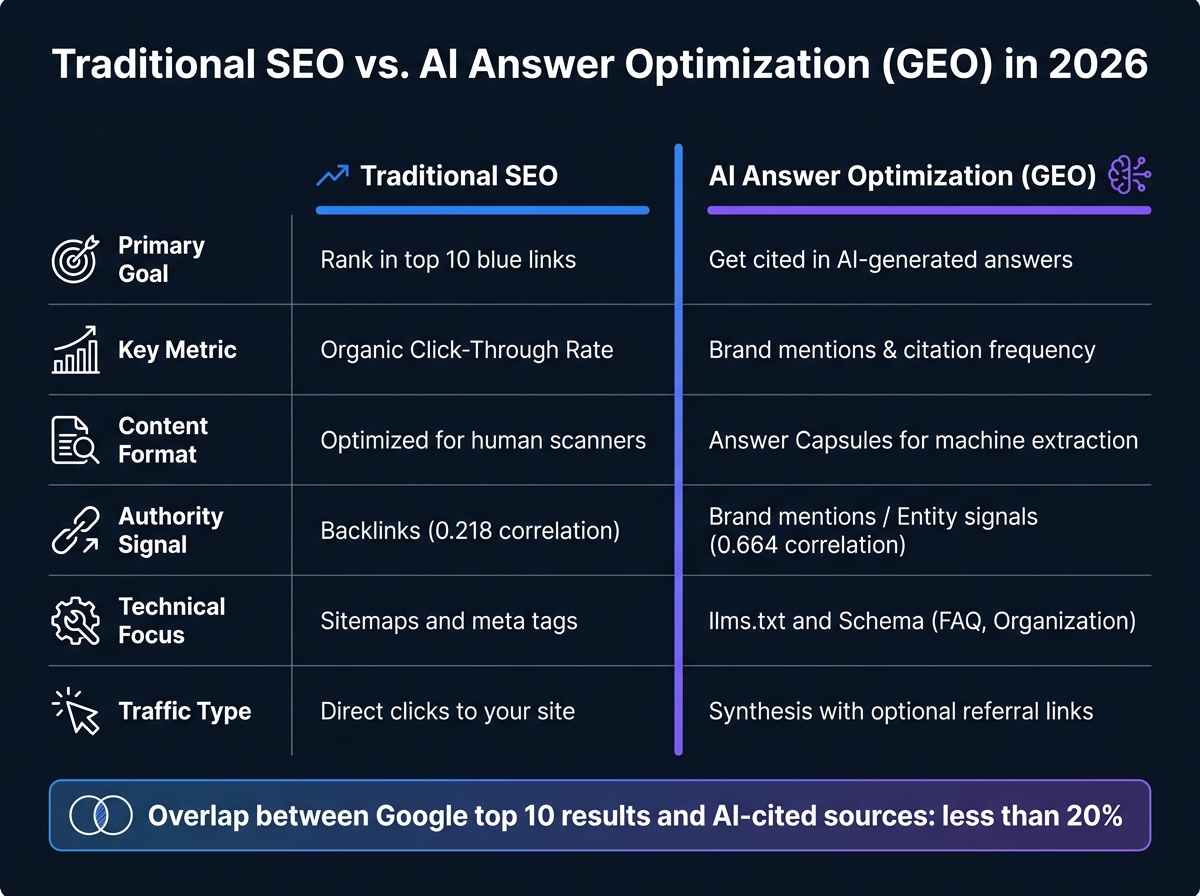
Traditional SEO vs. AI Answer Optimization: Key Differences in 2026
Diversifying traffic channels is a good start, but it doesn't address the real challenge: standing out within AI tools themselves. This is especially important given the projected 25% drop in traffic. When someone asks tools like ChatGPT or Perplexity for advice - say, which CRM is best for a 10-person team - the AI pulls information from its sources and synthesizes an answer. No clicks, no traditional rankings. In this new landscape, being cited in that response is the equivalent of "ranking #1" [19]. That’s why structuring your content for AI visibility is essential.
How to Structure Content So AI Tools Can Find and Use It
AI engines don’t read web pages like humans do. Instead, they extract specific passages. To make your content AI-friendly, start each section with an Answer Capsule - a concise, 40–60 word summary that directly answers the question implied by the heading. This self-contained snippet makes it easier for AI tools to pull and cite your content [19].
But structure alone isn’t enough. The density of your information matters too. Using GEO techniques - like including authoritative stats and citations - can boost AI visibility by as much as 40% [19]. Aim to feature at least one hyperlinked, credible statistic every 150–200 words. Keeping your content up-to-date is also critical; AI engines are three times more likely to cite pages that are less than three months old [19].
On the technical side, three steps can make a big difference:
- Make sure your
robots.txtfile doesn’t block key AI bots like GPTBot, ClaudeBot, or PerplexityBot. - Use the
FAQPageJSON-LD schema with 5–7 Q&A pairs per page. - Create an
llms.txtfile (atyourdomain.com/llms.txt) listing key pages with brief descriptions to help AI crawlers map your site more effectively [19][20][21].
"Structure amplifies content; it does not substitute." - Vincent Ruan, Founder, Attrifast [21]
Lastly, avoid promotional language. Data shows that overly promotional content is 26.19% less likely to be cited by AI tools. Stick to an analytical, fact-driven tone [19].
How to Check Whether AI Tools Are Surfacing Your Brand
One way to check your brand's visibility in AI-generated answers is through manual testing. Each week, run 10–30 target queries on tools like ChatGPT, Perplexity, and Claude. Track whether your brand appears, what text is quoted, and which competitors are mentioned [20][21][22]. This gives you a clear picture of your "share of voice" in AI responses.
For a more systematic approach, consider specialized tools. Semrush's AI Visibility Report can analyze industry-specific prompts to see which brands are cited most often. Surfer SEO offers an AI Tracker (starting at $99/month) to monitor how often your content gets cited. For $29/month, Attrifast can help fix GA4 misclassifications of AI-referred traffic as "Direct" [23][21][22].
"The key question is no longer 'How do I rank in search?' but 'How do I ensure my brand is trusted and recommended when AI provides the answer?'" - Dirk Nicol, LinkedIn [25]
These strategies highlight the shift from traditional SEO to AI Answer Optimization.
Traditional SEO vs. AI Answer Optimization: Key Differences
While traditional SEO and AI Answer Optimization (also known as Generative Engine Optimization or GEO) share some similarities, their goals and metrics differ significantly. Traditional SEO focuses on ranking high in search results and driving clicks, whereas GEO aims to get your content cited in AI-generated answers. Interestingly, brand mentions have a much stronger correlation (0.664) with AI citations compared to backlinks (0.218) [19].
| Dimension | Traditional SEO | AI Answer Optimization (GEO) |
|---|---|---|
| Primary Goal | Rank in top 10 blue links | Get cited in AI-generated answers [19] |
| Key Metric | Organic Click‑Through Rate | Brand mentions and citation frequency [19] |
| Content Format | Optimized for human scanners | Answer Capsules for machine extraction [19] |
| Authority Signal | Backlinks (0.218 correlation) | Brand mentions/Entity signals (0.664 correlation) [19] |
| Technical Focus | Sitemaps and meta tags | llms.txt and Schema (FAQ, Organization) [19][21] |
| Traffic Type | Direct clicks to your site | Synthesis with optional referral links [19][22] |
The overlap between Google’s top 10 organic results and AI-cited sources is now less than 20% [20]. This means a high Google ranking no longer guarantees visibility in AI answers. To stay competitive, both strategies need attention, but GEO offers an entirely new avenue to expand your reach.
Solution 3: Use SaaS and AI Tools to Keep Your Pipeline Full
Once you've optimized for AI visibility, the next step is to ensure your pipeline stays strong by leveraging smart tools. The key here is to turn attention into revenue. With organic search traffic decreasing, businesses that thrive are those that actively use tools designed to adapt to this shift.
AI Tools for Lead Generation and Sales Efficiency
Did you know most websites lose 96% of their visitors by failing to identify them? Tools like Knock Organic and nRev AI tackle this problem by converting anonymous visitors into actionable leads before they slip away.
For example, nRev AI delivers measurable results by automatically adding 400 qualified ICP leads to Salesforce weekly - without requiring manual prospecting from sales reps [27]. SpendFlo streamlined its operations by consolidating five tools into one nRev workflow, which resulted in 277,000 verified contacts for their sales team [27]. nRev AI offers a free tier with 2,500 credits, followed by a usage-based pricing model.
Signal-based tools like SyncGTM and vibeGTM take things further by triggering outreach based on real-world buying signals, such as job changes, funding announcements, or tech stack updates. These tools pull data from over 50 sources, achieving 82–90% contact coverage - a big leap from the 50% coverage typical of single-source databases [8]. Pricing starts at $99/month, and free tiers are available.
"The most durable response to AI search disruption for B2B teams is reducing pipeline dependence on organic search entirely." - Kushal Magar, SyncGTM [8]
AI-powered SDR agents like Piper from Qualified handle research, personalization, and multichannel follow-ups around the clock. Qualified also offers Signals, which overlays intent data to help sales teams focus on accounts showing active buying interest.
"Signals enables our reps to focus on accounts with the highest buying intent so that they can maximize pipeline." - Kristin Hersant, VP of Marketing, Qualified [26]
To ensure your efforts continue to pay off, integrating automation tools for lead nurturing and content production is a smart move.
Platforms for Marketing Automation and Content Production
A solid content engine is essential for keeping your pipeline full, even with a lean team. The current trend is shifting from rule-based automation ("if X, then Y") to goal-based AI that adapts dynamically. Tools like Salesforce Agentforce and the Tofu Platform don't just complete tasks - they adjust workflows based on outcomes.
Take Tofu, for instance. In Q1 2026, Unanet used the platform to create over 200 personalized landing pages, resulting in 10 closed-won deals directly tied to these AI-generated assets [30]. Similarly, PriceLabs developed a three-layer outbound engine with nRev AI, enriching 500 prospects weekly with hyper-personalized, multilingual sequences [27].
Another great example is HubSpot's Content Remix, which repurposes a single piece of content - like an SME interview - into blog posts, social media snippets, and ad copy. This approach keeps your brand visible across multiple channels without overloading your team. That’s especially important when 75% of marketing organizations already use AI for content personalization and campaign optimization [29].
Comparing SaaS and AI Tool Categories by Business Outcome
Here's a breakdown of different tool categories and what they offer:
| Tool Category | Primary Business Outcome | Setup Time | Integration Complexity | Pricing (USD) |
|---|---|---|---|---|
| Signal-Based Outbound (SyncGTM, vibeGTM) | Build pipeline independent of search | Fast (8–15 mins) | Low (Native CRM) | $99+/mo [8] |
| Visitor Identification (Knock, nRev AI) | Turn bouncing traffic into leads | Fast (Under 10 mins) | Medium (JS Snippet) | Usage-based [27] |
| AI SDR Agents (Qualified Piper, lemlist) | 24/7 lead qualification & engagement | Moderate | High (Workflow mapping) | Enterprise/Seat-based [28] |
| Agentic Marketing (Agentforce, Tofu) | Faster campaign execution (10x–15x) | Moderate | High (Full data stack) | Enterprise/Custom [31] |
| Intent Intelligence (Qualified Signals) | Focus on accounts with buying intent | Moderate | High (Salesforce/HubSpot) | Contact for quote [26] |
If you're dealing with declining traffic, start with visitor identification and signal-based outbound tools. These options deliver quick results without requiring a complete overhaul of your marketing stack.
Solution 4: Measure, Forecast, and Plan for Traffic Drops
Even the best-optimized content can falter if you're not accurately measuring traffic. By 2026, analytics tools like GA4 have become less reliable, often misclassifying lost clicks as "Direct/None" instead of organic traffic. This misclassification can make your dashboard appear stable while your search-driven leads quietly decline. Getting a clear grasp of these metrics is essential for forecasting and adjusting your strategy.
A Framework for Modeling Traffic Decline
To tackle these measurement challenges, you can use a straightforward formula to estimate your potential organic traffic loss in 2026:
2026 organic traffic loss = Baseline × Informational share × (25% × Category pace) × (1 − AI capture rate) [1]
The AI capture rate is a critical factor - it reflects how often your brand is cited in AI-generated content. Brands that appear in AI Overviews gain +120% more organic clicks per impression compared to those that don’t [11]. Here’s a table showing how different traffic decline scenarios affect your business and the steps you should take:
| Traffic Decline Scenario | Impact on Pipeline | Recommended Action |
|---|---|---|
| 10% Drop | Minor top-of-funnel dip | Audit AI visibility and optimize high-intent pages |
| 25% Drop | Significant lead gap | Shift 30% of your SEO budget to AI-optimized and bottom-funnel content |
| 40% Drop | Critical pipeline risk | Focus on outbound signals and direct-to-community strategies |
"A 25% decline in a channel isn't a forecast - it's a planning constraint. If you do not convert the headline into a spreadsheet, the number bounces off the strategy without landing." - BrandGEO [1]
Metrics That Matter in 2026
Traditional metrics like raw organic sessions no longer provide a full picture of marketing performance. Instead, focus on metrics that measure influence rather than just clicks. For example:
- Brand search volume in Google Search Console is a reliable indicator of top-of-funnel activity, as it reflects users who are already familiar with your brand.
- AI citation share of voice tracks how often your brand is recommended by platforms like ChatGPT, Perplexity, or Gemini.
Here’s how to rethink your KPIs:
| Old KPI | New KPI | What It Measures |
|---|---|---|
| Organic sessions | Brand search volume | Active brand intent |
| Page views | AI citation share of voice | Recommendations by AI platforms |
| Bounce rate | Engaged sessions (GA4) | True visitor interest |
| Organic conversions | Pipeline-influenced revenue | Content's role in closed deals |
| Traffic per post | Revenue per content piece | Financial ROI of individual assets |
Keep in mind that a large portion of B2B buyer activity - around 60–70% - happens in untrackable spaces like Slack, podcasts, and AI chats. To capture this influence, include a simple "How did you hear about us?" field on all forms. This small step can reveal insights that standard dashboards might miss.
Budget Reallocation Strategies for Traffic Drops
Once you’ve refined your metrics, it’s time to adjust your budget to protect your pipeline. Shift resources from informational content to high-revenue pages. Informational queries - like "how to" or "what is" - are seeing click-through rates drop by 30–60% as AI tools increasingly summarize this content directly [8][32]. On the other hand, bottom-funnel pages, such as pricing guides and integration docs, still drive clicks because they require user action.
Real-world examples show how effective this shift can be. In 2026, Lumanu focused on purchase-intent keywords like "best way to pay creators internationally." Within just 60 days, they recorded 566 ChatGPT clicks (a 135% increase) and 99 direct conversions from ChatGPT [9]. Similarly, iSpeedToLead, a real estate marketplace, revamped its content strategy to prioritize revenue-driving pages, leading to a 310.8% increase in AI search traffic and a 7.79% AI citation share - the highest in its category [9].
Additionally, consider allocating part of your SEO budget to monthly AI visibility audits. Tools like Profound and Otterly (starting at $96/month) can help you track how often your brand appears in AI-generated answers. Pair these insights with a custom GA4 channel group for "AI Referrals" to monitor traffic from sources like chat.openai.com, perplexity.ai, and gemini.google.com. This setup will give you a clearer picture of how AI is driving traffic to your site.
"The traffic is gone, but the influence remains. If you are still reporting marketing ROI based primarily on organic sessions... you are measuring a shrinking proxy." - Distk Editorial [32]
Conclusion: Steps to Take Before Web Traffic Shifts in 2026
Gartner's predictions are no longer just forecasts - they're happening right now. Traditional search traffic is on the decline, and more searches are bypassing the usual clicks altogether. For SaaS and AI companies still dependent on organic traffic, the time to act is running out.
Here’s the game plan: start diversifying your traffic sources. Focus on owned channels like email and community engagement. At the same time, make your content AI-friendly by adopting answer-first formats and implementing complete schema markup. This ensures that AI tools like ChatGPT and Perplexity can reference your content effectively. Also, rethink how you measure success - shift your focus to metrics like brand search volume, AI citation share, and revenue influenced by your pipeline. These adjustments are essential to navigating the changing web traffic landscape. Some companies are already turning these shifts into growth opportunities.
Take Riseworks as an example. By pivoting to bottom-funnel content, they achieved an impressive 318% growth in clicks by using Gartner’s forecast as a guide for strategic planning [9].
"Companies will need to focus on producing unique content that is useful to customers and prospective customers. Content should continue to demonstrate search quality-rater elements such as expertise, experience, authoritativeness and trustworthiness." - Alan Antin, Vice President Analyst, Gartner [24]
Here’s another crucial insight: visitors referred by AI convert at rates up to 4.4 times higher than those from traditional organic channels [4]. These visitors often arrive already informed, making them more likely to take action. While overall traffic might decrease, the higher quality of AI-driven visits can more than make up for it - if your strategy evolves to meet the moment.
FAQs
How do I estimate my pipeline loss from a 25% traffic drop?
To gauge pipeline loss from a 25% drop in traffic, begin by identifying your baseline organic sessions and the percentage driven by informational queries - these are the most likely to be impacted by AI interception. Adjust this figure based on your industry's AI adoption rate (e.g., multiply by 1.2 for tech-forward B2B sectors). Next, consider your AI visibility capture rate. Once you’ve identified the sessions at risk, multiply that number by your landing-to-opportunity conversion rate and your average contract value (ACV). This will give you an estimate of the potential loss.
What should I do first to reduce dependence on Google search?
The days of relying solely on traditional SEO are fading. Instead, it's time to pivot toward Answer Engine Optimization (AEO). This approach focuses on creating content that AI systems can seamlessly pull into their responses.
To excel at AEO, start by crafting structured and authoritative content. Think Q&A sections that directly address common user queries, or comparison tables that neatly organize information. These formats make it easier for AI systems to reference your content accurately.
Another key step? Monitor how your brand shows up in AI-generated answers. Pay close attention to whether your expertise is being highlighted. To strengthen your position, consider developing high-value resources like research reports or industry maps. These assets help establish your authority and improve your chances of being featured in AI-driven answer interfaces.
As AI continues to shape how people find information, ensuring your content is optimized for these systems is crucial. Traditional search traffic is being replaced by AI-powered answers - don’t get left behind.
How can I tell if AI tools are recommending my brand?
To see if AI tools are recommending your brand, it's important to regularly audit platforms like ChatGPT, Perplexity, Claude, and Gemini. Here's how you can do it:
- Run 10–15 buyer-intent or category-based prompts every month. Pay close attention to how your brand is mentioned, its positioning, the descriptions used, and any cited URLs.
You can track these results manually by creating a spreadsheet. Alternatively, consider using tools like Topify, Sona, or GroMach. These tools help you monitor mentions, citation rates, and identify competitive gaps across multiple AI platforms.