Founder-Led Growth Without Founder Burnout: The Guardrails

Most founder-led growth does not fail from lack of effort. It fails when the founder stays in too many steps for too long.
I see 1 clear lesson here: keep the founder in the calls and choices that shape revenue and use AI for lead generation, then build rules for the rest. That means 4 things:
- Define founder-only work
- Set limits on meetings, time, and approvals
- Write down sales and content know-how
- Use marketing automation with human review
The point is simple. AGL runs many marketing departments with a small team using Tango. Humans decide. Machines repeat. Nothing ships without approval. That setup helps agencies get more output without adding an AI stack to watch all day.
A few numbers make the case. The article notes that 53% of founders reported burnout, 75% reported anxiety, and 85% reported high stress. That is not just a personal issue. It is a system issue.
If I ran an agency, I would read this as a rule: the founder should guide growth, not carry every task. The 1 move to start with is a dependency audit. I would ask: what still waits on me that should run through a system by this quarter?
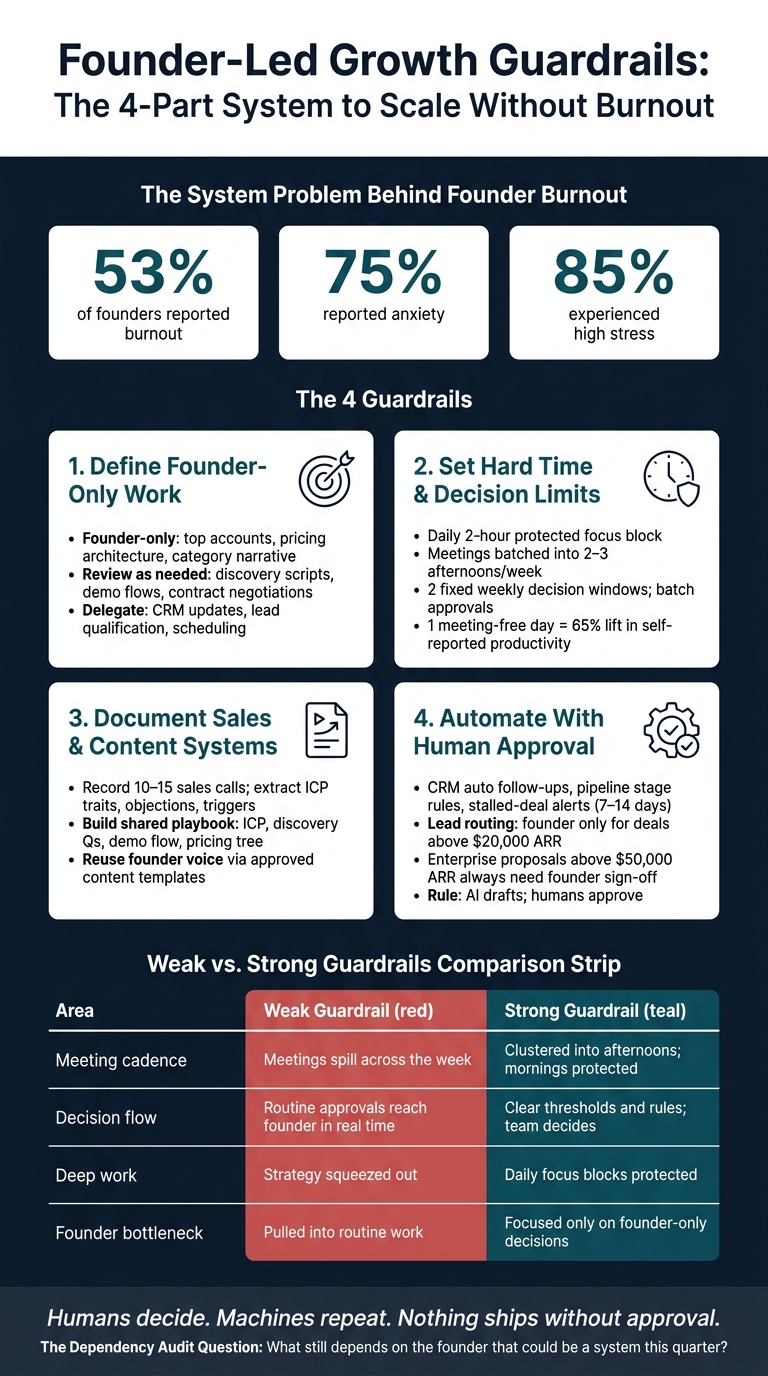
Founder-Led Growth: Weak vs. Strong Guardrails Across 4 Key Areas
Guardrail 1: Define Where the Founder Must Personally Show Up
Here’s the shift. Founder dependence does not start with effort. It starts with blurry lines.
When the founder touches too much, the agency slows down. When the founder stays in the few places that need their call, the team moves faster. That is how AGL runs many marketing departments with a small team using Tango. Humans decide. Machines repeat. Nothing ships without approval.
The lesson is simple. Turn founder judgment into a rule. Not a habit.
Founder-Only Work vs. Work the Founder Can Hand Off
Not all founder work matters in the same way. Some tasks need the founder’s call, network, and trust. Most do not.
A good filter is this: if a written process can get you close to the same result, hand it off.
Use 3 buckets:
| Category | Examples |
|---|---|
| Founder-only | Top-account discovery, pricing architecture, category narrative, flagship customer relationships |
| Review as needed | Standard discovery scripts, repeatable demo flows, typical contract negotiations |
| Delegate | CRM updates, basic lead qualification, routine follow-ups, scheduling, meeting notes |
This is the same idea behind Tango. The founder keeps the calls that shape the account. The team runs the repeat work. The system keeps it moving.
Set Decision Rights and Escalation Rules
Once you know what stays with the founder, set the rules for everyone else.
That means clear approval lines. Discounts or exceptions above $10,000 in ARR, or 15% to 20% off standard pricing, need founder or CRO approval. Smaller changes stay with the sales manager.[6][7][9]
Changes to your core ICP definition, new strategic partnerships, or major positioning shifts need founder sign-off. Routine campaign messaging, standard contract terms, and promotional offers stay with the team.[8][10]
Then put those rules inside the tools your team already uses.
If a quote crosses a discount or ARR threshold, the CRM should flag it and send it to the named approver on its own.[7][11] That is the point. No guessing. No waiting around for Slack replies.
At AGL, this is how output goes up without adding a messy AI stack to babysit. Tango puts the rule where the work happens.
Run a Weekly Activity Audit to Spot Founder Dependency
Most founders do not see the drag until they track it.
For 1 week, log every growth task in 30-minute blocks. Tag each task as founder-only, review as needed, or delegate.[3][4]
Then sort the list by time spent and impact.
The first handoff targets are usually easy to spot. Manual CRM updates. Tiny copy edits. Routine approvals. These eat time and add little.
Set a 30-minute review each week. Update the audit. Confirm what gets handed off next week. Align with your leadership team on who owns what.[4]
That is how repeat founder asks become clear ownership.
If you want the first move, do this: track your next 1 week of work in 30-minute blocks, tag each item, and move 1 repeat task into Tango by next week.
Guardrail 2: Set Hard Limits on Time, Meetings, and Decisions
Here’s the shift. Most founders do not have a time problem. They have a boundary problem.
A calendar audit shows the leaks. But that alone changes nothing. If you do not set hard limits, the same mess rolls back in by Tuesday afternoon.
At AGL, this is a core part of Tango. Humans decide. Machines repeat. Nothing ships without approval. That is how a small team can run many marketing departments without the founder getting dragged into every small call.
Calendar Rules That Protect Deep Work and Recovery Time
Once founder-only work is clear, protect the hours for it.
The rules are simple. Keep a daily 2-hour focus block. Batch meetings into 2 to 3 afternoons per week. Leave buffers around travel days or board days [19][18].
This is not just a nice habit. Research ties 1 meeting-free day per week to a 65% lift in self-reported productivity [15][19].
Keep meetings packed into a few afternoons. Keep mornings open for work that needs clear thought. That can be product strategy, key customer insight review, or core content creation.
Add 15 to 30 minute buffers between meetings. Block recovery time before and after heavy travel days or board meetings [12][13][14].
That protects decision quality.
The goal is simple. Keep the founder out of routine calendar cleanup. Keep them free for the calls only they should make. That is the same logic AGL uses in Tango. The team runs the flow. The founder steps in where judgment matters.
Cut Decision Load With Defaults and Batching
Meeting overload is loud. Decision overload is quiet.
But it can wreck a week just as fast [16].
The fix is to set the rules before the work shows up. That way, routine calls do not hit the founder live.
Set discount bands. Send only exceptions and high-ARR deals to the founder [17][20]. Do the same for contract terms and ICP routing. Once the rules are written down, the team stops guessing. They start deciding.
Then batch approvals into 2 weekly decision windows. Review queued items together.
Each decision owner should bring a short brief with:
- context
- options
- a recommendation
Now the founder is not building every answer from scratch. They are choosing between prepared paths.
That one shift matters. It contains decision-making. It gives the rest of the week back to focused work. It also fits the Tango system. You do not need a big AI stack to babysit. You need clear rules, clean inputs, and human approval at the end.
Weak vs. Strong Guardrails: A Side-by-Side Comparison
| Guardrail Area | Weak Guardrails | Strong Guardrails |
|---|---|---|
| Meeting cadence | Meetings spill across the week and interrupt mornings | Meetings are clustered into a few afternoons, with mornings protected for focus work |
| Decision flow | Routine approvals keep reaching the founder in real time | Discounts, contract terms, and ICP routing follow clear rules and thresholds |
| Deep work | Strategy and content get squeezed out | Daily focus blocks stay on the calendar |
| Founder bottleneck risk | The founder is pulled into routine work | The founder stays focused on the work only they should own |
This is the lesson. Guardrails are not about control for its own sake. They keep founder time aimed at the work that moves the agency.
That is how AGL runs more output with a small team through Tango. The machine handles the repeat work. People make the calls. Approval stays human.
Pick 1 rule this week. Start with a daily 2-hour focus block or 2 fixed decision windows. Put it on the calendar and treat it like a client call.
Guardrail 3: Turn Founder Knowledge Into Repeatable Sales and Content Systems
Here’s the shift. Time is not the only bottleneck.
A founder can block growth even with protected time if the team still needs them to explain the sale, the message, and the pushback on every deal. That’s the next leak. The know-how lives in the founder’s head, not in the system.
At AGL, this is where Tango matters. Humans decide. Machines repeat. Nothing ships without approval. That setup only works when the founder’s logic is written down first. Then a small team can run many marketing departments without the founder sitting in every call.
The move is simple. Turn founder know-how into a repeatable sales system.
Build a Sales Playbook From Real Founder Conversations
The best playbook does not start from guesses. It starts from real calls.
Record 10 to 15 sales calls. Transcribe them. Then tag the patterns. Look at which ICP traits showed up in closed deals, what buying triggers came up again and again, which discovery questions opened real talks, and which objections stalled or killed deals.[2][5][23]
Then turn that into a shared playbook with sections for:
- ICP
- Buying triggers
- Discovery questions
- Demo flow
- Common objections
- A pricing decision tree
That pricing tree matters more than most teams think. Reps need to know when to hold price, when to offer a standard discount, and when to escalate.[5][1]
Store the playbook in one shared workspace. Make it the default place for onboarding, deal reviews, and coaching.[5][1]
The rule is blunt. If someone other than the founder cannot run the motion the same way, the playbook is not done.[21]
Once the sales motion is on paper, the next step is to save the founder’s message in assets the team can reuse.
Preserve Founder Voice Through Reusable Content Assets
The playbook makes selling repeatable.
The content library makes the founder’s voice repeatable across outbound, posts, and decks.
Use the founder’s actual words. Not a cleaned-up version. Pull from outbound emails with high reply rates, LinkedIn posts with strong engagement, and pitch decks. Then build templates from those patterns: outbound sequences, follow-up emails tied to common demo outcomes, one-pagers that match the founder’s story flow, and LinkedIn post frames the team can adapt. To ensure these assets also drive organic traffic, teams use Clearscope to optimize the founder's voice for search intent.[1][22]
Tag each asset by use case and stage in a shared knowledge base. That way reps can grab the right asset without asking the founder to rewrite it.
This is also how Tango keeps output high without making quality slip. The rules are clear. The voice is clear. The team moves faster because they are not starting from scratch each time.
Ad Hoc Founder Selling vs. Documented Execution: A Comparison
| Area | Ad Hoc Founder Selling | Documented Execution |
|---|---|---|
| Consistency | Messaging drifts across reps | Same questions and talk tracks every time |
| Onboarding speed | New hires shadow the founder for months | Reps run calls within weeks using playbooks and recorded calls |
| Scalability | Pipeline capped by the founder's calendar | Multiple reps run the founder's logic in parallel |
You can spot the change fast.
The founder gets fewer requests to join every call. The team starts asking better questions, like how to adapt the playbook for one industry or one deal type. That means they are using documented guidance, not waiting on the founder.[5][23]
At AGL, that’s the point. A small team can produce more when the founder’s judgment is built into Tango. People still approve the work. The system handles the repeat steps. That is how you get stronger delivery, more output, and a team that does not need a stack of AI tools to babysit.
Next, the work has to move through tools that cut manual follow-up without cutting approval. Documentation makes that safe because the rules and voice are already clear.
Guardrail 4: Use Automation and Coordination Systems Without Losing Human Control
Here’s the shift. Automation does not replace the founder. It clears the founder out of repeat work.
That only works when the rules are set first. Docs say what should happen. Automation does the same steps each time. And a human still approves what matters.
That is the lesson here: machines repeat, humans decide.
Use CRM and Scheduling Automation to Remove Low-Value Founder Work
The first gains often come from 4 CRM automations.
- Automatic follow-up tasks start the moment a demo is logged, so no deal sits with no next step.
- Pipeline stage rules stop a rep from moving a deal forward unless there is a next action, a decision maker, an expected close date, and a deal value in USD.
- Stalled-deal alerts fire when a deal has no activity for 7 to 14 days, which prompts the rep or marks the deal for a close-lost call.
- Lead routing rules send inbound demo requests to the right rep, and only send them to the founder when deal value is above $20,000 ARR.
That setup cuts low-value founder work fast. The founder is not chasing updates or sorting every lead by hand.
Scheduling needs the same kind of control. Add qualification questions to the booking page before anyone gets time on the founder’s calendar.
Industry, role, current tool, and timeline are enough. Those 4 fields screen out weak-fit meetings before they clog the day.
Then add a hard limit. No more than 4 founder sales calls per day.
That one rule matters more than most teams think. A founder calendar should run the sales process, not let the sales process run the founder.
Apply AI-Assisted Workflows to Draft, Summarize, and Route Work
Once calls are recorded and transcribed, AI can do the first pass in seconds.
It can turn the call into structured summaries, next-step tasks, and CRM field updates. The founder checks the summary, fixes edge cases, and approves the rest.
The same call can become a recap email or follow-up draft. The founder only edits the parts that need judgment, like key accounts or message direction.
Content works the same way. The founder drops notes into a shared doc. AI turns them into a LinkedIn post draft or blog outline. A marketer edits it. The founder approves the final version before it ships.
The rule stays the same: AI drafts; humans approve.
Some work still needs founder sign-off every time. That includes enterprise proposals above $50,000 ARR, major pricing changes, and public posts.
Other work can move through a team lead using approved templates. That includes standard sales follow-ups and nurture emails.
This is the model AGL uses with Tango. The machine handles the repeat steps. The human checks the call. You get more output without building an AI stack your team has to babysit.
Add a Coordination Layer With Human Approval at Each Step
CRM automation handles actions. AI handles first drafts.
But neither one runs the order of work across a full growth push. They do not manage who goes next, what must be approved, or what is blocked.
That is where a coordination layer comes in.
Agile Growth Labs built Tango for this exact job. Tango plans work, assigns tasks across marketing, sales, and ops, and sends each output to a review queue at key stages.
So the founder does not get dragged into every handoff.
Take a new outbound campaign. It breaks into clear tasks:
- research the ICP list
- draft the sequence
- build the landing page
- set up CRM reporting
Each task moves only after a human approves it. The founder approves message direction. A team lead approves execution steps.
That changes the founder’s day. Instead of living in long status threads, the founder gets a short queue of items that are ready for review.
That is the payoff AGL built Tango to create. A small team can run many marketing departments because the system moves work, while humans keep control of what goes out.
Start with 1 workflow. Lock the approval points. Then run it through Tango.
Conclusion: The Operating Rules That Keep Growth High and Burnout Low
Here’s the shift.
Founder-led growth is not about the founder doing more. It is about the founder doing less of the wrong work.
That is how AGL runs many marketing departments with a small team. The founder or lead stays close to the calls that shape the account. Tango handles the repeat work in the background. Humans decide. Machines repeat. Nothing ships without approval.
That lesson matters because founder-led growth breaks the moment the founder becomes the choke point.
The fix is plain. Define the role. Set limits. Write the system down. Automate the repeat tasks. Use the checklist below to put those rules in place this quarter.
This is not just about being strict with your calendar. It is about building a system that cuts founder load.
Recent surveys found that more than 53% of founders reported burnout in the prior year, with 75% reporting anxiety and 85% experiencing high stress[24][25].
Those are not grit problems. They are system problems.
A Guardrails Checklist to Put in Place This Quarter
Start with the spots that create the most drag first: role, decisions, time, and repeat workflows.
| Guardrail Area | Action to Take This Quarter |
|---|---|
| Role design | List founder-only work; delegate the rest |
| Decision rights | Map decisions using decision thresholds; define escalation rules |
| Time limits | Cap meetings at 20% of weekly hours; block 2–4 hours of deep work daily |
| Batch approvals | Set 1 weekly approval window |
| Sales system | Document the core sales motion |
| Content system | Reuse founder voice through approved drafts |
| CRM automation | Automate follow-ups, routing, and alerts |
| Scheduling rules | Automate meeting booking and qualification |
| Dependency audit | Track which decisions and workflows still hinge on the founder unnecessarily |
If you run an agency, this is the part that changes margin and output.
At AGL, the Tango system works because the team does not ask people to remember every step. The rules live in the process. Approvals happen on a set rhythm. Drafts move fast. The founder stays in the calls that matter. That is how you grow delivery without building a messy AI stack you have to babysit.
One guardrail matters more than the rest.
The dependency audit.
Ask this: What still depends on the founder that could be turned into a system this quarter?
Start there. Then put 1 guardrail in place this week.
FAQs
How do I know what should stay founder-only?
Here’s the shift: founder-only work should be rare.
Keep it for the parts of the job that need empathy, instinct, or fine judgment. That means things like sensitive client talks, high-stakes relationships, and tough deals where tone and timing matter.
Everything else needs a home in the system.
If a task is repeat work, low risk, or based on clear data, automate it. That’s how AGL runs many marketing departments with a small team using Tango. Humans decide. Machines repeat. Nothing ships without approval.
And here’s the trap. Even when work stays founder-only, it still needs to be written down.
Why? Because undocumented judgment turns into a choke point. The founder becomes the step every task waits on. A simple process fixes that. It gives your team context, keeps quality steady, and makes your calls easier to repeat when the stakes are high.
What should I automate first to reduce founder load?
You usually don’t need more staff first. You need to spot the work your team keeps doing by hand.
Audit your workflows and find the biggest bottlenecks. Look for things like manual data entry or follow-ups that happen in different ways for different clients. Put high-frequency, repetitive tasks at the top of the list. That’s where capacity gets eaten up.
At AGL, this is the basic Tango move. Humans decide. Machines repeat. Nothing ships without approval. That lets a small team run many marketing departments without adding a messy AI stack to manage.
Start with your CRM. It should be the main source of customer data. Then automate low-stakes, high-volume work, like:
- Lead scoring
- Email follow-ups
- Support ticket routing
Don’t change everything at once. Roll changes out in phases. Measure results. Then expand what works.
If you want to see how AGL uses Tango to help agencies produce more with a small team, book a call.
How can I scale founder-led growth without losing quality?
You do not grow an agency by doing more by hand. You grow it by deciding what ONLY your team should do, then building a system that handles the rest.
That is the shift.
Move from manual work to a system that keeps your voice in place while automation handles the repeat tasks. At AGL, that is the point of Tango. Humans decide. Machines repeat. Nothing ships without approval.
Your time should sit on the work that changes the account. That means client strategy, offer changes, review calls, and sharp feedback. The rest should run inside a central CRM with clear rules.
That system should cover things like:
- lead scoring
- follow-ups
- task handoffs
- status updates
- reporting
When that is set, your team keeps control without living in the weeds. You still see what matters. You still guide the work. But the day-to-day motion no longer eats the week.
This is how AGL runs many marketing departments with a small team. Tango keeps the process tight, the output high, and the review step human. That is what helps agencies deliver more, avoid an AI stack to babysit, and support stronger retainers.
If your team still runs key work by hand, start with 1 flow in your CRM this week. Pick follow-up or lead scoring. Build the rule. Set the approval step. Then let Tango do the repeat work.