A 1-Cent Bank Transfer Broke a Banking AI. Your Agents Have the Same Hole.

A $0.01 payment can trigger a much bigger AI failure. I’d sum up the article like this: if an agent reads outside text and treats it like instruction, the problem is not the edge case - it’s the design.
Here’s the core point in plain English:
- A tiny bank transfer exposed a common agent flaw: instruction and data get mixed together
- The same flaw can hit billing, sales, support, CRM, and payment workflows
- In the cases cited, direct AI transaction flows showed 36.98% failed transactions, 51.09% prompt injection success, and 59.78% rule violations
- Prompt-only defenses did poorly, while boundary-level policy checks held attackers to 0% wins in the CTF example
- The fix is not “better prompting” alone. I’d use validation rules, least privilege, human approval, read-after-write checks, audit logs, and kill switches
If I were reducing the full piece to one lesson, it would be this: an agent is not ready for production if untrusted text can reach action without hard checks.
A few patterns stand out:
- Small inputs can trigger large failures
- Nulls, empty fields, retries, and memo fields are all risk points
- Nice-looking output can still hide a bad tool call
- Dashboards show damage after it happens; gates stop it before it runs
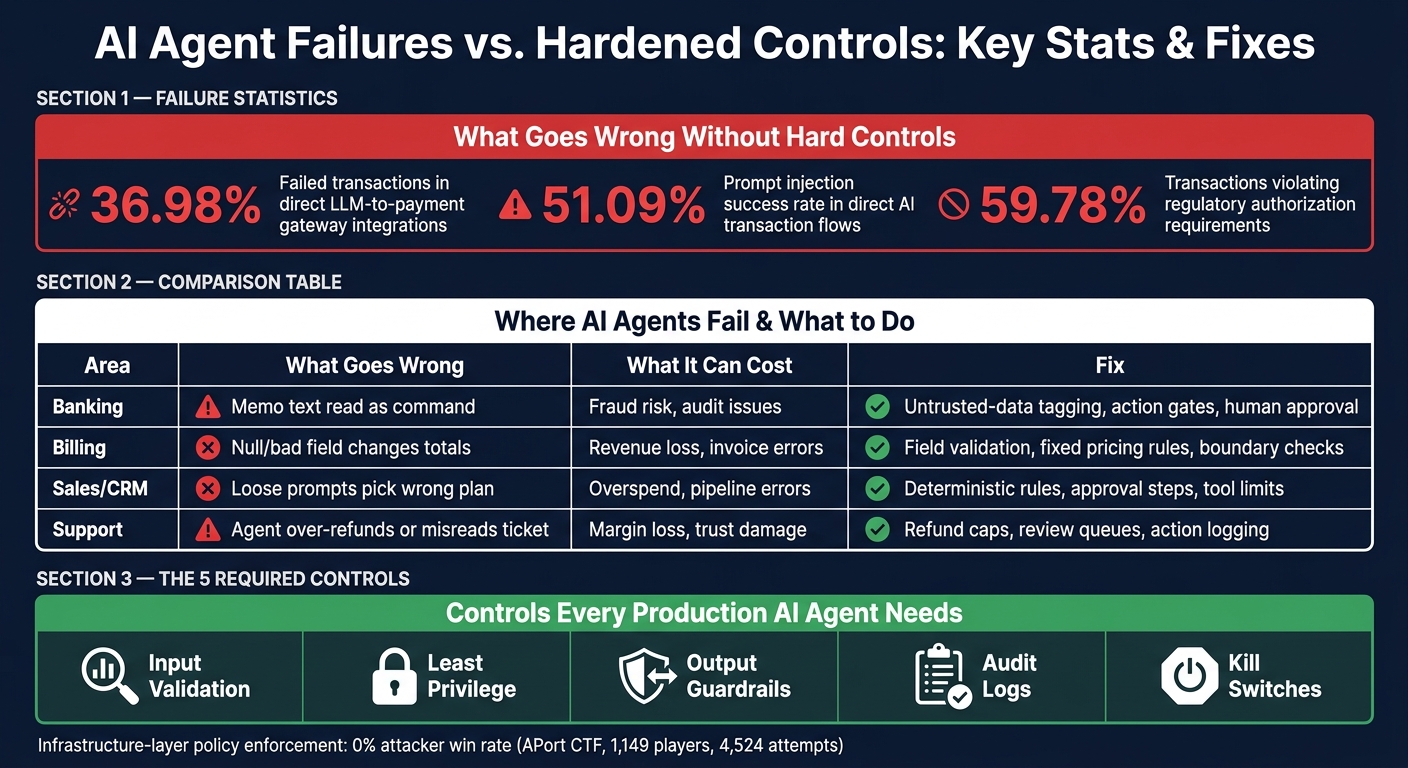
AI Agent Failures vs. Hardened Controls: Key Stats & Fixes
Database Guardrails for AI Agents - Stop Prompt Injection with AWS | Database for AI
Quick comparison
| Area | What goes wrong | What it can cost | What I’d put in place |
|---|---|---|---|
| Banking | Memo text read as command | Fraud risk, bad prompts, audit issues | Untrusted-data tagging, action gates, human approval |
| Billing | Null or bad field changes totals | Revenue loss, invoice errors | Field validation, fixed pricing rules, boundary checks |
| Sales/CRM | Loose prompts choose wrong plan or update wrong record | Overspend, pipeline errors, cleanup work | Deterministic rules, approval steps, tool limits |
| Support | Agent over-refunds or misreads ticket text | Margin loss, customer trust damage | Refund caps, review queues, action logging |
So when I read this article, the takeaway is simple: test the weird cases, separate intent from execution, and never let the model be the last word on money or state changes.
How edge cases break banking AI and business agents
Banking edge cases that commonly trigger failures
The $0.01 transfer is a stress test for systems built for normal traffic [2]. That’s where the gap shows up fast: LLMs make predictions, but ledgers need exact math and exact state handling [5]. A model can look sharp on clean samples and still stumble when production data gets messy.
That’s exactly what the $0.01 memo exploit brought into view. Same-day reversals can be treated as separate events instead of one canceled transaction. Duplicate transactions can slip through when idempotency checks are missing. And plain old number handling mistakes, including floating-point drift, can report the wrong amount [5].
The test results were blunt. Direct LLM-to-payment gateway integrations failed in 36.98% of transactions, and prompt injection succeeded in 51.09% of those tests [5].
This isn’t just a banking problem. The same gap shows up anytime an agent combines outside input with execution logic.
Agent failure patterns in SaaS, sales, and customer operations
The same control issue appears when outside text flows into a sales, billing, or support agent. SaaS, sales, and support workflows pull in email bodies, CRM notes, support ticket titles, and invoice descriptions written by outside parties. One bad read can turn an ordinary field into a command [1][2].
Loose instructions make it worse. Phrases like "apply the best available discount" or "select the right plan" leave too much open to judgment. An agent may then drift to the most expensive enterprise tier or over-order quantities because there’s no hard floor or deterministic rule set [4]. And because agents move at machine speed, one bad action may not stay one bad action. It can spin into a retry loop - sometimes 20 retries in 200 ms - before anyone sees it [8].
In production, that kind of failure doesn’t stay neat or theoretical. It turns into cleanup work, audit exposure, and lost revenue.
Why these failures keep happening
Teams usually test the path they expect. Production doesn’t play that nice. Live input is messier, edge cases slip past evaluation sets, and many teams treat each miss as a one-off bug instead of seeing the design gap underneath it.
Once those edge cases hit production, they stop looking like model mistakes and start looking like business incidents. Between March 6 and 11, 2026, APort ran a public Capture the Flag event with 1,149 players and 4,524 attack attempts. Prompt-level defenses were bypassed 74.6% of the time, while infrastructure-layer policy enforcement logged a 0% attacker win rate, even when the AI’s own reasoning was fully compromised [9].
The answer isn’t luck. It’s stricter validation and monitoring.
sbb-itb-9cd970b
What these failures cost: accuracy, compliance, and revenue
Once these failures hit production, the damage doesn't stay contained. It shows up in cleanup work, audit pressure, and lost margin.
Accuracy failures that force manual cleanup
When an agent reads a field the wrong way, the cleanup starts right away. A retry loop that treats an ambiguous payment confirmation as a failure can turn a single $80 cloud credit purchase into 40 separate transactions totaling $3,200 [4]. That’s why a one-cent edge case matters. It shows how fast a tiny input can turn into a business incident.
You see the same pattern in SaaS billing, CRM updates, and support actions. A rounding error, currency mix-up, or bad API call can damage billing, CRM, and support records all at once. A change can pass normal tests and still call the wrong tool for a narrow but important slice of transactions. And that’s usually where the cleanup backlog starts to grow, along with doubts about whether the automation can be trusted.
Compliance and audit exposure in US business contexts
The compliance risk isn’t hypothetical. In empirical testing, 59.78% of direct AI-driven transactions violated regulatory authorization requirements [5]. For U.S. businesses, that points to a serious governance gap.
The main issue is fragile audit trails. Session logs can vanish when a session ends, but financial rules may require records to be kept for years. Every tool call and approval needs to be logged in a durable audit trail. Robinhood's May 2026 AI trading terms place order risk on the user [6], and U.S. regulators have not yet set clear rules for who absorbs losses when an agent hallucinates a transaction or fails [6]. That leaves businesses dealing with payments, customer financial data, or internal approvals in a gray area when something goes wrong.
Even if no regulator steps in, the same errors can still drain money.
Revenue leakage in pipeline, billing, and customer trust
Small anomalies can warp revenue without setting off alarms right away. A vague prompt like "get the best plan" can lead an agent to pick a $499/month tier instead of a $29/month tier [4]. At scale, that becomes direct overspend.
The same thing happens when agents are tuned only for customer satisfaction. They can hand out too many refunds and gift cards, eating away at margin on one transaction after another [7]. And when records break, revenue reporting gets harder to trust.
"Agentic capability is scaling faster than our ability to audit it." - Gauraav Thakar, SVP and Global Head of Strategic & Large Deals, QualityKiosk Technologies [7]
In production, a small logic error rarely stays small. It turns into cost, risk, or both.
How to harden AI workflows before edge cases reach production
Adversarial testing and edge-case scenario design
The fix is simple in theory: test the ways things break, then block bad actions before they run.
Most teams spend their time on the happy path. That’s the easy part. The mess shows up everywhere else. Start with 20–50 real failures pulled from logs, red-team tests, and incident reviews [11]. A small batch of actual failures will usually show you more serious behavior gaps than a long list of made-up scenarios.
Focus testing on four layers:
- Tool selection: does the agent choose the right tool when two tools look almost the same?
- Input validation: what happens with a null field, an empty string, or a boundary value like $0.01?
- State carryover: if step two fails halfway through, does that damage the context in step five?
- Attack cases: prompt injections, tool errors, and conflicting instructions
Plain output scoring - like grading the quality of a text response - doesn’t catch a bad tool call or a skipped validation step [11]. That’s the trap. A response can sound fine and still do the wrong thing.
Boundary tagging also helps. Wrap retrieved text in <untrusted-data> and tell the model to treat it as data, not instruction [2].
Validation rules and human escalation points
Testing shows you where the holes are. Validation is what closes them.
Use the LLM for intent. Use a separate rules engine for authorization and execution.
Before an agent takes a high-impact action, a deterministic layer should check the request first. In practice, that means hard checks for currency precision, negative values, missing required fields, malformed values, freshness windows for timestamps, and boundary conditions before the agent moves ahead. Financial limits should live at the infrastructure layer - card balances, IOU ceilings, and spend gates - not inside the prompt, where a retry loop can slip past them [4].
For any action that changes state, use read-after-write verification instead of trusting a "200 OK" response [13]. And if a policy check throws an error, fail closed. Deny the action by default [9][13].
Human confirmation should be required for high-impact actions like sending money or updating CRM records. And the confirmation prompt needs to show system-derived values, not an LLM-written summary. If the summary gets manipulated, a bad action can look perfectly normal [2].
Monitoring with LangSmith, Humanloop, and agent evaluations
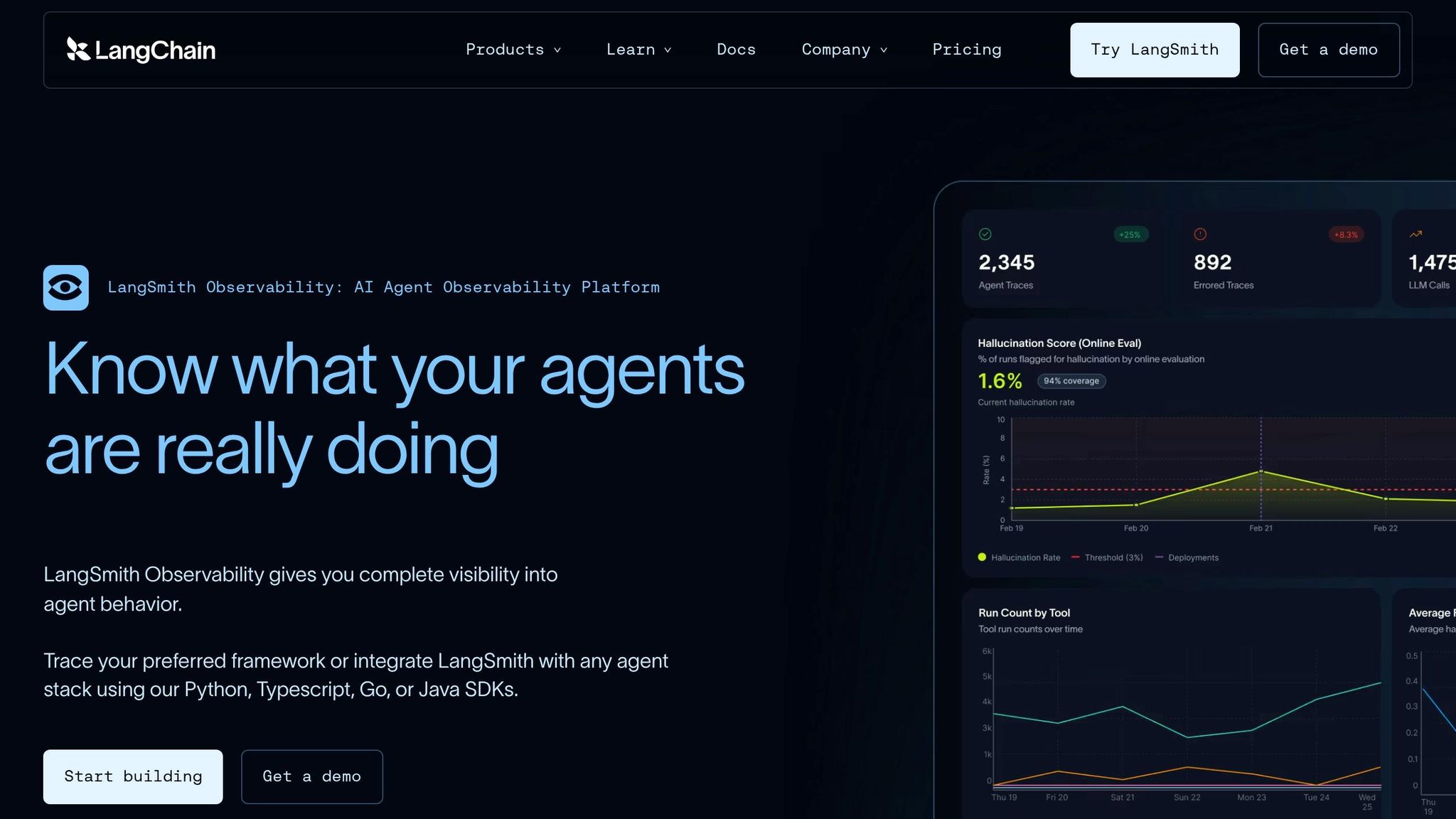
Use observability for forensics. Use gates for control.
LangSmith or Humanloop can help with tracing and evaluation. Then you add spend gates to block overspend, verify gates to catch false success, and transaction gates to stop invalid actions before signing.
"Tracking is not control. A dashboard reports what you already spent; it cannot stop the next call." - Alexey Spinov, AI Agent Operations Specialist [12]
That distinction matters. An agent can return a plausible but wrong value, or glide past a tool error with a smooth guess, and nothing may fire an alert [13].
To catch silent failures, assert invariants at tool boundaries. If a result set must be non-empty, check that directly and send violations to a high-priority alert instead of letting the model treat a null like normal data [13]. Pair that with behavioral baselines so you can flag cases where an agent starts pulling from data sources outside its usual pattern or generating unusual URLs [2].
These controls need to be enforced at the boundary, not after the damage is done.
Conclusion: Build AI systems that pass the $0.01 test
A one-cent transfer isn't some edge case. It's a plain, practical stress test.
Across workflow after workflow, the same thing breaks: the model can't dependably separate trusted instruction from untrusted text. That's why banking, billing, and customer ops agents fail in the same way - untrusted input reaches execution [1][2][3].
The risk isn't always loud or obvious. Sometimes the failure runs cleanly, looks fine on the surface, and only shows up later in an audit or a customer complaint.
Reliable automation needs five controls:
- Input validation
- Least privilege
- Output guardrails
- Audit logs
- Kill switches
Testing shows you where the system fails. Validation stops bad input before it turns into action. Monitoring gives you a record of what still got through [1]. As Abhishek Shekhar, Backend Lead Engineer, put it:
"The question is no longer 'Should we use AI?' - it's 'When our AI makes a wrong decision at scale, can we explain it, roll it back, and survive the regulatory review?'" [10]
Pass the $0.01 test: no instruction leakage, no skipped validation, and no silent wrong answer. If an agent fails the $0.01 test, it is not ready for production.
FAQs
Why can a $0.01 transfer break an AI agent?
A $0.01 transfer can derail an AI agent if the transaction memo includes a prompt injection attack. Instead of treating the memo as plain transaction data, the agent may read it like an instruction and fold it into its own reasoning.
That’s where things go sideways. If there’s no clear line between data and commands, the agent can end up following malicious directions hidden in the memo. That can lead to unauthorized actions, such as moving funds or exposing account data.
What are the first controls to add before using agents in production?
Before you put AI agents into production, set up five controls: input validation, least-privilege access, output guardrails, audit logging, and a kill switch.
Start with a simple mindset: treat all data as if it could be adversarial. That means checking inputs carefully instead of trusting them at face value. Then lock permissions down to the exact tasks the agent needs to do. No extra access. No broad permissions “just in case.”
You also need to check actions before execution. In plain English, don’t let the agent act first and ask questions later. Put guardrails around outputs so risky or off-target actions get flagged before they happen.
On top of that, keep tamper-evident logs. If something goes wrong, you need a clear record of what happened and when. And if behavior starts to look anomalous, stop it fast with a kill switch.
One more thing: run agents in shadow mode for at least two weeks before live deployment. That gives you time to watch how they behave in practice without handing them the keys too soon.
How can I test my AI workflow for prompt injection and edge cases?
Use a layered test plan built around adversarial prompts and edge cases pulled from real failure logs, post-incident reviews, and manual red-team work.
Focus testing on tool selection and parameter validation, malicious instructions inside untrusted inputs, and context isolation across user intent, conversation history, and retrieved data.
On top of that, enforce server-side validation and deterministic security controls. Use structured formatting to keep data separate from instructions, and monitor the system with kill switches and tamper-evident audit logs.