32. The Toll Booth Moved from Attention to Intention. PE Spotted It First.

- From Attention to Intention: Businesses are moving away from engagement-based models (clicks, impressions, screen time) to outcome-focused models that prioritize user intentions like "close the books" or "resolve this ticket."
- AI's Role: AI tools now execute tasks autonomously based on user commands, reducing reliance on traditional dashboards and interfaces.
- Private Equity's Early Move: While public markets hesitated, private equity firms identified this trend early, investing heavily in platforms that deliver outcomes, not just engagement.
- Key Metrics Evolve: Success is now measured by outcomes (resolutions, tasks completed) rather than inputs (clicks, hours). For example, tools priced above $250/month with deeper integration show 70% retention rates versus 23% for lower-tier tools.
- New Pricing Models: Subscription-based pricing is being replaced by outcome-based pricing models, reflecting the value delivered rather than time spent.
Why it matters: The intention economy is reshaping how software is built, priced, and valued. Companies that focus on delivering results - rather than just grabbing attention - are positioned to thrive.
Quick Tip: Start by analyzing your high-intent signals (e.g., demo requests, pricing page visits) and rethinking workflows to prioritize outcomes over engagement. Private equity firms are already capitalizing on this shift. Are you ready to follow suit?
Attention vs. Intention: What Changes in Business Models
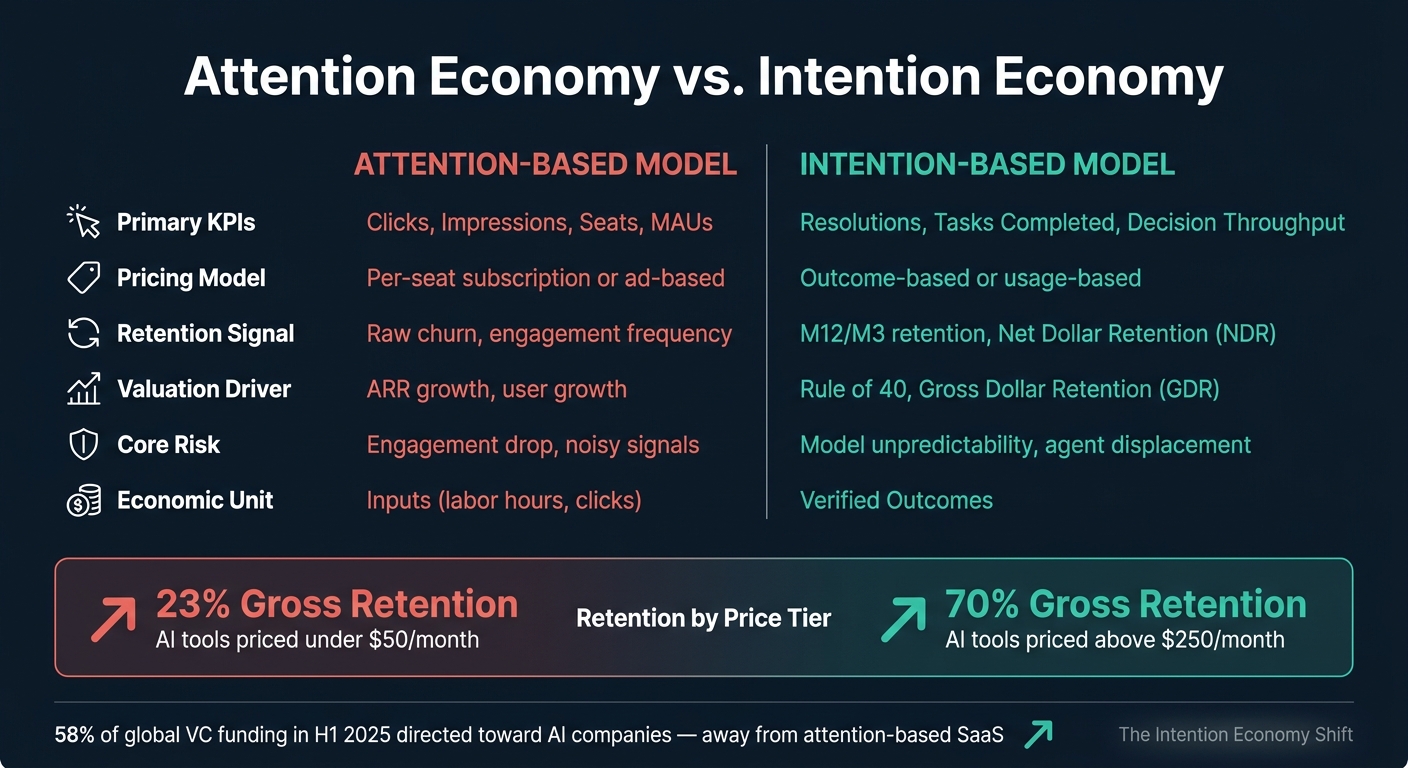
Attention Economy vs. Intention Economy: Key Metrics & Business Model Differences
Defining Attention-Based and Intention-Based Models
Attention-based business models focus on selling visibility - things like clicks, impressions, or seat licenses. In contrast, intention-based models revolve around fulfilling specific goals for users.
"The attention economy asked, 'How do we keep people looking?' The intention economy asks, 'What are people about to do, and how can we shape it?'" - Chris Kalaboukis, Author [5]
In the SaaS world, traditional models emphasize the user interface as the core value. But with intention-based models, the focus shifts to delivering outcomes seamlessly. For instance, an AI orchestration layer could interpret intent signals like "Close the books" or "Identify churn risk" and execute these tasks autonomously. The tool operates in the background, while the user sees the results upfront [1].
This isn’t just a tweak in how tools look or feel - it’s a complete overhaul of how and where value is generated and captured. This shift also impacts revenue metrics and risk dynamics in profound ways.
Revenue and Risk: Attention vs. Intention by the Numbers
The financial implications of these two models are starkly different, with intention-based approaches rapidly gaining ground. By the first half of 2025, 58% of global VC funding (and 64% in the U.S.) was directed toward AI companies, signaling a major shift away from traditional attention-based SaaS models [3]. At the same time, SaaS EBITDA multiples fell from a peak of 25× to a baseline of 15×, reflecting growing doubts about engagement-driven, seat-based revenue streams [3].
"The digital economy is shifting from selling inputs (clicks, hours) to delivering verified outcomes." - Stepan Gershuni, cyber•Fund [4]
Here’s a breakdown of the key differences between attention-based and intention-based models:
| Metric | Attention-Based Model | Intention-Based Model |
|---|---|---|
| Primary KPIs | Clicks, impressions, seats, MAUs | Resolutions, tasks completed, decision throughput |
| Pricing model | Per-seat subscription or ad-based | Outcome-based or usage-based |
| Retention signal | Raw churn, engagement frequency | M12/M3 retention, Net Dollar Retention (NDR) |
| Valuation driver | ARR growth, user growth | Rule of 40, Gross Dollar Retention (GDR) |
| Core risk | Engagement drop, noisy signals | Model unpredictability, agent displacement |
| Economic unit | Inputs (labor hours, clicks) | Verified outcomes |
One striking metric highlights the difference: AI tools priced under $50/month show just 23% gross retention, while those priced above $250/month achieve 70% [9]. This disparity isn’t about users being more sensitive to price at lower tiers. Instead, it reflects the depth of outcomes. Higher-priced intention-driven tools are deeply integrated into workflows, delivering tangible results that make them indispensable. On the other hand, attention-based tools are often the first to be cut when budgets tighten.
How Private Equity Spotted the Shift First
Private equity firms were quick to adapt as the intention economy began to take shape. They shifted their focus from surface-level engagement metrics to transaction-based validation. Why? Because while metrics like clicks and impressions can be manipulated, transaction data paints a much clearer picture. As Jack Dorsey and Roelof Botha aptly put it, "Money is the most honest signal in the world... Every transaction is a fact about someone's life" [2].
Another early indicator was the widening valuation gap in the SaaS market. By 2025, the average SaaS multiple had stabilized around 15× EBITDA. However, this figure concealed a split market. On one side were premium assets with proven AI integration and strong retention, commanding significantly higher valuations. On the other were engagement-driven tools, which saw their valuations drop. Private equity firms that understood this divergence were the first to act.
How PE Firms Read Intention Signals
Private equity due diligence has evolved, with retention and efficiency metrics now taking center stage. For example, a Gross Dollar Retention (GDR) of at least 85% is now seen as the baseline for a credible SaaS investment [8]. Similarly, a Rule of 40 score - measuring the balance between revenue growth and EBITDA margin - needs to exceed 40 to pass the initial filter. These metrics help identify whether a product is genuinely integral to a user’s workflow or just another tool people engage with casually.
Another key insight is the distinction between two types of AI integration. "Strategic" AI is embedded into a product's core functionality, improving with use and creating a proprietary data moat. In contrast, "performative" AI, like a chatbot tacked onto an interface, has become a basic expectation rather than a competitive edge [3]. By focusing on the former, private equity firms have refined their approach, setting the stage for targeted investments in the intention-driven market.
PE Investment Patterns in Intention-Driven SaaS
Armed with these refined metrics, private equity firms have shifted their investment strategies. In 2024 alone, they completed over 300 SaaS acquisitions worth a combined $130 billion [6]. Instead of targeting standalone tools, firms are now executing vertical roll-ups - acquiring multiple adjacent tools within a single industry and merging them into unified platforms. This approach allows them to own high-intent workflows from start to finish, raise prices by 15–30%, and eventually exit at premium multiples [6].
A standout example is Hg Capital’s acquisition of OneStream in March 2026. The firm paid $6.4 billion - at a 22× revenue multiple - for a financial operations platform used as the system of record by Fortune 500 finance teams. Hg Capital justified the premium by citing "data gravity", where workflows are so tightly integrated with OneStream’s data that switching becomes nearly impossible. As they put it, "Software that eliminates manual processes entirely commands higher multiples than software that makes manual processes faster" [12].
These deals highlight how focusing on intentional outcomes leads to higher valuations in a market that increasingly rewards consolidation.
| PE Firm | Deal / Portfolio Company | Strategy | Key Outcome |
|---|---|---|---|
| Hg Capital | OneStream (March 2026) | AI-driven financial system of record | $6.4B acquisition at 22× revenue [12] |
| Thoma Bravo | Verint Systems (August 2025) | AI-powered CX platform consolidation | $2B deal; 50% of ARR from AI [11] |
| General Catalyst | Long Lake | AI-enabled HOA management roll-up | $100M EBITDA in under 2 years [13] |
| Thrive Capital | Crete Professionals Alliance | AI-enabled accounting firm roll-up | $300M+ revenue; 30+ firms acquired [13] |
32 Ways the Toll Booth Moved from Attention to Intention
Private equity investment trends are revealing a shift in how value is created in SaaS and AI. These changes are reshaping strategies across go-to-market approaches, data tools, and pricing structures. Here's a breakdown of 32 ways this transformation is happening, grouped by its most visible effects.
Go-to-Market and Positioning Shifts
The traditional playbook for go-to-market strategies focused on grabbing attention. Now, success depends on engaging prospects with the right context at the right time. Consider this: 70–80% of B2B buyers are already deep into their decision-making process before contacting a vendor, and 94% of buying groups have a shortlist of vendors before the first sales call even happens [16].
- Focusing on high-intent accounts instead of volume-based leads. Teams using three correlated signals (e.g., pricing page visits, competitor trends, or a new "Head of Revenue Operations" job posting) report 25–35% higher conversion rates and 30–40% shorter sales cycles [16][17].
- Replacing generic persona-based outreach with signal-based strategies. Instead of cold emails to a "VP of Sales", reps now use specific triggers, like a CEO mentioning "GTM efficiency" on an earnings call [16].
- Embedding tools directly into decision-making processes. Tools that integrate seamlessly into workflows become indispensable.
- Optimizing content for AI search. With 29% of buyers starting their research on platforms like ChatGPT, companies are adapting content to be both human- and AI-readable [20].
- Targeting the "hidden buyer." Stakeholders in finance, IT, and security are influencing deals, even though 71% of them never interact with sales. Tailored content for these groups is now essential [20].
- Building trust as a top-of-funnel strategy. With 61% of B2B buyers preferring a rep-free experience, credibility through self-serve education and independent validation is vital [20].
- Responding to intent signals quickly. Timing is critical - pricing page visits should get a follow-up within 2 hours, and demo requests within 24 hours [17].
- Using AI agents to close deals. Companies like 1mind are leveraging AI not just for prospecting but also for conducting demos and presentations [18].
- Consolidating vendor lists around platforms with embedded AI. Enterprises are streamlining their software stacks, choosing platforms that deliver clear ROI over fragmented tools [21][3].
- Conducting security reviews earlier in the buying process. Shifting these reviews to the start of evaluations reduces friction later [21].
- Allocating 4–6% of ARR to AI tools for go-to-market efforts. High-growth SaaS companies investing at this level are seeing 15–20% faster sales cycles [19].
These shifts in positioning are paving the way for a deeper integration of AI tools that act on intent with precision.
Data and AI Tools That Act on Intention
While go-to-market strategies evolve, AI tools are stepping up to execute on intent signals more effectively. It’s not enough to identify intent - systems must act on it quickly and accurately. The best tools convert raw behavioral data into actionable insights.
"Data is a burden you give someone to solve. Understanding is a gift you give someone to take action." - Mario Ciabarra, CEO, Quantum Metric [2]
- Combining first-party, third-party, and contextual signals. Effective intent stacks unify data like website behavior, review site activity, and job postings into a single confidence score [16][17].
- Prioritizing signals by urgency. Teams categorize signals into tiers: Tier 1 (respond within 2 hours), Tier 2 (respond within 48 hours), and Tier 3 (nurture for later) [16][17].
- Precomputing context for immediate action. Tools like Felix Agentic turn raw data into structured insights, enabling instant AI responses to critical issues, such as an API timeout causing a $47,000/day revenue loss [2].
- Monitoring AI shopping agents. Platforms like ChatGPT and Perplexity are browsing product sites on behalf of buyers, prompting companies to optimize these interactions [2].
- Automating signal tracking to save time. Salesmotion reduced research time from 3 hours to 15 minutes per account, increasing qualified pipeline by 40% year-over-year [16].
- Deploying AI for back-office tasks. Pacaso used Qurrent-powered AI to automate marketing and property maintenance, scaling engagement without adding headcount [7].
- Creating autonomous systems that replace manual tasks. Synera's agents handle engineering design, simulation, and validation, delivering ready-to-use product designs [14].
- Measuring success by task completion, not app usage. As AI takes over workflows, success is judged by outcomes, not time spent in an app [14][1].
- Driving adoption through proven value. Dash0 launched "Agent0", achieving 90% customer adoption for automated system monitoring within two months [14].
- Shifting value to orchestration layers. Platforms like Microsoft Copilot and Salesforce Einstein focus on outcomes rather than user navigation [1].
- Cutting labor costs with AI execution. Klarna’s AI assistant managed 2.3 million customer service interactions in its first month, equivalent to the workload of 700 full-time agents [1].
These advancements in AI are reshaping not only workflows but also how businesses approach pricing.
Pricing and Monetization Built Around Intention
As AI agents transform workflows, SaaS pricing models are being replaced by ones that reflect actual usage and outcomes.
- Moving from seat-based to usage-based pricing. By 2026, over 60% of AI spend will focus on API calls and fine-tuning rather than seat licenses [19].
- Pricing relative to human labor costs. For example, if a task costs $1,500 manually, an AI agent might handle it for $750 [15].
How SaaS and AI Businesses Can Make the Shift
Shifting from chasing attention to capturing intention is a game-changer for SaaS and AI businesses. Here's how you can prepare to align with genuine buyer intent.
Auditing Where You Stand Today
Before diving into action, it’s crucial to understand the signals you already have. Many SaaS companies rely too heavily on attention metrics, overlooking the more telling signals that reveal true buying intent.
Start by evaluating your highest-value pages - these are your Tier 1 intent surfaces. Pages like pricing, case studies, ROI calculators, and comparison pages often hold the most actionable insights. Next, study user behavior on these pages. Look for patterns like repeated visits, pauses on specific sections, or sequences of actions that differ from a user’s historical activity. The key here is to measure how a user’s current behavior deviates from their own past behavior, rather than comparing them to a general audience. This approach provides a much clearer picture of intent [23].
The goal isn’t to create a flawless system right away but to stop treating all traffic equally. Once you’ve identified key intent signals, you can move on to quantifying them.
Where to Focus First
Once you’ve pinpointed your intent surfaces, the next step is to refine your approach with a scoring model. Start simple: assign point values to high-intent actions. For example, +10 for a demo request or +5 for a pricing page visit. Apply decay logic to keep the focus on recent activity - like setting a 7-day window for a pricing page visit to remain relevant. This ensures your scoring model reflects fresh intent, not outdated interest [22].
Automation is your best friend here. Automate your scoring model to trigger immediate follow-ups for Tier 1 signals. This can significantly boost pipeline velocity. In fact, intent-qualified opportunities move 30–50% faster through the pipeline, and being the first vendor to engage often gives you a major edge [23].
As your scoring system evolves, shift your focus from account-level to individual-level signals. Instead of just knowing a company is researching your product, aim to identify the specific decision-maker, such as a VP or Director, and understand their pain points. This level of precision can lead to a 42% higher conversion rate compared to account-level intent alone [23].
Roles, Governance, and Long-Term Upkeep
Transitioning to an intention-based model requires some organizational adjustments. Someone must take ownership of the signal stack. Enter the data steward - a dedicated role responsible for monitoring signal quality, managing decay rules, and ensuring your first-party data is properly integrated across your website and product.
Collaboration across teams is also essential. Sales, marketing, and product teams should operate under a unified intent data layer. Companies excelling in this space often have revenue operations teams acting as the glue, ensuring intent signals translate into coordinated actions rather than siloed efforts.
Finally, it’s important to differentiate between strategic AI and performative AI. Simply adding a chatbot to your homepage? That’s performative. Building a proprietary intent model trained on your customer data? That’s strategic. Such a model improves over time, creating a strong competitive advantage and standing up to scrutiny during valuation discussions.
As Jensen Huang, CEO of NVIDIA, puts it: "The canonical use case of the future is a large language model on the front end of just about everything. That large language model will figure out what is your intention, what is your desire" [24]. This strategic approach not only strengthens your competitive edge but also aligns with the broader value shifts discussed earlier.
Conclusion: Making the Move to the Intention Economy
The main takeaway here is straightforward: the toll booth has shifted. Value no longer lies in simply grabbing someone’s attention - it’s now found in acting on their intent. Private equity firms recognized this shift early, adjusted their strategies, and are already seeing the benefits. This move from attention to intention is shaping the future of SaaS and AI, and it’s time to rethink your own approach to align with this new model of value creation.
Today, success comes from delivering results quickly. Businesses are shifting away from chasing sheer user numbers and focusing instead on meeting immediate customer needs.
This also means traditional metrics need an upgrade. It’s not about counting seats or page views anymore. The real metrics now measure work done, outcomes achieved, and the impact on businesses. For instance, Salesforce reported an impressive 771 million Agentic Work Units in a single quarter back in May 2026 - a 57% increase from the previous quarter [25]. That’s a prime example of how intention-driven reporting looks in action.
To adapt, focus on actionable steps rather than waiting for the perfect plan. Start by evaluating your current processes, building a straightforward scoring model, rethinking workflows instead of just piling on more tools, and centralizing your data so AI can actually deliver results. The companies that hesitate, waiting for absolute certainty, risk falling behind.
"You don't need a perfect strategy. You just need to be the one driving things forward, not waiting for your portfolio companies to do it for you." - Nik Kapauan, Access Holdings [10]
The intention economy isn’t some distant trend; it’s already shaping how the fastest-growing SaaS and AI companies operate. The real question isn’t whether to adapt - it’s how fast you can shift from selling features to delivering solutions.
FAQs
What’s the difference between attention and intention in SaaS?
In the SaaS world, attention is all about grabbing users' interest - making them notice and interact with a product. Intention, however, digs deeper. It’s about aligning with what users want and need, steering them toward decisions that matter. This shift toward intention emphasizes understanding user goals and shaping behavior to deliver long-term value, particularly when it comes to AI-powered tools and strategies.
Which signals best predict real buying intent?
The most reliable signs of genuine buying intent come from patterns of active research or evaluation. For instance, multiple interactions within a short timeframe - like three or more signals over 14 days - paired with triggers such as hiring or adopting new technology, are strong indicators. On the other hand, single actions, like visiting a website or downloading content, are less telling when compared to consistent, engaged behavior.
How do you price software by outcomes without losing revenue?
To price software based on outcomes without sacrificing revenue, it's crucial to align customer payments with the tangible, measurable results your software delivers. For example, outcome-based pricing might involve charging for successful AI-driven resolutions, directly linking your revenue to performance and customer success.
To mitigate risks, consider hybrid pricing models that combine a fixed subscription fee with an outcome-based component. This approach provides a balance of financial stability and performance-based incentives.
The key to success lies in defining clear metrics, accurately tracking outcomes, and ensuring your software consistently delivers results that justify the pricing model.