Product Mentions in Trusted Communities Are Now Demand Signals That Algorithms Reward. Blusteak Are You in Those Conversations?
AI search engines now prioritize product mentions in trusted communities over traditional SEO signals. Platforms like Reddit, Discord, and G2 play a key role in shaping AI-driven recommendations. If your product isn’t actively discussed in these spaces, it risks being overlooked by AI models like ChatGPT and Perplexity.
Key Takeaways:
- Community Mentions Matter: AI models assess volume, sentiment, and source credibility of product mentions in spaces where users seek advice.
- Shift in Visibility Signals: Mentions in niche forums and review sites are 3x more predictive for AI visibility than backlinks.
- Actionable Metrics: Focus on 15–20 mentions across at least five platforms to gain AI recognition.
- High-Impact Communities: Target specific subreddits (e.g., r/SaaS, r/devops), Slack groups, and review platforms like G2.
- Blusteak’s Role: Agencies like Blusteak streamline community engagement and optimize AI visibility through structured placements and monitoring tools.
Why It Matters:
AI search engines trust community-driven insights over self-promotional content. To stay competitive, brands must actively participate in these conversations, ensuring their product is visible where buyers and algorithms look for trusted recommendations.
Brand Mentions for SEO: How to Get Cited by AI (3 Tiers) | 3.2. AEO Course by Ahrefs
How Algorithms Reward Product Mentions in Communities
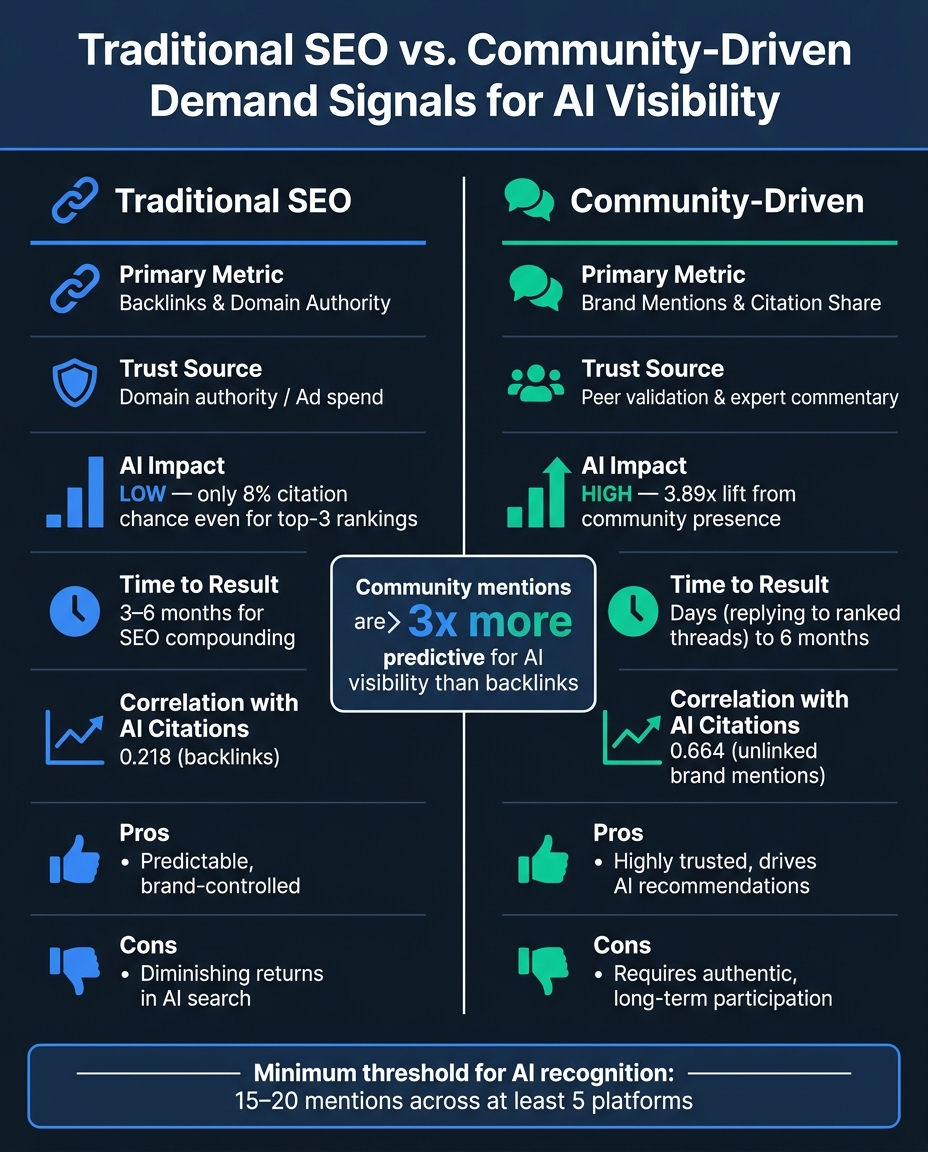
Traditional SEO vs. Community-Driven Demand Signals for AI Visibility
Key Algorithmic Demand Signals
Algorithms evaluate product mentions by looking at volume, sentiment, and trustworthiness. To do this, AI models create a "trust graph", which maps how frequently your brand is mentioned alongside relevant category keywords. Consistent co-occurrence with specific terms strengthens the association. However, sheer volume isn't enough. Mentions that come from personal experiences carry 3.2 times more weight than neutral ones, based on an analysis of over 26,000 ChatGPT citations [2].
Mentions in niche subreddits like r/devops or r/marketing are particularly impactful. Why? Algorithms identify these as practitioner-led spaces where discussions are highly technical and credible [3]. Engagement metrics like upvotes and active thread participation serve as quality signals. A comment with high engagement is seen as more trustworthy. This approach to weighing signals is very different from traditional SEO practices, as shown below.
Traditional vs. Community-Driven Demand Signals
The difference between traditional SEO signals and those driven by community activity is stark. For instance, unlinked brand mentions have a 0.664 correlation with AI citations, while backlinks only correlate at 0.218. This makes community mentions about three times more predictive for AI visibility [8]. On the other hand, even a top-three ranking in traditional search results gives a brand just an 8% chance of being cited in a Google AI Overview [10].
| Signal Type | Traditional (SEO) | Community-Driven |
|---|---|---|
| Primary Metric | Backlinks and Domain Authority | Brand mentions and Citation Share |
| Trust Source | Domain authority / Ad spend | Peer validation and expert commentary |
| AI Impact | Low (8% citation chance for top ranks) | High (3.89x lift from community presence) |
| Time to Result | 3–6 months for SEO compounding | Days (replying to ranked threads) to 6 months |
| Pros | Predictable, brand-controlled | Highly trusted, drives AI recommendations |
| Cons | Diminishing returns in AI search | Requires authentic, long-term participation |
How Graph-Based Algorithms Weight Community Mentions
Graph-based algorithms amplify the value of trusted mentions even further. For platforms like Reddit - with its Domain Authority of 91 - posts and comments can gain significant ranking power almost instantly [12]. These algorithms apply PageRank-style logic to community interactions. A well-upvoted thread on a high-authority platform doesn’t just reach human readers - it becomes a key input for AI retrieval systems.
"Reddit mentions are the new backlinks for AI search." - Axel Schapmann, RedShip [9]
AI models also use community detection to find clusters of related conversations. For example, if practitioners consistently describe your product in similar ways across platforms like Reddit, GitHub, and G2, the algorithm interprets this as a stable and reliable signal [3]. A single high-authority blog post can't replicate this effect. To be recognized as a viable category option by AI, your product typically needs 15–20 mentions across at least five different communities [9]. Without this threshold, your product may not even register as a consensus choice.
How to Find and Evaluate Trusted Communities
Finding High-Value Communities
When it comes to SaaS and AI tools, the best communities are those where buyers are actively seeking advice and making inquiries. These spaces are more impactful than large, unfocused groups where discussions are too broad. Take Reddit, for example. With 1.7 billion monthly active users across over 130,000 active communities [17], it’s a goldmine for targeted engagement. Plus, platforms like Google and OpenAI have struck data licensing deals with Reddit, meaning discussions there directly influence AI models [1][13]. A single mention in the right subreddit can carry far more weight than a generic post in a massive group.
"The highest-ROI subreddits are rarely the biggest ones. A 60K community with active tool inquiries outperforms a 2M community with general chatter." - Zoha Ahmed, Reddit Certified Partner, Skip the Noise Media [14]
For SaaS and AI tools, subreddits like r/SaaS, r/sales, r/devops, r/dataengineering, and r/PPC are worth exploring [14]. Beyond Reddit, LinkedIn is another treasure trove, with its 1 billion members and a strong 16.2% organic engagement rate [17]. Developer-focused tools should also look at GitHub Discussions or Hugging Face, which have become essential discovery platforms [18].
If you’re looking for niche, semi-private communities, tools like Slofile (for Slack groups) or Disboard (for Discord servers) can help you zero in on vertical-specific spaces [16]. Additionally, specialized directories like Top SaaS & AI Tools Directory are modern-day "best-of" lists. These directories are increasingly influential as AI search engines rely on them to generate tool recommendations [1][18]. With the number of new AI tools climbing from 200 per month in early 2023 to over 1,000 per month by Q1 2026 [18], standing out in these curated spaces is becoming more critical. Once you’ve identified promising communities, the next step is evaluating their true value.
How to Qualify a Community
Finding a community is just the first step - it’s equally important to ensure it’s worth your time. Audience size alone doesn’t tell the full story. What really matters is whether buyers are asking intent-driven questions like, "What tool do you use for X?" or "Is there a better alternative to [product]?" These types of posts often appear within 72 hours of a purchase decision [17], making them prime opportunities for engagement.
Another key factor is moderation quality. Communities with strong moderation - such as well-managed subreddits - tend to filter out spam, which increases credibility both for users and AI models [1][11]. Before diving in, do a quick scan of the community. Look for recurring buyer questions and note the types of answers that gain traction or use tools to automate keyword replies [16]. It’s also smart to check whether the community is frequently cited by tools like ChatGPT or Perplexity. If it pops up in AI-generated responses for your product category, it’s already influencing the models you want to target [10][11].
Public vs. Semi-Private vs. Review-Based Communities
Different types of communities serve different purposes, and each plays a unique role in shaping your visibility strategy. Public forums are ideal for building broad AI training signals, while semi-private groups excel at fostering trust through peer-to-peer recommendations. Review platforms, on the other hand, provide structured feedback that AI uses to compile "best tools" lists.
| Community Type | Examples | Accessibility | Participation Ease | Signal Strength | Best For |
|---|---|---|---|---|---|
| Public | Reddit, Hacker News, Quora | Open to all | Moderate (requires account history) | Very High | AI citation frequency and topical authority [1][17] |
| Semi-Private | Slack groups, Discord, RevGenius | Invite or app required | High (peer-to-peer) | High | Direct lead generation and GTM intelligence [13][15] |
| Review/Listing | G2, Capterra, Top SaaS & AI Tools Directory | Publicly viewable | Easy (customer-driven) | High | Inclusion in AI-generated "best tools" recommendations [1][18] |
For example, platforms like G2 are frequently cited in AI-generated SaaS responses. Securing at least 10 reviews on G2 can often trigger consistent mentions by AI tools [1]. By combining these community types, you create a multi-layered presence that AI algorithms interpret as reliable and consensus-driven.
How to Build a Community Mention Strategy That Works
A Step-by-Step Framework for Generating Mentions
Once you've identified the communities that matter to your audience, the next step is to establish a consistent and credible presence. Avoid spamming your product name - focus instead on building trust and creating a strong presence across multiple platforms. This helps AI models recognize your brand as a go-to option.
Start by pinpointing the exact buyer queries that AI tools prioritize, such as "best [category] tool" or "alternative to [competitor]." Then, investigate which Reddit threads, listicles, or forums tools like Perplexity or ChatGPT currently reference for answers. The gap between where your competitors are mentioned and where you're absent becomes your roadmap. From there, leverage key executives with active LinkedIn profiles to engage in these discussions. Personal accounts often carry more weight in community threads than branded handles.
When participating, stick to the 80/20 rule: dedicate 80% of your effort to genuinely helping - offering solutions, answering questions, or sharing templates - and only 20% to mentioning your product when it naturally fits [16]. This method turns community engagement into actionable AI demand signals. The key is specificity. As Axel Schapmann of RedShip explains:
"If your only mention is 'this tool is great,' the answer is no. If it's 'monitors Reddit in real time, scores by intent... starts at $29/month,' the answer is yes. AI tools cite the latter." - Axel Schapmann, RedShip [9]
Aim for 15–20 mentions across at least five platforms to create a consensus signal for AI models [9]. Broad, vague praise won't cut it - specific features, pricing, and use cases are what get noticed.
If building this presence feels daunting, consider how agencies like Blusteak can speed up the process.
How Agencies Like Blusteak Can Help
While it's possible to manage this strategy in-house, it can be time-consuming and easy to push aside. Agencies like Blusteak specialize in streamlining your brand's presence on platforms that AI models prioritize, such as community threads, listicles, expert quote platforms, and structured directories [23].
Blusteak goes beyond just content creation. They handle the technical aspects too, like optimizing for natural language processing (NLP), implementing FAQ and HowTo schema, and testing AI responses to your brand using tools like ChatGPT and Claude before launching content [23]. For example, one of their clients, a leading online pharmacy, saw a 50% boost in organic traffic and doubled the quality of leads within four months by targeting AI queries and building third-party authority [23]. As Blusteak puts it:
"SEO gets you on page one. GEO gets you chosen as the answer." - Blusteak [23]
Costs for in-house outreach range from $100–$300 per month, while agency placements average $500 per mention [20]. For early-stage SaaS teams, a hybrid approach often works best: use an agency for structured placements and have founders or key team members focus on community threads.
Organic, Team-Driven, and Structured Mention Types Compared
Not all mentions are created equal. Each type has its own benefits, challenges, and level of effort. Here's a quick breakdown:
| Mention Type | Benefits | Risks | Complexity |
|---|---|---|---|
| Organic | Builds trust and strong AI consensus [9] | No control over messaging; slow to develop [5] | High - relies on genuine product quality |
| Team-Driven | High authority; quicker impact [1] | May appear as "astroturfing" if not transparent [9] | Medium - requires consistent team effort |
| Structured | Predictable, permanent, machine-readable [19] | Requires budget; subject to editorial review [22] | Low to Moderate - involves setup for directories and outreach |
The most effective strategies combine all three types. Organic mentions from genuine users validate your brand. Team-driven engagement fills gaps and maintains visibility. Structured placements - such as listicles, podcast features, expert quotes, and directory listings - provide the machine-readable signals that AI tools heavily rely on. As Kristiyan Yankov of Above Apex explains:
"The winning frame is a coverage game – 'are we present everywhere our buyers and the AI layer are looking?'" - Kristiyan Yankov, Above Apex [20]
How to Measure and Act on Community Demand Signals
Tools and Methods for Tracking Mentions
Today's monitoring tools go beyond tracking brand mentions - they now use AI to detect buying intent. For instance, Buska (starting at $49/month) scans over 30 platforms 24/7 and assigns each mention an intent score (0 to 100). This helps teams focus on high-priority conversations instead of sifting through raw alerts [7]. Another option, Brand24, monitors more than 25 million public sources and adds emotion detection, allowing you to differentiate between admiration, frustration, or neutral chatter [24]. If you're part of a smaller team, Syften offers keyword alerts starting at $19.95/month, while CommunityTracker ($29/month) specializes in routing signals into GTM workflows by integrating with tools like Notion, ClickUp, and Trello [13].
The key to maximizing these tools is integration. By routing high-intent mentions directly into platforms like HubSpot or Salesforce, your sales team can act on warm leads instead of sifting through unrelated Reddit threads.
"The biggest improvement was not more data. It was knowing which posts were actually worth acting on." - Product Marketing Manager, CommunityTracker [13]
Next, let’s explore how these signals can be tied to measurable business results.
Linking Mentions to Business Metrics
Community mentions often surface on platforms like Slack, Reddit, and Discord, where typical analytics tools fall short. To connect these mentions to business outcomes, you can use strategies like UTM parameters on shared links, CRM referral data, and even a simple "How did you hear about us?" question in your onboarding process [5][25].
By overlaying mention data with Google Analytics and CRM reports, you can pinpoint spikes in mentions that align with traffic or pipeline growth. This lets you present hard data to stakeholders. For example, you can calculate revenue per mention by dividing community-driven revenue by the number of engaged mentions [5]. Customers sourced from communities tend to have lower acquisition costs since they’re already familiar with your product through peer recommendations rather than paid ads [6].
Another metric to watch is the AI citation rate - the percentage of AI-generated answers (from tools like ChatGPT or Perplexity) that reference your brand. This matters because ChatGPT referral traffic converts at 15.9%, far outperforming the 1.76% conversion rate of traditional Google organic traffic [25].
"The decision isn't whether to compete for AI-generated responses. The decision is whether to install the measurement infrastructure required to compete deliberately." - Peter Vogel, Founder, peppereffect [25]
Key Metrics and Their Impact
Understanding how specific metrics influence both visibility and revenue is essential. Here’s a breakdown of the most important metrics, what they measure, and their impact:
| Metric | What It Measures | Impact on Rankings & Revenue |
|---|---|---|
| Mention Count | Total tags of your brand or product across communities | Boosts relevance in community-ranking algorithms and builds brand awareness |
| Intent Score (0–100) | AI-assessed likelihood of buying intent | Helps prioritize high-value leads, directly affecting pipeline growth |
| Sentiment Score | Ratio of positive to negative mentions | Positive sentiment increases trust and boosts conversion rates from community discussions |
| Share of Voice (SoV) | Your mentions vs. competitor mentions in your category | Reflects market positioning; a 25–35% share signals leadership [25] |
| AI Citation Rate (SoLLM) | Percentage of AI-generated answers referencing your brand | Drives 35% more organic clicks and 91% more paid clicks [25] |
| Referral Traffic | Clicks from community links to your product pages | Expands top-of-funnel traffic and strengthens SEO authority via backlinks |
| Search Volume for Your Brand | Monthly searches for your company or product name | Indicates growing awareness and community-driven discovery [21] |
One particularly insightful metric is Share of Voice in comparison threads, where buyers actively evaluate options. Branded web mentions have a 0.664 correlation with AI visibility, compared to just 0.218 for traditional backlinks [21]. This highlights the importance of focusing on community-driven conversations to improve your brand's visibility in AI-generated content.
Aligning Content, Product, and Community for Long-Term Growth
Tailoring Content to Community Conversations
The best content strategies today don’t start in a conference room - they’re born in real conversations. Platforms like Reddit and niche Slack groups are goldmines for understanding what your audience is actually talking about. By diving into these discussions, you’re uncovering the exact questions people are asking. These questions don’t just guide your content - they shape the AI-driven answers of tomorrow.
One practical approach is adopting Answer-First Formatting. Start with a short, clear answer (40–60 words) that’s easy for AI to extract. Pair this with language mirroring - using the same conversational tone and phrasing you see in these communities rather than polished corporate jargon. Why? AI models value human-like language as a sign of authentic experience, tying directly into the "experience" layer of E-E-A-T. A brand that communicates like a real person earns more trust than one that sounds like a press release.
Another key opportunity lies in identifying "dark queries" - questions where competitors are mentioned, but your brand isn’t. These gaps are your chance to step in. Turn these overlooked topics into blog posts, FAQ entries, or even H3 headers. Doing this feeds AI models the signals they need to better understand and surface your brand.
"Community-driven SEO operates as an independent signal system. It supplies the 'experience' layer of E-E-A-T that static brand blogs often can't provide." - Topify [10]
By aligning your content with the natural language and concerns of your audience, you’re setting the foundation for consistent, relatable messaging across all platforms.
Syncing Messaging Across Channels
Once you’ve tailored your content to reflect community conversations, the next step is ensuring your messaging stays consistent everywhere. AI models build trust when they see the same message repeated across different platforms. But if your website calls your product "enterprise-grade" while your Reddit presence ignores that term, AI might form a fragmented view of your brand.
Regularly audit your messaging to ensure consistency. Tools like Schema.org’s sameAs property can help by creating machine-readable links between your website and profiles on platforms like G2, LinkedIn, and GitHub [1]. This helps AI crawlers connect the dots, reinforcing your brand’s "Entity Trust."
Here’s a telling stat: SaaS companies with active daily social media and consistent blog updates are mentioned in AI-generated search results 5x more often than those with minimal online activity [26]. The takeaway? Consistent messaging isn’t just a nice-to-have - it’s essential for building a strong, trustworthy brand identity.
Ethical Guidelines for Community Participation
Great content and consistent messaging are powerful, but they need to be backed by ethical engagement in communities. Authenticity is non-negotiable. AI models are getting better at spotting inauthentic promotion, and brands that try to game the system risk being excluded from AI training sets entirely [1].
Stick to the 95/5 rule: 95% of your contributions should provide value, while only 5% should mention your product. And when you do talk about your product, always disclose your affiliation. This not only aligns with FTC guidelines but also ensures your participation is seen as credible by both community members and algorithms.
"The brands that win will not be the loudest, but the ones that are consistently understood." - Yogesh Joshi, Founder, GeoRankers [3]
It’s also better to engage through personal accounts with established activity rather than brand accounts. A team member answering a question in r/SaaS feels more genuine than a brand handle doing the same. AI models recognize this authenticity, giving more weight to real voices over promotional ones [1][5].
Conclusion: Turning Community Mentions into Growth
The way buyers find information is evolving. Many now turn to Reddit threads, private Slack groups, and niche forums long before they even consider visiting a brand's website. AI models are tapping into these community-driven spaces to compile recommendations. If your brand isn’t part of these discussions, there’s a real chance it could be excluded from AI-generated shortlists.
To stay ahead, start by creating a citation map. Identify the key communities, trusted sources, and influential platforms (using tools like Choice Chaser to monitor mentions) - like review sites or industry blogs - that AI engines already rely on in your category. Then, focus on earning semantic mentions. Instead of relying solely on backlinks, position your brand name alongside a clear category claim. This aligns with earlier strategies for improving AI-driven visibility. As Kevin Indig from Growth Memo explains:
"In the world of LLMs, a mention on Reddit can be worth more than a backlink from a DR90 website." [4]
This approach lays the groundwork for steady, long-term growth.
By engaging authentically with communities, brands can generate mentions that not only boost AI citations but also attract loyal advocates. For instance, Younium started appearing in AI-generated answers for "B2B subscription management software" within just 70 days after securing 15 targeted listicle features [20]. This reinforces the importance of leveraging community signals to enhance AI visibility.
The most successful brands commit to consistent engagement, contribute meaningfully, and communicate effectively with both people and AI. Start small - focus on one community - and build genuine, lasting connections.
FAQs
How do I know which communities actually influence AI recommendations for my category?
Focusing on platforms where in-depth and meaningful conversations happen can make a big difference. Spaces like Reddit - think r/SaaS or r/marketing - and specialized forums are particularly impactful since AI models often pull insights from these types of discussions. Pay attention to posts that share personal experiences, specific recommendations, or generate strong engagement, such as plenty of upvotes or replies. By consistently monitoring and actively participating in these discussions, you can ensure your brand remains visible and part of the conversations that matter most.
What’s the safest way to mention my product without getting flagged as spam or “astroturfing”?
Engage in community conversations by offering specific and helpful insights that address actual questions or challenges people face. Instead of pushing promotions, aim for natural, contextually relevant mentions of your product - like its name, features, or practical use cases - when it truly fits the discussion.
Building trust takes time, so focus on contributing honest and useful input consistently. Avoid vague promotional phrases, stuffing keywords, or overt self-promotion. The goal is to ensure your involvement feels authentic and genuinely benefits the conversation.
How can I measure if community mentions are increasing AI citations and revenue?
Track AI citation frequency with tools that let you see how often your brand pops up in AI-generated responses. Keep an eye on community mention volume by monitoring platforms like Reddit or niche forums to gauge how much people are talking about you. Assess brand recognition by directly asking AI about your brand to see how well it's known. Finally, analyze referral traffic, signups, and conversions to link these community mentions to revenue. Combine all these metrics into dashboards for an easy, big-picture view of your brand's impact.