PE Firms Have $2 Trillion Ready to Deploy, Reddit Is Worth $43 Billion on Human Data Alone, and the SaaSpocalypse Just Wiped $1 Trillion From Software Stocks - The Pattern Hiding in All Three Stories Is the Same: Whoever Controls the Data Controls the Exit.

Data is the new currency driving business success. Three major stories from 2026 reveal this:
- Private equity firms hold $2.5 trillion in capital, targeting companies with irreplaceable data assets.
- Reddit’s $43 billion valuation stems from its archive of human-generated conversations, critical for AI training.
- The SaaSpocalypse wiped $1 trillion from software stocks, exposing vulnerabilities in companies reliant on workflows instead of proprietary data.
The common thread? Control over data defines market value, resilience, and exit opportunities. Businesses with exclusive, hard-to-replicate data thrive, while those dependent on human workflows face existential threats.
If you don’t own the data, you don’t own the future.
Data Moats in the Age of AI | EP 207
Why Data Is Now the Primary Driver of Business Value
The way businesses are valued has undergone a quiet but profound shift. For years, investors focused on metrics like revenue growth, profit margins, and customer retention. While these still hold importance, the real game-changer today is exclusive, irreplaceable data.
This shift is most evident in the distinction between "containers" and "conduits." Containers, like ERP, HCM, and CRM systems, store critical transactional data. Conduits, on the other hand, are workflow tools - think dashboards, project trackers, and ticketing systems - that sit on top of these containers. The key difference? AI can replace conduits, but it depends on the data housed in containers. This divide is reshaping how capital is allocated, with significant implications for business strategy.
How Private Equity Firms Are Betting on Data-Rich Platforms
Private equity (PE) firms are zeroing in on platforms with strong data foundations. Between 2015 and 2025, over $440 billion was invested by PE firms in acquiring more than 1,900 software companies [3]. Today, the focus has shifted to distinguishing businesses with valuable proprietary data from those reliant on human workflows - workflows increasingly replaced by AI.
A standout example came in Q3 2024, when Blackstone made waves with a $16 billion acquisition of AirTrunk, a data center platform. This was the largest deal of the quarter and highlighted the growing importance of physical infrastructure for managing massive amounts of data. Blackstone President Jon Gray explained the rationale:
"The biggest risk is actually the disruption risk. What happens when industries change overnight, like what we saw to the Yellow Pages back in the nineties when the Internet came along." [3]
Meanwhile, firms like Vista Equity Partners are taking things a step further by integrating AI into their portfolio companies. Their goal? To maximize the value of existing data, with efforts like boosting coding efficiency by up to 30% [3]. Whether acquiring data-rich companies or enhancing existing data, the underlying principle remains the same: owning proprietary data is the key to long-term value and competitive advantage.
Why Reddit Is Worth $43 Billion: The Human Data Argument
Reddit’s $43 billion valuation isn’t just about ad revenue - it’s about its treasure trove of authentic human conversations. This archive of unscripted dialogue is especially valuable in a world where AI labs face a growing shortage of high-quality training data. Experts estimate the total stock of human-generated public text at 300 trillion tokens, which could run out between 2026 and 2032 [6].
Adding to the challenge, by April 2025, 74.2% of new web pages were AI-generated, up from just 5% in late 2022 [6]. Relying on synthetic text for training poses risks of "model collapse", a feedback loop where AI systems degrade in accuracy. Reddit’s content avoids this pitfall because it’s rooted in genuine human interaction, not machine-generated material. Major players like Google and OpenAI recognize this value, paying $60 million and $70 million annually, respectively, for access to Reddit’s data feed [6]. At its core, Reddit’s valuation reflects the premium placed on data that AI cannot replicate.
The SaaSpocalypse: What Happened to Companies With Weak Data Assets
While companies like Reddit thrive on their unique data, others have struggled. By February 2026, the iShares Expanded Tech-Software ETF (IGV) had dropped more than 23% year-to-date, wiping out roughly $1 trillion in market capitalization from enterprise software stocks [2][5]. The hardest-hit companies were those whose value depended on human-driven workflows rather than proprietary data.
A major factor in this decline is "seat compression", where AI agents replace human roles, reducing the need for per-seat software licenses. Atlassian is a case in point: its stock plunged 35% in February 2026 after reporting its first-ever decline in enterprise seat counts. AI had automated many of the coordination and ticketing tasks that tools like Jira and Confluence were built to handle [7]. As AI strategy advisor Liat Benzur noted:
"The mistake the market is making is conflating rationalization with elimination. The bearish thesis extrapolates Klarna's cost-cutting exercise into an extinction event. The bullish thesis says enterprise software is structurally fine. Both are wrong." [2]
The table below highlights how different software categories are affected by AI:
| Software Category | Primary Value | AI Vulnerability |
|---|---|---|
| Systems of Record (ERP, HCM) | Proprietary transactional data | Low - AI depends on this data |
| Workflow Tools (Ticketing, Planning) | Human coordination | High - AI automates these tasks |
| Data Activators (Ratings, Benchmarks) | Authoritative, branded datasets | Very low - AI cannot replicate these |
| Conduits (Dashboards, Collaboration) | User interface and habit | High - AI bypasses the interface |
The takeaway is clear: owning and controlling data isn’t just an advantage - it’s the foundation for surviving and thriving in an AI-driven world. Businesses that rely on human workflows are at risk, while those with irreplaceable data assets hold the upper hand.
What Investors Look for in a Company's Data Assets
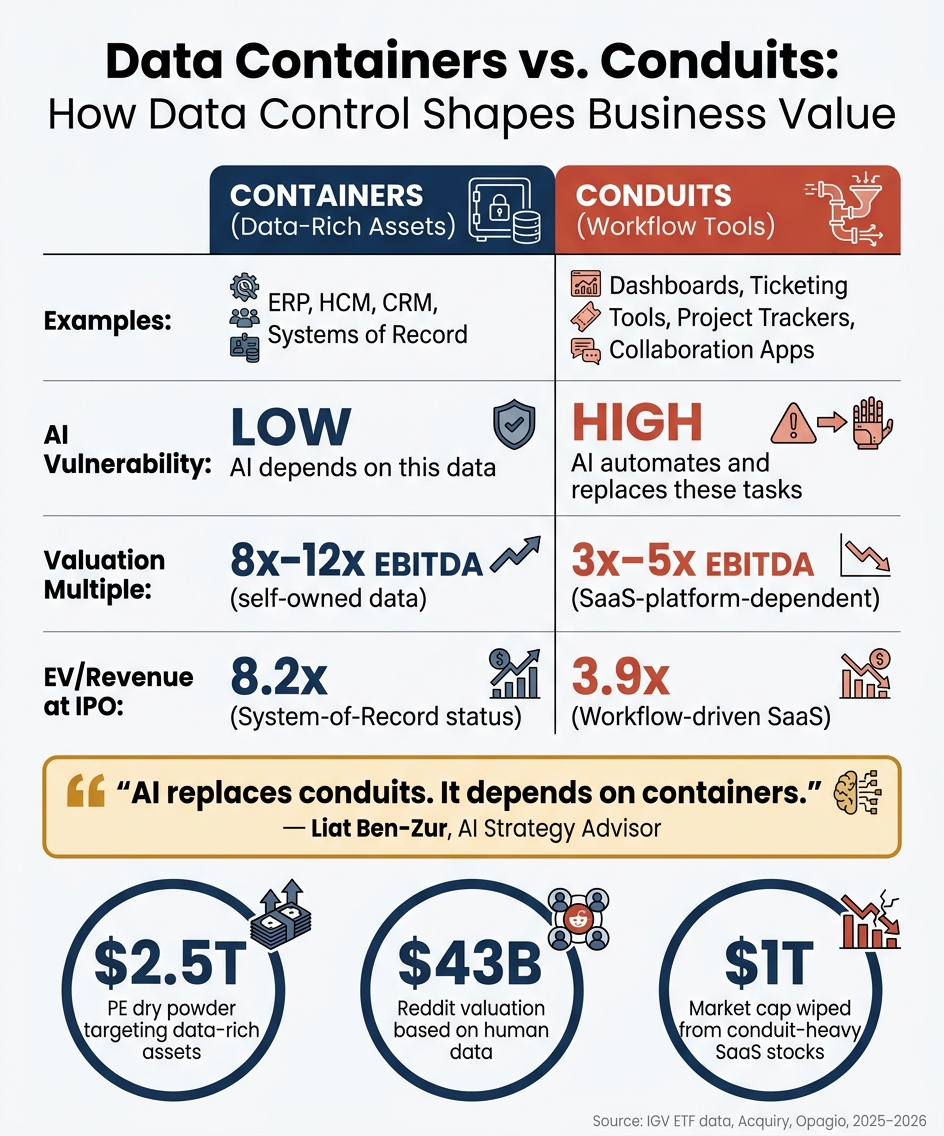
Data Containers vs. Conduits: AI Vulnerability & Valuation Impact
In today’s market, control over unique data can make or break a company’s value during an acquisition. Investors are meticulous when evaluating data assets, focusing on whether the data offers a competitive edge. If a dataset can be easily recreated, it loses its appeal. This scrutiny highlights how critical it is for data to stand out during due diligence.
What Makes a Data Asset Hard to Replace
The best data assets are those that are irreplaceable, impactful, and exclusive. They play a key role in driving measurable business advantages. Competitors can’t derive the same value from them, and there’s no alternative or synthetic way to replicate their impact [11].
One clear marker of irreplaceability is longitudinal depth. For example, having ten years of behavioral or transactional data from 50,000 businesses is not something a competitor can replicate overnight. Time, after all, is a resource that can’t be compressed [10]. Take Microsoft’s $26.2 billion acquisition of LinkedIn as an example - it wasn’t about the software but the decade-long accumulation of 400 million professional profiles, connection graphs, and career data [9].
"Data assets compound in value over time, making them the only asset category that reliably appreciates with use." - Mark Hillier, CCO & Co-Founder, Opagio [9]
Another critical factor is data sovereignty, or who actually owns the data. Investors differentiate between companies that fully control their data through self-hosted systems and those reliant on third-party platforms. The difference in valuation is stark: self-owned data assets often fetch 8x–12x EBITDA, while data tied to SaaS platforms typically lands at 3x–5x EBITDA [8]. This ownership directly affects exit multiples and negotiation leverage, reinforcing that data control is essential for premium valuations.
How Different Buyers Assess Data During Due Diligence
Once data assets are evaluated, buyers focus on different aspects depending on their goals.
- Private equity firms prioritize defensibility against AI disruption and the potential for post-acquisition monetization. They’re drawn to data flywheels, where user interactions continually enhance the dataset, making it harder for competitors to catch up. Spotify exemplifies this: every song skip, save, or playlist update strengthens its recommendation engine, creating a competitive moat that new entrants can’t replicate [9].
- Strategic acquirers focus on whether the data fills a gap in their existing systems. They assess whether the data can be scraped, purchased, or synthetically generated. If it can, the value of the asset drops significantly. A major red flag for buyers is the "thin wrapper" problem - products that are merely interfaces for public APIs, like OpenAI’s, without proprietary data or pricing power [13].
"The question is no longer just 'what does your software do?' It is 'what does your data know that no one else's data knows?'" - Joash Boyton, Founder & MD, Acquiry [10]
Across buyer types, Gross Dollar Retention (GDR) is a key metric. A GDR above 85% is often the baseline for premium valuations. Anything below that raises doubts about the stickiness of the data asset, even if it appears unique on paper [12]. Ultimately, buyers pay a premium only when the defensibility of the data is clear and verifiable.
Data Compliance and Governance: What Investors Check First
One of the first things buyers assess is compliance. They look for clean audit trails, documented data lineage, and robust access controls. By 2026, 179 out of 240 jurisdictions worldwide will have data protection frameworks in place [14]. For U.S. companies, this means adhering to regulations like CCPA/CPRA, HIPAA, SOX, and the EU AI Act for those with European operations.
Investors need assurance that data collection, storage, and usage processes are well-documented and secure. Without these safeguards, even a valuable dataset can become a liability.
"Without shared definitions, ownership, and controls, trust collapses before insight begins." - OvalEdge [15]
Weak data governance isn’t just a compliance issue - it’s a financial one. Poor practices cost organizations an average of $12.9 million annually due to inefficient operations and flawed decision-making [15]. Companies with clean, compliant, and well-documented data systems not only pass due diligence more quickly but also negotiate from a position of strength, directly improving their deal terms and valuation.
How to Build Products and Business Models Around Data
Product Architectures That Generate Defensible Data
The best data-driven products are designed to grow stronger with every user interaction. This is the principle behind a data flywheel - a system where increased usage continuously improves both the product and the value of its data. This concept mirrors how interconnected systems drive growth in other industries.
The most resilient architectures are often referred to as Systems of Action. Unlike passive Systems of Record - which simply store information - Systems of Action are deeply integrated into daily workflows, making them difficult to replace. For example, GitHub isn’t just a repository for code; it captures every commit, review, and collaboration pattern. This behavioral data layer encodes how teams work, creating a competitive edge that’s hard to replicate.
Take Incode Technologies as an example. The biometric authentication company scaled its revenue from $6 million to $170 million by January 2026. Every identity verification feeds its proprietary models, improving accuracy and creating a moat competitors can’t cross [19].
"Datasets that are low-value and commoditized in isolation, become high-value and unique in aggregate." - Abraham Thomas, Author of Pivotal [11]
Another standout example is Epic Systems in healthcare. Its "Cosmos" database links patient records across hospitals, enabling predictive AI tools - like readmission risk analysis - that competitors can’t match without access to similar fragmented datasets [16]. In both cases, the architecture itself becomes the barrier to entry.
Once a strong data architecture is in place, the next step is to align pricing models with the value being delivered.
Pricing and Monetization Models Investors Prefer
Alongside robust data architectures, companies are rethinking how they monetize their products. The traditional per-seat SaaS model is losing relevance as AI tools take over tasks once handled by humans. Instead, investors are favoring consumption-based and outcome-based pricing models that scale with usage rather than headcount.
Salesforce’s Agentforce showcases this shift. By charging based on outcomes - such as when an agent resolves a customer query - Salesforce reached approximately $800 million in ARR by the end of fiscal 2026 [20]. This isn’t just a tweak in pricing; it’s a complete reimagining of how revenue is generated.
"If an agent can't consume and pay for your product autonomously, you probably aren't there yet." - David George, General Partner, Andreessen Horowitz [18]
Data licensing is another model gaining traction. Reddit’s approach is a prime example. By gating its API at $0.24 per 1,000 calls, Reddit forced AI companies into formal licensing agreements. The result? $203 million in licensing contracts, including a $60 million annual deal with Google, and its first-ever quarterly profit by Q3 2024 [17]. The data was always there - what changed was Reddit’s decision to control access and terms.
Core Components of a Data Strategy That Holds Up
To maximize the value of defensible data and dynamic pricing, companies need a well-rounded data strategy. This doesn’t mean collecting everything; it’s about gathering the right data in a way that compounds value over time. Here are three key elements:
- Data sovereignty: Own your critical data. Relying on third-party platforms means you only have read access, not full ownership. Companies that control their data assets can achieve 8x–12x EBITDA multiples, compared to 3x–5x for those dependent on SaaS platforms [8].
"If you don't hold the database file, you don't have a business." - Mohammed Shehu Ahmed, Founder, RankSquire [8]
- Detailed tracking with automated feedback: Capture every user interaction - not just outcomes but the steps leading to them, including corrections and edge cases. This creates a behavioral map that competitors can’t easily replicate [16].
- Codify tribal knowledge: Transform expert intuition into structured data. For example, early-warning signals for churn or errors, identified by top employees, can be encoded into data models. This turns what was once informal knowledge into a lasting competitive asset [20].
How Data Control Shapes Your Exit Options and Deal Value
As discussed earlier, controlling your data has a direct impact on market value. This section dives into how that control shapes exit strategies and strengthens your position at the negotiation table.
How Data Is Valued Across PE Sales, Strategic Exits, and IPOs
The value of data isn't a one-size-fits-all concept - it shifts depending on the buyer and the chosen exit path, whether that's a private equity (PE) sale, a strategic acquisition, or an IPO. Each route places a distinct emphasis on certain aspects of a company's data assets.
Private equity firms, for instance, are less focused on growth narratives right now. Instead, they're targeting "mission-critical data containers." Deals involving these containers have maintained strong valuation multiples, even in volatile markets, because moving critical embedded data presents higher risks than leaving it in place. On the other hand, strategic buyers like AI labs, major tech platforms, and enterprise giants prioritize unique, human-generated data that can't be easily scraped or synthesized. This demand is reflected in lucrative annual licensing agreements for platforms such as Reddit [6]. For IPOs, companies that achieve "system-of-record" status enjoy a valuation premium, trading at a median of 8.2x EV/Revenue compared to just 3.9x for workflow-driven SaaS businesses [4].
| Exit Path | What Buyers Prioritize | Valuation Driver |
|---|---|---|
| PE Buyout | Retention, switching costs, mission-critical status | EBITDA multiples (24.4x for data infrastructure) [2] |
| Strategic Acquisition | Unique, non-replicable data; AI training value | Scarcity and licensing potential |
| IPO | System-of-record status, recurring data revenue | EV/Revenue premium (8.2x vs. 3.9x) [4] |
These differences in valuation create opportunities to negotiate better deal terms, with proprietary data serving as a key bargaining tool.
Using Proprietary Data to Negotiate Better Deal Terms
The premium placed on proprietary data opens the door to stronger negotiating power. When a buyer can't replicate your dataset, you're not just another seller - you become a critical gatekeeper, reshaping the dynamics of the deal.
Take Stack Overflow as an example. Despite a significant 76.5% drop in monthly questions following the rise of ChatGPT, the company still grew its revenue to $125 million in 2024 by licensing its 15-year archive of 58 million vetted Q&A pairs to AI companies [1][4]. The decline in traffic didn't diminish the value of its data, giving Stack Overflow an edge that traffic-reliant businesses couldn't match.
"The new power lies not in the algorithm, but in the unique, proprietary fuel it runs on. Your data is your destiny." - Sriram Parthasarathy, GPTalk [1]
This principle also influences deal structures. Companies with unique data assets can negotiate superior earnout terms, retain equity post-acquisition, or attract higher-quality buyers. Scarce data creates competition - when multiple buyers vie for access to the same asset, founders gain leverage that wouldn't exist if the product were easily replicable.
Key Takeaways From the Three Anchor Stories
The combined stories of PE's $2 trillion in dry powder, Reddit's $43 billion valuation, and the $1 trillion SaaS market loss highlight a shared trend: data drives outcomes.
- PE firms are holding capital not out of caution but to invest in "containers" - data assets so deeply embedded in client operations that replacing them is riskier than keeping them.
- Reddit commands a $43 billion valuation not because of its interface or ad revenue but because of its decades of authentic human conversations, which AI companies rely on and cannot duplicate.
- SaaS companies that suffered the most, like Chegg - losing 99% of its market cap - were "conduits." Once AI replaced human involvement in their workflows, their value plummeted [4].
"AI replaces conduits. It depends on containers." - Liat Ben-Zur, AI Strategy Advisor [2]
Data that can't be synthesized, grows in value over time, and is integral to client operations not only weathers market disruptions but also commands premium exit valuations [21]. For founders, the real question isn't whether to collect data - it's whether the data you're gathering today will leave buyers with no better alternatives.
Conclusion: Data Control Is the Business Advantage That Lasts
The stories of PE firms' massive capital, Reddit's human data valuation, and the SaaS market decline all point to one undeniable truth: proprietary data is the cornerstone of business value.
What truly sets successful companies apart isn’t just product design, growth rates, or even revenue streams - it’s the exclusivity and staying power of their data. Legacy data assets, painstakingly built over years or even decades, create nearly unbeatable competitive advantages. Take Epic Systems, for example, which holds longitudinal health records for one-third of Americans. The regulatory sensitivity and depth of this data make it irreplaceable [21]. This kind of data forms the foundation for long-term resilience and stronger exit opportunities.
The rise of AI only amplifies the importance of unique data. As Lewis Lin puts it:
"The API era and the LLM era are the same movie. The companies that survived the API era owned the graph. The companies that will survive the LLM era own the data." [21]
AI reduces the complexity of working with large, intricate datasets, making proprietary data even more valuable. This shift doesn’t just enhance operational efficiency - it also increases a company’s attractiveness to buyers or investors. Businesses that rely more on user interfaces than on the unique data behind them are left more exposed to competitive threats.
As you plan your next phase of growth, the key question to ask is: Does your data become harder or easier to replicate over time? For companies looking to raise capital, sell to a strategic partner, or go public, if the answer leans toward "easier", it’s a vulnerability that needs addressing - preferably before it becomes a red flag during due diligence.
"High-quality, proprietary data is the most durable moat - its structure, cleanliness, and domain relevance trump mere volume." - Nicholas Mitsakos, Arcadia Capital Group [7]
FAQs
What counts as 'proprietary data' in a SaaS business?
Proprietary data in a SaaS business stands out because it’s exclusive, challenging to duplicate, and often takes years to build. Whether through extensive collection efforts, exclusive access, or physical acquisition, this type of data becomes deeply ingrained in how clients operate. It shapes the way they define categories and measure success, making it a key driver of both long-term value and competitive advantage.
How can a workflow tool become a data “container” over time?
Workflow tools act as data "containers" by gathering, organizing, and managing the information created during various processes. Today’s platforms take it a step further with automation - streamlining data collection, validation, and storage. This transforms workflows into rich repositories filled with process logs, metrics, and other valuable insights. Over time, these tools become central hubs for proprietary data, making it easier to reuse, share, and integrate information. In data-driven industries, this capability is a game-changer.
What data proof do investors want to see in due diligence?
Investors prioritize proprietary, accurate, and verifiable data that clearly demonstrates ownership and control of key assets. They pay close attention to areas like user engagement, growth metrics, and unique data assets, as these provide a strong edge during due diligence. Showing undeniable control over these elements is essential for securing investment and establishing trust with potential backers.