Founder-Dependent Agency: 5 Signs Your Delivery Lowers Your Sale Price

I see founder dependence as a risk to the profit a buyer can keep, not just a drain on your time. For a $2M–$10M agency with 15+ clients, check 5 gaps that can lower your sale price: client plans, routine approvals, client ties, quality checks, and problem-solving that still need you.
Here is what I would look for:
- Client plans: Your team needs your memory to make calls.
- Approvals: Routine work waits for your sign-off.
- Client ties: Key clients turn only to you.
- Quality: Work meets the mark only after your edits.
- Problems: The same issues keep coming back to your desk.
AI is not the bottleneck if the team still needs your context. I would start with 5 accounts, log where you step in, and test whether clear rules let the team act without you. <u>Written steps alone do not prove the handoff works.</u>
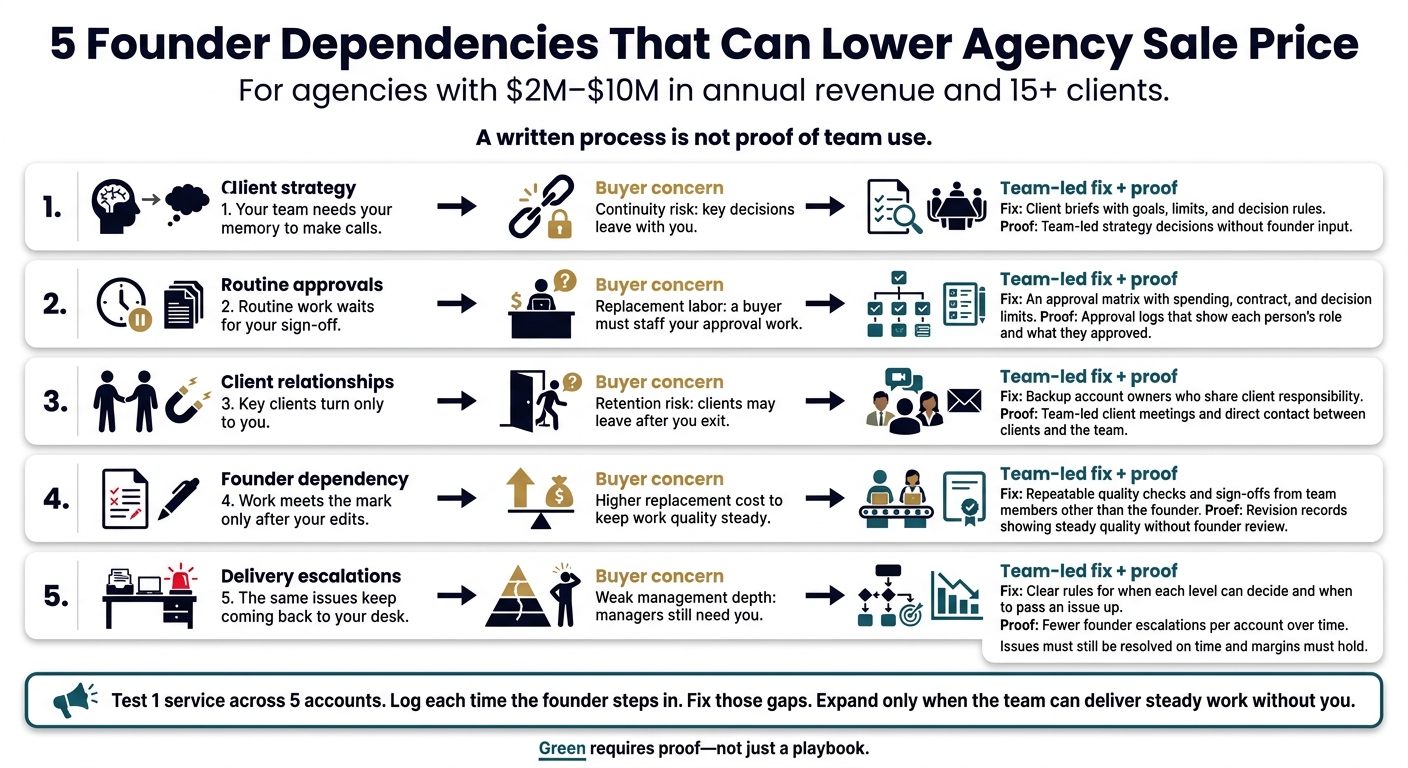
5 Founder Dependencies That Can Lower Agency Sale Price
Founder Dependency Kills Agency Valuation
sbb-itb-9cd970b
At a Glance: Founder Dependence and Buyer Concerns
Founder dependence puts delivery and pricing at risk when key client context stays in the founder’s head. Across 15+ clients, buyers want proof that the team can make decisions, keep clients, and check work without the founder, not just a written process that says they can.
A written process is not proof of team use. Each gap lowers transferable earnings and can weaken price.
| Founder-dependent behavior | Buyer concern | Delivery fix | Proof |
|---|---|---|---|
| Undocumented strategy | Continuity risk: key decisions leave with you. | Client briefs with goals, limits, and decision rules. | Team-led strategy decisions without founder input. [2][9] |
| Routine founder approvals | Replacement labor: a buyer must staff your approval work. | An approval matrix with spending, contract, and decision limits. | Approval logs that show each person’s role and what they approved. [4][9] |
| Founder-only relationships | Retention risk: clients may leave after you exit. | Backup account owners who share client responsibility. | Team-led client meetings and direct contact between clients and the team. [2][9] |
| Founder-dependent quality | Higher replacement cost to keep work quality steady. | Repeatable quality checks and sign-offs from team members other than the founder. | Revision records showing steady quality without founder review. [7][12] |
| Repeated founder escalations | Weak management depth: managers still need you. | Clear rules for when each level can decide and when to pass an issue up. | Fewer founder escalations per account over time. [3][4] |
Keep this proof in the systems your team already uses. Use these 5 checks to score how your team handles client work today.
1. Client Strategy Exists Only in the Founder’s Head
Signs of founder dependence
Client strategy has not transferred if your team still needs your memory to make routine decisions. Shared task lists show what to do, but shared decision records explain which client priority wins, why positioning changed, and whether a pricing exception still applies. [9]
Your team may know the work but lack the rules behind it. When those rules sit in your head or personal email instead of a shared CRM, each new request can send the team back to you. The gap is context, not task tracking. [9]
Why buyers may pay less
A buyer must pay to record that knowledge, train a replacement, and absorb handoff errors. Missing approval rules also make margins harder to protect. That can lead the buyer to ask for more founder involvement. [9][2]
For an agency with $2M–$10M in annual revenue and 15+ clients, this gap makes recurring profit look harder to transfer. The team can do the work, but it still needs the founder to guide key calls. [9][2]
What owners and COOs should check
Test 5 accounts using shared records only. The goal is to see whether account leads can make sound calls without asking you. [9][6]
- Review the last 30 days of client requests, decisions, and exceptions.
- Mark each request for founder direction on strategy, pricing, or scope.
- Ask each account lead to explain client priorities, positioning, past exceptions, and who can approve exceptions.
If the account lead still needs your help, the context has not transferred. [9][6]
What to fix and how to verify it
Create a shared client brief that explains both the plan and the reasons behind it. Include priorities, the “why” behind past decisions, acceptance criteria, and who can approve exceptions. [7][8]
Run a 60-day pilot on 1 repeatable service line. Move 1–2 low-complexity accounts to a delivery lead. Compare founder questions, rework, and client satisfaction with the baseline. [7][8]
Once strategy is in shared records, check approval authority. Knowing what to do does not mean the team has permission to act.
2. Routine Approvals Still Need the Founder
Signs of founder dependence
Routine approvals should move without the founder once the team has written strategy and clear authority. If work still waits, the gap is not AI output or team skill; it is the right to act on the context the team already has.
Across 20 accounts, three recurring approvals - pricing, scope, and final delivery - create 60 founder decisions per review cycle.
At a $2M–$10M agency, those decisions pile up. The team may know the answer but lack the right to approve it. Work stops at the founder’s desk. [5][13]
Why buyers may pay less
These signoffs are work someone must take over, not just oversight. A buyer takes on both the approval load and the risk of delays. That can weaken the earnings that transfer without the founder and lower the price. [9][6]
What owners and COOs should check
Review 30 days of approvals. Log each decision type, its wait time, and whether it was routine or an exception. Long waits show where too much authority still sits with the founder. [9][13]
What to fix and how to verify it
Give roles, not just named people, the right to approve work. Write clear limits for spending, discounts, strategy changes, and scope changes. State which contract terms need legal review and when the team must seek a higher-level decision. [11][5][8]
Name a backup approver. Keep final human approval with a qualified team reviewer, not the founder. [11][5][8]
Track founder approval counts and average wait times against the 30-day baseline. Then test a 2-week founder absence and review the exception log. [6][11][9]
Fewer founder signoffs are not enough. Decisions must still move within the agreed limits. Stalled requests show where approval rights remain unclear. [6][11][9]
Once approvals move off the founder, check whether clients still depend on the founder personally.
3. Key Clients Rely on the Founder Alone
Clients may rely on the founder because the founder holds the account history, not because the team lacks skill. When that context stays with the founder, moving approvals to an account lead does not prove clients will stay after the founder leaves.
Signs of founder dependence
Clients go around the account lead, expect the founder at every review, or discuss renewals only with the founder.
Buyers may check CRM records and email threads for the top 10 accounts to see who clients turn to for help. [9]
Why buyers may pay less
Buyers may pay less when client revenue depends on the founder staying.
If clients might leave with the founder, buyers cannot count on that revenue. They may lower the price, push for an earnout, or ask the founder to stay longer. Buyers may also call key clients to check whether those ties can pass to the team. [2]
What owners and COOs should check
Check where the founder was needed, not just where the founder took part.
Review last quarter’s meetings, renewals, and escalations. In a $2M–$10M agency with 15+ clients, even a few founder-only accounts can skew how much revenue can pass to a new owner. Work out those accounts’ share of total revenue. [1][4]
Check whether another team member has the client’s trust and handles renewals and escalations. That person should know the decision-makers, renewal concerns, and promises already made. [11]
What to fix and how to verify it
Give each key account clear owners, then test whether clients trust those owners without the founder.
- Assign a primary and backup owner to each key account. Record client history, preferences, pricing logic, and escalation paths in the CRM. Make the primary owner the day-to-day contact and the founder the executive sponsor. [11][3]
- Have the team lead client reviews and routine renewal talks for at least 2 delivery cycles. After the handoff, the founder should leave routine calls and email threads. [11][3]
- Check whether clients contact the new lead first, accept that lead’s advice, and renew without the founder stepping in. Attendance alone does not prove transfer. [11][3]
If clients now turn to the account lead first, check whether delivery quality still depends on the founder’s review.
4. Quality Drops Without the Founder’s Review
Signs of founder dependence
Quality depends on the founder when the rules for good work live in the founder’s edits, not in the team’s process. If missed requirements and rework grow when the founder stops reviewing, those edits are filling a QA gap rather than fixing it. [8][15]
The team may follow every step and still miss the mark. A process is not the same as a clear pass/fail standard.
Why buyers may pay less
Buyers may pay less if they must hire senior staff to replace the founder’s review. They also face the risk that quality drops after the founder leaves. The added labor cost reduces EBITDA and can lower the sale price. [6][16]
Look for measurable rework, not just differing views on what makes work good.
What owners and COOs should check
Compare similar work with and without founder review. Track revision rounds, missed requirements, client complaints, rework hours, and delivery delays. [5][14][15]
Count the founder’s editing time too. Leaving it out can make reviewed work look more efficient than it is. The test is whether quality holds without your edits, not just whether the team finishes the work. [5][14][15]
What to fix and how to verify it
1. Turn repeat edits into clear rules.
Create QA checklists for each service, with pass/fail rules and written client acceptance criteria. Record why the founder makes repeat corrections, not just what changes. Give the QA lead the authority to approve work that meets those rules. [11][15]
2. Test the rules without founder input.
Run 1 live engagement without founder input. Have the QA lead check a sample of work each week, then compare the same quality measures over 2–4 weeks. Steady results without founder edits show more than a checklist alone. [5][10][11][13]
If work still comes back to you after QA, check the escalation flow, not just the quality rules.
5. Delivery Problems Keep Returning to the Founder
Signs of founder dependence
Delivery problems keep coming back to the founder when the team lacks clear rules and the right to make decisions. If quality checks still send issues to your desk, the fix is to define who can decide what, not just ask the team to work harder. [10][11]
You become the default fixer because no one else has clear authority. Repeat escalations often point to missing decision rules, not just hard clients. [10][11]
Why buyers may pay less
Buyers may pay less if they need to hire someone to take over your account rescue work. That could mean a GM or VP of Operations at $120,000–$180,000 a year. [3]
What owners and COOs should check
Review the last 60–90 days of escalations across your 15+ accounts.
- Record the account, issue, decision needed, and time to resolve it.
- Separate gaps in authority from gaps in skills.
- Find the 3 repeat bottlenecks across accounts that rely most on you. [6][11]
What to fix and how to verify it
Give each repeat issue an owner, a response time, clear decision rights, and a set point for leadership to step in. Write short playbooks that explain why each rule exists and when to push back on client requests. [6][7][11]
Give current account leaders room to act within those rules first. Don’t assume you need another hire. [6][7][11]
Build a shared delivery dashboard with account health, decision logs, open issues, owners, and margin. Have the COO lead a weekly review of issues that fall outside the rules. [6][10][11]
Track founder escalations per account and time to resolve issues over 60–90 days. Fewer escalations count as progress only if issues still get resolved on time and margins hold. [6][10][11]
Use these escalation patterns in the scorecard below.
Sale-Readiness Scorecard for Owners and COOs
A sale-readiness scorecard shows which parts of delivery still depend on the founder, based on work records rather than gut feel. Green requires proof that the team can make decisions and meet standards without the founder, not just a written plan for how the handoff should work.
Use this scorecard to check the 5 warning signs. Yellow means the founder still helps, but written rules and a capable backup are in place. Red means work stops without the founder. Without proof, an item cannot be green.
| Dependency | Green: team-led | Yellow: supported handoff | Red: founder required | Required proof |
|---|---|---|---|---|
| Client strategy | Team sets strategy using written client rules. | Backup follows the brief; founder handles exceptions. | Strategy decisions wait for the founder. | Current client briefs with scope, deliverables, and roles. [12][7] |
| Routine approvals | Leads with approval rights sign off on their own. | Approval limits are written down; founder handles exceptions. | Routine sign-offs wait for the founder. | Approval logs showing who approved what. [3][4] |
| Client relationships | Account lead runs day-to-day client contact. | Backup owner takes part; founder still helps. | Key clients rely only on the founder. | Named backup owners and CRM contact logs. [3][4] |
| Quality control | Team QA meets set standards. | Backup uses written checks; founder reviews some work. | Work passes only after founder review. | QA results that match baseline standards. [1][8][12] |
| Delivery escalations | Team solves issues within its authority. | Backup follows written paths; founder handles exceptions. | Issues stay open until the founder steps in. | Escalation logs showing issues the team resolved. [10][8][4] |
- Rank the risks by sale impact. Weigh revenue at risk and how hard each handoff will be. Fix the red item tied to the most revenue first. [1][3][7]
- Give 1 role ownership of the transfer. Choose the COO, GM, or Delivery Lead. Do not leave it with “the leadership team.” [1][3][7]
- Check 1 full client cycle before changing a rating to green. Records must show that the team made decisions on its own and met set standards. A playbook alone is not proof. [1][7][9]
Conclusion: Build Delivery That Works Without the Founder
Put client rules, approval rights, QA standards, and escalation paths in the system, not the founder’s head. This lets the team take over decisions, not just tasks. [6][13]
System-led delivery reduces handoff risk and can support a higher sale price. Buyers get a business that can keep serving clients without the founder. [3][6][17][18]
Owners and COOs: test 1 service across 5 accounts. Log each time the founder steps in. Fix those gaps. Expand only when the team can deliver steady work without you. [8][12][13]
Next step: Run the free calculator.
FAQs
How do buyers calculate the cost of replacing me?
Buyers assess key-person risk by estimating how much EBITDA or earnings could fall if strategy, approvals, quality checks, or escalations stall without you. They also count the time and cost of a handover, training, written guides, and account-leader coverage to see whether earnings can hold up after you leave.
The test goes beyond downtime and rework. Buyers want to know whether the agency can keep earning without your client ties and judgment.
Uncertainty can change the deal. It may mean a lower valuation, a lower upfront multiple, or more of the purchase price tied to earn-outs.
How early before a sale should I reduce founder dependence?
Start reducing founder dependence at least 12 to 18 months before a planned sale. Written guides are not enough. Show that your team can run the business, manage client relationships, and make decisions without you stepping in.
Use that time to hand off key accounts and hire or give more authority to a second-in-command. Let the team lead through actual work cycles to show that the business can run without you.
This can help support a higher valuation and move more of your earnings from future payouts tied to risk into cash paid at closing.
Can I stay involved without hurting my agency’s valuation?
Yes, you can stay involved if you guide the agency rather than run its daily work. Keep your role in strategy and key client talks, while your team handles daily tasks, approvals, and account management without waiting for you.
Buyers may pay less for an agency that relies on its founder. That reliance creates transfer risk: the risk that work or client trust suffers when the founder steps back.
Write down how decisions get made. Give your team clear ownership of client ties. You can stay involved without being the person every task and client needs.