The Forum Became the Algorithm. Your Brand Needs a Community Signal.

Hook: AI now prioritizes user-driven content - like forums and reviews - over brand-generated material. If your brand isn’t part of these conversations, you’re invisible to AI-first search algorithms.
Value Summary: AI systems rely on community interactions to determine trust and relevance. Platforms like Reddit dominate AI citations, with 40.1% of references, compared to just 5%-10% for brand-created content. Building a strong community signal - authentic, peer-driven discussions about your brand - has become critical for discovery, lead generation, and growth.
Quick Overview:
- What is Community Signal? AI trusts user-driven input (forums, reviews, recommendations) as verified by real people.
- Why it Matters: SaaS brands with active communities grow revenue 2.1x faster with a newsletter to scale B2B SaaS and see 94% retention rates.
- Key Metrics: Leads from communities convert 4.8x higher using an AI lead-gen playbook, and active users are 2.4x more likely to upgrade.
- Action Steps: Engage authentically in forums, align community roles with business goals, and integrate data into your CRM. using tools like BrightLead for verified lead data.
Bridge: Here’s how forums became essential to AI, why community interactions are shaping SaaS growth, and how to create a strategy that works.
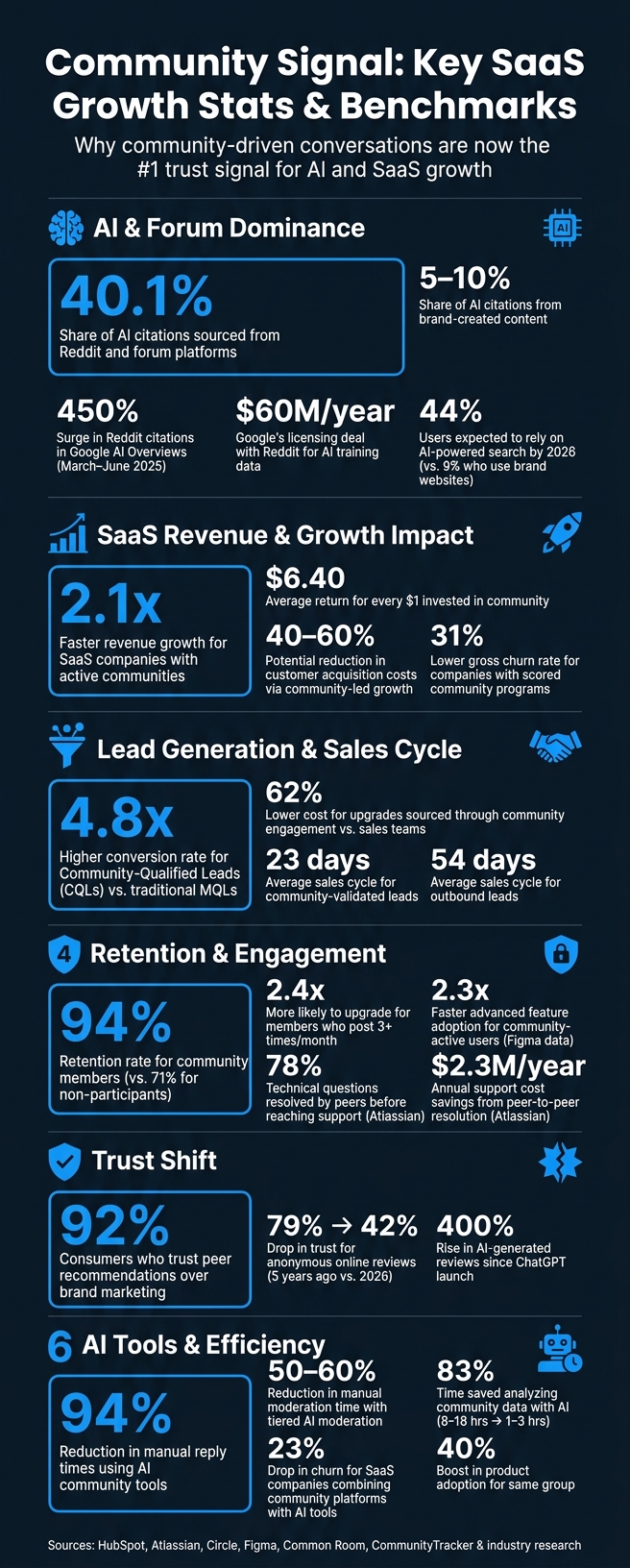
Community Signal: Key SaaS Growth Stats & Benchmarks
Georgi's secret growth hack: how this new founder turned community into a SaaS business
sbb-itb-9cd970b
How Forums Became Algorithms
The internet started as a place for real, person-to-person interactions. People asked questions, and others answered. Early forums like phpBB boards, Yahoo Groups, and Usenet threads were simple in design: new posts appeared in chronological order, and helpful replies were acknowledged without much fanfare. These platforms represented a shift from content created by brands to validation powered by communities - a critical point in understanding how things have evolved.
As platforms grew, this simplicity gave way to more complex systems. Reddit introduced upvotes and downvotes, transforming user opinions into measurable ratings. TikTok took it a step further, using metrics like watch time and re-watch behavior to decide what content users see, regardless of their follower count. Now, the way communities behave directly shapes the algorithms that determine what we engage with online. This change in community dynamics has become a key input for AI systems.
From Threads to Training Data
For brands, this shift is monumental: the conversations happening in communities today are feeding into AI training models. These interactions make their way into AI systems through two main pathways. The parametric pathway integrates forum content directly into a model’s training weights, while the retrieval pathway allows AI to pull live threads for real-time responses through methods like Retrieval-Augmented Generation [8].
This explains why Google signed a licensing deal with Reddit, reportedly worth $60 million annually, to access real-time posts for AI training [8]. Between March and June 2025, Reddit citations in Google AI Overviews surged by 450% [8]. What started as spaces for casual community discussions has now become a goldmine for training datasets.
Forums have a natural advantage in their Q&A structure, which often places answers front and center. For instance, a Reddit thread that begins with "The best tool for X is Y, because..." immediately offers AI the key information it needs. Duane Forrester, author of The Machine Layer, explains:
"A heavily upvoted Reddit thread is treated as more credible input than most published content on the open web, because it carries the accumulated validation of hundreds or thousands of independent human judgments." [8]
What Makes a Strong Community Signal
Modern algorithms assess community activity using four key factors. These components help quantify the quality and relevance of community input:
| Component | What It Means |
|---|---|
| Depth of Conversation | Detailed, thoughtful responses and long reply chains [5] |
| Diversity of Participants | Multiple, independent voices reaching similar conclusions [8] |
| Recency of Activity | Active, ongoing discussions that reflect current trends [9][5] |
| Cross-Platform Resonance | Consistent mentions across Reddit, Quora, and niche forums [1][4] |
AI models use these elements to calculate something called entity confidence - a measure of how consistently and independently a brand or product is described across various platforms [4]. For example, if your brand is described in a similar way on Reddit, Quora, and a specialized industry forum, the AI gains a clearer and more reliable understanding of your brand. On the flip side, if your brand is only mentioned on your own website or if descriptions vary wildly, that confidence drops.
"Community platforms have become the fact-checking layer for search engines and AI systems. Your branded content claims expertise. Community discussions prove it." - Austin LaRoche, CEO, ATAK Interactive [7]
Relying solely on your own website isn’t enough anymore. Real, authentic input from online communities is now a necessity.
Why Community Signal Matters for SaaS Growth
For SaaS companies, community signal isn't just a buzzword - it's a direct driver of growth. Companies with thriving communities grow revenue 2.1x faster than those without [14]. Even more striking, every $1 invested in community generates an average return of $6.40 across acquisition, retention, and support efforts [14]. These stats make it clear: a strong community isn't just a nice-to-have; it's a measurable, high-impact asset.
How Community Signal Affects Lead Generation and Retention
Community-driven leads slash acquisition costs because they stem from genuine user needs rather than disruptive advertising. For example, upgrades sourced through community engagement cost 62% less than deals initiated by sales teams. Plus, the sales cycle for community-validated leads averages just 23 days, compared to 54 days for outbound opportunities [6].
Retention metrics tell a similar story. HubSpot's research shows that community members have a 94% retention rate, compared to 71% for non-participants [10]. Atlassian's community platform, for instance, resolves 78% of technical questions before they ever reach customer support, saving the company a whopping $2.3 million annually [10]. Similarly, Figma found that users active in their community adopt advanced features 2.3x faster than those who aren't engaged [10]. These effects directly boost net revenue retention, making community a cornerstone of sustainable growth.
"Community engagement is a critical indicator in SaaS; when customers actively participate, their engagement signals powerful buying intent." - Garrett Mullins, Workflow Specialist [6]
Behavioral data further underscores this point. Community members who post 3 or more times per month are 2.4x more likely to upgrade to paid plans than silent users [6]. This makes community engagement one of the most reliable indicators of expansion opportunities.
Beyond cost savings and retention, community interactions play a pivotal role in shaping how buyers research and make decisions.
Why SaaS Buyers Turn to Peer Communities
The influence of community extends far beyond lead generation and retention; it also shapes buyer opinions long before they reach out to sales teams. Today’s B2B buyers are turning to private Slack groups, niche subreddits, and Discord servers to research products, often well before filling out a lead form [12]. In fact, 80% of B2B software purchases are now expected to happen online, with peer forums and discussions playing a major role [14].
Traditional trust channels are crumbling. Trust in anonymous online reviews has plummeted from 79% five years ago to just 42% in 2026 [11]. Meanwhile, the rise of AI-generated reviews - up 400% since the launch of ChatGPT - has only deepened skepticism [11]. In this landscape, an authentic peer recommendation like “we switched to this tool and here’s what happened” carries far more weight than any polished case study. It's no surprise that 92% of consumers trust peer recommendations over brand marketing [14].
"We've been measuring community like a media property… reach, impressions, engagement. But community isn't media. It's infrastructure for trust." - Jon Levesque, Community Builder [11]
For SaaS brands, this means that buying decisions are often shaped - or even finalized - in community spaces where your presence might be minimal or nonexistent. Ignoring these spaces could mean missing out on critical opportunities to influence potential customers.
How to Build a Community Signal Strategy for SaaS Brands
Understanding that community signals can drive growth is just the starting point. The real challenge lies in creating a system that captures and leverages those signals effectively. The difference often comes down to having a clear strategy - one that aligns your community with meaningful business outcomes.
Defining Business Outcomes and Community Roles
"If this community disappeared tomorrow, which business metric would suffer?" - Mindy Faieta, Head of Customer Success, Stateshift [15]
If you can’t answer that question, your community might not align with your business goals. The key is connecting member behaviors to measurable outcomes. For instance, a member who answers three forum questions monthly signals expertise and engagement - this is a retention and expansion signal. On the other hand, a member who refers new users is a critical pipeline indicator. These behaviors serve different purposes and should be treated accordingly.
Here’s how various community roles tie into specific business outcomes:
| Community Role | Key Behaviors | Business Outcome |
|---|---|---|
| Newcomer | Completes tutorials, asks questions | Activation / Time-to-Value [15] |
| Contributor | Answers questions, shares resources | Support Deflection / Content Creation [15] |
| Advocate | Recruits users, influences roadmap | Expansion / Organic Referrals [15] |
| Champion | High-frequency expert posts | Advocacy / High-LTV Retention [6] |
To make this actionable, assign weighted scores to these behaviors. For example, referring a new user might carry 30 points, while upvoting a post might only earn 1 point. This contribution ladder transforms vague participation into measurable data that your revenue team can use. When these signals are integrated into your CRM, community-led growth can potentially lower customer acquisition costs by 40–60% [15].
This framework creates a strong foundation for selecting platforms that will best capture and amplify these signals.
Choosing the Right Community Platforms
Once you’ve defined your goals and roles, the next step is choosing platforms that can effectively capture community signals. A mix of owned platforms (like Circle) and rented platforms (like Slack or Discord) often works best. Owned platforms offer control over data and SEO benefits, while rented platforms allow you to engage users where they already spend time.
Cloudflare’s use of Reddit showcases the potential of rented platforms. By May 2026, their r/Cloudflare subreddit had 1,251 individual posts ranking in Google’s Top 10 for technical queries. This drove 86,000 monthly referrals to their main site, thanks to active participation from employees in engineering, support, and trust departments [16].
"The conversations happening on Reddit were not just driving Google search results, they were training the AI models that would answer the next decade of buyer questions." - Soar.sh [16]
For most SaaS brands in the U.S., a hybrid model works best. Use platforms like Slack or Discord for real-time interaction and relationship-building, while leveraging owned forums (like Discourse or Circle) for evergreen content that builds long-term value through search. Avoid spreading your efforts too thin - focus on building depth, not breadth. A small, engaged group of fifty active members in a Slack channel will generate more meaningful signals than thousands of inactive accounts on a forum.
Setting Community Rules and Governance
Ineffective governance can derail even the best community strategies. A common pitfall is treating the community as a marketing tool without properly staffing it for support.
"If you cannot staff it as a support channel, do not launch it as a marketing channel." - Soar.sh [16]
Take Duolingo’s experience in January 2025 as an example. After a 1,400% spike in support requests, their r/duolingo subreddit’s volunteer moderators rebelled due to inadequate staffing - just two full-time customer success employees. This led to a ban on all account and billing-related posts [16]. The takeaway? Governance needs to be in place before your community scales.
One practical solution is setting up a "Slack back-office" early on. This is an internal channel where community posts are routed to the appropriate teams - whether in engineering, product, or support. Mint Mobile uses this approach with 108 employees monitoring a single Slack channel. This enables six identified employees to respond on Reddit with detailed, context-rich answers [16].
Establishing a clear charter, automated onboarding processes, and a crisis playbook from the start ensures your community remains structured and authentic. These measures allow you to build a community that not only thrives but also drives growth for your SaaS brand.
Running Community Signal with SaaS and AI Tools
Once you’ve nailed down your community strategy and governance, the next step is scaling your efforts. SaaS platforms and AI tools can turn community interactions into actionable insights, making this process much smoother.
Starting High-Value Interactions
Not all posts in a community are created equal. The real gold lies in discussions where members compare solutions, share challenges, or seek advice on workflows. These conversations often signal genuine buying intent. To generate more of these valuable interactions, you need to design your community to encourage them.
Tools like CommunityTracker (starting at $29/month) take things a step further than basic keyword alerts. They filter conversations based on commercial intent, automatically identifying the posts that matter most and turning them into actionable tasks for your go-to-market (GTM) team [17].
"The biggest improvement was not more data. It was knowing which posts were actually worth acting on." - Product Marketing Manager, CommunityTracker User [17]
AI doesn’t just monitor these interactions - it can help spark them. For example, an AI agent might ask clarifying questions on vague feature requests or suggest helpful resources to posts that have gone unanswered for 24 hours [19]. These small actions keep discussions alive and show members that the community is actively managed. This sets the stage for smarter community management, as outlined below.
Using AI Agents for Community Management
There’s a big leap from basic bots to advanced AI agents. Today’s AI tools can understand context, maintain your brand’s tone, and differentiate between a support query, a troll, or a potential lead - all without needing human input [20].
In September 2025, Circle’s team, led by Mathilde Leo, used AI workflows to rename 313 unclear post titles and flag policy violations. This saved them 45–65 hours per month [19].
"AI handles the busywork of moderation - so you can lead your community without burning out." - Pedro, Community Manager, Circle [19]
Teams using AI have cut manual reply times by as much as 94% [18]. To keep interactions feeling authentic, many teams use a human-in-the-loop threshold. This means AI only posts automatically if its confidence level is above 85%, flagging anything lower for human review [20]. Adding a randomized delay of 2–15 minutes to replies also helps responses feel more natural [20].
A tiered moderation system is another effective approach. Automated systems handle spam and offensive content, AI-assisted reviews flag low-quality or off-topic posts, and humans step in for complex disputes. This method can slash manual moderation time by 50–60% [21].
Using SaaS Platforms to Scale Community Operations
AI-driven tools are just one part of the equation. SaaS platforms take community management to the next level, especially for brands operating across multiple channels. Tools like Sift AI deploy specialized agents for tasks like triaging, tagging, maintaining brand voice, and detecting crises. These agents can work simultaneously to manage high-volume environments [22].
For businesses monitoring conversations on platforms like Reddit, Slack, Discord, LinkedIn, and GitHub, this kind of cross-platform coordination is essential. And the results speak for themselves. SaaS companies that combine community platforms with AI tools have reported a 23% drop in churn and a 40% boost in product adoption [10].
Atlassian’s community is a standout example. By March 2026, peer-to-peer answers resolved 78% of technical questions before they reached official support. This saved the company $2.3 million annually in support costs [10].
These tools don’t just streamline community management - they also make your community strategy more impactful. By integrating community activity into your CRM, you can turn engagement into actionable data. When members answer questions, refer others, or request features, that activity feeds directly into your pipeline, transforming community signals into measurable business outcomes.
Measuring and Improving Community Signal
Key Metrics for Community Signal
Tracking basic stats like member counts and likes might be easy, but they don't show whether your community is actually driving business results. To measure what really matters, focus on three areas: quality of engagement, member progression, and business impact.
Using a maturity model helps align metrics with the growth stage of your community. Early-stage communities should prioritize metrics like onboarding completion rates and the percentage of posts created by members (ideally, 60–80% peer-generated content). As the community grows, shift focus to deeper participation and cohort retention. For mature communities, metrics like revenue attribution and support deflection become key [24].
| Stage | Key Metrics |
|---|---|
| Beginner | MAU, growth rate, onboarding completion, % posts by members |
| Scaling | Engagement rate, event attendance, peer-to-peer interaction rate |
| Advanced | Revenue attribution, support deflection, product adoption lift |
Source: Circle Community Analytics Maturity Model [24]
A particularly impactful metric is Community-Qualified Leads (CQLs) - members whose behavior in the community shows strong purchase intent. These leads convert at a rate 4.8x higher than traditional Marketing-Qualified Leads (MQLs) [26]. For example, a SaaS company with a $10,000 average contract value would only need a few CQLs each month to justify the entire community investment.
With these metrics defined, the next step is integrating and analyzing this data across your systems.
Connecting Community Data Across Systems
Community data often sits in silos. Your forum platform might track active users, but your CRM has no idea who they are. Similarly, your product analytics tool might show feature adoption but not link it back to community interactions.
The solution? Connect these data points using UTM parameters and API integrations. For instance, you can add utm_source=community to product links so Google Analytics can track traffic and conversions from specific threads [25]. Then, sync community activity with your CRM. Tools like HubSpot (starting at $20/month) can integrate this data, flagging high-engagement members for your sales team [27]. This integration ensures community insights directly influence business strategies.
"Communities tell a big part of the story, but only part. When we integrate community data with a CRM... we can identify meaningful signals - like a user repeatedly viewing an add-on product they don't own." - Paul Schneider, Host, Higher Logic [30]
Platforms like Common Room (which offers a free starter tier) can centralize data from Slack, Discord, GitHub, and your CRM into one view. This makes it much easier to identify members who are nearing a buying decision [28].
Using AI to Read Community Data
Once you've integrated community data into your systems, AI can help turn it into actionable insights. Manually analyzing discussions is time-consuming - sorting through hundreds of posts can take 8–18 hours. AI tools, on the other hand, can cut that to just 1–3 hours by automating tasks like topic clustering and engagement scoring, saving ~83% of the time [23].
AI can also provide deeper insights. Sentiment detection helps you spot potential churn by flagging negative feedback clusters. Intent analysis identifies "buying language" such as "looking for a tool that does X" and routes those leads to your sales team [13]. Topic clustering highlights recurring product gaps that should be addressed in your roadmap [10]. And persona modeling helps you distinguish power users from at-risk members, so you can decide where to focus your efforts [10].
"The question is not whether that trust has commercial value. It clearly does. The question is how to see it." - Social Plus [25]
For example, in 2026, B2B SaaS company Linear used an AI bot in their Slack community to analyze discussions. The bot automatically prioritized the most-requested features for their product backlog, creating a direct link between community feedback and development decisions [10]. This kind of closed-loop system transforms community insights into a real competitive edge.
Connecting Community Signal to Revenue and Product Decisions
This section dives into how community signals can be directly tied to revenue growth and product development, building on the metrics and insights discussed earlier.
Building Revenue Models Around Community Signal
One of the most effective ways to leverage community data for revenue is through Community-Attributed Revenue (CAR). This involves linking CRM account records to prior community engagement, helping you identify which interactions played a role in closing deals [29].
For example, high-frequency contributors in your community often indicate expansion opportunities. Automated CRM alerts can be triggered based on these signals, often using lead generation tools to monitor web activity, enabling your team to focus on accounts with the highest potential for upgrades. Companies with scored community programs report a 31% lower gross churn rate compared to those without [6].
By assigning weighted scores to specific community behaviors, you can automate alerts when a member’s cumulative score crosses a predefined threshold. This ensures your sales team focuses on warm leads rather than wasting time on cold outreach.
"Community engagement is the most underscored signal in SaaS." - US Tech Automations [6]
Once revenue models are aligned with community data, these insights can also guide product development.
Using Community Feedback to Guide Product Development
Community forums are more than just support hubs - they act as diagnostic tools for your product team.
"Community becomes a diagnostic layer, not a support backlog." - Joshua Zerkel, Community Leader [32]
When members repeatedly bring up the same issues, such as integration challenges or onboarding friction, they provide clear signals for your product team to act on. For instance, in 2026, Figma used insights from community conversations to refine their product strategy. By observing how users described workflows to one another, Figma’s go-to-market teams adjusted product positioning based on real user language rather than internal assumptions.
Recurring themes in community discussions can also reveal priorities for development sprints. For example, if a specific integration is frequently mentioned in threads, it signals an area where the product team should focus their efforts.
Decision Tables for SaaS Leaders
To put these insights into action, it’s essential to distinguish between low- and high-signal behaviors and respond accordingly. The table below outlines examples of community signals, corresponding actions, and their business impact.
| Community Signal | Sales/Product Action | Business Impact |
|---|---|---|
| Member asks detailed questions about enterprise security | AE responds in-thread; Product reviews documentation gaps | Builds deal trust; identifies documentation improvements [31] |
| User shares a significant ROI story in a success channel | Community manager requests a case study feature | Provides strong social proof for sales outreach [31] |
| Recurring questions about a specific integration | Product team prioritizes integration in the next sprint | Boosts product stickiness; lowers churn [32][10] |
| Multiple colleagues from one account join the community | Signal flagged as a high-intent expansion opportunity | Highlights cluster behavior for account-based growth [29] |
The takeaway? High-signal behaviors demand a human touch. For instance, when a member asks a technical question, having a community manager flag it for an Account Executive to address in-thread builds trust. This approach makes the eventual upgrade feel organic, not forced [31].
Conclusion: Building on Community Signal
The landscape of trust and discovery has transformed. Forums once served as casual discussion hubs, but now they’ve become foundational training data for AI. Algorithms have taken over as the primary tools for discovery. Polished brand messaging? It’s no longer enough to earn trust. By 2026, 44% of users will rely on AI-powered search for insights, compared to just 9% who turn to brand websites [1]. That gap is growing fast, and it’s reshaping how brands need to engage with their audiences.
Your brand’s credibility now lives in the organic conversations happening across platforms like Reddit, Discord, and other niche communities. These are the spaces where real users share real opinions. As Matt Harris, Chief Revenue Officer at Club, explains:
"If people are talking about you in a trusted, human-centric space, the AI sees it as a verified fact. If you're just saying it about yourself on a landing page, it's just a claim." [2]
Unlike paid ads, which disappear as soon as the budget runs out, content created by communities has staying power. It remains indexed, gets cited, and continues to build what’s known as entity confidence over time [3][4]. A single forum thread, for instance, can simultaneously generate AI citations, attract warm leads, and provide valuable product feedback.
So, what’s the way forward? Start by engaging authentically. Stick to the 95/5 rule: focus 95% of your efforts on delivering value and limit brand mentions to 5% or less [1]. Ensure parts of your community remain publicly accessible so AI can crawl and index them. Align your CRM systems with engagement metrics, and shift your focus to tracking Citation Share instead of just keyword rankings.
"Community isn't media. It's infrastructure for trust. And trust compounds in ways that attention doesn't." - Jon Levesque, Community Leader [11]
Brands that view community as a long-term investment - rather than a short-term marketing tactic - will position themselves as reliable sources when buyers turn to AI for insights. By embracing this approach, you can tap into the power of community signals to drive lasting growth and credibility.
FAQs
How do I tell if my brand has a “community signal” today?
Wondering if your brand has a strong presence in online communities? Start by looking for mentions in trusted, third-party spaces like Reddit, Discord, or niche Slack groups. These platforms are where real users often share their thoughts, and AI models pick up on these discussions as signals of credibility.
A key indicator of a solid community signal is consistency. If independent sources describe your brand in similar ways - without relying on your website - that’s a good sign. To test this, try searching for your brand on platforms like Reddit. Pair it with problem-related keywords to uncover genuine, organic mentions from users.
What’s the fastest way to get mentioned in forums without sounding salesy?
To make an impact quickly, prioritize value-first, human-focused interactions that establish trust. Stick to the 95/5 rule: dedicate 95% of your efforts to delivering genuine value - like answering questions, sharing helpful insights, or giving practical advice. Reserve just 5% for mentioning your brand, and only when it directly addresses a specific need. Approach conversations as an individual expert, back your points with clear, relevant data, and steer clear of overly sales-driven language. This approach helps you build real, meaningful connections within the community.
How do I connect community activity to revenue in my CRM?
To connect community activity with revenue in your CRM, start by integrating community identity data into your sales and marketing tools. Leverage platforms that allow you to map activities - like attending events - directly to CRM contacts. Consider community engagement as a crucial factor in your account scoring process. By using UTM parameters, you can track conversions originating from community discussions. This approach helps you measure how participation in your community contributes to pipeline development, renewals, and overall growth, alongside other acquisition channels.