33. Your Customer List Is Your Moat. Your Data Pipeline Is Your Valuation. Your Distribution Is Your Exit.

In 2026, building software is faster than ever, but the real value of a business lies in three pillars: your customer list, your data pipeline, and your distribution channels. These are what create lasting competitive advantages, drive higher valuations, and make your company irresistible to buyers.
Here’s the breakdown:
- Customer List: Loyal customers create switching costs, making it harder for competitors to take them.
- Data Pipeline: A well-organized pipeline enhances product performance and proves scalability to investors.
- Distribution: Strong channels ensure you can reach your market effectively, compounding growth over time.
Key insights:
- Companies with deep workflow ownership are valued at 20–35x ARR, compared to 8–15x ARR for less integrated tools.
- Metrics like Net Revenue Retention (NRR) above 115% and a clean, scalable data pipeline are critical for high valuations.
- Align your distribution strategy with your exit goals: strategic buyers value trust and integrations, while private equity prioritizes efficiency.
Building these pillars ensures your business retains value, even in a rapidly evolving tech landscape.
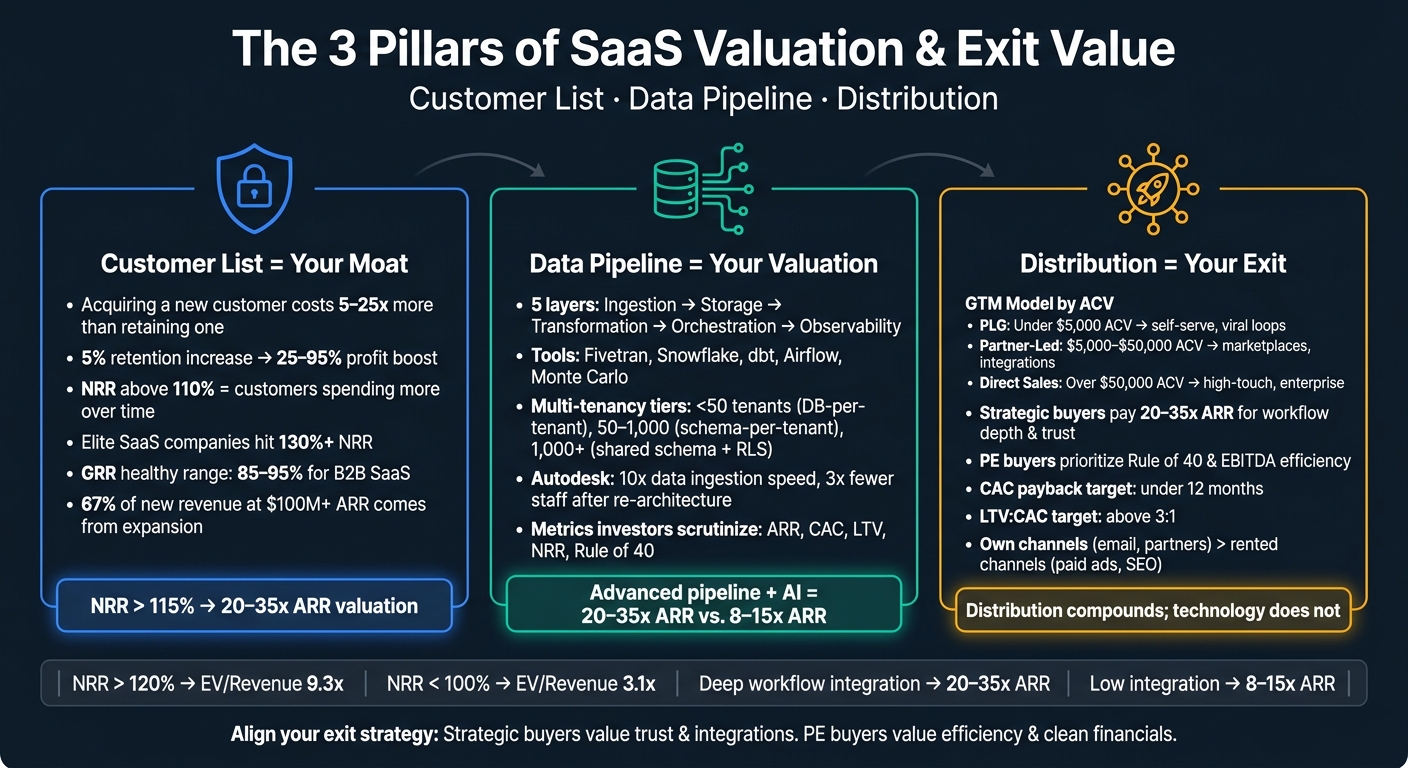
SaaS Valuation Drivers: Customer List, Data Pipeline & Distribution
Understanding SaaS Valuations: How to Navigate the 3x to 10x ARR Range | SaaS Metrics School
Building a Customer List as a Competitive Moat
A strong customer list is more than just a collection of contacts - it's the backbone of a lasting business advantage. The longer customers stick with your platform, the more their workflows, data, and team habits become tied to your product. This creates a natural barrier to switching, making your business harder to replace [1]. Let’s break down how retention metrics shape competitive differentiation.
Why Retention Metrics Matter More Than New Customer Acquisition
Focusing on new customers might feel productive, but retaining your existing ones delivers far better returns. Why? Because acquiring a new customer can cost 5 to 25 times more than keeping one you already have. Even a modest 5% increase in retention can boost profits by 25% to 95% [12][13].
For investors, Net Revenue Retention (NRR) and Gross Revenue Retention (GRR) reveal the health of your customer base. NRR above 110% shows that your current customers are spending more over time - whether through upgrades, additional seats, or increased usage. Elite SaaS companies often hit 130%+ NRR, while anything below 100% signals trouble [13]. On the other hand, GRR measures pure retention (without factoring in expansion) and should typically range from 85% to 95% for a healthy B2B SaaS company.
"Customer success is where 90% of the revenue is. Acquiring a customer is just the beginning - the real growth happens after the first sale." - Jason Lemkin, Founder, SaaStr [14]
These metrics aren’t just vanity figures - they directly impact valuation multiples.
Organizing Customer Data for Retention and Growth
Most businesses gather customer data but store it across disconnected tools - billing in Stripe, support tickets in Zendesk, and product usage in a separate database. This fragmented setup makes it tough to get a clear view of customer health. The solution? Build a Single Source of Truth by syncing all data streams into one centralized CRM. This gives your team a complete, actionable view of each account [9][10].
Once centralized, segment your customers based on factors like longevity, support needs, and growth potential. High-value customers tend to share these three traits:
- They stay 2–3 times longer than average.
- They require less support.
- They show clear potential for expansion (e.g., additional seats or increased usage).
Spotting these High-Value Customers (HVCs) early allows you to focus resources where they’ll yield the most impact. While tools like Salesforce and HubSpot are popular for managing this data, the structure and quality of your CRM matter more than the tool itself. A well-organized CRM with clear tagging and segmentation is far more effective than an expensive but cluttered platform.
Turning Your Customer List Into a Growth Engine
Retention systems work best when they can predict potential churn. Combining data like usage patterns, support tickets, and NPS scores into a weighted health score gives you the lead time needed to intervene and save accounts [12][13].
Take Monarch Money as an example. By moving from generic email campaigns to behavior-triggered onboarding sequences using tools like Segment, Snowflake, and Customer.io, they achieved impressive results: a 3.36% drop in cancellations, a 4.4% increase in report page views, and a 200% jump in referrals - all in just one week [15].
Upselling works on a similar principle. For SaaS companies generating over $100M in ARR, 67% of new revenue comes from expansion [14]. The key is to act on product signals. For example, if a customer consistently hits usage limits or starts adding new integrations, that’s your cue for an expansion conversation - not a routine quarterly check-in.
Here’s a quick look at how signals can reveal whether your customer base is a competitive asset or a weak spot:
| Moat Type | Primary Signal | Warning Signal |
|---|---|---|
| Data | Data density per account increasing monthly | Rising export request rate |
| Workflow | DAU/MAU ratio above 0.5 | Feature depth flat or declining |
| Switching Cost | Average integration count per account > 3 | Integrations are read-only |
| Economic | NRR above 115% | Renewals driven by inertia, not ROI |
(Source: [11])
Why Your Data Pipeline Determines Your Valuation
Having a customer list is great, but if you're looking to impress investors, a well-structured data pipeline is what really matters. It turns operational complexity into measurable metrics that can significantly impact your valuation. A fragmented pipeline raises concerns, while a clean, well-organized one shows scalability and reliability - qualities that drive higher valuation multiples.
What an Investor-Grade Data Pipeline Looks Like
An investor-ready pipeline isn’t just about running one-off analyses. It needs to reliably support critical business functions like financial reporting, investor dashboards, or AI-powered features. At this level, your pipeline must be production-grade.
Here are the five essential layers of an investor-grade data pipeline:
| Layer | Purpose | Common Tools |
|---|---|---|
| Ingestion | Collect data from all sources into a single system | Fivetran, Airbyte, Segment |
| Storage | Store data in a centralized, scalable warehouse | Snowflake, BigQuery |
| Transformation | Define and manage business logic | dbt, SQLMesh |
| Orchestration | Schedule and manage pipeline workflows | Airflow, dbt Cloud |
| Observability | Monitor for issues like data drift and errors | Monte Carlo |
The transformation layer is particularly crucial. Tools like dbt allow you to define key metrics, such as "Monthly Recurring Revenue (MRR)" or "churn", in a consistent, version-controlled way. This ensures all teams work from the same definitions, eliminating contradictory numbers. As Chad Sanderson, author of Data Products, explains:
"A pipeline should be production-grade if data quality meaningfully contributes to the pipeline's ROI." [17]
Scaling Data Infrastructure for AI and Multi-Tenant Environments
As your customer base grows, your pipeline must handle multi-tenancy effectively while keeping data secure and isolated. The approach depends on scale:
- Under 50 tenants: Use a database-per-tenant model.
- 50–1,000 tenants: Opt for a schema-per-tenant setup.
- 1,000+ tenants: Use a shared schema with warehouse-native Row-Level Security (RLS) to enforce security policies across all queries.
For AI features, the key question is whether sensitive customer data leaves your controlled environment. The best practice is warehouse-native AI inference - running models directly within platforms like Snowflake Cortex. This avoids sending data to external APIs, ensuring compliance with regulations like SOC 2 and CCPA while addressing enterprise data residency concerns.
Autodesk provides a great example of this in action. By re-architecting its analytics platform on Snowflake, the company achieved a 10x boost in data ingestion speed and reduced staff requirements by threefold. [18]
These infrastructure upgrades not only improve performance but also build the foundation for reliable investor-grade metrics.
Turning Data Maturity into Metrics Investors Trust
A solid pipeline produces accurate, auditable metrics, which directly tie to your business's value. Investors will scrutinize key figures like ARR, CAC, LTV, NRR, and the Rule of 40 (revenue growth + profit margin). If these metrics are cobbled together from multiple spreadsheets, it’s a red flag. If they come from a single, well-documented source, it signals operational excellence.
For example, calculate ARR from one auditable system - either your billing platform or CRM, but not both - and reconcile it monthly with finance. [19] Complex adjustments, such as handling currency conversions or customer upgrades, should be clearly documented. This documentation not only ensures accuracy but also builds trust during due diligence, saving potential acquirers from having to rebuild your models.
As Florian Delval, Product Marketing Lead at Snowflake, puts it:
"The old model of copying data between dozens of tools is broken. It creates a costly, high-latency and ungoverned ecosystem that is difficult (if not impossible) to trust." [18]
Companies with advanced data pipelines and strong AI integration are seeing valuation multiples of 20–35x ARR, compared to 8–15x for those without this level of infrastructure. Your pipeline isn’t just a technical asset - it’s a critical factor in justifying a premium valuation.
Distribution as the Engine for Growth and a Successful Exit
Once you've built a solid customer base and streamlined your data pipeline, the next big step is distribution - turning those assets into revenue and boosting your exit value. Simply put, a great product and loyal customers only matter if you can effectively reach the market. As Peter Thiel famously said:
"Poor distribution, not bad product, is the number one cause of failure." [6]
Distribution isn't just an art; it's a measurable system. The key is aligning your strategy with your ultimate goals.
Aligning Distribution with Your Exit Strategy
Different types of acquirers value different distribution strengths, and this can make or break your exit strategy. For strategic buyers - like large SaaS platforms or enterprise software companies - the focus is on building distribution moats. These include category authority, owned audiences, and deep workflow integrations that are tough to replicate. These buyers are often willing to pay a premium (20–35x ARR for vertical AI companies with strong workflow depth) because they're buying trust and market access, not just the tech. [2]
Private equity firms, however, prioritize efficiency and scalability. They want a clean, predictable revenue engine with metrics like the Rule of 40 and measurable performance. Their main question isn't about market dominance but about whether the business can run smoothly without the founder's involvement. [8]
So, what does this mean for you? If you're aiming for a strategic exit, focus on building deep integrations and market authority. If you're targeting private equity, tighten up your EBITDA and document your processes thoroughly. Misaligning your distribution approach with your exit goal can be a costly mistake.
Key Go-to-Market Models for SaaS and AI in the U.S.
Your Annual Contract Value (ACV) plays a huge role in determining the best go-to-market (GTM) model. Here’s a breakdown of the three main GTM strategies for U.S. SaaS and AI companies:
| GTM Model | Ideal ACV | Key Characteristics |
|---|---|---|
| Product-Led Growth (PLG) | Under $5,000 | Self-serve, viral loops, low friction |
| Partner-Led / Ecosystem | $5,000–$50,000 | Marketplaces (e.g., Salesforce, Shopify), integrations |
| Direct Sales | Over $50,000 | High-touch, relationship-driven, enterprise-focused |
These models show how tailoring your distribution strategy to your ACV can turn operational strengths into market dominance.
Take Abridge as an example. In 2026, it embedded its AI directly into Epic's electronic health record platform. This move gave Abridge instant access to major U.S. health systems without needing individual sales cycles. [7] That’s the power of partner-led distribution - it allows you to leverage trust and reach that would otherwise take years to build.
Another example is Harvey, which partnered with global law firm A&O Shearman in 2024 to co-develop ContractMatrix. The firm's reputation brought in smaller law firms, creating a distribution wedge that cold outreach could never replicate. [5]
As Moe Ali of Product Faculty puts it:
"In AI, you're either compounding or collapsing. Distribution is the only dividing line." [5]
Creating a Distribution Engine That Attracts Buyers
The difference between a one-off distribution activity and a repeatable distribution engine comes down to instrumentation. Acquirers want to see a system that reliably produces customers, not just proof that you’ve had success in the past.
Start by building a strong Revenue Operations (RevOps) foundation. Your CRM should tag every deal as partner-sourced or partner-influenced, making it easier to measure the ROI of each channel. Focus on metrics like CAC payback (aim for under 12 months) and LTV:CAC ratio (target above 3:1), as these are key indicators that boost buyer confidence. [8]
Prioritize owning your distribution channels. Assets like email lists, partner networks, and communities are much more defensible than rented channels like paid ads or algorithm-driven SEO, which can be disrupted overnight. As Curtis Pyke explains:
"In AI-native software, the intelligence layer is becoming cheaper, faster, and more portable than the demand layer. As technical differentiation compresses, durable advantage shifts toward audience ownership, trust formation, workflow placement, and go-to-market execution." [7]
Lastly, make sure your business can run independently. Document clear GTM playbooks and maintain at least 24 months of clean, cohorted MRR data. If your business can't operate on its own for 90 days, expect a lower offer or a longer earn-out period. Your distribution engine should be something a new owner can seamlessly take over - not something only you can manage. [20]
Conclusion: Connecting Customers, Data, and Distribution to Build Long-Term Value
When you think about the relationship between customers, data, and distribution, it’s clear how these elements form a self-reinforcing cycle. Strong distribution channels not only bring in buyers but also generate valuable data. This data, in turn, strengthens workflow integration and increases the difficulty of switching to competitors. The result? Companies achieve Net Revenue Retention (NRR) above 115%, which drives valuation multiples into the 20–35x ARR range - where vertical AI companies with deep workflow integration are projected to thrive by 2026 [2].
Trace Cohen of Value Add VC captures this idea perfectly:
"If OpenAI ships this feature natively in six months, what happens to your business? The right answer is... nothing, because our moat is distribution and workflow depth." [2]
A Step-by-Step Roadmap for Scaling and Exiting
The roadmap below outlines how SaaS companies can scale effectively, focusing on the right priorities at each stage of ARR growth:
| Stage | ARR Range | Primary Focus | Key Metric Target |
|---|---|---|---|
| Early Growth | $0–$1M | Activation & product-market fit | Activation rate > 40% |
| Scaling | $1M–$10M | Repeatable channels & retention | NRR > 100% |
| Expansion | $10M–$50M | Hybrid sales & ecosystem integrations | NRR > 115% |
| Pre-Exit | $50M+ | Capital efficiency & clean data room | Rule of 40 ≥ 40% |
This progression emphasizes different priorities as your company grows. For example, during the early growth phase, focus on activation triggers and implement behavior-based onboarding within the first 30 days. By day 60, introduce weekly holdout tests to identify which channels are driving retention. By day 90, integrate your CRM to enable bidirectional data sync and create win-back strategies based on actual churn reasons.
When preparing for an exit, start at least 12–24 months ahead. Clean up your financials to meet GAAP standards, reduce reliance on founders, and ensure you have 24 months of cohorted Monthly Recurring Revenue (MRR) data. These steps will help position your company for a smooth and profitable exit [15][20].
Key Takeaways for Founders and Operators
Here are the big lessons for those building and scaling SaaS businesses:
Retention matters more than acquisition. Companies with NRR above 120% achieve an EV/Revenue multiple of 9.3x, compared to just 3.1x for those below 100% [14]. It’s not about having the most features - it’s about creating deep workflows that make switching unthinkable.
Your data pipeline’s value depends on what it learns. Simply collecting logs and telemetry won’t cut it. Strong moats are built on explicit user interactions - like corrections and behavioral choices - that improve your models. Tools like Snowflake and Segment provide the infrastructure, but it’s the learning loops you design that investors care about [16].
Distribution creates compounding advantages; technology doesn’t. [4] For example, Glean’s early integrations with Slack, Zendesk, and Salesforce built switching costs that competitors couldn’t match - even with similar technology [7]. Own your channels, whether it’s email lists, partner networks, or ecosystem placements. Relying too much on rented channels can leave you vulnerable to sudden disruptions. Regularly evaluate your workflow lock-in, data loop strength, and ecosystem integrations to ensure your moat stays strong [3].
FAQs
What’s the fastest way to raise NRR above 115%?
If you're aiming to boost your Net Revenue Retention (NRR) above 115%, the quickest path is to tackle churn and amplify expansion revenue. To make this happen, prioritize customer success by ensuring your clients achieve their desired outcomes. Build champions within accounts - loyal advocates who can help drive adoption and expansion internally.
Additionally, leverage AI-powered tools to monitor customer health in real time. These tools can flag potential churn risks and highlight upsell opportunities, allowing you to act proactively. By combining these strategies, you can retain more customers while uncovering new growth opportunities with precision.
What makes a data pipeline “investor-grade” in due diligence?
A data pipeline earns the label "investor-grade" during due diligence when it reliably delivers accurate, timely, and actionable insights. Instead of merely transferring data or offering incomplete details, it should provide clarity on critical business metrics such as customer churn, revenue leakage, and renewal likelihood. The goal is to produce dependable, decision-ready signals that highlight scalability and support key business decisions effectively.
Which distribution channel should I prioritize based on my ACV and exit goal?
When aiming for growth, it's crucial to prioritize distribution channels you can directly manage. This includes creating a reliable distribution network that ensures your product or service reaches the right audience efficiently. Additionally, tapping into referral-driven growth loops can amplify your reach organically, as satisfied customers bring in new ones.
For businesses with a high Average Contract Value (ACV), this approach becomes even more critical. These companies often have their sights set on maximizing valuation, especially if an exit strategy is part of their long-term plan. By owning and optimizing scalable distribution channels, you not only drive growth but also position your business as a more attractive asset for potential buyers.