Your Competitors Are Getting Cited by AI. You're Getting Ignored.
AI tools like ChatGPT, Perplexity, and Gemini are reshaping how customers discover brands. If your competitors are being cited by these platforms and you're not, you're losing trust, visibility, and conversions. AI citations - when your content is sourced and linked by AI - can drive traffic that converts 4.4 times higher than organic search. Yet, even ranking high on Google doesn’t guarantee AI visibility.
Here’s why your competitors are ahead:
- AI prioritizes authority and relevance. Domain authority and alignment with user queries are critical.
- Content structure matters. Clear, concise answers and well-organized formats are more likely to be cited.
- Freshness and specificity win. Updated, targeted content outperforms generic or outdated pages. Utilizing AI-powered content generation can help maintain this necessary volume and quality.
To close the gap, focus on creating AI-friendly content briefs, ensuring technical accessibility for AI crawlers, and tracking citations to refine your strategy. Ignoring this shift means falling behind in a competitive landscape where AI has become a key decision-making tool for buyers.
Understanding AI Citations
What Are AI Citations?
AI citations occur when tools like ChatGPT, Perplexity, or Google AI Overviews use your content to answer a user's question and include a link back to your page as the source. Think of it as a digital footnote with the potential to reach a huge audience.
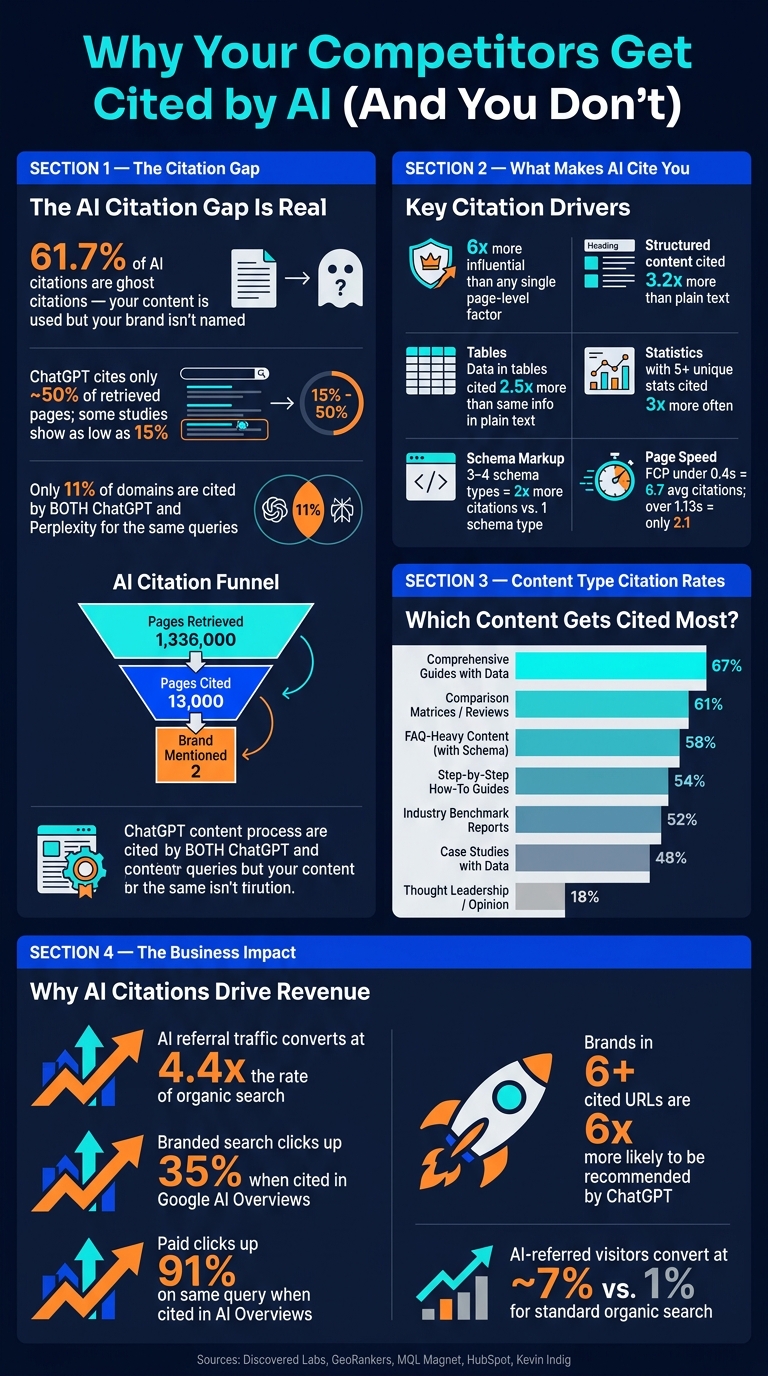
It's important to distinguish between a citation and a mention. A citation includes a direct link to your URL, while a mention simply references your brand name in the response text. These don't always go hand in hand. In fact, 61.7% of AI citations are "ghost citations" - instances where the AI links to your site but doesn't actually name your brand in its answer[9]. Essentially, your content gets used, but your brand misses out on direct recognition.
"The link is there. The brand mention is not. This is what I like to call a ghost citation: the AI using your content doesn't mention you in the answer." - Kevin Indig, Growth Advisor[9]
Let’s take a closer look at how AI decides which sources to cite.
How AI Decides What to Cite
Most AI platforms rely on a process called Retrieval-Augmented Generation (RAG). When a user asks a question, the AI doesn't just pull from its pre-existing knowledge. Instead, it actively searches the web, finds relevant pages, evaluates them, and crafts an answer based on those sources[6].
However, just because your content is retrieved doesn't guarantee a citation. For example, ChatGPT may pull dozens of URLs for a single query but only cites about 50% of them[10]. Some studies suggest the percentage is even lower, with just 15% of retrieved pages earning a spot in the final answer[13]. The AI prioritizes sources based on factors like clarity, credibility, and direct relevance.
One of the biggest factors? Domain authority. It’s roughly six times more influential than any single page-level factor[11]. Beyond that, how closely your content matches the language users use when asking questions plays a major role.
"Prompt-content alignment is your number one lever. Pages whose words and phrasing match how your buyers actually ask questions show a standardised effect roughly three times larger than the next-strongest page-level signal." - Ben Moore, Co-founder, Discovered Labs[11]
Different AI platforms also have their own preferences. For instance:
- ChatGPT leans toward authoritative, encyclopedic content - Wikipedia alone accounts for nearly 48% of its top citations[3].
- Perplexity tends to highlight fresh, community-driven sources like Reddit[3].
- Google AI Overviews pulls heavily from its search index, with YouTube as its most-cited domain[8].
Interestingly, only 11% of domains are cited by both ChatGPT and Perplexity for the same queries[3]. This highlights how citation patterns vary across platforms, making it impossible to rely on a single strategy.
These selection processes have a direct impact on how people perceive and engage with your brand.
How AI Citations Affect Business Growth
AI citations are more than just a nice-to-have - they can significantly influence how potential customers view your brand before they even visit your site. When an AI tool cites your product or content, it’s not just directing traffic; it’s giving your brand an endorsement. This implicit trust can translate into measurable results.
For example, brands cited in Google AI Overviews see 35% more organic clicks from branded searches and 91% more paid clicks on the same query[2][8]. Plus, visitors who come through AI-generated referrals are often pre-qualified, meaning they’re more likely to convert. AI referral traffic has a conversion rate 4.4 times higher than traditional organic search[1]. In some cases, AI traffic boasts a 7% conversion rate, compared to just 1% for standard organic results[4].
The benefits compound over time. Brands featured in six or more cited URLs are roughly six times more likely to be recommended by ChatGPT than those with fewer citations[5]. The more often your content is cited, the stronger your credibility becomes, creating a cycle of trust and recognition.
sbb-itb-9cd970b
How to Build AI Citations | Charlie Marchant | Whiteboard Friday 4k
Why Competitors Get Cited and You Don't
AI Citation Statistics: Why Your Brand Gets Ignored by AI Tools
Authority and Trust Signals
AI engines don’t just evaluate individual pages - they assess brands as entities. When your brand becomes synonymous with its industry or category, it’s more likely to be cited automatically when users ask category-level questions [14]. The consensus around your brand also plays a big role. For example, brands that appear consistently across platforms like G2, Reddit, and industry publications are 2.8 times more likely to show up in ChatGPT responses than those with a scattered online presence [7].
Inconsistent branding can be a major roadblock. If your website refers to your company as a "platform", but your G2 profile calls it a "tool", AI systems may struggle to form a clear and unified understanding of your brand [14].
"AI engines cite entities, not just pages. The brand that becomes the recognized noun in a category gets cited automatically when buyers ask category-level questions." - MQL Magnet [14]
Here’s an example: A B2B SaaS company specializing in data security initially showed up in only 8% of 50 buyer-intent prompts, crafted using effective AI prompts, while its leading competitor appeared in 94%. By focusing on consistent branding, third-party mentions, and stronger independent signals over six months, the company boosted its citation rate to 34% [14].
But it’s not just about being recognized as an entity - how you structure and optimize your content can also make or break your chances of being cited.
Content Structure and Formatting
AI models love content that’s easy to extract. In other words, your content needs to present clear, self-contained answers without requiring extra interpretation [15].
"If your content forces the model to do interpretive work, the model will find something structured in a way that is easier to break apart." - Cassie Wilson Clark, Marketing Strategist [15]
Websites with features like clear headlines, bullet points, and well-organized data are cited 3.2 times more often than those that rely solely on long paragraphs of text [16]. Data also shows that AI-cited articles typically include 4.2 statistics and 1.6 expert quotes per piece, compared to just 1.2 statistics and 0.2 quotes in non-cited articles [17].
Even the placement of your content matters. AI engines tend to extract information from the top third of a page, with the average cited paragraph appearing at a depth of just 0.36 [11].
And if you want to stay relevant, keeping your content fresh and specific is crucial.
Content Freshness and Specificity
In fast-evolving industries like SaaS and AI, content has a shelf life of about 90 days. Regularly updating your pages signals AI systems to re-evaluate and keep your content in their selection pool [15].
Specificity is another key factor. A targeted page like "What is the average cost of X in 2026?" will consistently outperform a sprawling 5,000-word guide that only briefly mentions costs [18]. AI prioritizes content that answers a single question thoroughly over pages that skim multiple topics.
Original data can give you an even greater edge. Pages with five or more unique statistics are cited roughly 3 times more often than those without [1]. When competitors publish proprietary research or surveys, they create content that AI engines have to cite because no one else offers that data. Combining these strategies strengthens your brand’s authority and makes your content stand out to AI systems.
How to Make Your Brand AI-Citable
Write Content AI Can Easily Process
How you structure your content is just as important as what you write. AI systems don’t read pages like humans - they scan for clear, standalone pieces of information they can extract. If your main points are buried in dense paragraphs, they might get overlooked.
"The fundamental unit of content in AI search is not the page. It is the extractable assertion." - GeoRankers Research Team [7]
To make your content more AI-friendly, include a 40–80 word answer block directly under each H2 heading. This provides AI with a concise, easy-to-cite statement right where it’s most likely to look. Why does this matter? Because 44.2% of AI citations come from the first 30% of an article, while only 24.7% come from the last third [7].
Tables can also boost your content’s visibility. Data presented in tables is 2.5 times more likely to be cited than the same information in plain text [7]. If your site relies heavily on JavaScript, take note: AI crawlers like GPTBot can’t always process content that loads client-side. Pre-rendered HTML is essential for ensuring your content is accessible [7].
Once your content is structured for AI, focus on the types of content that are most likely to be cited.
Focus on High-Value Content Types
Not all content formats are equal in the eyes of AI. Certain types have much higher citation rates, and knowing which ones to prioritize can make a big difference. Comprehensive guides with data tables top the list, earning citation rates of 67%, followed by comparison matrices and product reviews at 61% [19].
| Content Type – Citation Rate | Citation Percentage |
|---|---|
| Comprehensive Guides with Data | 67% |
| Comparison Matrices / Reviews | 61% |
| FAQ-Heavy Content (with Schema) | 58% |
| Step-by-Step How-To Guides | 54% |
| Industry Benchmark Reports | 52% |
| Case Studies with Data | 48% |
| Thought Leadership / Opinion | 18% |
FAQ sections are another powerful tool. Pages with 10 or more questions see a 156% increase in citation likelihood [19]. The trick? Make sure each question reflects how real users phrase their queries, and ensure every answer can stand on its own.
"If your content uses different terminology than how users actually ask questions, you won't surface in answers - even if your traditional SEO metrics look strong." - Matthis Duarte, Senior SEO Strategist, Knownful [3]
While individual pages play a role, your brand’s overall credibility also impacts how often AI cites your content.
Improve Site-Wide Signals
Your website’s technical setup can have a big influence on how AI systems view your brand. A few strategic changes can enhance your site’s credibility and visibility.
First, make sure your site is accessible to AI crawlers. Update your robots.txt file to allow bots like GPTBot, OAI-SearchBot, PerplexityBot, and ClaudeBot to index your content. Adding an llms.txt file to your root directory can also help by offering AI crawlers a clear map of your key pages [3].
Schema markup is another critical factor. Pages that use 3–4 schema types (such as Article, FAQPage, and BreadcrumbList) earn twice as many citations as those with only one [3]. Linking your brand to authoritative sources like LinkedIn, Crunchbase, and Wikidata via the sameAs property can further boost your citation rate by 3x [20].
Lastly, don’t underestimate the importance of page speed. Pages with a First Contentful Paint under 0.4 seconds average 6.7 citations, while slower pages (over 1.13 seconds) drop to just 2.1 citations [7].
In 2026, Ash Metry, founder of Keywords.am, saw his site’s AI search visibility jump from 3% to 13% in just two weeks after implementing technical fixes and conducting a prompt audit [22]. This example shows the untapped potential for brands that address these foundational elements.
Tracking and Monitoring AI Citations
Once you've optimized for AI, the next step is to track how often your brand gets mentioned and evaluate the business impact of those mentions.
Check AI Platforms for Brand Mentions
Start with a manual check. Head to platforms like ChatGPT, Perplexity, and Google AI Overviews and try a few targeted queries. Use prompts such as "what is [your brand]?", "[your brand] vs. [competitor]", or "best tools for [your category]." If your brand doesn’t show up, it could mean competitors are dominating that space.
Analytics tools can also help you uncover trends. For instance, in GA4, filter by session source/medium for domains like chatgpt.com or perplexity.ai to identify traffic coming from AI platforms. ChatGPT referrals often include a ?utm_source=chatgpt.com parameter, while Google AI Overviews might append a #text= fragment to URLs. This data not only shows if AI is driving traffic but also how that traffic performs. On average, AI-referred visitors convert at about 7%, compared to just 1% for traditional organic search [4].
"Mentions show whether your brand is part of the conversation. Citations show whether your content is shaping it." - Zoe Ashbridge, Author, HubSpot [4]
To scale this effort, consider using specialized tools designed to track citations automatically.
Tools for Monitoring AI Citations
Manual checks are a good start, but dedicated tools offer a broader and more detailed look at your AI citations. These tools can run numerous prompts across multiple AI platforms and provide ongoing tracking of your citation share.
| Tool | Platforms Monitored | Core Advantage |
|---|---|---|
| HubSpot AEO | ChatGPT, Perplexity, Gemini | Links citation data to content workflows [4] |
| BrandCited | 9 platforms (e.g., DeepSeek, Llama) | Offers 91 audit checks and schema analysis [25] |
| Trakkr | ChatGPT, Claude, Gemini, Perplexity | Tracks citation position and competitive share [12] |
| ZeroRank | ChatGPT, Gemini, Google AIO | Provides sentiment analysis and prompt tracking [24] |
| Citingly | Major AI Engines | Highlights content gaps blocking citations [26] |
Many of these tools also offer free initial scans. For example, HubSpot AEO Grader, Ahrefs AI Visibility Checker, and BrandCited provide no-cost audits to help you get started [4][23][25]. Brands that use these tools often see a 43% increase in citation rates, making them a worthwhile investment for deeper tracking [25].
How to Assess Citation Quality
Tracking citation volume is important, but the quality of those citations matters just as much. A mention - where your brand name appears - is helpful, but a citation that includes a direct link to your site is far more impactful for building authority and driving traffic [4][27].
Positioning is another key factor. Content ranked at the top has a 58% chance of being cited, while items further down (e.g., position 10) see that chance drop to 14% [13]. Additionally, it’s important to monitor sentiment. Tools like ZeroRank and Trakkr can help you identify whether your brand is framed positively (e.g., "industry leader") or negatively (e.g., "overpriced option") [24][12].
"AI visibility is not a project. It's a monitoring discipline." - Sebastian Mueller, The Citation Lab [29]
A helpful metric to track is the Mention-to-Citation Gap. This is the difference between your citation rate and visibility rate. If this gap exceeds 25 percentage points, the issue is often technical - such as missing schema markup, poor canonical tags, or crawl errors - rather than a lack of brand awareness [28]. Identifying and addressing these issues can significantly improve your results.
Conclusion: Building a Lasting AI Presence
Getting cited by AI isn’t just a one-time achievement - it’s a discipline that requires constant effort. The brands being cited today didn’t get there by accident. They focused on building recognizable identities, structuring content for easy extraction, earning mentions on trusted third-party platforms, and keeping their pages updated.
And the stakes are high. With 40% to 60% of AI citations changing every month [22], the visibility you gain today can disappear just as quickly if you don’t stay on top of things. This means your content and technical foundations need consistent attention to maintain relevance.
The rewards, however, are worth it. Visitors referred by AI convert at 14.2%, far outpacing the 2.8% conversion rate from traditional Google search [31][21]. For SaaS companies, the difference is even more striking - 57.84% versus 37.17% [21]. This isn’t just about getting noticed; it’s about driving real revenue.
"The brand that does the consistent effort for two years becomes the default citation in its category for the decade after." - MQL Magnet [14]
To secure your spot as a trusted AI citation, you need a strategy. Start with the basics: check your robots.txt file to ensure AI crawlers like OAI-SearchBot and PerplexityBot aren’t being blocked [30][21]. Audit your third-party profiles on platforms like G2, Crunchbase, and LinkedIn to make sure your brand description is consistent everywhere [14]. From there, focus on creating answer-first content, implementing structured schema, refreshing your pages every 90 days, and earning third-party validation. Brands that treat AI visibility as a core part of their strategy will become the go-to answer in their category.
FAQs
How can I tell if my brand is being cited by AI tools?
To find out if AI tools are referencing your brand, try running relevant searches in incognito mode. Keep an eye out for mentions of your brand in AI-generated responses, and check if your website is being linked as a source. Additionally, you can use AI citation tracking tools to monitor mentions across platforms like ChatGPT and Google AI. These tools can give you insights into your brand's reach and influence.
What’s the fastest way to make my pages easier for AI to cite?
To improve the chances of AI citing your pages, focus on creating clear and concise answer capsules at the beginning of each section. Use headings framed as questions and provide standalone, factual statements that are easy to understand. Incorporate structured data, such as FAQ schema, to make your content more accessible. Regular updates to your content and ensuring fast page load times are also key. By emphasizing clarity, organization, and keeping your content up to date, you can increase its appeal to AI systems.
What technical issues often prevent AI crawlers from citing my site?
The most frequent problems include blocking AI crawlers in your robots.txt file and JavaScript-rendering failures. Disallow rules in robots.txt often prevent many AI bots from accessing your content. Similarly, content that's dynamically loaded without server-side rendering can be invisible to these bots. On top of that, server issues like 5xx errors and rate limiting can also obstruct crawlers.
To address these issues and improve citations, make sure your robots.txt file allows access for AI bots. Also, consider implementing server-side rendering to ensure your content is fully visible to them.