The Anti-AI-Agency Red Flags Checklist: 9 Signs Before You Sign

Most AI agency risk starts before the work starts. If I were hiring an AI agency today, on September 10, 2026, I’d screen for 9 things right away: vague scope, weak proof, tool-only talk, big promises, bad reporting, fuzzy ownership, SaaS mismatch, unnamed staff, and lock-in contracts.
The reason is simple. In 2025, 42% of companies abandoned most of their AI work, up from 17% the year before. And 46% of AI proof-of-concepts got scrapped before production. For a B2B SaaS team, that can mean lost budget, lost time, and flat pipeline.
Here’s the lesson: judge the system, not the pitch. At AGL, the bar is clear with Tango. Humans decide. Machines repeat. Nothing ships without approval. That is how a small team can run many marketing departments, ship more, avoid an AI stack to babysit, and keep delivery tight.
If I were reviewing an agency, I’d check:
- Scope: what ships in 30, 60, and 90 days
- Proof: SaaS case studies with baseline and outcome
- Process: workflows, approvals, and version control
- Claims: no hard promises before data review
- Reporting: CRM-linked reports tied to pipeline and SQLs
- Ownership: prompts, workflows, dashboards, and exports in writing
- Fit: GTM motion, ACV, sales cycle, and stage
- Staffing: named owners and response SLAs
- Contract: short terms, milestones, and exit rights
A fast rule helps.
- 0 to 1 high-risk flags: move ahead
- 2 to 3: push edits
- 4+: walk away
The point is not more AI activity. The point is output that shows up in delivery, retainers, and agency value at sale. Take this checklist into your next agency call and score the answers live.
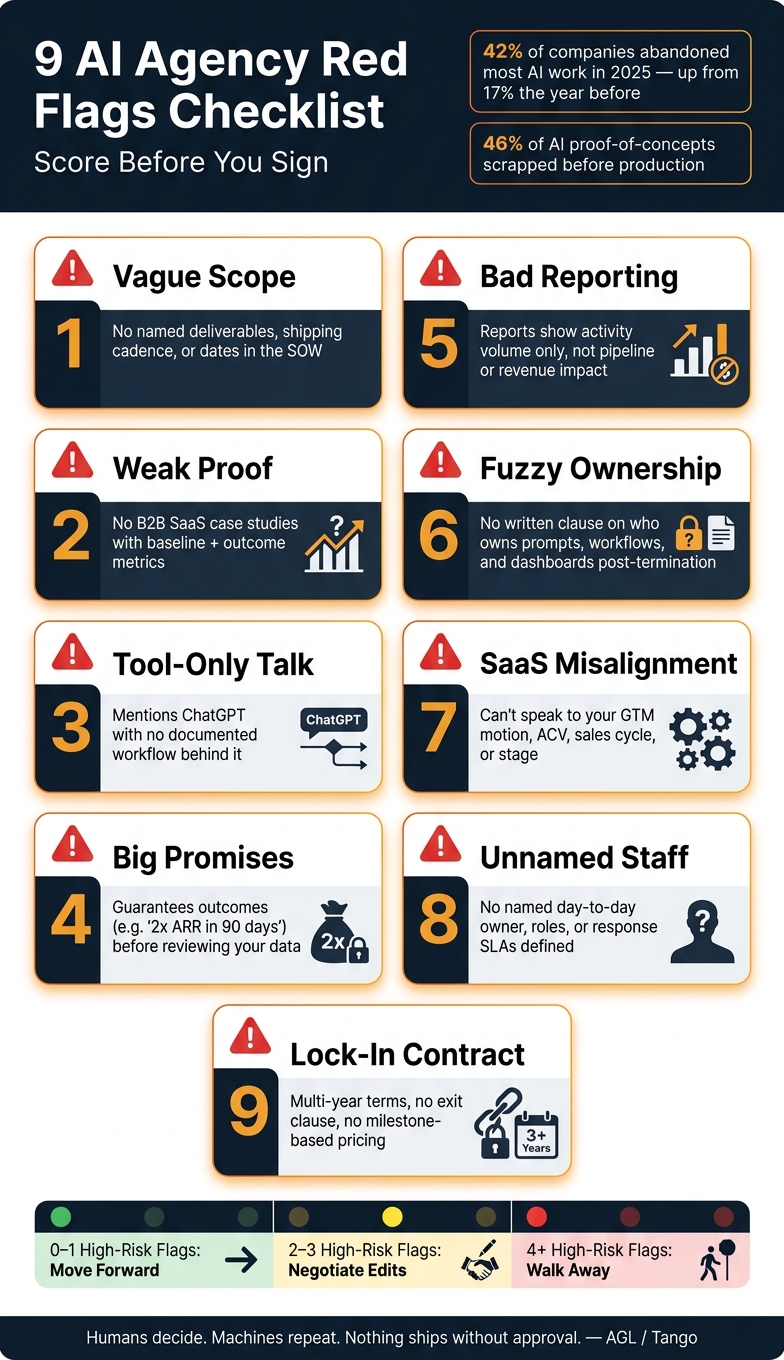
9 AI Agency Red Flags Checklist: Score Before You Sign
The One Video That Exposes Every Fake AI Automation Agency (5 Red Flags Before You Pay $5k/Month)
sbb-itb-9cd970b
The 9 Red Flags to Check Before You Sign
Most agencies don’t fall apart in the pitch.
They fall apart in the SOW and the contract.
That’s the part many teams rush past. Big mistake. If an agency is weak, this is where it shows. AGL learned that the hard way, then built Tango to remove the fog. Humans decide. Machines repeat. Nothing ships without approval. That’s how a small team can run many marketing departments without chaos.
Red Flags 1–3: Vague Scope, Weak Proof, and Generic Tool Dependence
Red Flag 1: Vague deliverables with no shipping cadence.
If the SOW says, “implement AI to streamline marketing workflows,” that is not a deliverable.
A good SOW names what ships, how often, and when. For example: 4 net-new outbound email sequences per month, each A/B tested, with QA sign-off, plus biweekly review meetings on Tuesdays at 10:00 a.m. PT.
If timing is missing, scope turns into a fight.
Red Flag 2: No B2B SaaS case studies with real numbers.
Generic wins don’t mean much.
Ask for case studies with 3 things:
- company type
- baseline
- outcome
This is the level you want: “Reduced SDR research time by 35% and added $750,000 in qualified pipeline in Q3 for a U.S. B2B SaaS client.” Without SaaS pipeline or ARR proof, don’t assume they can run your motion. [1][2][3]
AGL’s view is simple. If the work ties to pipeline, you should be able to show it. That’s why Tango is built around repeat work, review steps, and reporting that points back to revenue.
Red Flag 3: ChatGPT or AI assistants with no workflow behind them.
A tool is not a system.
Anyone can say they use ChatGPT. That tells you almost nothing. What matters is the workflow behind it. Who does what? What gets checked? Who approves it? How are versions tracked?
If an agency can’t show the process, they are working on the fly. That does not scale.
Red Flags 4–6: Unrealistic Claims, Weak Reporting, and Unclear Asset Ownership
Red Flag 4: Guaranteed outcomes before reviewing your data.
Bad agencies sell certainty too early.
If someone says, “we’ll 2x your ARR in 90 days” or “guarantee 80% automation of your marketing” before looking at your data, that’s not confidence. That’s a warning.
A serious team checks your CRM data, conversion rates, ACV, and sales cycle first. Then they talk in ranges, with clear assumptions.
That’s how AGL works with Tango. The system helps produce more. It does not skip judgment.
Red Flag 5: Reporting that stops at activity volume.
Activity is not the same as impact.
If the report only shows how many emails went out or how many tasks were done, you still don’t know what changed in the business.
Ask for a CRM-linked dashboard. Revenue-grade reporting should connect work to your CRM and track AI-influenced opportunities, pipeline value, and sales-cycle change in dollars and days.
If they can’t show a sample dashboard tied to CRM data, they are not set up for SaaS accountability. [1][3][4]
This is one place where AGL gets paid back for process. Tango keeps work moving, but the point is not more motion. The point is more output you can trace.
Red Flag 6: Unclear asset ownership at termination.
If ownership is fuzzy, expect trouble later.
Some agencies keep control of the prompts, automation workflows, dashboards, and data artifacts they built for your GTM motion. That means you may pay for the work and still lose access when the deal ends.
Here’s the contract test:
| Dimension | Client-Owned Assets | Agency-Controlled Assets |
|---|---|---|
| Post-termination access | Full access to all assets | Restricted or revoked |
| Export rights | Defined (JSON, CSV, playbooks) | Undefined or not addressed |
| Reuse rights | Client can iterate freely | Must re-license or rebuild |
| Documentation | Version history and playbooks included | Opaque, no handoff materials |
If transfer at termination is not spelled out in plain English, assume you won’t get it back.
Red Flags 7–9: SaaS Misalignment, Opaque Staffing, and Bad Contract Structure
Red Flag 7: An agency that cannot speak your GTM language.
Not all growth motions work the same way.
A poor-fit agency may push high-volume, low-touch automation into a high-ACV sale with a 180-day sales cycle and a buying group with many people in it.
A serious agency asks about your GTM motion such as PLG vs. sales-led, your stage such as Seed vs. Series C, your ACV, your sales cycle, and your core stack before they tell you what to do.
If the plan ignores your motion, stage, ACV, or sales cycle, move on.
Red Flag 8: Unnamed staffing.
If you don’t know who is doing the work, you don’t know what you bought.
Clear delivery means naming the day-to-day owner, spelling out roles like strategist and automation engineer, and setting SLAs. For example, response to critical issues within 4 business hours.
Without that, there’s no clean line of ownership.
AGL built Tango for this exact reason. A small team can do a lot, but only when roles are clear and approval rules are fixed.
Red Flag 9: A contract built to lock you in, not to deliver results.
The pricing model tells you a lot.
Some deals are built around shipped work. Others are built to trap you in a retainer. That difference matters.
| Dimension | Milestone-Based Pricing | Lock-In Pricing |
|---|---|---|
| Contract length | 90-day or 6-month terms | Multi-year with no exit clause |
| Pricing tied to | Shipped workflows and milestones | Fixed monthly retainer |
| Risk-sharing | Discovery at fixed fee, build linked to deployment | No performance linkage |
| Change orders | Transparent process defined | Undefined or penalized |
| Fit | SaaS motion, ACV, and stage reflected | One-size-fits-all playbook |
| Staffing transparency | Named pod, defined SLAs | No named pod or SLA |
Use short terms. Use milestone pricing. Use clear exit clauses.
That one move will save you from most bad agency deals.
What Good Looks Like in an AI Agency
Most agencies do not fail because they lack ideas.
They fail because the work lives in slides, not in a system.
That is the line to watch before you sign. A good AI agency should show you how work moves, how it gets checked, and who says yes before anything goes live.
The Minimum Standards Your SOW and Reporting Should Include
A good SOW should read like a product plan.
Each deliverable needs a clear name, shared owners, a definition of done, and a fixed sprint cadence, like 2-week sprints starting 10/01/2026 with reviews every other Friday at 2:00 PM PT. [5][7]
The acceptance criteria should be testable. It should also tie to a business metric.
For example, the SOW might say increase demo requests by 15% quarter-over-quarter or reduce average first-response time by 30% within 60 days. It should spell out the metric, the baseline, and the measurement window. [5]
If the SOW is real, the reporting should be just as specific.
It should connect to your CRM, product analytics, and attribution tools. You should also see weekly ops reporting and monthly or quarterly executive summaries. [5][7]
This is where a lot of agency deals fall apart. The promise sounds sharp. The paper does not.
Signs the Agency Has a Real Operating System Behind the Pitch
A strong SOW only matters if the agency can show the process behind it.
Ask to see documented workflows, SOPs, named owners, and SLAs. Request anonymized workflow examples, internal runbooks, and screenshots of their coordination system. Ask to speak with a delivery manager, not just a salesperson. [6]
You can spot process quality in the small stuff.
Look at how they manage prompts, revisions, and approvals. The best teams treat prompts like code. They are version-controlled, documented, tested, and reviewed. They keep a prompt library with the owner, purpose, update date, and test results. [8][9]
Human review should also be clear by risk level.
Outbound sales emails and customer-facing messages need human sign-off. Low-risk internal summaries may run on their own. The agency should define which outputs need human sign-off and which can run automatically. [10][11]
This is the lesson.
Humans decide. Machines repeat. Nothing ships without approval.
That is how Agile Growth Labs runs many marketing departments with a small team. Tango documents and orchestrates the delivery workflows behind the work, not just the client-facing tasks. That internal discipline is what separates an agency that can scale from one that is winging it. [6]
The real test comes when work goes sideways.
Ask to review escalation paths, incident postmortems, and change logs. If they cannot show those, the pitch is ahead of the process.
Before you sign, ask for 1 real workflow, 1 approval path, and 1 reporting sample. That will tell you more than the deck ever will.
How to Vet Agencies Using This Checklist
Most agency deals are won in the pitch, then lost in the fine print.
That’s the shift. A strong vetting process is not about who sounds smart on a call. It’s about who can show the work, tie it to a metric, and put it in writing. That matters even more when you run marketing for many clients at once.
At AGL, that’s how we think about delivery with Tango. Humans decide. Machines repeat. Nothing ships without approval. That setup helps a small team run many marketing departments without a messy AI stack to manage. The point is simple: judge the system, not the pitch.
Turn the 9 red flags into a 3-pass review:
- First call
- Proposal review
- Contract negotiation
Questions to Ask on the First Call and in Proposal Review
On the first call, use the checklist like a script. Do not let the agency lead the whole talk.
Ask:
- Scope and timeline: What exactly ships in the first 30, 60, and 90 days?
- SaaS metrics: Which SaaS metrics are you explicitly targeting in the first 90 days, qualified pipeline, activation rate, expansion revenue, ticket resolution time, and how will you measure movement?
- Operating model: Show a weekly operating cadence for a SaaS client.
- Tools vs. process: Walk through 1 concrete automation you've built, including triggers, data sources, and hand-offs to humans.
Then do 2 things.
First, test the answers.
Then, check the SOW.
During proposal review, go line by line. The SOW should be tight enough to manage against, not just read once and forget.
Look for:
- Specific deliverables, go-live dates, and the SaaS metric tied to each one so the work can be tracked in dashboards
- What reports you get, on which dates, and in what format
- Proof behind any automation claim, such as 70% of customer support in 60 days, with 2 prior SaaS case studies that show ticket volume, CSAT impact, and changes in FTE allocation
- Any fees beyond the monthly retainer, and what happens to fees if agreed milestones are missed
If a risk is not answered in the proposal, turn it into a contract edit. Do not leave it as a verbal promise.
Use contract negotiation to close every gap the proposal exposed. Turn each high-risk flag into a clear SOW edit, reporting rule, or exit clause. Spell out who owns prompts, workflows, code, integrations, and any model or environment access before you sign.
Simple Scoring Sheet for Side-by-Side Agency Comparison
Log each answer. Score the risk right after the call. That gives you a clean side-by-side view.
| Red Flag | Evidence Provided | Risk Level (L/M/H) | Contract Impact |
|---|---|---|---|
| Vague scope & deliverables | SOW lists 90-day roadmap with dated, named assets | Low | Clear milestones for payment and review |
| No proven SaaS case studies | One generic case study, no SaaS metrics or ARR context | High | Hard to benchmark impact; higher execution risk |
| Overreliance on generic tools | Only mentions ChatGPT with no workflow diagrams | High | Risk of shallow automation, low ROI |
| Unrealistic automation claims | Claims 80% support automation, no prior examples | High | Potential churn if expectations aren't met |
| Weak reporting standards | Monthly report, no metric definitions or dates | Medium | Hard to attribute impact to agency work |
| Unclear ownership of assets | No clause on prompt/workflow IP | High | Assets may be lost or locked in at exit |
| SaaS domain misalignment | Mostly e-commerce portfolio | Medium | Learning curve; slower impact |
| Opaque staffing & delivery model | Unnamed or part-time delivery team | Medium/High | Accountability issues; communication friction |
| Bad contract structure | Long lock-in, no performance checkpoints | High | Hard to exit; misaligned incentives |
Use the scorecard to compare agencies on evidence, not pitch quality. [12][13]
0–1 high-risk flags: move forward.
2–3: negotiate.
4+: walk away.
That’s the lesson. Good agency buying is not about trust first. It’s about proof first. If you want the kind of delivery AGL builds with Tango, where a small team produces more, approvals stay with humans, and output stays tight, start by forcing that level of clarity in the vetting stage.
Action: take this checklist into your next agency call and score the answers live.
Conclusion: Use This Checklist to Avoid Costly AI Agency Mistakes
Here’s the part many agency owners miss: the sale is not the win. The handoff is. A smooth pitch can still hide a messy system.
That matters more with AI work. Once you sign, getting out can cost 2.3× to 5.7× the first spend and take 18 to 36 months.[14] One weak deal can drain revenue, slow your team, and cut into SaaS profit margins and EBITDA for years.
That’s why your bar should be high before any signature hits the page.
Good agencies show clear process, clear ownership, and clear reporting. They tie work to revenue, efficiency, or EBITDA. They can explain who does what, how work gets checked, and what happens if things miss the mark.
At AGL, that standard comes from Tango. Humans decide. Machines repeat. Nothing ships without approval. That’s how a small team can run many marketing departments without adding an AI stack to babysit. The result is more output, tighter delivery, and room for higher retainers.
If an agency can’t explain its system with that kind of clarity before kickoff, don’t expect clean delivery after kickoff.
The Decision Filter to Use Before Any Signature
Use 1 filter before you sign.
Get written answers to all 9 red flags. Push on scope, ownership, reporting, staffing, and exit terms. If any part stays vague, walk away.
No gray area. No “we’ll sort it out later.”
If the agency cannot close every gap in writing, do not sign.
FAQs
How do I score an AI agency quickly?
Your agency is not buying AI. You are buying output.
That is why the best AI partners do not lead with big claims. They lead with proof. AGL runs many marketing departments with a small team using Tango. Humans decide. Machines repeat. Nothing ships without approval. That is how you get more done without adding a messy AI stack to manage.
Start by scoring an AI agency on measurable outcomes and technical fit.
Look at proven SaaS case studies first. Skip generic promises. You want to see what they shipped, what changed, and how they worked. AGL ties this to the Tango system, where repeat tasks are handled in a set flow and people stay in control. That is the point. More output. Better delivery. No extra tool chaos.
Then ask for their exact workflow.
Not “Do you use ChatGPT?”
Ask how work moves from brief to draft to review to approval. Ask what is automated, what is checked by a person, and what gets stored in your systems. If they cannot explain that in plain English, that is a red flag.
Focus on 4 areas:
- Integration with your CRM and stack. The agency should fit into how your team already works.
- Clear reporting and KPIs. You need simple numbers tied to the bottleneck they are fixing.
- Ownership of prompts, data, and assets. Your agency should keep control of what gets built.
- A 90-day pilot. Start with 1 bottleneck before you sign any long-term contract.
That last point matters most.
A short pilot tells you more than a polished sales call ever will. Pick 1 stuck point. Maybe it is reporting, content production, QA, or CRM follow-up. Then judge the agency on output, speed, and how much work your team had to do to keep it moving.
That is the lesson. Judge the system, not the pitch.
If you want a partner that works this way, look at how AGL uses Tango to help a small team run more client marketing without losing control. Start with 1 bottleneck. Then see what the system can do.
What should I get in writing before I sign?
Before you sign, get the contract clear on ownership and data control.
Your business should keep full ownership of everything. That includes the data you give the vendor, the data made during the work, the prompts, and all assets made from that work.
Spell out what happens at the end, too. The contract should confirm data deletion when the deal ends, including any related model weights. It should also give you full data portability and control, so your agency is not stuck inside a closed system.
How can I tell if an agency fits my SaaS model?
The best agency fit often comes down to 2 things. Proof and process.
Look for agencies with proven SaaS case studies, clear reporting, and workflows that fit your CRM and tech stack. AGL does this with Tango. Humans decide. Machines repeat. Nothing ships without approval. That’s how a small team can run many marketing departments without the usual mess.
The focus should stay on results you can track, like MRR growth or retention. Not loose promises. Not generic AI tools by themselves. Tools do not run client work. Systems do.
You should also confirm data ownership up front. Ask who owns the prompts, assets, accounts, and outputs. Make sure policies are clear and written down.
Avoid agencies that hide data inside master accounts or can’t explain ownership rules in plain English. That setup can trap your clients and make your agency harder to run, and harder to sell.
If you’re looking at agency partners now, ask to see the case studies, reporting view, and ownership policy before you sign.