What $60M in Data Licensing Tells You About the Value of What You Already Know

Companies often overlook the revenue potential of the data they generate daily. But here's the reality: data licensing is a growing, highly profitable market. With profit margins of 90–98%, licensing data can transform operational byproducts into significant income streams.
Key takeaways:
- Reddit earns $60M/year licensing user-generated content to AI companies.
- News Corp secured a $50M/year deal with OpenAI for its publications.
- AI training data alone generated $800M in 2025, projected to grow to $2–$3B by 2027.
If you’re not monetizing your data, you’re leaving money on the table. Start by identifying your most marketable datasets, packaging them into actionable insights, and building a scalable licensing framework. Even small datasets can bring in $10K–$100K annually, while larger ones can generate millions.
The time to act is now - data monetization must evolve is no longer optional; it’s a competitive edge.
The Problem: Most Companies Ignore Their Data Assets
Where Proprietary Data Lives in SaaS and AI Companies
SaaS and AI companies generate an enormous amount of data every day, yet many fail to realize its potential as a revenue driver. This data is tucked away in various corners of the business, including CRM logs, product usage statistics, workflow records, user behavior patterns, and AI interaction histories. The table below breaks down common data sources and how they can be turned into revenue opportunities:
| Data Source | Captured Data | Revenue Potential |
|---|---|---|
| Interaction/Behavioral | User clicks, navigation paths, feature usage | Insights for benchmarking and improving UI/UX |
| Workflow/Log Data | Task completion times, process bottlenecks | Standards for efficiency and predictive operational tools |
| Signal/Event Data | Job changes, funding rounds, tech adoption | Sales intelligence and intent tracking |
| Outcome Data | User success metrics, quantified ROI | Performance indexes and trend forecasting |
Identifying where your data lives is just the starting point. The real challenge lies in turning that raw information into a valuable asset.
What Stops Companies from Monetizing Their Data
Despite the potential, many companies struggle to monetize their data for several reasons. One of the biggest hurdles is what’s known as "accounting invisibility." Under accounting standards like IAS 38, the costs associated with collecting and organizing data are treated as immediate expenses. As a result, internally developed data assets often don’t show up on the balance sheet, effectively making them invisible to leadership [3]. And if an asset isn’t visible in financial reports, it’s unlikely to become a strategic priority.
Another roadblock is how companies view their data. Instead of treating it as a valuable asset, they see it as a byproduct of operations. Mark Hillier, CCO and Co-Founder of Opagio, sums it up perfectly:
"Raw data is a liability. Governed data is an asset." [3]
Regulations like GDPR and CCPA are also often seen as obstacles rather than opportunities to improve data quality and value. This mindset leaves companies unable to tap into the full potential of their data, which can have serious financial repercussions.
The Cost of Doing Nothing with Your Data
Leaving data untouched isn’t a neutral choice - it has real financial consequences. Ignoring these assets not only means missing out on additional revenue streams but also losing competitive ground. Companies that build strong data ecosystems often achieve valuation premiums of 5x to 10x their revenue, compared to only 2x to 5x for those that don’t [3]. This difference grows over time as competitors use their data to create self-reinforcing advantages, or ""data flywheels", that get stronger with every user interaction [3].
Here’s how the two approaches stack up:
| Feature | SaaS-Only Model | SaaS-Plus-Data Model |
|---|---|---|
| Valuation Premium | 2x–5x revenue [3] | 5x–10x revenue [3] |
| Revenue Streams | Subscriptions only | Subscriptions + licensing + insight services |
| Competitive Moat | Technology (easily copied) | Data (strengthens over time) [3] |
| Customer Retention | Tool utility | Insights integrated into workflows [4] |
Lisa Moschkau, a Data and Analytics Strategist at Analytics8, points out a key oversight:
"The connection most leaders miss: the work required to unify, govern, and trust your data for internal use is the same foundational work that makes data viable for external monetization." [5]
In other words, the same infrastructure you build for internal analytics and AI can also pave the way for external revenue opportunities. Failing to act doesn’t just mean missing out on licensing income - it can also lead to slower product development, lower company valuations, and a growing disadvantage compared to competitors who are already leveraging their data.
sbb-itb-9cd970b
Data monetization best practices. Your data is your product - start making money from it!
The Solution: A Framework for Monetizing Your Data
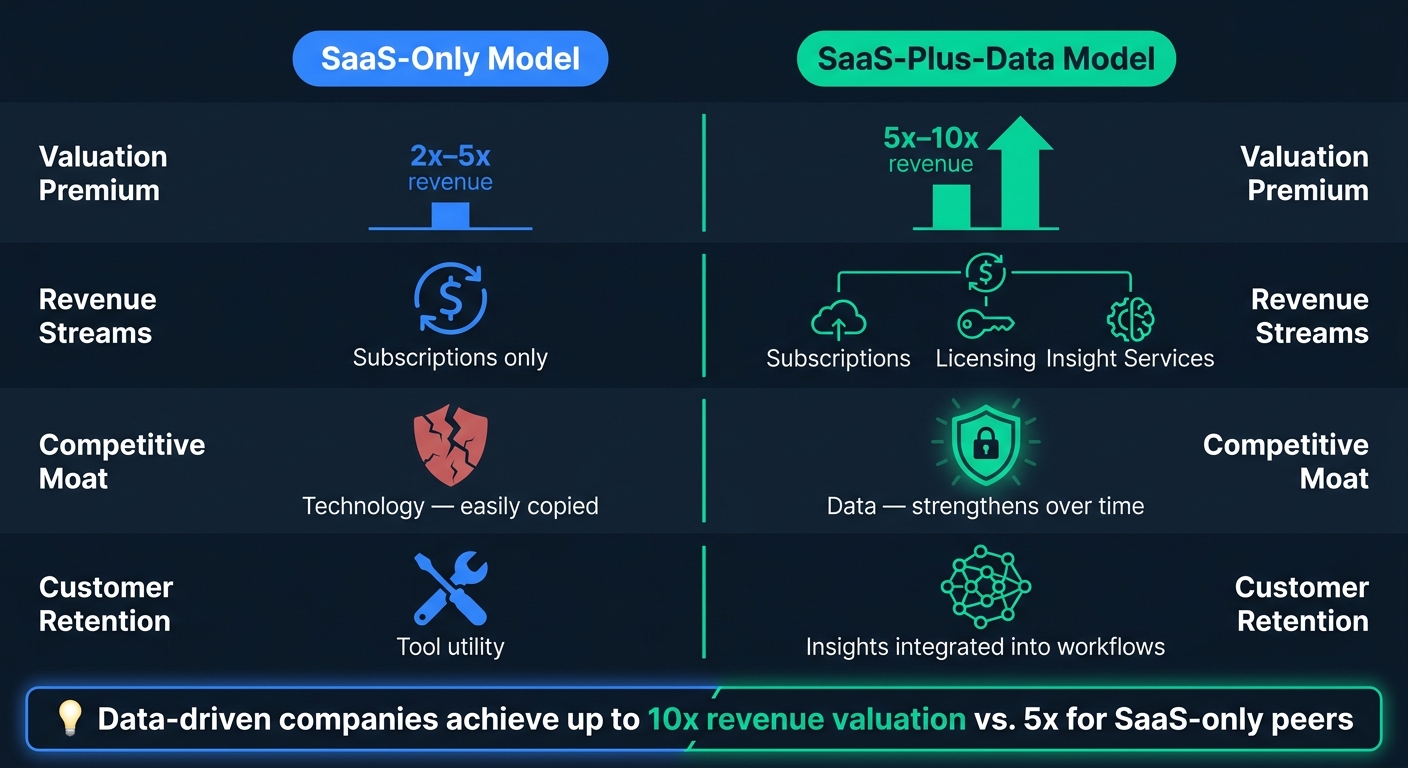
SaaS-Only vs. SaaS-Plus-Data Model: The Revenue Gap
How to Find Your Most Marketable Data Assets
Start by conducting a thorough audit of your datasets. Evaluate their uniqueness, quality, and commercial relevance. Ask yourself: Can competitors easily access this data? Is it up-to-date and complete? Does it help users make faster or better decisions?
Here's a simple benchmark to assess your data's potential:
| Metric | Weak | Average | Strong |
|---|---|---|---|
| Data uniqueness (% not available elsewhere) | <20% | 20–60% | >60% |
| Data-driven revenue (% of total) | <10% | 10–40% | >40% |
| Data completeness score | <70% | 70–90% | >90% |
| Time to derive insights | Weeks | Days | Real-time |
Data with less than 20% uniqueness has limited potential, while datasets exceeding 60% uniqueness indicate a strong competitive edge [3].
Focus on signal and event data - like job changes, funding rounds, or technology adoption trends. These datasets are highly valuable but degrade quickly, requiring updates every 24–48 hours. Despite this, they can command impressive market rates, ranging from $75,000 to $300,000 annually for category-level access [2].
Identifying your most valuable data assets is just the beginning. Packaging them effectively is key to unlocking their revenue potential.
How to Package Data into Market-Ready Products
Turning raw data into actionable insights is essential for monetization. Buyers don’t want unstructured numbers - they want insights that are ready to use. The most successful data products are packaged into formats like:
- API Passthrough: Offers real-time data enrichment.
- Batch Sync: Provides historical data for in-depth analysis.
- Push Feed: Sends alerts for new events as they occur.
- Embedded Analytics: Integrates insights directly into workflows.
Pricing models have shifted to focus on value-based outcomes. Common structures include per-record pricing ($0.005–$0.05 per record per month at scale), tiered volume deals, and revenue share agreements (5–20% of attributable revenue) [2]. Adding exclusivity to your offering can increase pricing by 25–50% [2].
Once your data is packaged and priced, you’ll need a solid licensing framework to protect it and ensure scalability.
How to Build a Legal and Scalable Licensing Framework
Data privacy isn’t a roadblock - it’s a cornerstone of data monetization [3]. A strong legal framework safeguards your intellectual property and builds buyer trust, making your data more valuable.
Your license agreement should address these four key areas:
- Scope of Use: Clearly define how buyers can use your data. Prohibit resale or verbatim reproduction unless explicitly allowed.
- Redistribution Rights: If buyers embed your data into their own products (OEM model), ensure the contract allows it.
- Audit Rights: Include provisions for third-party audits if payment discrepancies exceed 5% [2].
- Termination and Data Deletion: Require buyers to delete your data and remove any model weights trained on it after the contract ends [6].
On the operational side, ensure your delivery system supports schema stability. Any changes to your data schema should include at least 30 days' notice to avoid disrupting buyers' systems [2]. Start with a six-week paid pilot before committing to long-term contracts. This allows both parties to test the data's accuracy and performance in real-world scenarios, reducing risks for everyone [2].
Tools That Make Data Licensing Easier
SaaS and AI Tools That Support Data Monetization
The right tools can transform raw data into products that are ready for the market, drastically reducing the time and effort needed to launch. Once you've established a legal framework, these tools let you bypass the need for a large engineering team and hit the ground running.
A common challenge in data monetization is data preparation. Platforms like RightData's DataMarket leverage AI to streamline metadata harvesting, identify sensitive information (PII), and map relationships across data silos. These tasks, which once took weeks of manual effort, are now automated. RightData reports a 90% decrease in manual cataloging efforts and a 60% faster time to actionable insights [10]. Additionally, by delivering well-structured and governed data products, the platform boosts AI model accuracy by 40% - a significant advantage for buyers building AI solutions on your data [10].
When it comes to packaging and distribution, Monda offers a seamless way to create product listings and sync them across major marketplaces like Snowflake, Databricks, and Google Cloud - all without requiring custom engineering. In 2024, a company called Redmob leveraged Monda to build a 7-figure data business in just a year, doubling its revenue by targeting qualified buyers and speeding up sales cycles [12]. Currently, Monda supports over 500 data providers and manages more than 6,000 data products [9][11].
"Monda is the only multi-marketplace solution available for data providers: it's the only platform enabling you to publish on data marketplaces within seconds, as opposed to months." - Monda [9]
For buyers like AI agents rather than human analysts, tools such as OnDB and Spartera simplify the process further. OnDB converts APIs and databases into paid endpoints, automating tasks like routing, per-query settlement, and discovery through a skills.md file - eliminating the need for manual billing or contracts [7]. Meanwhile, Spartera allows sellers to encapsulate verified analytics logic into callable objects, enabling agents to query directly. Sellers retain 80% of every query fee, reflecting a shift toward granular, usage-based pricing models [8]. These tools are part of a broader movement toward pay-per-query pricing models, moving away from traditional flat-rate subscriptions.
| Tool | Focus | Pricing Model |
|---|---|---|
| RightData (DataMarket) | Governance, PII detection, metadata | Enterprise licensing |
| Monda | Multi-marketplace publishing | Subscription-based |
| OnDB | AI agent endpoints | Per-query (HTTP 402) |
| Spartera | Verified analytics products | Per-query (80/20 revenue split) |
How Top SaaS & AI Tools Directory Helps You Scale Data Licensing
Selecting the right tools for data licensing is no small task. The stack often includes platforms for governance, packaging, delivery, and subscription management - each with its own set of specialized options. This is where the Top SaaS & AI Tools Directory comes in, centralizing your search and simplifying the evaluation process.
Instead of spending weeks researching which tools integrate with your data warehouse or meet compliance standards like GDPR and CCPA, the directory allows you to filter by key features like integration capabilities, security certifications (e.g., ISO 27001), and pricing models. It also highlights no-code solutions alongside enterprise-grade platforms, making it easier to find tools that align with your needs. Beyond data monetization, the directory connects these tools to broader SaaS growth strategies, helping founders focus on scaling recurring revenue streams like MRR.
Conclusion: Your Data Can Generate Real Revenue
The $60M deal discussed earlier highlights a key point: valuable insights have always been hidden in plain sight within accessible data. This principle applies directly to your business. Support tickets, transaction records, behavioral patterns, and niche insights sitting in your systems could become the foundation for a profitable licensing revenue stream - similar to the strategies we've explored. As Lisa Moschkau, Data and Analytics Strategist at Analytics8, puts it:
"The connection most leaders miss: the work required to unify, govern, and trust your data for internal use is the same foundational work that makes data viable for external monetization." [5]
But this opportunity isn't going to last forever.
The global data monetization market is expected to hit $41.25 billion by 2034 [13], and the demand for AI training data is growing rapidly, with projections of a 50–70% compound annual growth rate through 2027 [1]. Regulatory changes, like the EU AI Act, are also pushing companies toward licensed data agreements, creating even more opportunities for businesses ready to act.
So, where do you start? It’s easier than you might think. Start by auditing your data assets, updating your service terms to allow sublicensing, and focusing on one high-value use case. Even small data catalogs can bring in $10,000–$100,000 annually [1], while larger datasets are already generating between $500,000 and $5 million per year [1]. The potential is there - it's just waiting for you to take the first step.
FAQs
What data can I legally license without violating privacy laws?
When it comes to licensing data, legality starts with ethical collection practices. This means obtaining proper consent and ensuring compliance with privacy laws like GDPR. To stay on the right side of the law, it's crucial to manage data responsibly and maintain transparency throughout the process.
For added protection, prioritize using anonymized or aggregated data. This approach not only safeguards individual privacy but also allows you to monetize insights without crossing ethical or legal boundaries.
How do I price a data product if I don’t know its market value?
To price a data product when its market value isn't clear, emphasize its practical benefits and the added value it delivers to decisions or operations. Explore pricing models that align with factors like specific use cases, the volume of data provided, or the size of the customer base. Additionally, you can rely on valuation strategies such as estimating the revenue it generates or the costs it helps save (income-based approach) or calculating the expense required to replicate the data (cost-based approach) to shape your pricing strategy.
What’s the fastest way to launch a paid data licensing pilot?
The quickest approach is to launch a small-scale pilot program with your current customers. Choose a sample group from your audience and offer them paid access to your data. This allows you to track important metrics, assess how it performs in practical scenarios, and tweak things as necessary. It’s a low-risk way to demonstrate value and accelerate your decision-making process.