The Window Is Closing. Brands That Wait Will Pay More and Win Less.

If you’re still delaying the adoption of AI-driven SaaS, you’re already falling behind. Competitors are not just reducing costs - they’re pulling ahead in productivity, customer engagement, AI-powered content generation, and revenue. By early 2026, 87% of marketers were using generative AI daily, up from 51% in 2024. Many leverage an AI prompt repository to maintain this daily pace. The costs of waiting? Missed opportunities, rising expenses, and a widening gap that’s harder to close. Here’s what you need to know:
- AI is now standard: 78% of SaaS tools have AI baked in, making it a baseline for businesses - not an optional upgrade.
- Financial impact: Delaying AI adoption could cost mid-sized businesses $8,000–$15,000 monthly due to inefficiencies.
- Customer expectations: Buyers now demand instant, personalized, AI-driven interactions. Without AI, your brand risks invisibility.
- Rising costs: Early adopters lock in lower rates, while latecomers face usage-based pricing and higher entry costs.
Acting now can cut costs, boost productivity, and future-proof your operations. The longer you wait, the more expensive and less effective catching up becomes.
Market Shift: AI and SaaS Are Now the Baseline, Not the Edge
From Early Adopter Perk to Industry Standard
Just a couple of years ago, AI was seen as a competitive advantage. Today, it’s become a must-have. The SaaS market has already surpassed $300 billion in 2026, growing by 18% annually [7]. And here’s the kicker: 78% of SaaS products now include AI as a core feature, not just an optional upgrade [7]. The shift is undeniable - 89% of marketing teams were using AI daily by early 2026 [8]. Teams that started adopting AI in 2024 are now producing over four times more content per marketer [6]. This isn’t just a small improvement; it’s a game-changer. The gap between early adopters and those lagging behind is growing wider, making it harder for latecomers to catch up.
"AI has transitioned from a premium add-on to a foundational capability. SaaS vendors that fail to embed AI risk rapid commoditization." - SaaSStatsHub Annual Report [7]
What Late Adoption Actually Costs You
Delaying AI adoption isn’t just about missing out on cool features - it’s a financial and operational setback. Teams that integrated AI in 2024 saw their productivity more than double by 2026 and reduced their payback periods from nearly 8 months to just over 4 months [6]. These tools quickly start paying for themselves, but only if you act early.
AI automation also frees up time. On average, marketers using AI regain between 6 and 8 hours each week [6][8]. For a team of 10, that’s an extra 300 to 400 hours every month. Without AI, teams are slower, less efficient, and stuck paying higher labor costs for work that AI could handle in minutes. And as customer expectations evolve, these inefficiencies become even more glaring.
How Customer Expectations Have Changed
It’s not just internal processes that are shifting - your audience’s expectations are, too. AI is reshaping what customers expect from brands. As of now, 86% of marketers say AI has raised the bar across all channels [10]. Buyers want instant, personalized, and conversational interactions, reflecting the seamless experiences they get from AI-powered tools.
Even the way customers discover brands is changing. Half of Google searches now feature AI-generated summaries that bypass traditional websites [10]. Meanwhile, AI-driven platforms like Perplexity and ChatGPT Search are driving 11% to 18% of B2B discovery traffic [6]. If your brand isn’t optimized for these new channels, you risk becoming invisible to a growing number of potential buyers.
"Our entire world as marketers - the ability to generate leads - will rise and fall as to whether or not we understand the essentials of Answer Engine Optimization (AEO) in the coming months and years ahead." - Marcus Sheridan, Co-Founder, AI Trust Signals [9]
Relying on outdated methods like manual outreach and traditional SEO is no longer enough. In an AI-driven market, sticking to old habits is like competing with one hand tied behind your back.
5 Ways AI and Automation are Transforming SaaS in 2025
The Financial Case: Why Waiting Means Paying More and Getting Less
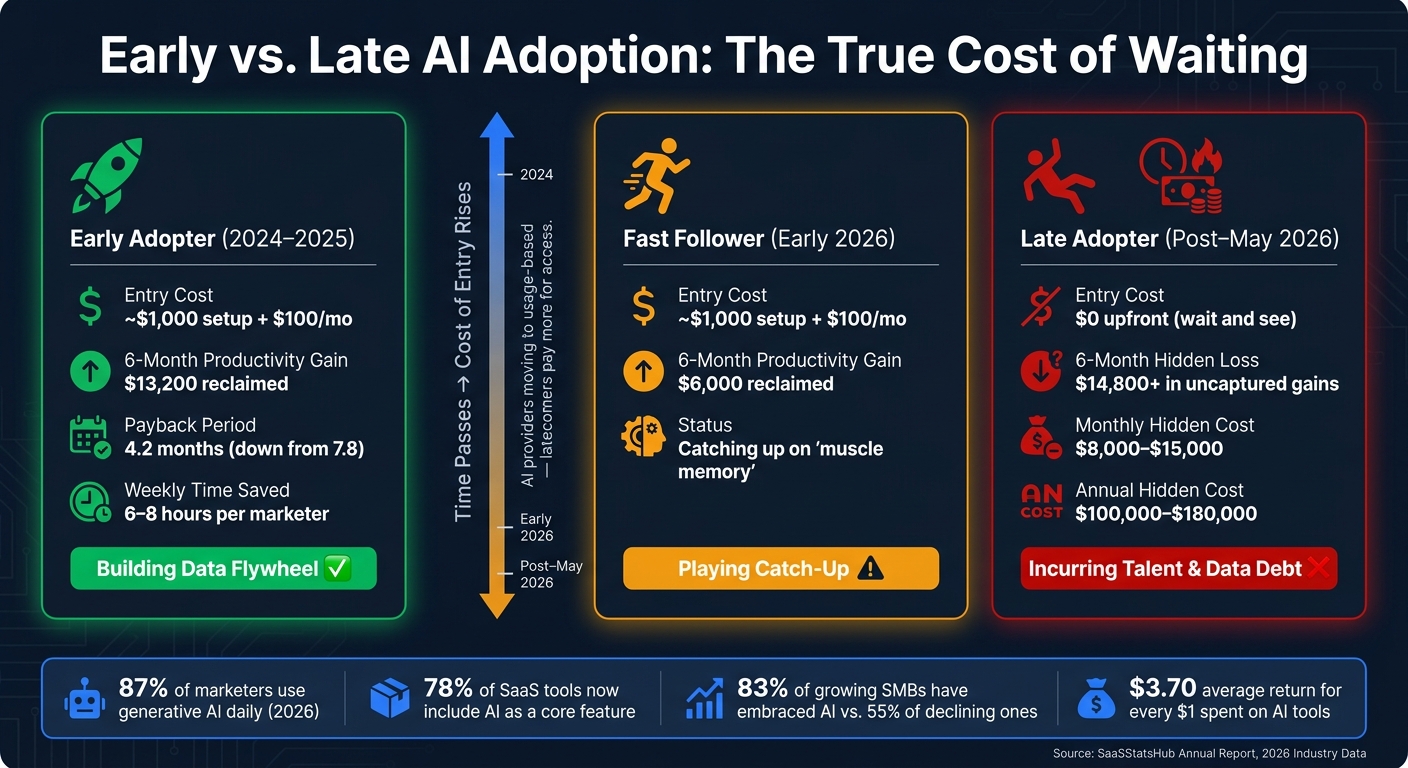
Early vs. Late AI Adoption: The True Cost of Waiting (2024–2026)
Early vs. Late Adoption: A Side-by-Side Cost Breakdown
Delaying the adoption of AI tools can lead to higher costs and missed opportunities. For example, the median payback period for AI investments decreased from 7.8 months in 2024 to just 4.2 months in 2026 [1]. This means early adopters are seeing faster returns on their investments compared to those who wait.
| Scenario | Entry Cost | 6-Month Outcome | Competitive Position |
|---|---|---|---|
| Early Adopter (2024–2025) | ~$1,000 setup + $100/mo | ~$13,200 in reclaimed productivity [14] | Building a proprietary data flywheel [15] |
| Fast Follower (Early 2026) | ~$1,000 setup + $100/mo | ~$6,000 in reclaimed productivity | Catching up on "muscle memory" [1] |
| Late Adopter (Post–May 2026) | $0 (Wait and see) | $14,800+ in uncaptured gain and owed debt [14] | Incurring talent and data debt [15] |
This table shows how waiting shifts expenses from visible subscription fees to hidden productivity losses. Furthermore, as AI infrastructure investments surge toward a $700–$750 billion run-rate by 2026 [4], providers like OpenAI and Anthropic are moving toward usage-based pricing models. This means late adopters will likely pay more for access, while early adopters enjoy locked-in rates at lower costs.
Outdated technology setups only add to these challenges, creating inefficiencies and unnecessary expenses.
The Hidden Price of Outdated and Fragmented Tech Stacks
Beyond the obvious costs, sticking with outdated or poorly integrated systems creates ongoing expenses that are easy to overlook. For a mid-sized business, the hidden cost of not using AI ranges from $8,000 to $15,000 per month, or $100,000 to $180,000 annually [1]. These losses stem from slow workflows, manual data entry, and senior employees spending valuable time on tasks AI and sales tools could handle in minutes.
Using fragmented systems compounds the problem. Every disconnected tool introduces an "integration tax", consuming 1–3 hours per integration per month just for monitoring and fixing issues [16]. For a support team managing 50 tickets daily, constant tool-switching wastes 4–8 hours of productivity every day [16]. Developers, too, spend 20–30% of their time maintaining outdated systems - tasks like API updates and data normalization that don’t drive growth [3].
| Feature | Legacy / Fragmented Stack | AI-Ready SaaS Stack |
|---|---|---|
| Maintenance | 20–30% of dev time on upkeep [3] | Vendor handles all updates and infrastructure [3] |
| Data Flow | Siloed; manual connectors required [16] | Unified data layer; real-time visibility [16] |
| Response Time | Business hours only; slow to convert [11] | 24/7 instant response via AI agents [11] |
| Scalability | Requires linear headcount growth | Scales output without adding headcount [12] |
"Building reporting from scratch wasn't a strategic investment, it was overhead dressed up as control." - NinjaCat [3]
Revenue Loss and Market Share You Won't Get Back
For a $5 million B2B company, failing to adopt AI could cost over $420,000 annually [13]. This includes:
- $80,000–$180,000 in wasted senior employee time spent on tasks like drafting reports.
- $200,000–$800,000 in lost deals due to slow response times.
- $200,000–$300,000 in unnecessary headcount costs.
These losses don’t just hurt profit margins; they weaken a company’s ability to compete. Early adopters are creating data infrastructure and operational habits that compound over time. 83% of growing small businesses have embraced AI, compared to just 55% of declining ones [1]. This isn’t a coincidence - it’s a direct cause-and-effect relationship. Staying updated with the latest SaaS and AI insights is essential for maintaining this competitive edge. Companies that act early gain speed, efficiency, and cost advantages, making it increasingly difficult for latecomers to catch up.
Once competitors secure top spots in AI-powered search rankings, personalized outreach, and automated customer journeys, reclaiming lost market share becomes a monumental challenge. The longer you wait, the more it costs - and the smaller the rewards.
AI-Driven SaaS Tools Your Brand Needs to Adopt Now
The Core Tools Every Modern Brand Stack Needs
Did you know the average U.S. company juggles about 47 marketing tools but actively uses only 12 daily? This inefficiency leads to a staggering $96 billion in global SaaS waste each year[17]. The way forward isn’t adding more tools - it’s about building a smarter, more focused stack. The ideal setup? A three-tier structure: a unified CRM at the core, a workflow automation layer connecting your systems, and an integrated reporting interface to track revenue[21].
"The 'best of breed' era is over... The future isn't 50 specialized tools. It's operating systems that handle entire workflows." - The AI CMO[17]
Consolidating tools into integrated AI platforms doesn’t just save money; it also eliminates the inefficiencies of constant tool-switching. On average, tool-switching eats up 23% of marketers' productive time every day[17]. Brands that consolidate have seen campaign launch times shrink from weeks to minutes and SaaS costs drop by as much as 90%[17][18]. A streamlined stack not only reduces waste but also lays the groundwork for impactful AI-driven solutions.
High-ROI AI Use Cases to Focus On First
Once your stack is streamlined, you can quickly implement AI applications that deliver measurable results. Start with areas where AI can replace repetitive tasks with real-time, data-based decisions.
One of the easiest wins? AI-driven lead scoring. Companies that adopt this approach often see a 47% improvement in sales-accepted lead rates within just 90 days[22]. Take Rachel Okonkwo, VP of Marketing at a $34M ARR SaaS company. In late 2025, she shifted her team’s focus from content tools to AI-powered lead scoring integrated with product usage data. The results? A 52% boost in sales-accepted leads and a reduction in the sales cycle from 67 days to 44 days - all within three months[22].
Agentic AI for outbound sales and support is another game-changer. In early 2026, a Series-D cybersecurity SaaS implemented a multi-agent demand-generation system using Claude 3.5 Sonnet and 6sense intent data. This upgrade resulted in a 4.2x increase in SQL conversion rates and $14.2 million in new pipeline revenue, effectively replacing manual prospecting efforts[20]. Similarly, a Fortune 500 SaaS company deployed an AI support agent through Amazon Bedrock, achieving a 75% Tier-1 ticket deflection rate and saving $2.1 million annually in support costs[20].
"Generative AI is a skilled contractor. Agentic AI is a coworker who owns the outcome." - Your Marketing People[19]
If you’re looking for quick ROI, prioritize use cases like predictive lead scoring, AI-enhanced email campaigns, autonomous agents for 24/7 chat qualification, and AI-assisted content creation. Marketers who focus on these areas report a 20% increase in ROI and a 19% reduction in costs[5].
Using SaaS and AI Marketplaces to Find the Right Tools Faster
With thousands of AI SaaS products launching every quarter, finding the right tools can feel overwhelming. That’s where curated directories come in handy.
Agile Growth Labs is one such resource. It’s a directory tailored to lead generation, marketing automation, sales optimization, and customer engagement. What sets it apart? Tools are organized by how they fit into real workflows - not just by what’s trending. Agile Growth Labs also offers structured comparisons across key categories like CRM, outreach, content, and analytics. Plus, they provide a waitlist for exclusive training and curated tool recommendations, making it easier for teams to get started.
When evaluating tools - whether through a marketplace or independently - keep these six factors in mind: use-case fit, integration depth, data residency, pricing model, vendor stability, and exit cost[23]. For example, a solo founder might prioritize pricing flexibility, while an enterprise team would focus on vendor reliability and data security. Before adding anything new, audit your existing tools. Most teams only use 40–60% of their current tools’ capabilities[21]. Canceling tools that haven’t been accessed in 90 days can save 30–40% of your SaaS budget[17].
How to Roll Out AI SaaS Without Losing Control
A Phased Rollout Plan That Starts With Quick Wins
The biggest misstep companies make with AI SaaS isn't choosing the wrong tool - it’s trying to tackle too much, too soon. Taking a phased approach helps minimize risks and builds confidence within your team early on.
Start by mapping out your current workflows to identify where AI can make an immediate impact. Before integrating AI, ensure your CRM data is clean and accurate. Aim for at least 80% completeness on critical fields like contact owner, company size, and deal stage to guarantee reliable results [24][26].
From there, follow a five-phase plan: diagnose high-impact opportunities, design a workflow blueprint, build a staging environment, pilot with a 60-day test, and finally, scale to full production [27]. The goal is to have a functional system in staging by week 6 and a full rollout by week 12.
"A production rollout by week 7 is essential." - Lilach Bullock, Marketing Consultant [27]
To keep the process on track, assign a single person to lead the rollout. Committees often slow progress and create confusion. A dedicated leader ensures quicker decisions and faster issue resolution [25]. This structured approach not only reduces risks but also positions your company to gain the competitive edge of early AI adoption.
Once your rollout plan is solid, it’s time to evaluate AI tool stacks carefully to match your strategy.
How to Vet Vendors and Avoid Common Pitfalls
Not every tool labeled "AI-powered" actually delivers. An audit of European AI startups revealed that about 40% lacked any real AI functionality in their products [30]. Meanwhile, the costs for GPT-3.5-class capabilities have plummeted - making it easy for vendors to slap an "AI" label on tools that are essentially basic automation [30].
Here’s a quick test: if a skilled engineering team could replicate the tool’s AI features in two weeks, it’s likely just a wrapper - not a genuine AI solution [30]. When assessing vendors, focus on these five practical criteria:
| Criterion | What to Look For |
|---|---|
| Use-Case Fit | Does it address a specific need in your workflow rather than just looking impressive in demos? |
| Integration Depth | Offers direct CRM integration (e.g., HubSpot, Salesforce) instead of relying on third-party connectors [24]. |
| Security & Compliance | Certifications like SOC 2 or ISO 27001 and clear data residency policies [24]. |
| Pricing Transparency | Calculate total costs: (Price × Seats × 12) + onboarding, training, migration, and support [29]. |
| Exit Terms | Allows clean data exports, avoids proprietary lock-in formats, and provides reasonable notice periods [23]. |
Before committing to a vendor, conduct a 14-day trial using three real workflows from your team. Test the tool on days 2, 7, and 12. If it can’t handle your actual workflows by day 12, move on [29]. Also, 30 days before contract renewal, reassess the vendor using your criteria to avoid getting stuck with auto-renewals [23].
After selecting the right tool, the next step is to focus on tracking performance and fine-tuning.
Tracking ROI and Adjusting as You Go
Less than 40% of marketing teams can currently prove the value of their AI investments [32]. The solution isn’t more data - it’s focusing on the right data from the outset.
Start by setting baseline metrics before launch. Use a three-tiered framework to measure success: adoption metrics (are people using the tool?), efficiency metrics (is it saving time?), and business outcomes (is it driving revenue?). If adoption doesn’t improve within the first 30 days, investigate immediately. Most issues stem from training gaps or workflow mismatches, not the tool itself [25].
Here’s a breakdown of common AI SaaS use cases and their related benchmarks:
| AI SaaS Use Case | Key KPI | Target Benchmark |
|---|---|---|
| Predictive Lead Scoring | Conversion rate / sales productivity | 30–50% improvement [31] |
| Email Automation | Click-through rate / revenue per email | 13–41% increase in CTR [31] |
| Conversational AI (Chat) | Lead response time | Under 90 seconds [28] |
| Customer Service AI | Support ticket volume / resolution time | 30–50% reduction [25] |
| General Tool Adoption | Daily active users (DAU) | 60–80% of licensed users [25] |
| Onboarding Speed | Time-to-first-value | Under 14 days [25] |
Don’t forget to allocate 20–30% of your implementation budget for post-launch refinement and additional training [25]. The first 90 days are critical for setting the stage for long-term success. Once the system is live, make sure to retire old spreadsheets and outdated tools. If the old methods remain accessible, people will default to them [25].
Conclusion: The Window Is Open Now - Here Is How to Move
91% of SMBs using AI report revenue growth[33], and U.S. small businesses are seeing an average return of $3.70 for every $1 spent on AI tools[34]. These numbers make one thing clear: hesitation comes at a cost. Every moment you wait not only adds to your expenses but also gives competitors more time to strengthen their position.
"The window for small and medium-sized businesses to gain a genuine competitive advantage through AI is not closing - it is right now." - Loucas Protopappas, NeuralCoreTech[33]
The time to act is now. Start by tackling your data - cleaning it up is a quick, one-week task that delivers more impact than spending a month testing tools. Follow that with a 90-day focus on implementing a high-impact workflow. This short period is enough to see measurable results and start benefiting from AI’s compounding effects[2].
To make the transition smoother, here’s a phased roadmap to guide you from planning to execution. By breaking the process into manageable steps, you can integrate AI into your operations without overwhelming your team:
| Phase | Timeline | Focus Area | Key Action |
|---|---|---|---|
| Foundation | Days 1–30 | Data & CRM | Audit your data and activate AI features in tools like HubSpot or Salesforce. |
| Distribution | Days 31–60 | Ad Creative & Content | Test creative tools from multiple vendors to enhance your campaigns. |
| Optimization | Days 61–90 | Search & Generative Engine Optimization | Implement structured data and FAQ schema to improve AI-driven search visibility. |
| Personalization | 6 Months+ | Revenue & LTV | Deploy a Customer Data Platform (CDP) and start personalizing marketing at scale with predictive modeling. |
This roadmap offers a clear path forward, ensuring every step moves you closer to measurable gains and long-term success.
FAQs
What’s the fastest AI SaaS “quick win” I can launch in 30 days?
Want to see results fast? Add an AI-powered inbound lead qualification agent to your website. Here's why: Studies reveal that responding to leads within five minutes can boost qualification rates by an astounding 21 times compared to waiting just 30 minutes. Timing is everything.
With tools like Ovox and Outgrow, you can set up conversational agents that work around the clock. These agents can greet visitors, qualify leads, and even schedule meetings - all without requiring a single line of code. In no time, your website transforms into a 24/7 conversion powerhouse.
How do I prove AI ROI without building a complex attribution model?
To demonstrate AI ROI without relying on a complicated attribution model, start by zeroing in on workflows where AI functions independently. For example, you can run straightforward A/B tests by comparing AI-generated outputs - like subject lines or ad creatives - against their human-made counterparts within the same campaign. Then, measure the differences in metrics like conversion rates or click-through rates.
When it comes to efficiency, document the time and costs involved before implementing AI. After adoption, track the savings in both areas. Make it a habit to periodically review the results so you can fine-tune workflows and achieve even better outcomes.
What data should I clean before enabling AI in my CRM?
Before integrating AI into your CRM, it’s crucial to clean up your data for reliable insights. Start by auditing for duplicates, outdated records (like contacts inactive for over 12 months), and incomplete fields - aim for at least 80% field completion. Standardize formats across the board, such as using ISO codes for countries and the YYYY-MM-DD format for dates. Consolidate duplicate customer identities and assign clear ownership for critical fields. To keep your data in good shape, set up validation rules to enforce quality standards moving forward.