SEO Became the Training Data. The Brands Winning AI Are the Same Ones Winning Organic. Thinkster

If I had to sum this up in one line: the brands showing up in AI answers are usually the same brands already doing well in search.
Here’s the short version:
- AI search pulls from the web pages that already rank well.
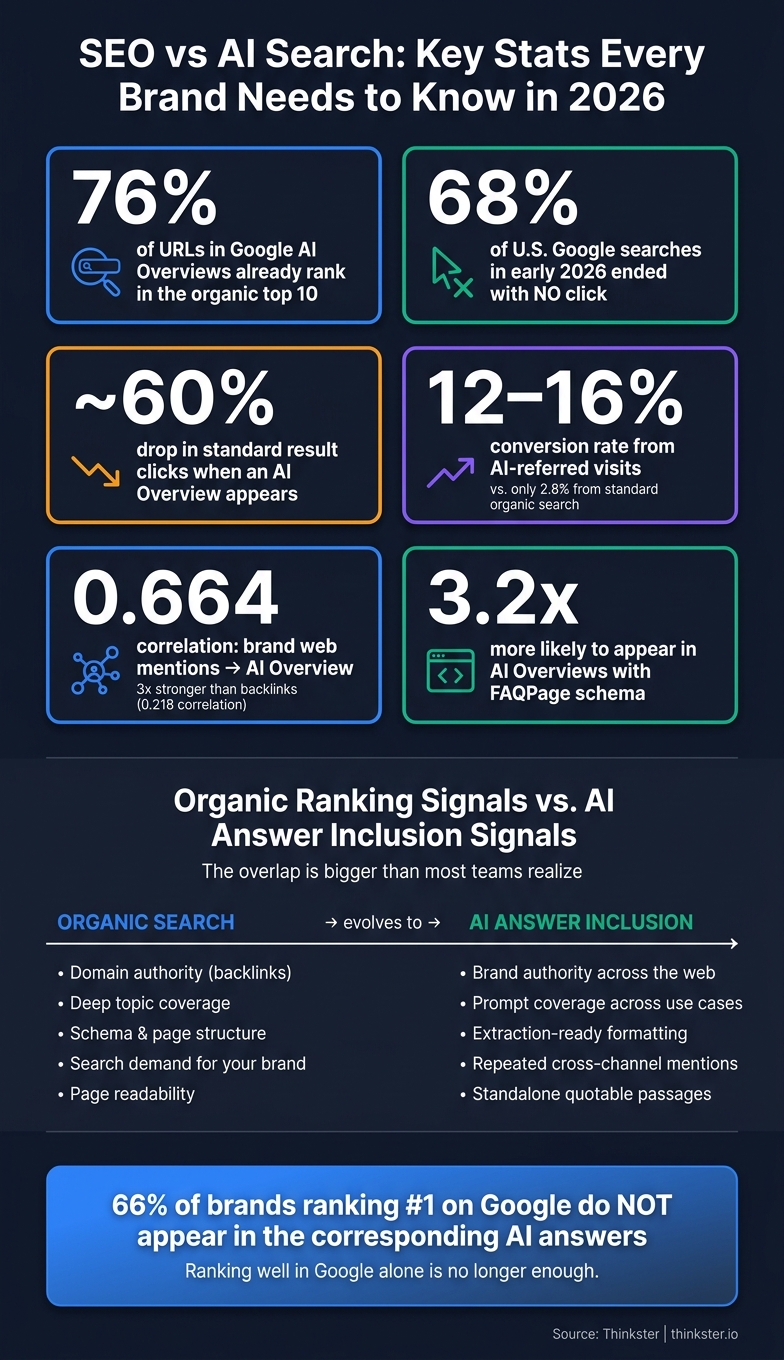
- About 76% of URLs in Google AI Overviews already rank in Google’s top 10 for the same query.
- 68% of U.S. Google searches in early 2026 ended with no click.
- When an AI Overview shows up, standard result clicks can drop by almost 60%.
- At the same time, AI-referred visits can convert at 12% to 16%, vs. about 2.8% from standard organic search.
So if I want more AI visibility, I don’t need a brand-new playbook. I need to do a few things well:
- build topic clusters around buyer problems
- format pages so AI can quote them
- add schema like FAQPage, HowTo, and Product
- keep brand details the same across my site, LinkedIn, Crunchbase, and directories
- publish data, surveys, benchmarks, and comparison pages
- track where my brand does - and does not - appear in ChatGPT, Gemini, Perplexity, and Google AI Overviews
The big shift is this: SEO is no longer just about getting clicks. It also feeds the systems that write the answers. That means my content, brand mentions, and page structure now shape whether AI engines mention me at all.
SEO vs AI Search: Key Stats Every Brand Needs to Know in 2026
Why the Same Brands Win Organic Search and AI Answers
SEO Became Part of the AI Training and Retrieval Layer
AI systems learn from public web content, so years of SEO work from established brands helped shape what those systems know [6]. That’s why SEO now affects AI visibility, not just search rankings.
You can see it with brands like HubSpot, Zapier, Salesforce, and Ahrefs. AI Overviews often cite pages that already do well in organic search. So the same content choices that help pages rank also improve the chances of getting cited.
The Signals Overlap More Than Most Teams Realize
The signals that help a page rank - deep topic coverage, clear structure, trusted backlinks, and search demand for your brand - are mostly the same signals that make a page easy for AI to quote. The emphasis changes a bit, but the base doesn’t.
There’s one big difference, though. AI models lean more on brand authority across the web than classic domain authority. In plain English, that means AI looks at how often and how consistently your brand shows up across the internet, not just how strong your own site looks.
For SaaS and AI brands, that changes the game. Visibility now depends more on what the market says about you, not only what your site says about itself. And the data backs that up: brand web mentions correlate at 0.664 with AI Overview visibility, which is about 3x stronger than the 0.218 correlation for old-school backlinks [2].
| Organic Ranking Signal | AI Answer Inclusion Signal |
|---|---|
| Domain authority (backlinks) | Brand authority across the web |
| Deep coverage of a topic | Prompt coverage across specific use cases |
| Schema and page structure | Extraction-ready formatting (answer blocks, FAQPage schema) |
| Search demand for your brand | Repeated cross-channel mentions |
| Page readability | Standalone passages AI can quote |
If your brand already has deep, well-structured content, you’re not starting from scratch. You already have the raw material. The next move is simple: make that content easy for AI systems to extract, understand, and cite.
That puts the focus on the signals you can control directly.
The Signals You Can Control to Increase AI Visibility
Build Topical Authority Through Content Clusters
Start with one buyer problem. Then build a cluster around it and cover the nearby questions in full.
For example, if your topic is CRM, don’t stop at one page. Add connected pages on what a CRM is, how to choose one, and how to implement it. A tight set of connected pages sends a strong subject-expertise signal [3]. That’s part of why brands like HubSpot, Zapier, Salesforce, and Ahrefs tend to show up across both channels.
Internal links matter here too. They help search engines and AI retrieval systems read the cluster as one connected topic, not a pile of random pages.
Use Structured Content, Schema, and Clear Entity Naming
Once the cluster is in place, make each page easy for AI systems to pull from. These systems often extract single passages, not whole pages. So each major section should open with a 40–60 word direct answer, followed by supporting detail.
Pages that use FAQPage schema appear 3.2x more often in AI Overviews [2]. Use schema types such as FAQPage, HowTo, Product, and Organization. Also connect your Organization entity to LinkedIn, Crunchbase, and Wikidata so the brand is easier to identify [3].
Answer Engine Optimization matters more than it seems. Use descriptive nouns across the page. Write "Answer Engine Optimization improves citation rates" instead of "This improves citation rates." If a passage gets pulled on its own, it still makes sense [4].
Publish High-Trust Pages and First-Party Data Assets
Good structure helps a page get retrieved. Trust helps it get cited.
That means you need material AI can quote with confidence. AI engines tend to favor sources that are easy to reuse and verify, such as original surveys, proprietary benchmarks, original frameworks, and expert-authored use-case content [4][7].
Use the table below to focus on the signals that tend to move visibility the fastest.
| Signal | How to Measure | Impact on AI Visibility |
|---|---|---|
| Structured data (FAQPage, HowTo, Product) | Schema validation / rich result presence | High: 3.2x citation probability [2] |
| Topical authority (content clusters) | Cluster completeness / internal link density | High: Increases selection for category prompts [3] |
| Entity corroboration (3rd-party mentions) | Brand mention volume across external sites | Very High: 3x stronger than backlinks [2] |
| Content freshness | Days since last substantive update | Medium: Eligibility for fast-moving queries [1] |
| Extractability (answer blocks) | Presence of 40–60 word direct answer sections | High: Essential for Gemini and Perplexity synthesis [7][2] |
| Original data / research | Citation share / earned media mentions | High: Primary source status increases citation gravity [4] |
In fast-moving SaaS and AI categories, update core pages every quarter with a new stat, example, or product change.
Top SEO Experts Build Me an AI Search Strategy (GEO)
A Problem-Solution Playbook for SaaS and AI Brands
These three failure modes help turn organic authority into AI visibility. Each fix lines up with the signal that's missing.
Problem: We Do Not Appear for Category and Use-Case Prompts
Start with a high-intent prompt audit. Run the exact buyer queries your customers use in ChatGPT, Perplexity, and Gemini:
- "best [category] tool for [use case]"
- "[brand] vs [competitor]"
- "[brand] alternatives"
If your brand doesn't show up, that gap usually points to the next content cluster you need to build.
Then check Google Search Console, Ahrefs, and Semrush to spot the high-intent conversational queries where your brand is missing or barely visible. After that, use AlsoAsked to find the follow-up questions that should become cluster pages.
Pages sitting in positions 11–20 are often the fastest wins. A few internal links from stronger pages, plus a content refresh, can move them into the top 10. That matters because roughly 76% of URLs cited in AI Overviews already rank in the organic top 10 [2].
If the category fit is clear but the brand still doesn't appear, the next issue is usually entity authority.
Problem: AI Answers Mention Competitors but Not Us
Build comparison and alternatives pages. Then work on earning mentions from the sites AI already cites.
Nearly 66% of brands ranking at the top of Google for a query do not appear in the corresponding AI answers [5]. So ranking well in Google alone isn't enough.
Comparison pages work best when they support a clear brand story across the web. Use the same category labels and value props across your website, LinkedIn bio, Crunchbase profile, and directory listings. That way, the model picks up one clear brand signal instead of a messy mix.
Brand web mentions correlate at 0.664 with AI visibility. That's roughly 3x stronger than the 0.218 correlation for old-school backlinks [2]. In plain English: if AI engines keep seeing your brand mentioned on the sources they trust, your odds of showing up go up.
Find the domains AI engines already cite in your category, then make those your top outreach targets for guest content or PR.
If the brand is clear but you're still absent, the issue is usually extractability.
Problem: Our Content Is Strong but AI Still Does Not Surface It
In many cases, the fix is formatting, not a full rewrite.
Open each main section with a 40–60 word direct answer. Swap vague pronouns for descriptive nouns so extracted passages still make sense when they're pulled out of the page. Also check AI crawler access in robots.txt. If crawlers are blocked, AI visibility can drop even when organic performance looks strong.
Use this table to match the symptom to the fastest fix.
| Observed Issue | Likely Cause | Primary Remediation Steps |
|---|---|---|
| High Google rank but 0% AI visibility | Low extractability or stale content | Reformat with 40–60 word answer blocks; add a fresh statistic or current example [1] |
| AI mentions competitors but not your brand | Weak brand authority or missing comparison content | Publish "Alternative" and "Comparison" pages; increase brand mentions on sites AI already cites |
| Not appearing for category or use-case prompts | Thin topical coverage or low organic rank | Build content clusters; push pages from positions 11–20 into the top 10 via internal links [2] |
| Brand is described inaccurately | Inconsistent brand signals across the web | Standardize category labels across all social and directory profiles; use sameAs schema [3] |
Tools, Measurement, and Next Steps
How to Find Gaps Using Search Console, Ahrefs, Semrush, and AlsoAsked
The next step is simple: figure out which signals are missing, then fix crawlability, entity consistency, and extractability.
Google Search Console is the best place to start. Look for pages with high impressions but low CTR, with extra attention on rankings in positions 11–20. Those pages often sit just outside the strongest visibility range and can be good candidates for AI Overview exposure.
Ahrefs helps you spot brand mention gaps on the domains AI engines already cite. Semrush shows which keywords in your category trigger AI Overviews. And AlsoAsked helps you map follow-up questions people ask, which can guide your H2 and H3 structure.
| Tool | Primary Use |
|---|---|
| Google Search Console | Spot high-impression/low-CTR pages and prioritize positions 11–20 for AI Overview visibility |
| Ahrefs | Find brand mention gaps on domains AI engines already cite |
| Semrush | Identify keywords that trigger AI Overviews in your category |
| AlsoAsked | Map conversational prompts to content structure |
| GA4 | Track referral sessions and assisted conversions from perplexity.ai, chat.openai.com |
It’s also worth checking your robots.txt. If it blocks AI crawlers like GPTBot, OAI-SearchBot, Google-Extended, or PerplexityBot, you may be cutting off discovery before it starts.
Track these five KPIs every month: AI citation share, brand consistency across AI answers, AI referral traffic, assisted conversions, and overview share [4][8]. That gives you a clear view of whether AI visibility is leading to revenue.
How Structured Directories Reinforce Entity and Category Signals
Once you’ve reviewed your pages and brand mentions, clean up your category labels across structured directories.
Structured directories strengthen entity signals by linking your brand to standardized category and use-case labels in a format AI retrieval systems can parse cleanly [4][5]. When your brand shows up the same way across categorized sources, AI systems are more likely to form a clear, stable entity profile around it.
That supports the same schema and category signals you’re already publishing on your own site. In plain English: if your site says one thing and trusted directories say the same thing, AI systems have an easier time connecting the dots.
Conclusion: Brands That Build Authority Now Will Own Both Channels
Use these checks to turn organic authority into repeatable AI visibility.
AI search rewards many of the same inputs as organic search - topical authority, structured content, brand mentions, and high-trust pages - but it weighs them a bit differently. This isn’t a separate playbook. It’s the same job, done with tighter execution.
"Your content is no longer a destination, but an input." - Cassie Wilson Clark, Strategist [1]
A page with clear answer blocks, accurate schema, and strong entity signals has a better shot at earning citations over time. Brands that start now - building content clusters, publishing comparison pages, standardizing entity signals, and refreshing top pages every 90 days - will be in a stronger spot as more competitors start doing the same work.
FAQs
How is AI visibility different from SEO?
AI visibility isn’t the same as old-school SEO. The goal shifts from ranking high on a results page to making sure AI systems can understand, retrieve, and cite your content when they generate answers.
SEO leans on signals like backlinks, keyword relevance, and domain authority. AI visibility leans more on content that is structured, authoritative, and easy to extract, so AI systems can interpret it and put it to use.
Why do some high-ranking pages never appear in AI answers?
Some high-ranking pages still don't show up in AI answers. The reason is pretty simple: AI models don't rely on search rankings alone.
They often lean on fixed, curated training data and outside trust signals. So even if a page ranks well in Google, that doesn't mean an AI system will pull from it.
AI systems also tend to favor sources that make their meaning easy to verify. That usually means:
- Clear entity signals
- Structured, easy-to-extract content
- Steady third-party mentions
A lot of top-ranking pages just don't have those traits, even when they perform well in search.
What should I fix first to improve AI mentions?
Start with Freshness, Structure, and Authority (FSA). Audit your top five pages and figure out what’s holding each one back: outdated content, weak structure, or low brand visibility.
Then tackle ONE issue first:
- Freshness if the content is out of date
- Structure if it feels dense or hard to scan
- Authority if the content is solid but your brand still isn’t showing up