You're Still Optimizing for Google. AI Already Moved On Without You.

Hook: Optimizing for Google? You're already behind. AI-driven discovery is reshaping how buyers find and choose products.
Key Takeaways:
- 60% of searches now end without a click, as users get direct answers from AI tools like ChatGPT, Bing AI, and others.
- AI-driven search accounts for 17% of B2B SaaS discovery and converts at 14.2%, compared to 2.8% for Google organic traffic.
- Traditional SEO strategies like backlinks and keyword density don't work for AI. 80% of AI citations come from third-party platforms, not your website.
- Buyers are skipping Google and asking AI specific, detailed questions like, “Best CRM under $50 per seat for 20-person teams that integrates with Slack.”
What You Should Do:
- Audit Your AI Visibility: Test buyer-focused prompts on AI platforms (ChatGPT, Perplexity, etc.) and track where your brand appears.
- Optimize for AI Search: Use structured data (schema markup,
/llms.txt), publish concise answers, and ensure your product is listed on platforms like G2 and Capterra. - Leverage Third-Party Mentions: Build authority by securing citations from trusted sources like Reddit, LinkedIn, and industry publications.
- Focus on Bottom-of-Funnel Content: AI prioritizes comparison pages and specific answers over general blog posts.
Why It Matters: AI-driven discovery is a "winner-takes-all" game. If your brand isn’t cited in AI-generated answers, you’re losing buyers before they even visit your site. It’s time to rethink your strategy and build for an AI-first world.
Why Google Optimization No Longer Matches How Buyers Search
How Search Habits Have Changed in the AI Era
The way buyers conduct research has taken a dramatic turn. Back in the day, a B2B buyer might have searched Google for something like "best CRM software" and spent days sifting through results. Fast forward to 2023, and that same buyer could turn to ChatGPT with a much more specific query, such as: "What's the best CRM under $50 per seat for a 20-person sales team that integrates with Slack?" In seconds, they’d get a concise shortlist of two to four vendors, skipping the need for endless Google searches [12].
This shift reflects how buyers now prioritize details like budget, team size, and technical compatibility - criteria that traditional keyword strategies often fail to capture. According to Gartner, search engine volume could drop by 25% by 2026 as AI chatbots and virtual assistants take over more research tasks [8]. The once-linear buyer journey of awareness, consideration, and decision-making is evolving into something far less structured. Ashley Faus, Atlassian's Head of Lifecycle Marketing, captures this transformation perfectly:
"Marketers need to stop thinking about the buyer journey as a funnel and start treating it like a playground." [6]
This change in search behavior is reshaping how AI models evaluate and prioritize content.
How AI Models Read and Prioritize Content
As buyer queries become more detailed, AI models have adapted by changing how they retrieve and assess content. Unlike traditional search engines that rank pages, AI synthesizes and recommends information based on clarity and structure. Content that provides direct answers in self-contained blocks is favored, while long-winded introductions are often skipped. Beyond just page content, AI also evaluates a brand's reputation across multiple platforms rather than focusing solely on individual pages [11].
AI models place a premium on well-organized content clusters and verified authorship. For example, pages with a named human author - marked with structured schema data - are cited 2.4 times more frequently than those without. Brands that are mentioned by credible third-party sources are 6.5 times more likely to appear in AI-generated responses than those relying solely on their own domains [1] [7]. The WinWithSEO State of AI Search Report underscores this point:
"The single most-correlated variable with citation share wasn't backlinks, traffic, or domain authority - it was whether the page named a human author and linked them to a verifiable identity graph." [1]
In this new landscape, traditional SEO signals like domain authority take a backseat to factors like topical expertise and interconnected content that demonstrates genuine knowledge [7].
These shifts in content prioritization are having a direct impact on lead generation and sales strategies.
What This Means for Lead Generation and Sales
The way content is discovered now directly affects both search performance and the sales pipeline. For example, when AI Overviews appear in search results, organic click-through rates can drop from 15% to just 8% [7]. With many searches bypassing traditional clicks altogether, the stakes are higher than ever. AI responses often boil down to a shortlist of two to four vendors, creating a "winner-takes-all" scenario. If your brand isn’t on that list, you’re effectively out of the running before the buyer even clicks.
"The buyer's question goes directly to ChatGPT or Perplexity, which synthesizes an answer and produces a shortlist. Brands that do not appear are eliminated before a single click occurs." - Mersel AI [9]
Some companies are already adapting to this new reality. For instance, Ramp, a fintech SaaS company, launched a structured Generative Engine Optimization (GEO) program in early 2026. Within just 30 days, the company increased its AI visibility from 3.2% to 22.2%, earning over 300 citations during that time [9]. On the flip side, companies like HubSpot have seen massive declines, reportedly losing 70–80% of their organic blog traffic between 2024 and 2026 as AI Overviews began dominating the informational queries that once drove their traffic [9] [10].
The gap between brands that adapt to these changes and those sticking to outdated SEO practices is growing fast - and the consequences are impossible to ignore.
sbb-itb-9cd970b
Building an AI-First Discovery Strategy for SaaS
Where AI-Driven Buyers Find SaaS Products
The way buyers discover SaaS products has shifted dramatically. 51% of B2B buyers now start their product research inside an AI chatbot, rather than using traditional search engines [13]. This shift means your brand needs to stay visible in AI-first search environments.
Different AI platforms play distinct roles in this process. For example, ChatGPT is commonly used for creating shortlists - buyers might ask it something like, "What’s the best project management tool for remote teams?" Perplexity focuses on deeper research and draws from community-driven sources like Reddit and forums. Meanwhile, Google AI Overviews have become quick-reference tools, activated by 82% of B2B tech queries in early 2026, compared to just 36% a year earlier [15][16].
"AI is the discovery layer. Google is the validation layer. Conversion happens downstream of both." - 5W First-Stop Study [13]
The key takeaway? Your product needs visibility across all these platforms. Start by performing a prompt audit: test 20–30 buyer-focused queries such as "best CRM for startups" or "[Your Brand] vs [Competitor]" on ChatGPT, Perplexity, and Gemini. Look at where your product appears (or doesn’t) and identify the sources these platforms reference [14][16]. This analysis will highlight gaps to address. You can then use AI content analytics to track how these changes impact engagement and conversions. From there, refine your content so AI engines can easily extract and showcase relevant insights.
How to Structure Content So AI Can Understand It
AI systems don’t process content the way humans do. They prioritize clear, extractable answers - direct statements that address specific questions without needing additional context. Lengthy introductions or overly promotional language often get ignored.
To optimize your content for AI:
- Start each section with a straightforward answer to the main question, then expand on it.
- Use structured headings (H1, H2, H3) to organize your content. Pages with clear heading hierarchies are 40% more likely to be cited by ChatGPT, and content updated in the last 30 days receives 3.2× more citations compared to older material [19].
Technical updates also matter. Ensure your robots.txt file allows AI crawlers like OAI-SearchBot, PerplexityBot, and ClaudeBot to access your site. Add an /llms.txt file to guide AI engines to your most important pages. Use schema markup - such as Organization, SoftwareApplication, and FAQPage - to make your content machine-readable. Additionally, connect your brand to authoritative profiles using the sameAs property [18][19]. These steps make it easier for AI to understand and cite your site.
Turning Internal Data Into AI-Ready Content
Your internal data can be a treasure trove for AI, but it needs to be presented in a way that’s easy to extract. Performance benchmarks, churn reduction metrics, and ROI figures from case studies are examples of proprietary insights AI platforms value - especially for decision-stage queries where live data retrieval is involved [17].
The format of your data is just as important as the content itself. AI engines typically pull individual sentences rather than full paragraphs. Use short "answer capsules" (40–60 words) right after H2 headings to make your data easily quotable [5][4]. For example, instead of burying a stat like "customers reduced churn by 34% in 90 days" in a paragraph, lead with it.
"Original data makes it structurally irreplaceable... it creates citation necessity rather than citation preference." - Ritner Digital [4]
Quantitative queries - like "How much does X reduce churn?" or "How many integrations does Y support?" - pull from research domains 44% of the time for citations [1]. To stand out, consider publishing one proprietary benchmark or industry audit per quarter. Use Dataset schema to tag these reports, ensuring your brand is recognized as a primary source rather than just another vendor. This distinction could be the difference between being cited or overlooked.
How to Dominate AI Search Results (AI SEO Strategy)
AI‐Driven Strategies to Replace Old SEO Playbooks
With AI reshaping how people discover products, it's time to move beyond outdated SEO strategies and adopt approaches that align with the modern buyer journey.
Build Content Around Real Buyer Prompts
Search behavior has evolved drastically. While Google searches average just 3.4 words, ChatGPT prompts often hit 60 words, packed with specifics like budgets, team sizes, and unique constraints [12]. This shift means generic content won't cut it anymore. To stay relevant, dig into sales call transcripts, support tickets, and chat logs to uncover the detailed queries buyers are actually asking. Then, structure your content around four key elements: the product they want, their specific situation, constraints they face, and the format of the information they need.
Focus first on bottom-of-funnel content. AI models typically handle broad "What is X?" questions with existing training data, making top-of-funnel pages less likely to earn citations. Instead, comparison and alternatives pages dominate, accounting for 27% of citations in commercial AI responses [7]. For example, a page titled "Best CRM for Startups Under $50/Seat" is far more likely to be cited than a generic "What is CRM?" article.
Once you’ve created buyer-focused content, the next step is ensuring your product listings are optimized for AI visibility.
How to Optimize Listings on AI‐Powered Marketplaces
To stand out in AI-driven marketplaces, your product listings need a solid structure. Surprisingly, 44% of the top 10 SaaS brands on Google fail to receive ChatGPT citations for the same keywords they rank for organically [22].
"Market share does not equal AI visibility. Content structure does." - Limor Barenholtz, Director of SEO & AI Search, Similarweb [20]
Platforms like Top SaaS & AI Tools Directory rely on consistent, clear, and detailed product information to recommend listings. AI engines cross-check data from multiple sources - your website, G2, Capterra, and LinkedIn. Any inconsistencies in your product name, category, or features can reduce AI confidence and lower your citation rate [20][24]. To avoid this, ensure all profiles present identical information and claim every relevant feature and industry tag in directory listings. Neglected tags can make your product invisible to AI when it tries to match a buyer's specific query. Also, if your pricing isn’t machine-readable - hidden behind a "Contact Sales" button, for instance - AI agents may skip over your listing entirely when addressing budget-related searches [21][23].
Beyond optimizing listings, AI agents offer another way to strengthen your presence in the buyer journey.
Using AI Agents to Support the Buyer Journey
AI agents are increasingly handling tasks like shortlisting products - work that sales development reps used to manage. By 2026, 57% of companies are expected to have AI agents in production [24]. However, poorly structured product data can make your offering invisible to these agents.
The rewards for optimizing for AI agents are huge. Ahrefs reports that while AI-driven traffic accounted for just 0.5% of total traffic, it drove 12.1% of signups in a 30-day period - a conversion rate 23 times higher than standard organic traffic [5]. Similarly, Hamming.ai saw its daily traffic jump from 200 to 1,900 visitors in early 2026, with 40% of demo requests directly linked to AI search discovery and agent recommendations [12].
"Agents are already transacting on behalf of humans. The next round of optimization moves past citation into selection." - Arnel Bukva, Founder, LoudFace [5]
To ensure your product stays on an AI agent's radar, publish critical details like pricing, technical specs, and key features through APIs. Use the SoftwareApplication JSON-LD schema to make your data easily readable for AI agents [21][23]. Buyers coming through AI agents are often pre-qualified - they’ve already outlined their needs, compared alternatives, and decided to engage. Your job is to make sure these agents have clean, structured data to put your product on their shortlist.
How to Measure Results in an AI-Driven Discovery World
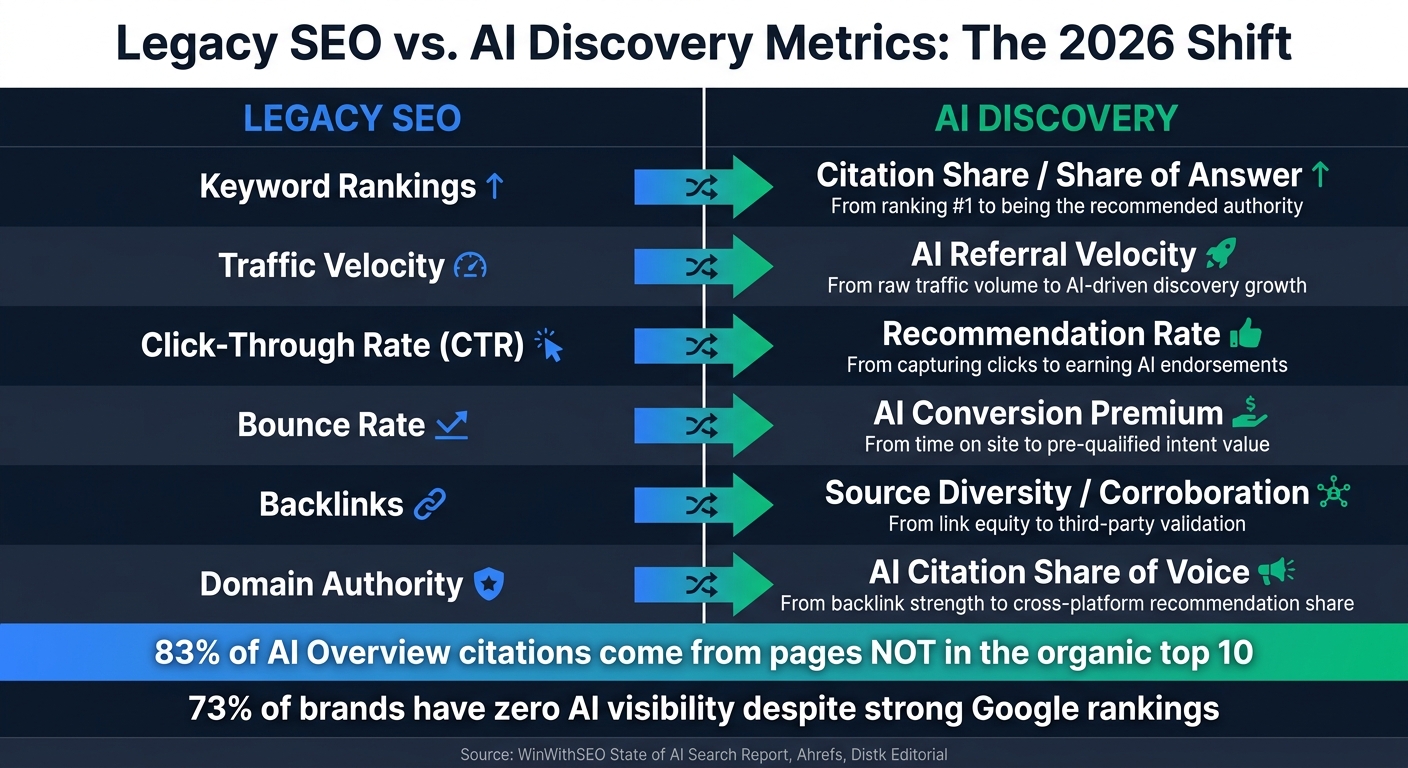
Legacy SEO vs. AI Discovery Metrics: The 2026 Shift
As AI transforms how people find information, measuring success requires a new approach that reflects shifting buyer behavior. Traditional SEO metrics, built to track clicks, fall short in a world where AI delivers answers directly, often without generating clicks. This change calls for a fresh framework that ties AI visibility to tangible business outcomes.
The Metrics That Replace Search Rankings
A clear sign of outdated measurement models is a phenomenon called "The Great Decoupling" - where search volume rises, but clicks drop because AI answers queries directly. With a staggering 60% nonclick rate [2] and organic click-through rates plummeting by 61% when AI Overviews appear [26], relying on keyword rankings is like measuring foot traffic for an online store - it no longer reflects reality.
Instead, focus on metrics tailored for the AI era:
- Citation Share: This tracks the percentage of AI-generated answers in your category that mention your brand. It's the AI equivalent of "share of voice" [25].
- Prompt Coverage: Measures how often your brand appears in answers to high-intent buyer questions.
- AI Conversion Premium: Highlights the value of AI-driven traffic, which converts 4.4× to 23× better than traditional organic visitors [27][28].
"A brand can now be surfaced, recommended, and materially influence a purchase decision in AI search without necessarily generating a click." - Aleyda Solis, International SEO Consultant [29]
To get started, identify 30–50 high-intent buyer prompts and track how often your brand appears in AI-generated answers. Tools like Profound (costing $500–$2,000/month) and Otterly.ai ($300–$1,500/month) can handle this tracking across platforms like ChatGPT, Gemini, and Perplexity [26][5]. Additionally, monitor Branded Search Lift in Google Search Console. When users encounter your brand in AI chats but don’t click immediately, they often search for your brand name later - a measurable indicator of AI-driven awareness [30][26].
Connecting Finance, Product, and Marketing Data
Measuring AI discovery in isolation misses the bigger picture. The real value emerges when AI-driven leads are connected to your CRM and pipeline data. Use platforms like HubSpot, Salesforce, or Close to tag leads from AI referral sources and analyze whether they close faster or bring higher deal values compared to traditional organic leads [27][29]. These leads are often "pre-sold", having already evaluated options within the AI interface.
On the content side, add a "How did you hear about us?" field to lead forms with an "AI Assistant" option. Research suggests 20–30% of B2B leads will attribute their discovery to AI when asked directly [26]. This self-reported data fills gaps left by conventional analytics, especially since much of the B2B buyer journey happens in AI chat sessions that don’t leave a digital trail. Use a three-layer framework to guide your efforts:
- Presence: Does your brand appear in AI-generated answers?
- Readiness: Is your content structured for AI to extract and recommend?
- Business Impact: Is AI-driven visibility translating into revenue? [29]
Legacy SEO Metrics vs. AI Discovery Metrics: A Side-by-Side View
The table below outlines how traditional SEO metrics are being replaced by AI-specific benchmarks:
| Legacy SEO Metric | AI Discovery Metric | What Changes |
|---|---|---|
| Keyword Rankings | Citation Share / Share of Answer | From "ranking #1" to being the recommended authority [25][26] |
| Traffic Velocity | AI Referral Velocity | From raw traffic volume to growth in AI-driven discovery [25] |
| Click-Through Rate (CTR) | Recommendation Rate | From capturing clicks to earning AI endorsements [29] |
| Bounce Rate | AI Conversion Premium | From time on site to the value of pre-qualified intent [25][26] |
| Backlinks | Source Diversity / Corroboration | From link equity to independent third-party validation [27][29] |
| Domain Authority | AI Citation Share of Voice | From backlink strength to cross-platform recommendation share [26][31] |
"If you are still reporting marketing ROI based primarily on organic sessions... you are measuring a shrinking proxy." - Distk Editorial [31]
This shift isn’t just cosmetic. For instance, 83% of AI Overview citations come from pages that don’t rank in the organic top 10 [28]. This means excelling in traditional SEO doesn’t guarantee AI visibility - and vice versa. Both now require distinct measurement strategies to succeed in their respective arenas.
Conclusion: Moving to an AI-First Content Discovery Approach
Shifting to an AI-focused discovery strategy means stepping away from the comfort zone of traditional SEO and embracing a more agile, structured approach. The numbers don’t lie: 73% of brands have no AI visibility despite strong rankings in traditional search [34][35], and only 12% of AI citations align with Google's top 10 results [33]. If your strategy in 2026 revolves solely around optimizing for Google, you’re fighting for a shrinking audience while buyers increasingly find answers - and make decisions - on AI-driven platforms.
How to Audit Your Current Discovery Footprint
To get started, test your brand's presence on AI platforms. Run 20–50 high-intent buyer prompts through tools like ChatGPT, Claude, Perplexity, Gemini, and Google AI Overviews. Score each result on a scale from 0 (no mention) to 2 (accurate mention), with 1 for indirect references like footnotes or links. This process takes just 2–4 hours using free-tier accounts.
Keep in mind that 85% of AI brand mentions come from third-party sources - platforms like G2, Reddit, YouTube, LinkedIn, and industry publications - not your website [33]. So, the audit needs to go beyond your domain. Check your "citation surface." Is your Crunchbase profile up-to-date? Are you included in third-party “best of” lists? Also, confirm that AI crawlers can access your site without restrictions.
"Your #1 Google ranking and AI invisibility are predictable outputs when you optimize the wrong surface." - Sharma, Co-founder, DerivateX [3]
A 3-Phase Plan to Make the Transition
Once you’ve audited your AI visibility, it’s time to act. Below is a 90-day roadmap designed to make meaningful progress in AI discovery:
| Phase | Timeframe | Focus | Key Actions |
|---|---|---|---|
| Phase 1 | Days 1–30 | Foundations | Audit AI visibility, map 50+ buyer prompts, implement FAQPage/Organization schema, unblock LLM crawlers [32][3] |
| Phase 2 | Days 31–60 | Content & Citations | Focus on BOFU (bottom-of-funnel) content like comparisons, alternatives, and pricing; restructure pages with concise 60-word answers; secure 5–10 third-party expert mentions [17][3] |
| Phase 3 | Days 61–90 | Validation & Measurement | Build off-site authority with founder commentary and podcast transcripts, integrate AI-referral tracking in GA4, and launch a Share of Model dashboard [36][32] |
A great example of this approach in action is REsimpli, a real estate investor CRM. Between January and April 2026, they went from zero AI visibility to becoming the #1 cited tool in ChatGPT for "best CRM for real estate investors." Their success came from driving 22 new G2 reviews, ensuring consistency across Crunchbase and founder bios, and earning placements in three third-party listicles [3].
How to Track Progress and Keep Improving
After implementing your 90-day roadmap, tracking your progress is essential to adapt to AI’s ever-changing landscape. AI discovery isn’t static - model updates, new training data, and evolving citation patterns can shift your visibility score even if you haven’t changed your content. 83% of AI citations come from content updated within the past year [36], so keeping your content fresh is non-negotiable - it’s now a ranking factor.
Monitor your Share of Model weekly by analyzing how often your brand appears across your defined set of prompts using buyer intent analysis. Pair this data with AI-referred pipeline metrics in your CRM to directly connect visibility to revenue. As Kyle Poyar explains:
"AEO isn't a content thing or an SEO experiment. It's a GTM capability." [36]
Treat it as such - with dedicated resources, a proper budget, and quarterly reviews to keep pace with the evolving AI ecosystem.
FAQs
How do I check if AI tools mention my brand?
If you're curious about whether AI tools are referencing your brand, there are a few effective ways to find out:
- Use monitoring tools: Platforms like Ahrefs’ Brand Radar can track mentions of your brand across AI tools such as ChatGPT and Perplexity. Simply input your brand name and its variations to keep tabs on mentions over time.
- Manually test AI tools: Ask AI platforms industry-related questions to see if your brand comes up in their responses.
- Set up Google Alerts: This is a simple way to get notified whenever your brand is mentioned online, including in AI-generated content.
For a deeper dive, consider AI-focused tools that analyze how your brand is being referenced in AI-generated responses. These insights can help you understand your brand's presence in the AI landscape.
What content gets cited most by AI answers?
AI platforms tend to reference content that is well-organized, credible, and thorough. Popular formats include listicles (like "Top 10"), detailed articles, and direct comparisons (such as "Best X vs. Y") because they offer clear, easy-to-attribute claims. Moreover, content that is up-to-date, backed by reliable sources, and packed with specifics has a higher chance of being included in AI-generated outputs.
How can I measure AI visibility without clicks?
To gauge AI visibility without relying on clicks, consider metrics such as:
- Coverage: How frequently your brand shows up in AI-generated responses.
- Mentions: The number of times your brand is referenced in those responses.
- Citations: Instances where your site is directly cited as a source.
Additionally, evaluate prominence, which measures your brand's placement within AI responses, and share of voice, which reflects how your presence stacks up against competitors. These metrics offer a broader perspective beyond traditional click-based measurements.