The New SEO Isn't About Pages. It's About Ecosystems.

SEO has evolved. It's no longer about optimizing individual pages for keywords. Instead, success now hinges on building content ecosystems - interconnected networks of pillar pages, clusters, and internal links that establish authority on broad topics. Here's what you need to know:
- Search engines analyze concepts, not just keywords. Google and AI tools like ChatGPT focus on topical authority and relationships between content.
- Content ecosystems outperform standalone pages. Sites with strong clusters rank for 300% more keywords and see 47% more organic traffic.
- AI tools rely on structured ecosystems. AI-powered search engines cite sources with clear, organized content hubs - making ecosystems essential for visibility.
- SaaS and AI companies benefit the most. Buyers in these industries need content that supports every stage of their journey, from research to decision-making.
The takeaway? To stay competitive, shift from a page-by-page SEO strategy to building a well-organized, interconnected content ecosystem. This approach drives more traffic, improves rankings, and ensures your site is ready for AI-driven search.
Engineering the SEO Ecosystem for the AI Era | Aimee Jurenka
Core Elements of an SEO Ecosystem
An SEO ecosystem is made up of interconnected parts, each playing a key role in creating a cohesive and effective strategy.
Pillar Pages and Content Hubs
At the heart of the ecosystem is the pillar page. This serves as the central hub, typically running 3,000–6,000 words, and covers a broad topic comprehensively while directing readers to more detailed, related content.
Pillar pages focus on high-volume "head" keywords, signaling to search engines that your site is a reliable authority on the subject. However, a pillar page on its own is just a long article. When paired with supporting content, it evolves into a powerful content hub.
"A pillar-and-cluster set tells Google 'these pages belong together as a topic' in a way that a flat blog cannot." - The SEO Company [11]
Cluster Content and Internal Linking
Cluster pages, often called "spokes", are the supporting articles connected to the pillar page. Each cluster dives into a specific subtopic, targeting long-tail keywords introduced in the pillar. These articles, ranging from 1,200–3,000 words, showcase the depth of your expertise [8].
Internal linking is what ties everything together. Every cluster page should link back to the pillar, and the pillar should link to its cluster pages. This approach not only enhances user navigation but also boosts SEO performance. Research shows that clustered content can increase organic traffic by 30% and extend rankings 2.5× longer [9].
For instance, in March 2026, Growigami reported on a B2B SaaS client in the project management niche. They created a 4,200-word pillar page titled "The Complete Guide to Software Project Management", supported by 12 cluster pages on topics like "Agile vs. Waterfall" and "Sprint Planning." Within a year, this content cluster generated 18,700 monthly organic visits. One cluster page, "Jira Alternatives", accounted for 40% of the total leads [2].
To maintain this interconnected structure, ensure each new post links to 2–3 cluster pages, allowing authority to flow in both directions [1].
Technical Foundations
Once your content clusters are in place, a solid technical setup is essential to ensure search engines can easily navigate and index your content. Three critical elements of this foundation are crawlability, site architecture, and schema markup.
Search engines rely on links to discover content, so if pages are buried too deep or lack internal links, they may go unnoticed. A good rule of thumb is to make every supporting article accessible within 3 clicks from the homepage [13]. Orphan pages - those without any internal links - often struggle to gain visibility and authority.
Your site’s architecture should follow a logical hub-and-spoke model, which should also be reflected in the URL structure (e.g., example.com/topic/subtopic/). While not a direct ranking factor, this structure helps search engines better understand the relationships between topics [11]. Adding structured data with schema markup, such as Organization or FAQ, further improves machine-readability, which is becoming increasingly important as AI systems analyze sites for accurate citations [12].
"Technical GEO is not a separate optimization layer sitting on top of SEO. It is the infrastructure that makes your brand, products, and relationships easier for search systems to interpret correctly." - Potenture [12]
Here’s a breakdown of the key technical components and their roles:
| Technical Component | Role in Ecosystem | Key Metric |
|---|---|---|
| Crawlability | Ensures deep pages are discovered | Indexed vs. published pages |
| Internal Linking | Distributes authority and relevance | Internal link coverage (>95%) |
| Schema Markup | Makes content machine-readable | AI citation share |
| Site Architecture | Defines topic relationships | Average crawl depth (≤3 clicks) |
| Canonicalization | Prevents intent cannibalization | Duplicate intent clusters |
These technical components are the backbone of your SEO ecosystem, ensuring that every piece of content works together to create a unified and effective strategy.
Building Topic Clusters and Content Hubs
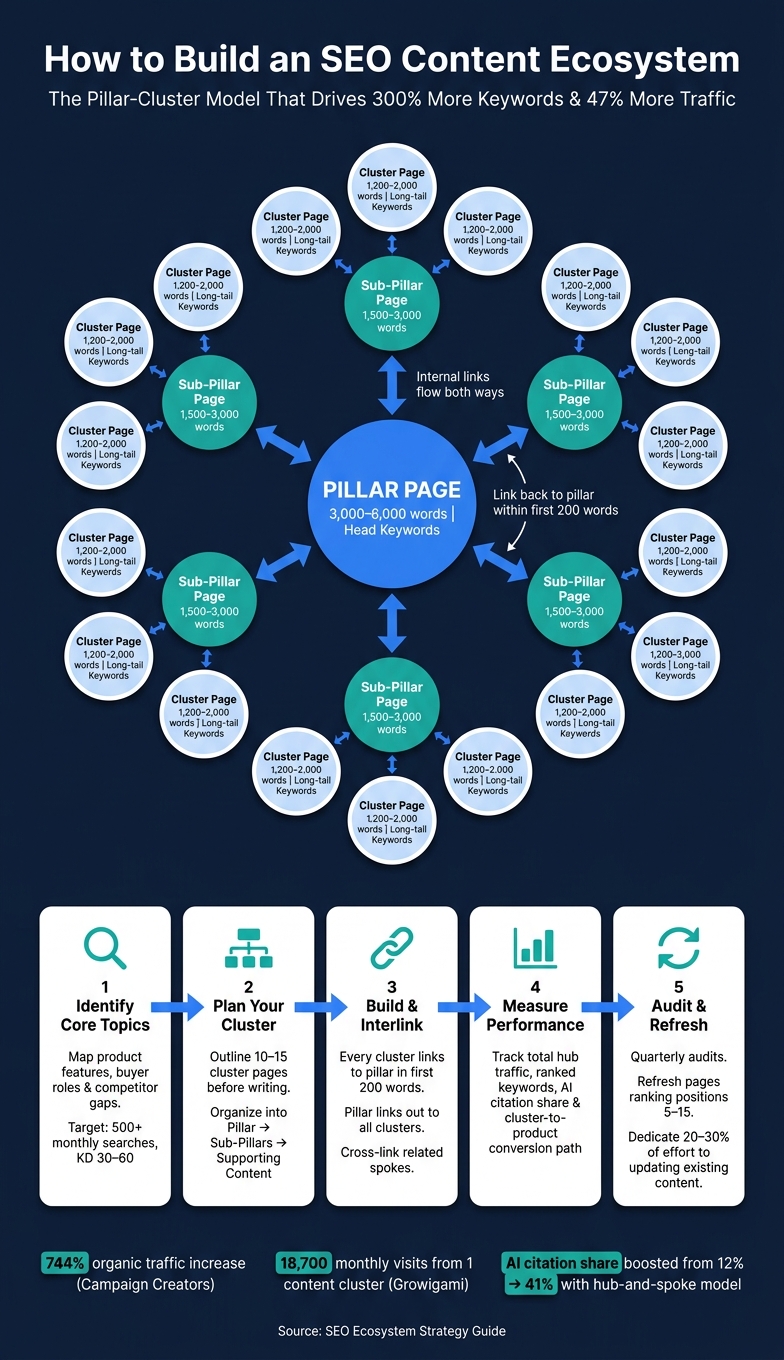
How to Build an SEO Content Ecosystem: Pillar-Cluster Model
Once you’ve established a strong technical foundation, the next step is creating topic clusters and content hubs. This approach can drive consistent growth - but it’s also where many teams either make significant progress or waste months on ineffective efforts.
How to Identify Core Topics
Start by mapping out your product’s main features, the problems it addresses, the roles of your buyers, and key workflows [2]. Then, look at competitors’ content to spot superficial coverage or gaps - areas where you can quickly establish authority [15].
When you’ve identified potential topics, evaluate them based on three criteria:
- Search Volume: The total cluster should exceed 500 searches per month.
- Keyword Difficulty (KD): Aim for a KD score between 30 and 60.
- Commercial Relevance: Ensure the topic aligns with your product’s value [2][18].
A topic that checks all three boxes is a strong candidate for building a full content hub.
"Google's algorithms increasingly prioritize depth of expertise over keyword stuffing, making topical authority a cornerstone of modern SEO strategy." - Search Engine Journal [16]
Tools like Ahrefs ($99–$999/month) and SEMrush ($130–$500/month) are excellent for identifying keyword clusters and analyzing gaps. For a deeper dive, MarketMuse ($149–$399/month) offers topic modeling and authority scoring, helping you map an entire hub before creating content [2]. This focused approach strengthens your site's authority and sets the stage for an effective content strategy.
How to Map and Interlink Clusters
Before writing, plan your internal linking strategy. Outline all 10–15 cluster pages in advance to avoid orphaned content down the line [18]. Organize each hub into three layers:
- Pillar Page: Broad, high-level content covering the main topic.
- Sub-Pillars: Pages diving deeper into major aspects of the topic.
- Supporting Content: Articles addressing specific questions, comparisons, or definitions [14][15].
Ensure every cluster page links back to the pillar page within the first 200 words and that the pillar page links back to the clusters [2][19][20]. Cross-link related cluster pages where there’s a natural connection. For example, a page on "SaaS onboarding flows" could link to one on "SaaS churn reduction." Use the main keyword as anchor text rather than generic phrases [2][20].
After publishing a new cluster article, update 3–5 related pages with links to it. This “backfilling” process keeps your internal linking structure strong and ensures new content isn’t left isolated [20][3].
"Internal linking is not optional decoration - it is the connective tissue of your topical map and must be engineered, not random." - Martial Notarangelo, Founder, Authority Specialist [15]
A real-world example: In 2025, Campaign Creators revamped their blog into three pillar pages, each supported by 6–8 cluster articles. Over the next year, their monthly organic sessions skyrocketed from 1,091 to 9,214 - a 744% increase - without increasing their publishing frequency [20].
How to Measure Ecosystem Performance
Once your clusters are mapped and interlinked, shift your focus to measuring their overall performance. Instead of tracking individual pages, evaluate the cluster as a whole. Key metrics include:
- Total Ranked Keywords: How many keywords the cluster ranks for.
- Combined Organic Traffic: The total traffic across all URLs in the hub.
- Average Position: The cluster’s overall ranking performance [3][18].
It’s also important to monitor the cluster-to-product path: what percentage of users entering through a cluster article eventually visit a product page or complete a conversion [10]? Use GA4’s Path Exploration report to analyze how readers navigate between hub pages. This helps you determine if your internal linking is effectively guiding users through the buyer journey [17].
Looking ahead, tracking your AI citation share will become increasingly relevant. This refers to how often your pillar topics appear in AI tools like ChatGPT, Perplexity, or Google AI Overviews [19][3]. Early data shows that implementing a hub-and-spoke model can boost AI citation rates from 12% to 41% [21]. Conduct weekly manual searches for your core topics in AI search modes to see where you’re being mentioned and identify gaps.
"The right metrics are cluster-level: total organic sessions across all URLs within the cluster month-over-month." - Megan Ragab, Founder, Topical Map AI [10]
| Metric | Tool | What to Look For |
|---|---|---|
| Pillar Page Ranking | Google Search Console | Climbing rankings for high-volume head terms |
| Total Hub Traffic | GA4 (Page Path Filter) | Consistent growth across all cluster URLs |
| AI Citation Share | Manual/API Tracking | Visibility in Perplexity/ChatGPT for topic queries |
| Internal Navigation | GA4 (Path Exploration) | High percentage of users moving from spoke to pillar or product |
| Keyword Coverage | GSC / Ahrefs | Ranking for 50+ related long-tail keywords per hub |
Finally, perform quarterly audits using Google Search Console to eliminate keyword cannibalization. Allowing multiple pages to compete for the same keyword can dilute your ranking potential and hinder the hub’s performance [3].
Using AI and SaaS Tools in SEO Ecosystems
Modern SEO strategies require more than just well-planned content - they demand speed and automation, areas where AI and SaaS tools excel. While a strong content hub establishes authority, the rapid execution enabled by these tools drives measurable results.
AI Tools for Content Creation and Optimization
AI is reshaping SEO by speeding up content production and improving quality. What used to take 2–3 weeks can now be done in just 48–72 hours with AI-powered workflows, increasing efficiency by 5–7 times [22].
A crucial method for maintaining high-quality output in this fast-paced environment is Retrieval-Augmented Generation (RAG). By feeding AI tools with product documentation and interview transcripts, you ensure that the content is rooted in real-world expertise. For SaaS companies, this approach helps create content that resonates with industry professionals and reflects genuine insights.
AI also simplifies internal linking through automated semantic scoring, eliminating the need for time-consuming manual audits [23][24]. Google’s John Mueller highlights the importance of internal linking:
"With regards to internal linking, I do think this is one of the most important elements of a website. Because it's a great way for you to tell us what you would consider important on your pages." [23]
Additionally, AI-driven campaigns have been shown to reduce acquisition costs by 29% compared to traditional production methods [22]. While AI takes content creation and linking to a new level, SaaS tools ensure that your ecosystem remains scalable and manageable as it grows.
SaaS Tools for Managing Your Ecosystem
As SEO ecosystems expand, manual workflows become impractical. SaaS platforms step in to automate technical tasks and streamline processes.
-
Search Atlas (starting at $99/month) offers features like "OTTO SEO", which autonomously handles technical updates such as meta tags, schema, and internal links across hundreds of pages. Its "Atlas Agent" can even execute full marketing playbooks for both SEO and paid channels. Frankie Fihn, Founder of Beyond Agency Profits, shared:
"Search Atlas has quickly become one of our go-to tools... it cuts 90% of the grunt work." [25]
- For teams prioritizing AI visibility, CLEO (by RegenAI) acts as a Presence Engine. It connects content publishing, social signals, and AI citation tracking. In one 90-day case study, a U.S.-based payment engine saw its AI citations increase fourfold without altering its core content strategy [26].
- SIGMAEO (starting at $47/month) allows integration of custom AI models like GPT-4o, Claude, or Gemini, while also tracking brand mentions across six AI platforms. For SaaS companies focusing on long-tail keywords, PSEOScale generates thousands of intent-matched pages with AI-assisted content that stays within strict brand guidelines [27].
These tools represent a leap forward, moving from simply identifying issues to autonomously resolving them - saving time and effort compared to traditional workflows.
How "Top SaaS & AI Tools Directory" Supports Your Ecosystem
With so many tools available, selecting the right ones can feel overwhelming. That’s where the Top SaaS & AI Tools Directory comes in. Hosted at agilegrowthlabs.com, this resource simplifies the process by curating tools across the entire digital ecosystem. From CRM and marketing automation to content creation and analytics, the directory helps SaaS founders quickly find vetted solutions.
For teams building or scaling their SEO ecosystem, joining the directory’s waitlist provides access to exclusive recommendations and strategies. These insights are tailored specifically for SaaS and AI businesses, helping teams identify platforms that deliver strong ROI at every growth stage.
Scaling and Maintaining SEO Ecosystems
An SEO ecosystem isn't something you build once and forget. It's more like a living organism that requires consistent care and updates to stay relevant. Interestingly, updating older content often provides better returns than churning out new material. Regular audits are the backbone of keeping your ecosystem performing at its best.
"The sites that grow fastest aren't the ones publishing the most new content - they're the ones running the tightest feedback loops on existing content." - THE SEO ENGINE Editorial Team [1]
How to Audit and Improve Your Content
Did you know blog posts tend to lose traffic after 6–12 months without updates? [1] That’s why quarterly audits are crucial. Focus on pages ranking in positions 5–15 on search results - these are your best opportunities for improvement. A simple refresh could push these pages into the top 3, often at a much lower cost than creating brand-new content [1].
While you're auditing, look for keyword cannibalization and issues with internal links. If multiple pages target the same search intent, they can end up competing with each other, which weakens your authority. Group these pages by intent and either consolidate or redirect duplicates. Internal links are another area to monitor - TripleDart found that about 50% of internal links go stale or break within a year of launch [3].
Another critical area to check is your index health. If the number of indexed pages isn’t keeping up with your published pages, it could point to crawlability or content quality issues that need immediate attention [1].
Once you've ensured technical health, align your content strategy with your business goals to keep everything moving in the right direction.
Aligning Your Ecosystem with Business Growth
As your SaaS product evolves - whether through new features, pricing models, or targeting new customer segments - your content ecosystem needs to adapt too. For instance, a content cluster built for your original use case may not serve a new market vertical effectively.
To maintain focus, stick to 3–7 core topics [6]. Spreading your efforts too thin can weaken your authority, leading to content that fails to resonate with search engines or users. When entering a new product direction, either link it back to an existing content pillar or create a new dedicated cluster. For example, a site with 18 interconnected articles on a topic typically outperforms a single 5,000-word guide and holds its rankings 2.5 times longer [6].
Quarterly strategy reviews are a smart way to ensure your content still aligns with your product’s evolution, the pain points of your buyers, and the workflows your customers rely on [2].
Tracking Long-Term Ecosystem Performance
Once you've established regular audits and strategic alignment, performance tracking becomes essential for sustained SEO success. Instead of focusing solely on individual page rankings, shift your attention to how your entire topic cluster performs. Here are four key layers to monitor:
| Measurement Layer | Metrics to Track |
|---|---|
| Visibility | Rankings, Citation Share (ChatGPT/Perplexity), Share of Voice [28] |
| Engagement | Organic Sessions, AI-Referrer Sessions, Dwell Time [28] |
| Conversion | Assisted Conversions, Demo Requests, Trial Starts [28] |
| Pipeline | SQL-to-MQL Conversion, Sales-Cycle Length, Attributable Revenue [28] |
One emerging metric to watch is AI citation share - how often your content is featured in tools like ChatGPT, Perplexity, or Google AI Overviews. By 2026, 68% of AI Overview citations are expected to come from pages outside the top 10 organic results [6]. This means strong topical authority can still drive visibility, even if your traditional search rankings aren't stellar. Running 10 sample queries weekly across these platforms can give you a reliable snapshot of your standing [29].
To keep your ecosystem thriving, dedicate 20–30% of your monthly content efforts to refreshing existing assets. This approach ensures your SEO growth compounds over time rather than fading away.
Conclusion: The Case for SEO Ecosystems
As highlighted earlier, establishing strong topical authority can result in 300% more keywords and 47% higher organic traffic [4]. Yet, 44% of SaaS brands ranking in Google's top 10 remain invisible to tools like ChatGPT [7]. This underscores the growing divide between traditional SEO approaches and the emerging ecosystem-driven SEO model.
Key Takeaways
The data makes one thing clear: the future of SEO lies in creating unified ecosystems. By 2026, the focus of competition will shift from individual pages to topical clusters [6]. Search engines and AI tools, including ChatGPT and Perplexity, now evaluate the overall coherence, depth, and structure of your content network rather than assessing isolated articles.
"AI systems don't rank pages - they cite sources. And how do they decide which sources are the best... It isn't based on a single page's keywords - it's based on the coherence, depth, and structure of your entire content network." - Brad Bartlett, Content Strategist [4]
The impact of this approach is evident. For instance, Glide saw a 14x increase in product signups within a year by transitioning to a unified organic revenue engine [5]. Similarly, Stampli achieved 5x growth in their inbound pipeline by adopting a combined SEO and AEO (Answer Engine Optimization) strategy [5]. These examples showcase the tangible benefits of embracing an interconnected SEO ecosystem.
Next Steps for SaaS Leaders
To implement this strategy, SaaS leaders can follow a structured 30-60-90 day plan:
- Days 1–30: Conduct a site audit to identify content gaps and fix broken internal links.
- Days 31–60: Develop core topical maps, starting with 3–4 spoke pages supporting each pillar page.
- Days 61–90: Strengthen authority signals by adding FAQ schema to posts, using entity-rich anchor text for internal links, and publishing an
llms.txtfile to clarify your content structure for AI crawlers [30].
Focus your efforts on 3–5 core topic hubs initially, ensuring each hub is built out with 8–15 in-depth pages before expanding further [3][6].
"The SaaS companies that dominate organic search in 2026 are not publishing more content. They are publishing better-structured content." - Alexander Chua, Co-Founder, Growigami [2]
FAQs
How do I choose the right pillar topics for my business?
Start by pinpointing 5–10 key areas where your business needs to establish authority. These should align with your core strengths and the needs of your audience. To make the selection process easier, use a prioritization scorecard. This tool can help you evaluate topics based on three main factors:
- Conversion potential: Does the topic have the ability to attract and convert readers into customers?
- Competition: How challenging will it be to rank for this topic in search engines?
- Subtopic support: Can the topic naturally branch out into 8–15 related subtopics?
When choosing topics, steer clear of those that are too broad or vague. Instead, zero in on areas that match your value proposition, solve specific customer problems, and allow for easy subtopic organization. This approach ensures you create a focused and effective content ecosystem.
How many cluster pages should I build before expecting results?
For a strong content cluster, aim for 8 to 25 pages per pillar. Most effective strategies usually target 8 to 15 pages to maintain a balance between depth and manageability. Less than 8 pages might not establish enough authority, while exceeding 25 pages can make upkeep challenging. Before building a hub structure, use keyword clustering to ensure your topic can support at least 8 subtopics with measurable search volume.
How can I track whether AI tools are citing my content?
To keep tabs on AI citations, you'll need to think beyond the usual SEO tools and establish a solid monitoring system. Start by crafting 15–25 intent-driven queries that align with the types of searches your target audience might perform. Run these queries weekly using platforms like ChatGPT or Google AI Overviews to identify where your content is being cited.
For a more scalable approach, consider leveraging Google Analytics 4 to track referral traffic. Additionally, tools like Promptwatch can help automate the process, making it easier to test and track how often your content is cited across various pages.