Bad SEO Is Dead. Your Strategy Might Be, Too.

SEO as you know it is failing in 2026. AI-driven search engines now dominate, with 65% of Google searches ending without a click and AI-generated summaries taking center stage. SaaS companies relying on outdated SEO tactics - like chasing traffic or producing generic content - are losing visibility and revenue fast.
Key takeaways from this shift:
- AI Overviews dominate: 62% of SaaS-related keywords are owned by AI summaries.
- Traffic loss: Informational queries see a 60% drop in organic click-through rates.
- New discovery habits: 37% of consumers now start product research on AI platforms like ChatGPT.
- AI referrals matter: Referral traffic from AI platforms grew 357% year-over-year.
To stay relevant, SaaS companies must pivot to strategies that focus on being cited by AI systems, creating depth-driven content, and aligning SEO with sales goals. Forget chasing keywords - success now hinges on structured, expert-backed content that meets AI search systems' standards.
SEO Strategy 2026: The Shift Most B2B SaaS Are Missing
Why Outdated SEO Tactics No Longer Work
Old-school SEO methods like chasing high-volume keywords, pumping out endless content, and aggressively building backlinks are now doing more harm than good. The game has changed, and AI-driven search engines have completely redefined how content is discovered, evaluated, and ranked.
What Bad SEO Looks Like in 2026
In 2026, ineffective SEO doesn't just fail - it actively hurts your online presence. AI has made generic, surface-level content a liability. One of the biggest offenders? Commodity content. These are the bland explainers and listicles that AI tools can summarize in seconds, leaving no reason for users to click through [1]. While mass-producing such content once drove traffic, it now signals to search engines that your site offers little in terms of originality or value.
Another misstep is focusing solely on traffic metrics - treating organic sessions and keyword rankings as the ultimate goals, rather than focusing on SaaS metrics and strategy that drive value. These "vanity metrics" tell you how many people visited your site but say nothing about whether those visitors converted into customers.
"SEO can no longer hide behind vanity metrics. If it isn't tied to pipeline, revenue, and customer acquisition cost, it's not a growth channel, it's just a content expense." - Stephen Titcombe, B2B SaaS SEO Expert [1]
AI-generated content without human oversight is another major pitfall. A 2026 study revealed that articles created entirely by AI performed poorly, with a 70% lower click-through rate and an 85% drop in ranking positions compared to similar human-written content [5]. Churning out content without editorial input leads to irrelevance and lost opportunities.
How AI and EEAT Changed Search
Google's search algorithms now prioritize content that demonstrates Experience, Expertise, Authoritativeness, and Trustworthiness (E-E-A-T). Pages that skim over topics without offering original insights or firsthand knowledge are quickly filtered out.
Modern AI search systems use Retrieval-Augmented Generation (RAG), which pulls specific passages from content rather than ranking entire pages. This means every section of your content must be able to stand alone. If a passage lacks clarity or loses meaning when viewed in isolation, it won’t make the cut. Keyword stuffing, once a common tactic, now backfires - reducing AI visibility by 8% to 10% [10].
Google's algorithms also employ "query fan-out", where a single search prompt generates multiple sub-queries to build a complete answer. Content that only focuses on one keyword can’t meet this demand. Only well-rounded, deeply researched content gets cited across these sub-queries [10].
"The retrieval system does not care about your prose style. It cares about whether a passage can stand alone as a citable fact without losing meaning." - Kurt Fischman, CEO, Growth Marshal [6]
These shifts make it clear when your SEO strategy is lagging behind.
Signs Your SEO Strategy Is Out of Date
A few warning signs can help you identify if your SEO approach needs an overhaul:
- Impressions without clicks. If Google Search Console shows steady or increasing impressions but a drop in clicks, AI Overviews might be absorbing the traffic that used to come your way.
- High traffic, low conversions. Lots of visitors but few conversions suggest your SEO efforts are attracting the wrong audience.
- Missing from AI-generated answers. Search your key industry terms in tools like ChatGPT or Google’s AI Overviews. If your brand isn’t mentioned, your content isn’t seen as credible.
- Over-reliance on informational queries. Content focused on "how-to" or "what is" topics is especially vulnerable to AI Overviews, which now appear in over 40% of searches for these types of queries [6].
These red flags highlight the risks of sticking to outdated strategies. Companies like BetterCloud and Datanyze serve as cautionary tales. BetterCloud saw its organic traffic plummet by 94% after Google’s November 2025 update targeted thin, AI-generated content. Similarly, Datanyze lost 95% of its traffic when Google devalued its programmatic landing pages [9]. Both companies relied on tactics that seemed effective - until the search landscape shifted dramatically. Even a top ranking can no longer guarantee clicks when AI Overviews dominate the top of the page.
Recognizing these failures is the first step toward adopting modern SEO strategies that resonate with today’s search engines. In the next section, we’ll dive into how SaaS companies can use AI to create content that drives real engagement.
What Modern SEO Looks Like for SaaS Companies
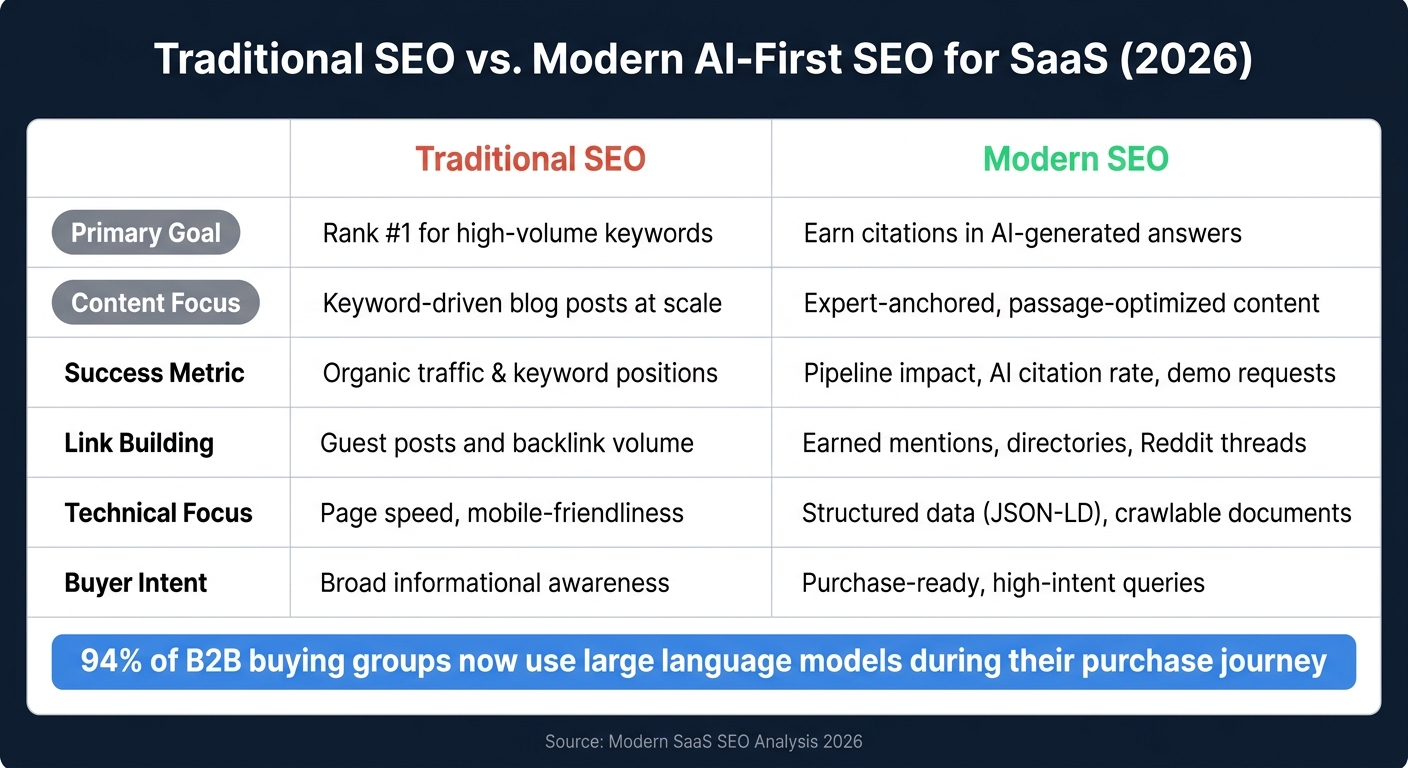
Traditional SEO vs. Modern AI-First SEO for SaaS (2026)
Modern SEO for SaaS is no longer just about climbing search rankings. The game has shifted to becoming the source that AI tools cite in their responses. This shift addresses the limitations of outdated methods and aligns with how AI-driven search is changing user behavior.
"A SaaS company that only optimizes for Google rankings is building half an engine." - Optimist [13]
Old SEO vs. Modern SEO: A Comparison
The evolution from traditional to modern SEO impacts everything - from how content is created to how success is measured. Here’s a breakdown:
| Dimension | Traditional SEO | Modern SEO |
|---|---|---|
| Primary Goal | Rank #1 for high-volume keywords | Earn citations in AI-generated answers [13] |
| Content Focus | Keyword-driven blog posts at scale | expert-anchored, passage-optimized content [6] |
| Success Metric | Organic traffic and keyword positions | Pipeline impact, AI citation rate, demo requests [13][6] |
| Link Building | Guest posts and backlink volume | Earned mentions, directories, Reddit threads , and social monitoring tools [16] |
| Technical Focus | Page speed, mobile-friendliness | Structured data (JSON-LD), crawlable documents [15][8] |
| Buyer Intent | Broad informational awareness | Purchase-ready, high-intent queries [14][2] |
This shift highlights why targeting buyer intent and integrating product-led assets are critical. With 94% of B2B buying groups now using large language models during their purchase journey [13], content must be structured for AI retrieval. Otherwise, your brand risks being invisible to most buyers before they even visit your site. The focus has moved from vanity metrics like keyword rankings to meaningful outcomes like AI citation rates and pipeline performance.
How to Target Buyer Intent at Every Funnel Stage
For SaaS companies, SEO must address the buyer journey at every stage. Early-stage buyers look for educational content that addresses their pain points. Mid-funnel buyers are comparing solutions and need detailed product and integration pages. Late-stage buyers search for terms like "Competitor vs. Your Product" or "best [category] software." This is where comparison and alternatives pages shine, converting at over 7.5%, compared to just 0.5% for standard blog posts [17].
"SaaS SEO is not 'blog posts that rank.' It's a distribution system that captures intent at every stage of a multi-stakeholder buying journey." - Nirav Parmar, SEM Monks [17]
For example, between September 2025 and March 2026, QUITTR - a habit-breaking app - went from zero organic clicks to generating $45,000/month in organic revenue. They achieved this by targeting high-intent queries like "best app to quit addiction?" across both Google and AI platforms like ChatGPT and Perplexity [19]. Instead of focusing on volume, they prioritized depth and intent.
Connecting SEO to Product-Led Growth
Once intent is mapped across the funnel, aligning SEO with product-led growth ensures a seamless conversion process. Using an AI-based conversion optimization platform can help personalize these experiences to maximize lead generation. Modern SaaS SEO ties content directly to product workflows through tools like ROI calculators or integration hubs. These tools offer immediate value and naturally guide users toward the paid product.
Take Encharge, a marketing automation platform, as an example. In 2023, they launched a free AI subject-line generator that earned 78 high-authority backlinks from sites like HubSpot and Beehiiv. After 10 uses, the tool displayed a full-screen call-to-action that drove sign-ups. This strategy helped Encharge grow to $40,000 MRR before its exit [20].
AI-referred visitors are especially valuable, converting at 4.4x to 5x the rate of traditional organic search visitors. These users arrive already informed about your solution, making them a far more efficient audience to convert [15][8].
"The unit of success is not a Google ranking. The unit of success is a citation inside the answer an AI assistant gives to a prospect." - Sam Claassen, StartupCookie [18]
Using AI Tools to Create and Optimize Content
AI tools have reshaped how SaaS companies create content, but the real success comes when AI's speed is combined with human expertise. This approach - where AI handles tasks like research, outlining, and basic drafting, while humans inject product-specific knowledge and editorial finesse - ensures content resonates with expert SaaS audiences.
"SaaS audiences are expert readers... They can immediately detect when an article is regurgitating public internet knowledge versus offering a perspective that comes from actual product depth." - Rework Analysis [24]
The benefits of this collaboration are clear: AI-assisted workflows can cut the time to produce a 1,500-word draft from 3–4 hours to just 30–45 minutes. Entire content cycles that used to take weeks can now be completed in 48–72 hours. But the key to success lies in human editing. Websites that published 50–100 AI-assisted articles with thorough human editing experienced traffic growth of 30–80%, while those that churned out over 1,000 unedited AI articles saw traffic plummet by 40–90% [7]. This faster workflow also creates room to incorporate deeper insights from internal company data into content.
Combining AI Assistance with Human Expertise
Speed is just one piece of the puzzle. To truly stand out, content needs to reflect the specific questions buyers are asking. Internal data sources like sales call transcripts and support tickets are goldmines for these insights. These questions often highlight what buyers care about most - questions that AI might otherwise need to source from the web. By grounding content in proprietary product knowledge, especially through retrieval-augmented generation (RAG), you avoid the generic tone that alienates technical buyers.
Choosing the right topics is equally important. The Analyze AI Framework [22] helps prioritize topics by scoring them on a 0–3 scale based on how closely your product addresses the issue. A score of 3 means your product is the clear solution, like answering "how to track brand mentions in ChatGPT." A score of 0 means the topic has no connection to your product. By focusing efforts on score-2 and score-3 topics, your content not only attracts attention but also drives conversions.
Structuring Content for AI Search Systems
How you organize your content can make or break its visibility with AI systems. 72% of pages cited by ChatGPT include an "answer capsule" - a short, standalone summary at the beginning of each section that an AI can easily extract [25]. Start each section with a clear, concise claim, then expand on it with additional context. This "claim-first" structure works well for both readers and AI retrieval systems.
Technical details also play a big role. Pages with 30+ external links to authoritative sources are cited 60% more often by AI systems [21]. Adding FAQ schema using JSON-LD can improve visibility across platforms like ChatGPT, Perplexity, and Gemini [25]. And don’t forget to check your robots.txt file - make sure it allows indexing by bots like GPTBot, ClaudeBot, PerplexityBot, and Google-Extended [4]. Once your content is structured for AI, the next step is using data to fine-tune its performance.
Using Data to Continuously Improve SEO Performance
By 2026, traditional rank tracking has become less useful. The metrics that matter now are branded search volume growth, AI citation rates, and the impact on your sales pipeline. Google Search Console’s "AI Overviews" filter, introduced in January 2026 [4], lets you see which queries are triggering AI-generated answers that include your content.
Outside of Google, tools like Semrush's AI Visibility Toolkit and Writesonic's citation gap analysis can pinpoint where competitors are being cited by AI systems while you’re not [12][26]. These gaps highlight opportunities for new content. The key metric? Brand mentions correlate with AI visibility at 0.664, while backlinks only correlate at 0.218 [23]. This shift in how authority is measured underscores the importance of building brand presence and focusing on structured, expert-driven content to stay competitive in the AI-driven SEO landscape.
How to Keep Your SEO Working in an AI-First World
SEO Principles That Hold Up Over Time
The basics of SEO haven't vanished - they've just become more demanding. Technical SEO is now the bare minimum. Google's AI Overviews still rely on its traditional search index through Retrieval-Augmented Generation (RAG). So, if your page isn’t indexed or doesn’t qualify for a standard snippet, it won’t get cited by AI [11][27]. Here’s a real-world example: In January 2026, a SaaS company audited by SerpNap resolved 23 technical issues, including broken canonical tags and orphaned pages. The result? A 34% boost in organic traffic within six weeks, all without changing a single word of content [3].
But technical fixes alone won’t cut it. The type of content that thrives is the kind AI can’t replicate. This means relying on original data, firsthand expertise, and strong, specific perspectives - things AI struggles to generate from existing knowledge [11][3]. Structure also plays a huge role. AI search systems focus on retrieving specific passages, not entire pages. If a section of your content doesn’t stand on its own when pulled out of context, it essentially becomes invisible to these systems - a higher bar than traditional SEO ever set [6].
"A page with a DR of 80 and pristine technical SEO can still be completely invisible to LLMs if its passages are context-dependent, pronoun-heavy, or structurally ambiguous when extracted in isolation." - Kurt Fischman, CEO, Growth Marshal [6]
How to Build a Brand That People Search For
Once your technical SEO is solid, building a recognizable brand is the next step to staying relevant in an AI-driven search landscape. A strong branded search demand is one of the best ways to avoid losing traffic to AI summaries of your competitors. When users search for your brand directly, they’re much less likely to be swayed by AI-generated content showcasing other options.
Consistency across your online presence is key. Brands that maintain uniform product names, feature details, and founder bios across their top five indexed pages are cited by AI systems 3.2x more often than brands with inconsistent information [4]. For example, your Crunchbase profile, Wikidata entry, and LinkedIn bio should all align. AI systems treat your brand as an "entity", and any inconsistency makes them less confident in citing you.
Your off-site presence matters just as much as your website. As Apoorv Sharma, Co-founder of DerivateX, explains:
"If you have spent five years optimizing only your own site, you have spent five years optimizing one node in a graph that the LLM weights against the rest of the web before it cites anyone." [28]
To increase your chances of being cited, focus on the four layers of your citation surface:
- Reference: Platforms like Wikipedia and Crunchbase.
- Evaluation: Review sites such as G2 and TrustRadius.
- Comparison: Mentions in third-party listicles.
- Validation: Case studies, Reddit threads, and podcasts.
Together, these layers make up about 80% of what determines whether an AI system will cite your brand [28].
How SaaS Marketplaces Support Long-Term SEO
A consistent brand presence can be further amplified by leveraging SaaS marketplaces, which boost both credibility and AI citation potential. Mentions on third-party marketplaces and aggregators act as a 6.5x multiplier for your chances of being cited in AI-generated summaries [29]. Additionally, products recommended by AI systems tend to have 3.6x more reviews than non-recommended alternatives in the same category [28]. This makes platforms like G2 and Capterra essential, as review volume and recency directly impact AI visibility.
Listing your product on directories like Top SaaS & AI Tools Directory (agilegrowthlabs.com) not only puts you in front of buyers actively searching for solutions but also provides structured, third-party validation. This combination of human discovery and AI-readable data creates a visibility advantage that’s hard to achieve with just your own website.
"The era of 'ranking' for keywords is dying. We've entered the era of 'being recommended.'" - David Brown, Head of B2B Marketing, SSOJet [29]
FAQs
How do I get my SaaS content cited in AI Overviews and ChatGPT?
To increase the chances of your SaaS content being cited, concentrate on passage-level optimization. AI models favor content that's clear, factual, and well-organized. Use tools like lists, tables, and FAQs to make your information easy for machines to process. Incorporate original data, such as benchmarks or case studies, to add depth. Regularly update your content to keep it relevant, and establish credibility by earning consistent mentions on platforms like Reddit, LinkedIn, and YouTube. Having strong third-party validation enhances trust and makes your content more likely to be cited.
What SEO metrics should I track if clicks keep dropping?
If you're noticing a drop in clicks, it might be time to rethink your strategy. Instead of focusing solely on traditional traffic metrics, consider an influence-based approach. Here are some key areas to monitor:
- AI visibility: Keep an eye on how often your brand or content is cited in tools like Google AI Overviews or AI assistants such as ChatGPT. This can indicate how well you're integrated into these emerging platforms.
- Commercial visibility: Track your share of voice for high-intent keywords. This shows how competitive your presence is in the spaces where customers are ready to take action.
- Brand demand: Look at trends in branded search volume and direct traffic. These metrics reflect how much buzz and recognition your brand is generating.
- Revenue correlation: Even if traffic dips, make sure your qualified leads and conversions remain consistent. This ensures your efforts are still driving meaningful business results.
Shifting your focus to these areas can help you better understand your influence and maintain momentum, even when traditional traffic numbers fluctuate.
Which pages should I create first to target high-intent buyers?
To connect with buyers who are ready to make a decision, focus your efforts on the pages that sit at the bottom of your sales funnel. These are the spots where users are actively comparing options or looking for specific details to finalize their choice. Here’s where to put your energy:
- Comparison pages: Showcase the differences between your product and the competition. Clearly outline the trade-offs to help buyers see why your solution stands out.
- Pricing pages: Make your pricing structure easy to understand with clear tier breakdowns. Incorporate tools like the SoftwareApplication schema and include FAQs to help AI engines and users alike get the most out of your page.
- Use-case and integration pages: Tailor these pages to address specific industries, roles, or tools. This makes it easier for buyers with detailed queries to see how your product fits their needs.
By refining these pages, you can better engage high-intent buyers and guide them toward choosing your product.